Showing posts with label Adam. Show all posts

Saturday, 14 June 2025

Ballet Cymru's Giselle 3.0

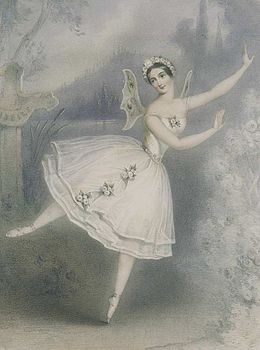
Scene from Act Two of the Original Performance of Fisekke


Ballet Cymru Giselle  Pontio Arts and Innovation Centre, Bangor 13 Jun 2025 19:30

Yesterday I saw Ballet Cymru's third production of Giselle.  Their first production was in 2006 when they were known as Independent Ballet Wales (see Ballet at the Bridport Arts Centre, BBC website, Oct 2006).  Their second was livestreamed from Lichfield Cathedral on 5 Jul 2021 (see Giselle Reimagined, 9 Jul 2021).  I later saw it in Leeds and Newport and even danced a bit of Darius James and Amy Doughty's choreography for a workshop that Ballet Cymru held for Powerhouse Ballet when they visited Leeds (see Ballet Cymru's Giselle, 10 Nov 2021).  Their latest version was premiered in Newport on 16 May 2025 and is now touring the United Kingdom (see Ballet Cymru's New Giselle, 8 Jun 2025).  I was not in Bridport to see Giselle 1.0, but I did see and liked Giselle 2.0.  In Giselle 3.0, Darius James and Amy Doughty reverted to Adolphe Adam's original score and much of Petipa's choreography, albeit with a simplified libretto.   I thought it worked very well.

The versions of Giselle that big national companies perform, such as Peter Wright's, Rachel Beaujean's or Mary Skeaping's, require a lot of dancers for such roles as the vignerons and hunters in Act 1 and the wilis in Act 2.  Ballet Cymru is still not a big company so the story has to be tweaked if it is to be told successfully.  That is probably why James and Doughty dropped such characters as Giselle's mother who warns her daughter of the likes of Albrecht and the consequences of too much dancing for a girl with a dicky heart, Bathilde (Albrecht's betroathed) who presents Giselle with a necklace just before Hilarion exposes Albrecht or Moyna and Zulma in Act 2 aptly described by Susan Dalgetty-Ezra as "Myrtha's sidekicks".  But they did keep a lot of the essentials, including the peasant pas de deux and the mesmerizing arabesques from Act 2.  They set Act 1 in a Welsh village and Act 2 in a forest, and they dressed their wilis, including the men, in romantic tutus.

Isobel Holland, who had danced Myrtha powerfully in Giselle 2.0, was equally impressive in the equivalent role in Giselle 3.0.  If I am not mistaken, her makeup and costume in Giselle 3.0 were similar to her costume and makeup in  Giselle 2.0.   I gave her my loudest clap at the reverence.  Also impressive were Mika George Evans in the title role and Jakob Myers as Albrecht.  They are both athletic dancers, and they came into their own in Act 2.  I once saw Carlos Acosta and Natalia Osipova in Giselle, and Evans and Myers reminded me strongly of their performance.  Jacob Hornsey elevated Hilarion's role into a major part of the drama, which cannot have been easy, as he is portrayed as a bit of a churlish chump in most productions.   The same is true of Wilfred, Albrecht's squire. James Knott, who danced the equivalent role as Albrecht's friend, made that a much bigger role.  It is not clear from the cast list whom I should congratulate for the peasant pas de deux bit they delivered one of the highlights of my evening.

Before the show, the audience was treated to a performance by local ballet students called Duets.  It is part of a programme that offers dance training to children in rural or former mining, steel-making or heavy industrial communities who would otherwise be unable to receive it.  Immediately after their performances, the children are led to any vacant seats in the auditorium where they watch the company.  Until Wales gets its own national ballet school with connected associates schemes, it is the best way to identify and promote talent and ambition in that nation.  It is good not only for Ballet Cymru and Wales but also for all the other ballet, contemporary dance and theatre companies in the rest of the UK and beyond.  It is a project that deserves the widest possible support.  


Monday, 23 January 2017

Skeaping's Giselle

Engish National Ballet Giselle Coliseum 22 Jan 2017

Giselle may have been premiered on 28 June 1841 but it is no museum piece. Feudal landowners may be a bit thin on the ground these days but there is no shortage of spoilt wealthy young (and not so young) men who behave just like Albrecht. Nor, sadly, is there a shortage of women who are hurt by them, just as much as Giselle. They may not stab themselves with swords but they suffer in other ways and sometimes their suffering can be fatal.  There is no need to reimagine Giselle.  Leave that to the audience. That's why we are there.

In contrast to Akram Khn's Giselle, Mary Skeaping's keeps Adam's score and what we believe to have been Corelli and Perrot's choreography as varied by Petipa and sets the ballet in the German countryside. I find that helpful for then I can concentrate on the interpretation.  There are lots of possibilities. As Lauretta Summerscales says in her video on how she interprets the iconic role:
"If I do it 50 times, I'm sure I'd still find in that 50th time something new."
If one ballerina who dances Giselle regularly can conjure up her character in 50 different ways, how many more interpretations must there be for those who watch different productions or even the same production with different casts?

Although I bought my ticket before I knew who was dancing, I was glad to see that my Giselle today was Elisa Badenes. I cannot recall ever seeing her before because she dances with the Stuttgart Ballet so I looked her up and found that she had advanced from corps de ballet to principal in a very short time. On the way to London, I tweeted:
She did not disappoint me.  She is a beautiful dancer, graceful. and aetherial. Her arms appear as subtle and as soft as gossamer in the wind.

Her Albrecht was Cesar Corrales who was a thrill to watch. Charming and athletic I can see why Giselle begged clemency from Myrtha and danced with him to keep him alive.  In other productions, I feel Albrecht gets off lightly compared to Hilarion, but not this time.  His jumps were thrilling - especially some spectacular entrechats just before the bell struck 4 where his legs interweaved like shuttles.

Hilarion, danced by Fabian Reimair, projected possessiveness, meanness and jealousy as well as recklessness.  For once I felt he had what was coming to him as Myrtha's wilis tossed him off stage.

As for Myrtha, she was portrayed steely and icily but with authority by Alison McWhinney. This was the first time I had noticed her in a major role but I shall certainly look out for this impressive dancer in future. Her attendants, Zulma and Moyna, danced by Rino Kanehara and Adela Ramirez, were splendid too,

The English National Ballet Philharmonic under Alex Ingram played magnificently from the opening bars of the overture. Adam's score needs an orchestra like them. David Walker's sets and costumes were gorgeous. Alex Ingram's lighting - particularly the flashes at the start of act II - conjured menace convincingly.

Altogether, one of the best performances of Giselle I have ever seen - and I have watched quite a few over the decades.

Saturday, 22 October 2016

English National Ballet's other Giselle


Standard YouTube Licence


While I acknowledge the merit of Akram Khan's Giselle I am very glad that English National Ballet has revived Mary Skeaping's. Skeaping was the preeminent dance historian of her day, particularly on the early and romantic eras of ballet. I remember her recreations of The Return of Springtime and The Loves of Mars and Venus for the Royal Ballet's former outreach company, Ballet for All. Skeaping's Giselle was, as Luke Jennings noted in his review A Giselle to cry for (The Guardian, 14 Jan 2007)  "the product of several years of research." It is regarded as a particularly pure and authentic production of the ballet.

Skeaping created her version in 1971 and the English National Ballet has re staged it several times since. This production has therefore already stood the test of time and I am confident that it will be re-staged many times over the next 45 years and beyond. One reason for my confidence is that it has a strong, dramatic story in which the tension builds up steadily and relentlessly with its own logic, albeit premised on the strange belief system on which the romantic literature of the early 19th century was based. Another is that it retains Adam's hauntingly beautiful score that have been translated into the most beautiful movements with exquisite designs by David Walker and lighting by David Mohr as Patrick Baldwin's photos on the company's website show. It is easy to understand the critical press acclaim quoted on the trailer.

Would Skeaping's Giselle (or Sir Peter Wright's,  Rachel Beaujean and Ricardo Bustamante's or Yuri Grigorovich's for that matter) have stagnated or become a museum piece had it not been "re-imagined" by a leading contemporary choreographer for our times? I don't think so. As the website of the Dutch National Ballet notes:
"Giselle has no sell-by date. It’s timeless, just like the Night Watch’."
 A few sentences earlier the same web page explained the reason for the ballet's timelessness:
"Giselle is one of the most romantic works of the classical repertoire, but also one of the most challenging when it comes to dancers’ dramatic and emotional empathy. Its lively, colourful first act with the moving mad scene, and the ensuing unearthly, pure ‘white’ act, are still danced all over the world today. It is not without reason that Giselle is known as the ‘Hamlet of dance’."
Now just as there have been many versions of Hamlet over the years, new versions of Giselle are to be encouraged, and where they have merit, welcomed. I mentioned Mats Ek's and Dance Theatre of Harlem's Creole Giselle in Akram Khan's Giselle 28 Sept 2016 but I do not think that any of those interesting re-imaginings will ever divert the stream.

Those like me who have seen Akram Khan's Giselle on tour and yearn for Skeaping's have to make our way to London to see it. I shall be watching it with a friend from my adult ballet class in Manchester. It will be performed at the Coliseum between the 11 and 22 Jan 2017 and tickets are available from the box office and online. I shall review it after the 22.

Saturday, 6 June 2015

English Youth Ballet's Giselle deserves Full Marks for Innovation


English Youth Ballet, Giselle, St George's Hall, Bradford 5 June 2015

If the rest of British industry were as innovative as English Youth Ballet Silicon Valley and South Korea wouldn't hold  candle to us. Janet Lewis, the company's artistic director, has completely rewritten Giselle setting it in rural England in 1912. Contrast the synopsis of the English Youth Ballet's production with Peter's Wright's for the Royal Ballet or the plot of the first performances as set out in Wikipedia.  Lewis has invented for Giselle a father and made him head butler of the local estate, a girl friend for Hilarion called Lucienne and lots of parlour maids, scullery maids, wood nymphs, villagers and others. She has given Giselle a job as the posh kids' governess and inserted whole new scenes into the ballet with chunks of music that I had never heard before into the score.

They say that necessity is the mother of invention and the necessity in this case was to find roles for the English Youth Ballet's massive cast.  As I noted in English Youth Ballet in Bradford 24 April 2015 English Youth Ballet consists largely of children and young people who tour the country with the full length classical ballets. The idea, according to the "About EYB" page, is to give young dancers outside London aged 8 to 18 an opportunity to perform in public in a professional setting.  The "EYB Experience" page continues:
"English Youth Ballet gives young dancers a unique opportunity to experience what life in a professional ballet company is really like. It is an exciting journey from acceptance at the audition, to classes, challenging choreography, tough rehearsals and enjoyable performances in the theatre, which mirrors exactly what a dancer in a professional company experiences."
That brings obvious benefits for the kids, their teachers and their parents.

The English Youth Ballet brought their production to St George's Hall in Bradford last night and despite anxieties about the show that I kept to myself when I  blogged about it in April I am glad to say that it worked. Lewis had retained all the good bits of Giselle, her signature dance in Act I with its awkward pointe work, the poignant mad scene, the beautiful arabesques for the corps in Act II, the despatch of Hilarion and the powerful and affecting pas de deux as Giselle dances with Albrecht (re-branded "Albert" in this production) to keep him alive.

The mad scene by Amy Drew, one of the resident principals, was really chilling.  For once I understood the nature of Hilarion's offence.  He was portrayed brilliantly as a really nasty piece of work by Richard Read another of the resident pros.  He thoroughly deserved the bunch of fives landed on him by Giselle's dad (Trevor Wood). I felt far less sorry for Hilarion than I usually do when he was done over by Myrtha (Adele Robbins) and the girls. Dangerous ladies those wilis for they also destroyed a group of schoolboys. When I came across two of them rattling collection buckets for a new children's unit at Bradford Royal Infirmary on the way out of the auditorium I wasn't going to argue and coughed up meekly. Oliver Speers, one of the tallest dancers I have ever seen with very expressive features, brought Albrecht to life.  I have lost count of the number of times I have seen Giselle and I have always been troubled by it (see Reflections on Giselle 29 Jan 2014). One of my problems is that Albrecht, who is a thorough blighter, lives yet poor old Hilarion has to die. Well I actually felt sorry for Speers's Albrecht and I can quite see why Giselle gave him a second chance.

All the dancers - not just the principals - were good and that includes a little boy who may not have slept well last night. He was good too and I'm not just saying that. As there were so many kids it would be invidious to single any out for special praise but this ballet depends largely on the strength of the corps in the second Act. There are some really nasty bits for the wilis as they have to balance in arabesque for quite a time and move forward in formation as the music rises to crescendo which could easily look scrappy of not done well. Yesterday it was done well and all credit to the girls and those who coached them.

The programme notes do not identify the orchestra or the arranger of the score but it was done very well. As I noted above there was quite a few chunks of new music were apparently taken from other Adam ballets. Equally ingenious was Sebastian Petit's set with its backdrop of pines which doubled for both Acts and his atmospheric lighting.  St. Geroge's Hall is really a concert hall and not the best venue for ballet.  I have seen opera there and that's even worse because the front of the house had to be cordoned off for the orchestra. The stage is quite small and the dancers seemed quite cramped at times.  Three qrands jetés brought Giselle from the back to the very edge of the stage.  Had Osipova danced those steps she would have found herself in row E of the stalls. Yet, despite the limitations, the show was a success.

The young dancers were there to have fun and jumping by the chatting and giggling as I passed the stage door they certainly seemed to have enjoyed themselves.  The audience, which seemed to consist largely of mums, dads and teachers. applauded enthusiastically though not always in the right places. At the end of the show, the director appeared with one of the consultants from the Infirmary to appeal for funds for the children's unit. The doctor told us that the company had danced to the patients in the paediatric ward many of whom had never seen ballet before and they really loved it.  On Thursday I mentioned two initiatives to bring ballet to the people of Bradford (BP's big screen in Centenary Square and Northern Ballet's Start Project) so this is a yet another.

There are two more performances today. If you are in Bradford today and have no plants for the afternoon or evening I thoroughly recommend this show.

Monday, 8 December 2014

Now you can see why I am such a fan of the Dutch National Ballet

I am very grateful to Richard Heideman, press officer of the Dutch National Ballet for bringing this video to my attention on twitter:

I think it is the best flashmob that I have ever seen.

For those who don't follow ballet this dance is a scene from the second act of Giselle . Myrthe, Queen of the Wilis, summonses the souls of girls who died of a broken heart just before their wedding night. Giselle, the heroine of the story, has just joined their number because she died in the arms of her mother on learning that Albrecht, a local aristocrat who had dressed up as a peasant was really a count and already engaged to be married to another lady. In some versions Giselle kills herself with Albrecht's sword which he left lying around for Hilarion, Giselle's old boyfriend, to pick up. In other productions, Giselle dies of shock or a broken heart.

I find something very dark and creepy about Giselle on stage which I find hard to reconcile with my religious beliefs (see Reflections on Giselle 29 Jan 2014). But Petitpa's choreography to Adam's haunting score is magnificent and I watch it as an abstraction as I would a ballet Balanchine. The beauty of this film is that it strips away the spooks and superstition and celebrates the glorious choreography and gorgeous music.

Shot in a Beijing shopping centre with the dancers wearing trainers and jeans rather than pointe shoes and romantic tutus with little wings hanging out at the back and their hair worn loose rather than in buns this is a marvellous way to appreciate this wonderful romantic ballet.

I am in no position to rank ballet companies but I have seen the world's finest including the Royal Ballet, English National, the Bolshoi and Mariinsky and American Ballet Theatre. Of all the great national companies the Dutch is the one I admire the most and like the best. If you want to learn more about this wonderful company I have written 11 articles about Ernst Meisner and his outstanding young dancers.