Sadly, I can't be at the Meervaart to see the Dutch National Ballet Junior Company today but I can learn something about two of the dancers from a vlog ("video blog") put together by Timothy van Poucke from Woerden and Salome Leverashvili from Tblisi.
So far, I have found the following three videos:
Vlog # 1 Q & A Time:Tim and Salome introduce themselves while sitting on Pilates balls and ask each other questions. We learn, for example, that Salome identifies with flamingos because they are pink and skinny, that Tim once accomplished 10 pirouettes and Salome 7, that they both like cooking and Amsterdam is their favourite city.
Vlog #2 Tim's Warm Up Routine: here Tim displays and demonstrates what look to me like instruments of torture which he uses to soften the muscles of his body. I actually inherited some of those bits of kit but had no idea what to do with them. Now I wish I didn't know.
Vlog #3 Tim and Salome's Make-Up Session:Salome bravely lets Tim apply her stage make-up. "What is this?" she squeals at the end of the end of the session and awards Tim 4/10 for his efforts. But the truth of the matter is that she looks lovely and would still look lovely if she had been dragged through a hedge backwards.
Like everyone who has begun his or her career with the Junior Company, they are excellent young persons. Clearly, they know how to have fun but they are also very accomplished dancers. Under Ernst Meisner's leadership, they will evolve into superb young artists.
I am particularly excited about Salome because she comes from the same country and trained in the same ballet school as Elena Glurdjidze whom I once had the good fortune to meet and whom I miss very much (see Elena Glurdjidze - So Lovely, So Gracious11 Feb 2014).
As I said in Thinking of Amsterdam this morning, I plan to see the company while it is touring the Netherlands. I look forward to seeing Tim, Salome and their fellow dancers on stage very soon and perhaps even making the acquaintance of some of them.
Standard YouTube Licence
Every year the Dutch National Ballet scours the world for twelve of its most promising young dancers and invites them to Amsterdam for an intensive programme of training and performances. The artistic coordinator of that programme is Ernst Meisner who is well known to, and well liked by, British audiences (see Meet Ernst Meisner and his talented young dancers6 Dec 2014). Many of his dancers have been recruited into the Dutch National Ballet and other leading companies and their careers have taken off like rockets. Michaela DePrince, for example, joined the Junior Company in 2013 and is already a grand sujet. Cristiano Principato joined the programme a year later and has contributed work to New Moves (see Palagio 4 June 2016).
Ernst has now recruited new dancers for the Junior Company which includes Hannah Williams who was born in Ashford. Hannah trained in the United States and the Netherlands which no doubt explains her transatlantic accent but that will not prevent ballet goers in the country from wishing her, and all the other members of the Junior Company, all the best.
Every year the company tours the Netherlands and occasionally one or two theatres abroad. Before the Linbury closed for renovation they danced two shows here each year. I am desperately racking my brains trying to find the best way of tempting them back. The first opportunity to see the new dancers will be at the Meervaart Theatre in Amsterdam in Juniors Go Dutchon 18 and 19 Feb 2017. Tickets start at 15 euros and the theatre is only 23 minutes from Schiphol airport by the 69 bus. There are cheap and convenient flights from Southend, Manchester and just about every other corner of the UK. Despite the post-Brexit nose dive of sterling Amsterdam is still a lot cheaper than London and there is plenty to do apart from watching ballet when you get there (see Three Days in Amsterdam12 Sept 2016).
Last Monday I mentioned Jakop Ahlbom's Swan Lake at the Meervaart Theatre in Amsterdam (see Jakop Ahlbom's Swan Lake2 May 2016). On 24 Jan 2017 the same theatre will stage a more conventional Swan Lake by the Ballet of the State Opera of Tatarstan. The video of the cygnets land pas de deux from the white act ooks good so I thought I would find out something about this company and its homeland.
I regret to say that my only thing I knew about Tatars up to now had been that were once known for the swiftness of their arrows. When I was a small child my father's reply to my mother complained of procrastination whether it was visiting in-laws, home improvements or anything else he did not enjoy doing was:
"I go, I go; look how I go,
Swifter than arrow from the Tartar's bow."
A quotation from Puck in Midsummer Night's Dream. However there is a great deal more to Tatarstan than that.
The first thing to note is that they do have a State Opera House with a ballet company that looks pretty good judging by its soloists and repertoire. They seem to have all the 19th century classics and Soviet staples and a few of their own one of which is Carmina Burana that may or may not have anything to do with David Bintley's.
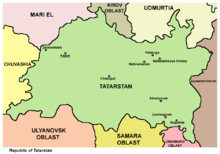
So what and where is Tatarstan? According to Wikipedia it is a landlocked republic in South West Russia. Its map bears a remarkable similarity to that of Switzerland though its land area is somewhat larger (26,000 square miles compared to Switzerland's 15,940 square miles) and its population is very much smaller (3.8 million compared to Switzerland's 8.2 million). Unlike Switzerland it is relatively flat. Its highest point is only 1,125 feet compared to mighty Mt Rosa's 15,203. It also has lakes (though the biggest, Lake Kubyshew and Lower Kama, appear to be reservoirs) and rivers that are as great as the Rhine and the Rhone. It has a splendid red and green flag and its motto is Bez Buldırabız! which means "Yes we can".
"The "Nutcracker" ballet, performed on May 21, 1992 was not only the highlight of the program, but also a sensation, as legendary Rudolf Nuriyev conducted the orchestra. After the performance, which was a great success, outstanding ballet dancer agreed to give his name to the festival."
"Swan Lake is een moderne vertaling van Het Zwanenmeer, een vrije interpretatie van het oorspronkelijke sprookje. Centraal in zijn bewerking staat de destructieve kracht van liefde. Hoe gaan wij om met de liefde, in alle puurheid maar ook in de dubbelhartigheid ervan. Jakop is geïnteresseerd in het dilemma van de mens die we willen zijn, en de mens die we soms moeten en zullen zijn. Hoe blijven we dicht bij onszelf in ons verlangen naar de ander, in ons verlangen naar volmaaktheid. Swan Lake is een associatieve vertelling, waarin de personages zich gewaar worden van hun obscure kanten, liefde niet alles overwint en een mens zijn diepste wezen niet kan verloochenen."
Now I have never studied Dutch (though I have German which I believe helps) so my translation may well be rubbish but I think that means that Swan Lake is a modern version of Swan Lake, a free interpretation of the traditional folk tale. The rest I can't make head or tale out of at all and the Google machine translation seems to be gobbledegook.
I have had a little bit more luck in the Lees Meer (Read More) section:
"Het oorspronkelijke Zwanenmeer vertelt het verhaal van de witte zwaan Odette, die is betoverd door de tovenaar Von Rothbart. Zij is ‘s nachts vrouw, maar overdag moet ze als zwaan door het leven. Tijdens een jachtpartij staat prins Siegfried op het punt de witte zwaan neer te schieten, als zij plots in een mooie vrouw verandert. Ze worden verliefd en hij belooft haar te trouwen. Dan zal de vloek verbroken worden. Ze spreken af dat zij die avond naar het bal op het kasteel zal komen. Daar verschijnt echter Von Rothbart met zijn dochter Odile. Zij is het zwarte evenbeeld van Odette. Siegfried denkt dat het zijn geliefde is, danst met haar en belooft haar zijn trouw. Als Odette bij het kasteel arriveert, ziet Siegfried zijn vergissing in. Haar kans op verlossing lijkt verloren."
This seems to tell the story of Von Rothbart's spell over Odette, Siegfried's falling in love with her and Rothbart's passing off Odile as Odette quite faithfully.
One big difference between this Swan Lake and everybody else's is that the choreographer is using an adaptation of Tchaikovsky by Alamo Race Trackrather than the original score. The cast will include Helena Volkov, Tycho Hupperets, Gwen Langenberg, Ivan Cidrian Ugrin and Silke Hundertmark.
Sadly I won't be able to make it as I shall be in Italy for the Casa for Alessia gala but should be happy to publish a review from any of my dear readers.
Van Manen appeared at those performances because the Junior Company include one of his works in their tour each year. This time it was was Trois Gnossienneswhich he created for the Dutch National Ballet on 20 Oct 1982. The music that he used for this ballet is by Erik Satie, the same composer who inspired Sir Frederick Ashton to create Monotones. That is another ballet I love very much.
Copyright 2016 Dutch National Ballet, All rights reserved
Reproduction licensed by kind permission of the company
They work very well together. Earlier in the performance Princic had danced a masterly Ballet 101and Chapski had charmed us in the Pas de Six. My review of the whole show is Ballet Bubbles 16 Feb 2016.
Audiences in this country will gain an opportunity to see more of van Manen's work when the Netherlands Dance Theatre tours the UK next month. I hope to catch NDT2 in Bradford and at The Lowry.
This work featured two of my favourite young dancers: Thomas van Damme who had delighted me the previous year with his performance of Ernst Meisner's Embers with Nancy Burer in 2015 (see Junior Company's New Season6 Feb 2015) earning Meisner my personal choreographer of the year award for 2015 (see Highlights of 201529 Dec 2015) and Emilie Tassinari who had impressed me and many others in Cinderella at the Coliseum (see Wheeldon's Cinderella13 July 2015). Those two have really blossomed since I first met them just over a year ago and I am sure that they can both look forward to a glittering future.
Photo Michel Schnater, Copyright 2016 Dutch National Ballet. Reproduction licensed with kind permission of the company,All rights reserved
Those chaps were also in that piece. As they have only just joined the company this was the first time I had seen them. I am very impressed and will follow their careers with interest.
You will find my review of the show in Ballet Bubbles on 16 Feb 2016.
Copyright 2016 Dutch National Ballet, all rights reserved
Reproduction licensed by the company
Another lovely photo of the Dutch National Ballet Junior Company's performance of Ballet Bubbles at the Meervaart Theatre in Amsterdam on 14 Feb 2016 (see my review Ballet Bubbles 16 Feb 2016). This shows the young American dancer, Clara Superfine, in David Dawson's 5.
Dutch National Ballet Junior Company, Ballet Bubbles, Meervaart Theatre, Amsterdam, 14 Feb 2016
Mata Hari is a hard act to follow (see Brandsen's Masterpiece14 Feb 2016). Mindful of the words of Voltaire's wise Italian that "le mieux est l’ennemi du bien" I feared that anything following it would be an anticlimax. That was what happened after the opening gala in September (see The best evening I have ever spent at the ballet13 Sept 2015). After seeing some of the best dancers in the world on the same stage the same evening I was temporarily spoilt for anything else.
In fact, the Junior Company's matinee performance of Ballet Bubbleswhich I saw at the end of a weekend that included a preview of the 2016 to 2017 opera and ballet season with interludes of heavenly singing and dancing and a tour of the home of the company which allowed access to company class and a walk on the Stopera's stage for Friends of the Dutch National Ballet as well as Mata Hari was the pièce de résistance. It was in its own way every bit as good as Mata Hari. The ability of the Dutch National Ballet to stage two outstanding but very different shows at the same time is an astounding achievement. I struggle to think of another company in the world that could have done the same.
Of course, I should not have been so apprehensive. The week before, the Junior Company had premièred Ernst Meisner's joyful No Time Before Time at the finals of the 2016 Lausanne International Ballet Competition and nobody gets to dance there in any capacity unless they are special. Meisner's work was the finale of a brilliant performance which included work by David Dawson, Krzysztof Pastor, Hans van Manen as well as Charlotte Edmonds. In an opening address just before the start of the performance (which was in Dutch - not a language that I have ever studied - so I may well have got it wrong) I believe that Meisner explained that the Junior Company offers opportunities not only for the world's most promising young dancers but also for young technicians and choreographers such as Edmonds.
The performance was staged not in the Stadsschouwburg where the last two seasons' tours had started (see The Junior Company of the Dutch National Ballet - Stadsshouwburg Amsterdam 24 Nov 201325 Nov 2013 and The Dutch National Ballet Junior Company's best Performance yet8 Feb 2015) but in the Theater de Meervaart near an artificial lake called the Sloterplas in the western suburbs of Amsterdam. Although nobody in my hotel nor even the Stopera seemed to know where it was, the Meervaart proved to be a good venue, particularly for a matinee performance where there were lots of children. There was plenty of space to sit and chat before and after the performance. In the interval the management served drinks to the audience: red and white wine or fruit juice to the adults and every kind of sugary fizz to the children. A delightful gesture which I appreciated as I had had no time for lunch or dinner the day before nor any kind of meal on Sunday until after I had landed in England.
The show began with a short talk by Meisner who spoke about the company and the works that were to be performed. As in previous years each piece was preceded by a film in which a dancer set out his or her thoughts in his or her language of choice.
In the first film Emilie Tassinari introduced the pas de six from Arthur Saint-Léon's La Vivandière which was originally staged in London in 1844 with Fanny Cerrito as La Vivandière and Saint-Léon himself as Hans. This is a gorgeous romantic ballet which is a type of dance in which Tassinari excels and seems to enjoy. In the previous year she had danced a divertissement from Napoli delightfully. In La Vivandière she danced the role that had been created by Cerrito which includes some spectacular grands jetés and tours en l'air that prompted a barrage of bravo from the audience. Saint-Leon's steps were traced impressively by the young Canadian dancer Theo Duff-Grant. They were accompanied equally impressively by Lisanne Kottenhagen, Melissa Chapski, Clara Superfine and Hannah Williams.
The next piece was Eric Gauthier's Ballet 101. It is one of my all time favourites and one that I would love to do. In fact Mel has kindly offered to coach me. It requires enormous strength and agility but it is also very witty. Last year it was performed by Xander Parish at the 45th anniversary gala of Northern Ballet (see Sapphire 15 March 2015). I had previously seen Daniel Montero dance it for the Junior Company in 2013. I am collecting material for a book to be called "Will I like Ballet?" in which I shall refer to this piece throughout the work. On Sunday the piece was danced by Giovanni Princip who was nothing short of magnificent.
Next came Edmonds's Fuse which was arranged to Armand Amar's Dam in China and Paddy Fields. There is a lot of energy in this work with its compelling beat which was translated into movement by Thomas van Damme, Antonio Martinez Cegarra and Belle Beasley. Amar's music cannot have been easy to choreograph or dance but it was interpreted imaginatively by the choreographer and executed beautifully by her dancers. This was the first time I had seen Edmonds's work and I look forward to more.
The first act was rounded off by Dawson's 5. 5 is only the second of his works that I have seen, the other being Empire Noir in Cool Britannia (see Going Dutch29 June 2015). That work had been fast and furious and that was also true of 5. The music, Adolphe Adam's Giselle, albeit with some reworking,was familiar but the movement was not. It was exciting and the crowd loved it. The female roles were danced by Chapski, Superfine and Tassinari and the male ones by Joseph Massarelli and Daniel Robert Silva. Dawson has been commissioned by Scottish Ballet to produce a new Swan Lake. If his reworking of Giselle is anything can go by Liverpool can look forward to swans on steroids when Scottish Ballet comes to town.
The first ballet after the interval was Pastor's arrangement of Kurt Weil's Silbersee and Wie Lange Noch. Pastor is another of the Dutch National Ballet's resident choreographers whose work has been performed by Scottish Ballet. I was very impressed with his Romeo and Juliet when it came to Sadler's Wells in 2014 (see Scottish Ballet's Timeless Romeo and Juliet18 May 2014). Silbersee was a duet by Silva and Massirelli and Wie Lnnge Noch a pas de deux by Tassinari and van Damme. A beautiful and haunting work with many layers of meaning.
No performance by the Junior Company would be complete without a work by van Manen. In previous years the great man has come on stage to take a bow and the applause has exploded. Trois Gnossiennes with music by Erik Satie is of particular interest to British balletomanes because of its similarity to Ashton's Monotones. The music is sublime and so is van Manen's choreography executed sensitively by Chapski and Princic.
The last work was Meisner's No Time Before Time and it was my favourite by a mile. Starting with a solo by Silva who is joined gradually by the rest of the company in long, swooping stretches each giving the impression of a great bird in flight. The score by the Romanian composer and violinist Alexander Balanescu lifted the audience and enhanced the impression of flight. It must have been such fun to choreograph and even more fun to dance. The piece builds up. There is a lovely duet. Then some exuberant jumps. A pas de quatre. More exits and entrances. A pas de trois. Finally two dancers remain on stage and the music cuts. For those of us who were fortunate enough to be at the Meervaart it felt as though we were dancing too. I don't think I have ever seen a happier audience.
There was no rush for the exits after the show. The bars remained open and the audience stayed to chat. I caught Meisner after the show. "Had this been London the stage would have been knee deep in flowers" I said to him. Having danced with the Royal Ballet he would have seen flower throws. I also met several of the dancers after the show some of whom I met for the first time and several of whom I already knew. In the next few weeks I shall gather material for a feature on the Junior Company which I hope will do them even more justice than last time.
The Junior Company is now starting a tour of the Netherlands beginning at Oss near the Belgian border on the 18 Feb 2016 and finishing in the Hague on the 28 May 2016. Coming from a small village in the North of England 200 miles from London I applaud this initiative. I only wish they could have included a trip to the UK this year as they have done in previous years. But the Netherlands is not far and no part of that country is hard to reach. A performance by 12 of the most promising young dancers in the world would richly reward the jounrey.
My birthday falls on Sunday. Don't ask me how old I will be because it's depressing. But there is one thing that never fails to cheer me up and that is to watch the excellent young men and women of the Junior Company of the Dutch National Ballet. They are recent graduates of some of the world's best ballet schools and they are now cadet members of one of the world's best companies. I featured them in a series of articles in 2014 (see The Junior Company3 Dec 2014) and I have been following them for almost as long as I have been keeping this blog.
Last weekend they danced in the finals of the Lausanne International Ballet Competition. This weekend they will begin their tour of the Netherlands with a performance of Ballet Bubbles at the Meervaart wherever that may be. Their programme will consist of
La Vivandière Pas de six – Arthur Saint-Léon
Ballet 101 – Eric Gauthier
Fuse – Charlotte Edmonds
5 – David Dawson
Kurt Weill – Krzysztof Pastor
Trois Gnossienes – Hans van Manen
New work – Ernst Meisner.
I will catch their matinee on Sunday which will enable me to see Ted Brandsen's Mata Harithe night before and catch a plane home in time for work on Monday. The role of Mata Hari will be danced by Anna Tsygankova. She danced Cinderella at the Coliseum so delightfully. That will be another treat,