Showing posts with label Royal Albert Hall. Show all posts

Saturday, 7 January 2023

The Birmingham Nutcracker

Nutcracker 22 Homepage sizzle from Birmingham Royal Ballet on Vimeo.

Birmingham Royal Ballet The Nutcracker Royal Albert Hall, 31 Dec 2022 16:00

When I was young the London Festival Ballet converted the Royal Festival Hall into a theatre and staged The Nutcracker during the Christmas holidays.  Because of the venue, those performances were less formal than those at Covent Garden, or Sadler's Wells.  Probably they were also significantly less expensive because there were always lots of families at those shows. I was introduced to ballet at one of those performances as were many other young people.  The Birmingham Royal Ballet continues that tradition by turning the Royal Albert Hall (London's other great concert hall) into a theatre and staging The Nutcracker there between Christmas and New Year's Eve. 

Although the story, choreography, casts and costumes appear to be the same, a performance of The Nutcracker in the Royal Albert Hall is an altogether different experience from a performance of the same ballet at the Hippodrome. For a start, there is a narrator.  The story is told by Simon Callow who is described as the "voice of Drosselmeyer".  The performing space is large.  The orchestra occupies a balcony above the stage.   Scene changes such as the expanding Christmas tree are achieved by lighting and projection  

The ballet is essentially about a young girl's dream.  Clara (as she is called in this country) is given a nutcracker in the shape of a prince by Drosselmeyer, one of the guests at her parents' Christmas party.  In her dream, the nutcracker comes to life and leads a detachment of toy soldiers against a pack of rodents.  The rodents are about to gain the upper hand but Clara saves the day by thumping their king.  As a reward, she is transported to a magical land where she is entertained by Spanish, Arabian and Chinese dancers representing chocolate, coffee and tea, cossacks, mirlitons, flowers and finally the Sugar Plum fairy and her cavalier.   That is significantly different from the Russian version where the girl (known as Marie) becomes the Sugar Plum (see the "About the Performance" page on the Bolshoi's website).

One of the strengths of the Russian version is that audiences see the lead ballerina from the start.  In the Birmingham and most other Western versions, she enters at the very end.  Her pas de deux with her cavalier is little more than a divertissement,  That always strikes me as a shame when Sugar Plum is danced by a principal.  That is so different from Odette, Giselle, Aurora or any of the other great classical roles where audiences get to know the lead ballerina

I attended the 16:00 performance on New Year's eve which had a stellar cast.  Céline Gittens was the Sugar Plum. Brandon Lawrence was her cavalier. Reina Fuchigami was Clara.   Jonathan Payn was Drosselmeyer.  Gittens is my favourite ballerina with that company,  As I said in my review of her performance as Juliet, she has a quality that reminds me of her compatriot Lynn Seymour. Lawrence supported her gallantly as her cavalier.

Perhaps because it was the last performance of the year and they were looking forward to New Year's eve parties the artists seemed to dance with added energy and flair.   I particularly liked the Spanish dance performed by Rosanna Ely, Louis Andreasen and Oscar Kempsey-Fagg. I also enjoyed the Snowflakes scene in the first act and the Waltz of the Flowers in the second.  That is because I had performed those dancers, albeit after a fashion.  Martin Dutton of the Hammond taught me the first snowflake's role at a KNT workshop in Manchester.  I have also attended several of Jane Tucker's workshops on Waltz of the Flowers for KNT and Powerhouse BalletI learned more about The Nutcracker from those workshops than I had previously gained in a lifetime of watching it from the stalls.

There were some fun gimmicks on the set.  Clara's brother was given a rat on wheels for Christmas.  After that same brother had trashed the nutcracker Drosselmeyer was able to fix it remotely.  I should have mentioned earlier that Drosselmeyer's store with his name in gothic writing appeared at the beginning.

A good ballet needs a good orchestra and this company has one of the best.  Peter Murphy conducted them on New Year's eve to loud applause from both cast and audience.  

Every major company in the UK has its version of The Nutcracker.  I have seen them all at one time and another.   We all have our favourites.  This version is mine.

Monday, 30 December 2019

The Nutcracker #4 - Birmingham Royal Ballet at the Albert Hall


Standard YouTube Licence

Birmingham Royal Ballet The Nutcracker Royal Albert Hall, 29 Dec 2019 13:00

Having seen Sir Peter Wright's version of The Nutcracker for the Birmingham Royal Ballet several times in Birmingham as well as once at the Royal Albert Hall I had very high expectations of yesterday's performance.  I am pleased to report that those expectations were exceeded.  There are two reasons why I liked yesterday's matinee so much.  The first was the sheer quality of the dancers and musicians with Celine Gittens and Brandon Lawrence in the leading roles and Koen Kessels conducting the orchestra.  The second was the straightforward interpretation of Hoffman's story with great special effects but no creepiness or spookiness.

The performance began not with the familiar overture but sounds of industrial activity from Dr Drosselmeyer's workshop. Drosselmeyer (Tom Rogers) appeared on stage and introduced himself through the voice of Simon Callow. He explained that he is called a doll maker but prefers to call his creations "automatons" as he likes to think they have a touch of magic about them.  Nowadays, that "touch of magic" might be called artificial intelligence and that was seen in the self-propelled toy mice that scurried about the Stahlbaums' sitting room as well as the humanoids Columbine, Harlequin, Jack-in-the-Box and, of course, the Nutcracker.  Callow announced that he was bringing gifts for his delightful goddaughter Clara and her somewhat less agreeable brother Fritz.  Beatrice Parma danced Clara. Wesley Mpakati, an 11-year old schoolboy from Tyseley according to Brum Pic, was Fritz,

After that introduction, the orchestra struck up and the ballet unfolded in the traditional way.  The workshop was removed and replaced by a Christmas tree which became the centrepiece of the Stahlbaums' Christmas party.  Guests arrived including Drosselmeyer and his assistant (Gus Payne). They distributed presents to the children: dolls to the girls and drums, rattles and war toys to the boys and the nutcracker to Clara. Fritz and his friends made thorough nuisances of themselves earning more than a few tickings off from Mr Stahlbaum (Jonathan Payn). At one point they grabbed the nutcracker from Clara and damaged it.  Happily, Drosselmeyer was able to repair the damage.  He demonstrated Harlequin (Hamish Scott), Columbine (Rosanna Ely) and the Jack-in-the-Box (Max Maslen) to the guests.

I took a particular interest in the Jack-in-the-Box because Joey Taylor tried to teach me that dance in KNT's Day of Dance last April (see Best "Day of Dance" Ever 23 April 2019).  "And were you able to do any of that?" my companion asked.  "Not much" I had to admit, "but then I am over 70."  However, I am proud to say that several of my classmates who are also adult ballet students did very well even managing a couple of cartwheels.   In yesterday's performance, Taylor was in the Spanish dance.  As my box in the grand tier overlooked stage right, I shouted "Bravo Joey" at the end of the divertissement which I hope he heard.   If not, he will know that I appreciated his performance should he ever get round to reading this review.

After the party, the Christmas tree expanded and giant baubles descended from the ceiling.  Mice and toy soldiers appeared and fought a battle that the mice nearly won. Clara saved the day for the soldiers by clobbering the mouse king (Gabriel Anderson) with one of her pointe shoes.  As a reward, she was transported to the land of sweets by a jet-propelled seagull.  The expansion of the Christmas tree was achieved by massive side panels on either side of the stage.  The same side panels showed rotating rotor blades in engines below the seagull's wings.  In the land of sweets, Clara was treated to the Spanish, Arab, Chinese and Russian divertissements followed by the mirlitons, waltz of the flowers and the Sugar Plum pas de deux.

Gittens was excellent as ever  Over the years I have seen her in most of the leading classical roles.   I think that she is particularly good in The Nutcracker.  I should mention in passing that she is this publication's ballerina of the year, her company is Terpsichore's "company of the year" and Ruth Brill is our choreographer of 2019.  Finally, Birmingham Royal Ballet's former director, David Bintley, has been awarded a knighthood in the 2020 honours list.   As he comes from the next village but one to mine in the Holme Valley I take particular pleasure in congratulating him on that accolade (see  My Home and Bintley's 12 May 2015).  Quite an annus mirabilis for the company.

Everybody danced well yesterday and I say that despite a couple of slips on the artificial snow.  Lawrence partnered Gittens deftly and jumped impressively in the final pas de deux.  Rogers was a splendid Drosselmeyer.  Yijing Zhang was a delightful snow fairy.  Anderson was a fine mouse king.  Maslen made an impressive Jack-in-the-Box.   Finally, it was good to see the musicians at work.  Kessels, whom I met briefly at the Dutch National Ballet's gala in 2018, is almost a dancer in his own right and I was grateful for the monitor that remained focused on the maestro throughout the show.

There are three more performances of The Nutcracker before the season ends.  Ticket prices are not cheap. Even the programmes cost £10.  However, if you see no other ballet over the coming year this is the one to catch.

Thursday, 13 June 2019

Cinders in the Round


Standard YouTube Licence

English National Ballet Cinderella  Royal Albert Hall 9 June 2019, 14:30

I have seen three of English National Ballet's productions in the Royal Albert Hall: Romeo and Juliet in 2014, Swan Lake in 2016 and now Cinderella.  The last of those is by far the best.  I would go so far as to say that it was one of the best shows by that company I have ever seen in a lifetime of pretty regular ballet going.

This was not an entirely new show for me, or indeed for London, as it is an adaptation of Christopher Wheeldon's production for the Dutch National Ballet. That company performed it at the Coliseum in 2015 (see Wheeldon's Cinderella 13 July 2015).  I saw it again in Amsterdam just before Christmas (see Cinderella in the Stopera 24 Dec 2018). Wheeldon has used the same creatives: Craig Luca for the libretto, Julian Crouch for sets and costumes, Basil Twist for the tree and carriage, Daniel Brodie for the video and Natasha Katz for the lighting design.

There are several big differences between the Albert Hall and the Stopera or Coliseum.  The first is that the audience surrounds the stage and dancers make their entrances and exits down the gangways. A wonderful opportunity, incidentally, to admire the dancers' costumes, hairstyles and makeup. The second is scale. The projectionist did some wonderful things with a massive screen that stretched from floor to ceiling. One scene showed the royal palace with portraits of the royal family looking down sternly on the antics of the coming generation. One developed horns, another blushes and yet another a withering frown of indignation. The third big difference was that the orchestra performed on a platform high above the stage where they had enough space to swing a leopard. So much better than being cooped up in an orchestra pit under the stage.

The story progressed very much as it had in Holland.  Little Cinders is playing with her parents when her mum suddenly coughs up blood.  The scene changes to the graveyard where her father introduces a new lady in his life.  At first, she does not seem to be such a bad old stick because she presents (or rather gets one of her daughters to present) a bouquet to Cinderella.  Cinders lets the flowers fall to the floor. Perhaps not surprisingly, the new step mum just does not like her new stepdaughter.

The two stepsisters are actually girls, unlike Ashton's version in which he and Robert Helpmann put on drag. One of them is a little kinder to Cinders than the other.  Wheeldon cuts out the dancing lesson and visits from the cobbler, dressmaker and milliner and substitutes spirits of lightness,  generosity, mystery and fluidity representing the seasons. These take the form of tree trunks, unicorns and conkers instead.  He even does away with the fairy godmother but gives her four fates, Skyler Martin (formerly of HNB), Daniel McCormick, Erik Woolhouse and Aitor Arrieta instead. They arrange for Cinders to be conveyed to the ball ib one of the most ingenious carriages I have ever seen.

The second act is the prince's ball where the step mum and her daughters turn up with Cinders's dad but no Cinders wearing quite the wrong outfits and generally making fools of themselves.   Things got worse when the drink was served because the stepmother drank just a teeny weeny bit too much and had to be lifted off the floor and carried to a couch. That role was performed by Sarah Kundi who is one of my favourite dancers. I have followed her ever since she was with Northern Ballet in Leeds. She used to remind me of a famous dancer of my youth whom she still resembles in many ways. Since she joined ENB I have begun to appreciate her for her own qualities.  Kundi stole the second act if not the show and she raised more than a few laughs in the third act when she showed up at the breakfast table with one almighty hangover.

Back to the story. Cinders arrives in a lovely golden dress. She is spotted by the prince who falls for her. Everything goes swimmingly until midnight when the clock chimes, the fates arrive and her stepmother cottons on as to who she must be. Cinders scarpers leaving one of her shoes behind. The third act begins with Cinders serving her dad, Her step mum arrives nursing her head and pukes into the porridge bowl.  The prince then tours his kingdom slipper in hand auditioning for brides.  Some improbable candidates show up. A knight in armour. One of the trees. A unicorn.  Something with very smelly feet.  The step mum and her two daughters one of whom is molested by her mother with a mallet.

And, finally. Cinderella who fits the slipper perfectly.  The stepmother peevishly tosses it onto the fire but, happily, Cinders kept the other one. There is a royal wedding and everyone is happy.  Cinderella even has a kiss for her former tormenter.  And the kinder of the two step-sisters finds love with the prince's best friend.  I have been rather spoilt watching  Anna Tsygankova and Matthew Golding in the leading roles in London and Remi Wörtmeyer and Anna Ol in Amsterdam but Erina Takahashi was a lovely Cinders and Joseph Caley was a great prince. Good to see Gavin Sutherland from Huddersfield conducting the orchestra, But the star for me on Sunday was definitely Kundi.

Sunday, 30 December 2018

The Nutcracker returns to the Royal Albert Hall


Standard YouTube Licence

Birmingham Royal Ballet The Nutcracker 29 Dec 2019 14:00 Royal Albert Hall

Each of the five largest ballet companies of the United Kingdom has a version of The Nutcracker in its repertoire.  I have seen all of them at one time or another and the ones that I like best which are Scottish, Northern's and the Birmingham Royal Ballet's more than once.  If I had to choose one it would be Peter Wright's production for the BRB. Last year I saw it in the Hippodrome in Birmingham. Yesterday I saw it upscaled fro the Royal Albert Hall.

This was not the first time I had seen ballet in that auditorium.   On previous occasions, I had seen Romeo and Juliet and Swan Lake in the round performed by the English National Ballet.  Birmingham Royal Ballet used the space quite differently.  They created a stage at one end of the floor above which they positioned the orchestra. On either side of the stage, they placed enormous screens upon which all sorts of images such as pine branches and baubles to represent a growing Christmas tree and falling snow for the snow scene. Seating was installed in the part of the floor not used as a stage and the gallery was closed off altogether.  My view from the centre of the Rausing circle was comparable to the view from the front of the amphitheatre at Covent Garden.

The libretto was very similar to the one for the version that I had seen at the Hippodrome last year and used about the same number of dancers. The one big difference was a voiceover by Simon Callow which was probably harmless enough but not particularly necessary. He was supposed to represent Drosselmeyer who was already represented in dance more than adequately by Rory Mackay.  What rankled a little bit with me was that Callow spoke in a thick continental accent that made Drosselmeyer appear to be some kind of foreigner which was unlikely as he was Clara and Fritz Stahlbaum's godfather. Unlike Sir Peter Wright's production for the Royal Ballet, there was no subplot of the nutcracker being Drosselmeyer's nephew imprisoned in wood. Nor were there an,y angels in the Birmingham version.

The other three lead characters yesterday were the Sugar Plum danced by Celine Gittens, her prince Brandon Lawrence and Clara who was Arancha Baselga. On 26 June 2018, I had been captivated by Gittens's portrayal of Juliet although she had been one of my favourites for some time (see MacMillan's Masterpiece 29 June 2018). I chose yesterday's matinee specifically to catch Gittens and I am glad to say that she did not disappoint me. I was too far away to see her face which had been so eloquent when she danced Juliet but her elegance was unmistakable.  As in June, she was partnered by Lawrence who demonstrated his strength and virtuosity. Baselga delighted her audience with her energy as she threw herself into the divertissements in Act II. I admired and liked her particularly in the Russians ance as she was tossed from dancer to dancer like a bag of cement.

Another of my favourites is Ruth Briill who danced Clara's grannie with Kit Holder. I had thought of auditioning for that role if and when Powerhouse Ballet ever performs that ballet but having seen Brill in Birmingham's production and Hannah Bateman in Northern's (see Northern Ballet's "The Nutcracker" - All My Favourite Artists in the Same Show 14 Dec 2018) that may be a little bit too ambitious.  I had also contemplated auditioning for Mrs Stahlbaum until I saw Yvette Knight's impressive solo. Maybe I could be a rodent but not the rat king like Tom Rogers yesterday.

Plaudits are due to Harlequin, Columbine and the Jack in the Box danced by Gus Payne, Reina Fuchigami and Max Maslen, the Snow Queen (Alys Shee) and each and every one of the dancers in the divertissements in Act II. I particularly liked Laura Purkiss as the Spanish princess and Beatrice Parma as the rose fairy.

I must also congratulate the orchestra and its conductor Koen Kessels whom I had the pleasure of meeting ar the party following the Dutch National Ballet's gala on 8 September 2018. I attended the ballet with the nearest I have to a grandson and his mum who is the nearest I have to a daughter. She was particularly affected by the music saying that it had touched her in a way that previous performances of the score had not/. Clearly, I was not the only one to regard the music as special

Altogether it was one of the best performances of The Nutcracker that I have ever attended and a great way to end the year.  It is in the running for my ballet of the year as indeed is the Birmingham Royal Ballet for company of the year.  Upon the merger of my chambers with Arden Chambers earlier this year we acquired an annexe at Snow Hill in Birmingham which I intend to use to the full.  As I shall be spending far more time in their city I hope to see even more of the Birmingham Royal Ballet and get to know it even better.

Saturday, 18 June 2016

Ballet West in Malaysia

Performance at the Penang Performing Arts Centre
(c) Ballet West, 2016, all rights reserved
Licensed by kind permission of the company


While Ballet West's alumni Natasha Watson and Andrew McFarlane have been dancing with the English National Ballet in Swan Lake in the Round at the Royal Albert Hall, teachers and students of Ballet West have been holding three days of intensive workshops at Direct Academia International in Penang in North West Malaysia. The party was led by Gillian Barton, Ballet West's Principal, and Jonathan Barton who is Vice-Principal of the School and the principal male dancer of its performing company. Also in the party were Martin Fenton who teaches contemporary, jazz and hip-hop (see the staff page of the Ballet West website) and their students Uyo Hiromoto and Oscar Ward.

Some 150 young dancers from all parts of Malaysia and the Republic of Singapore took part in the workshops. The workshops finished with a performance at the Penang Performing Arts Centre on 12 June 2016. Gillian Barton, who saw the show, remarked:
"The performance was spectacular. Oscar and Uyu ..... performed superbly. I could hardly believe that Jonathan and Martin had only worked with the students for one day plus a few rehearsals. It was such a polished performance. No other teachers could have done better.”
The workshops provided an opportunity to audition prospective students for Ballet West. Two students from Singapore are already there and five others from Malaysia have attended short courses.

Any students from Malaysia or Singapore who find their way to Taynuilt will get an opportunity to obtain performance experience by dancing in one of the full length classical ballets which the performance company stages at various auditoriums around Scotland each year. In 2017 the company will dance Swan Lake at the following venues on the following dates:
  • Stirling, Macrobert 20 and 21 January
  • Helensburgh, Tower Digital Arts Centre 27 January 
  • Paisley, Paisley Town Hall 28 January 
  • Oban, Corran Halls 9 February 
  • Glasgow, SECC 11 February 
  • Greenock, Beacon Arts Centre 12 February 
  • Livingston, Howden Park Centre 16 February 
  • Edinburgh, EICC, 18 February.
Ballet West last performed that ballet in 2014 and I saw it in Pitlochry on 1 March 2013 (see Swan Loch - Ballet West's Swan Lake, Pitlochry 1 March 2014 3 March 2014). It was a beautiful production with an Odette and an Odile danced by the same person, a Siegfried, cygnets, Legnani's  32 fouettés, all the usual divertissements and not a single bike to be seen. 

It is probably too late for Ballet West to do anything about it for the coming tour but maybe they could consider adding The Dancehouse in Manchester or the Stanley and Audrey Burton Theatre in Leeds to their touring schedule in future years. After all, Isaac Bowry who came from Manchester and Andrew Cook who came from Leeds contributed considerably to their 2014 production. If they can make it to Penang they can surely find their way to the North of England.

Monday, 13 June 2016

Swan Lake in the Round


Standard YouTube Licence

English National Ballet, Swan Lake, Royal Albert Hall, 12 June 2016

Watching ballet in the Royal Albert Hall is quite a different experience from watching it on a proscenium stage. Even though the performance space is so much larger it is in many ways more intimate. I think that may be because the audience surrounds the dancers who often down the aisles between them to enter the stage. Swan Lake is particularly well suited for arena performances because much of the action takes place around a lake which is by definition a space enclosed by land.

The scale of the production is staggering. According to the programme there were 120 dancers of whom 60 were swans. There were also 80 musicians in the orchestra. Many of the dances doubled in size. There were 8 cygnets and not just 4. The pas de six became a pas de douze. There were 8 princesses, 8 Spanish dancers and 8 Hungarians.

The reason for the scaling up was that those dances would have been lost to at least half the audience had they been performed with the usual numbers in the traditional way. However, there are some roles that cannot be scaled up. Clearly you can't have 2 Siegfrieds, 2 Odette-Odiles (except for Odette's 'don't be such a blithering idiot' bits of the black act which I shall mention later) or indeed 2 Rothbarts. For those roles the company needs to deploy dancers of exceptional versatility who are thrilling to watch and capable of filling the massive space single handed. All the dancers I saw yesterday met that requirement.

The key to the success of this ballet - unless you rewrite the story as Sir Matthew Bourne and David Nixon have done (see Wikipedia Swan Lake (Bourne) synopsis and Swan Lake Story on the Northern Ballet website) - is a strong Odette-Odile. She must be ethereal, delicate and almost fragile in the second and fourth acts and an only two human vamp in the third. Now what I perceive to be the difficulty for the ballerina - and it may well be that I am quite wrong about that - is that human personality leans towards one or the other and if you lean one way it is not easy to project the other.

One ballerina who can pull it off is Erina Takahashi.  I saw her dance Odette-Odile at the Palace in Manchester on the 9 Oct 2014 (see What Manchester does today 10 Oct 2014). Here is what I wrote about her then:
"Yesterday was the first time I had seen her (or at any rate the first time I had noticed her) and she impressed me considerably. She was a very convincing Odette in the prologue and second act - so delicate and feminine - and I couldn't imagine her as Odette but the lady is tough as well as beautiful and she is also an accomplished actor. She danced the seduction scene even more brilliantly than she had danced Odette."
I had forgotten that I had written those words for this is what I tweeted at 15:59 yesterday
Immediately after seeing Act III I wrote:

On the bus to King's Cross I concluded:
I have never really believed that Siegfried could have been taken in by Odile's appearance because she moves and behaves so differently from Odette. I think he was so dazzled by Odile, and in particular by her 32 fouettés, that he temporarily forgot about Odette even when she fluttered in to warn him not to be such a blithering idiot. Had it been mistaken identity the spell could have been undone but as Siegfried's promise was intended it could not. At least not unless he jumped in the lake or fought Rothbart or something.

My view of Siegfried - any Siegfried - has recently been revised by David Dawson (see Empire Blanche: Dawson's Swan Lake 4 June 2016). Siegfried is a blundering adolescent. Yes he really is impressed by silly things like cross bows.  He falls in love with visions. He makes promises he cannot keep. Yet he cannot be ignored for he is heir to the throne.  However, great virtuosity is required of him. He must thrill us in the third Act with his leaps and his turns in the air.  One of the most thrilling dancers in English National Ballet who filled that bill exactly was Yonah Acosta.

The third major player in the story is Rothbart.  He must also thrill and also chill even though he has no great solo. However, he does have a cape to wave or rather wings to flap and his appearances were heralded by flashing lights across the auditorium and the antics of his skull headed acrobatic acolytes. Yesterday his role was performed by Fabian Remair whom I had last seen as Tybalt in Romeo and Juliet (see Manchester's Favourite Ballet Company 28 Nov 2015). He had impressed me then and he did so again yesterday. A first soloist with the company he is clearly a name to watch.

There were fine performances also by Michael Coleman as Siegried's tutor and the master of ceremonies, Jane Haworth as Siegfried's mum (or the queen) and Shiori Kase and Vitor Menezes. Everybody in the cast did well. Although she did not dance a solo role on this occasion I am always delighted to glimpse Sarah Kundi, one of my favourite dancers, in any role. She was in the Spanish dance and I gave her an especially loud clap as she passed my box at the end of her piece.

This year the swans included Natasha Watson and the guests at Siegfried's party Andrew McFarlane who trained at Ballet West (see A Cause for Double Celebration at the Robin's Nest 9 Feb 2016). I could not recognize Andrew but I do know Natasha and I uttered a little "brava" for her at the end of the show. I am so proud of her and also of Andrew. Natasha is a Genée  medallist and was the only British finalist in Lausanne in 2015. She is on a trajectory to the top and I wish her all the best.

I should say a word about the expanded orchestra.  They played well.   Indeed rarely have I heard the English National Ballet Philharmonic play better.  I had expected Gavin Sutherland to cinduct them but instead Helena Bayo appeared. It was the first time I had seen her but I hope it will not be the last.  Often my eyes turned to her from the stage for her body was expressing the music too just as beautifully as any of the dancers.  She directed the musicians with passion but also with sensitivity. The result was a most delightful rendering of one of my favourite ballet scores.

Some things have to be done differently in the round.  A real live dancer who is obviously not Takahashi has to represent Odette during the seduction scene. The ballerina could not lead the admirable Helena Bayo onto the stage. All that could be done was a reverence by the lead dancers and a kiss from the conductor blown back to them.  There were also monitors around the auditorium with the camera fixed on the conductor. I surmise that was for the benefit of the dancers.

Although I enjoyed yesterday's performance tremendously I do have reservations.  It is spectacular but at times I felt the emphasis was on the spectacle - the flashing lights, the acrobatics, the costumes and the sheer numbers on the stage - rather than on the dancing.  It is obviously more expensive to stage than a proscenium show because the ticket prices were high even for London.  However there were plenty of people able and willing to pay the price for the Albert Hall was packed to the gunnels. In The Arena Phenomenon in the programme noted that the novelty and appeal of ballet in the round attracts audiences who do not regularly attend conventional performances. The absence of a ripple of applause when the principals appeared or at turn 28 of Odile's fouettés, someone from my box shouting out "He's behind you" when Rothbart took his curtain call to mixed cheers and boos, the middle age man in the box next to mine sticking his fingers in his mouth and whistling his appreciation at the end of Act III and the eyes of so many on the synopsis page of the programmes suggested that was indeed the case. Nothing wrong with that of course if ballet in the round inspires a love of ballet generally, but it is an indulgence which, like chocolate, should be savoured only sparingly.

Tuesday, 31 May 2016

A Good Old Fashioned Swan Lake without Gimmicks


Standard YouTube Licence


Swan Lake is special to me and it has become even more special since I tried to learn the cygnets' dance, Siegfried's solo and the swans' entry at KNT's Swan Lake intensive last year (see KNT's Beginners' Adult Ballet Intensive - Swan Lake: Day 1, Day 2 and Day 3). The last "Swan Lake" I saw had bikes, a whole load of new characters with names like Anthony and Odilia and a completely different story set somewhere where they vote for Bernie Sanders. I didn't like it the first time I saw it in 2004 even though it had a stellar cast (see  Don't Expect Petipa 5 Jan 2016) and I didn't like it any better when I saw it again in March (see Up the Swannee 17 March 2016).

So my tongue is hanging out for a real Swan Lake with a Siegfried, Odette-Odile and Rothbart with all the usual divertissements plus Legnani's 32 fouettés but minus the bikes and other gimmicks. And I am glad to see that English National Ballet have offered us  exactly that with Yonah Acosta as Siegfried, Erina Takahashi as Odette-Odile and Fabian Raimair as Rothbart. That would be more than enough to justify the somewhat steep - nay mountainous - ticket price and the return rail fare to London but my cup would run over were I to see Sarah Kundi and Natasha Watson on stage too.

Audiences in England already know Kundi well and my readers have read how much I admire her work but they may not have seen Watson before.   They should for she is a name to look out for. She is a graduate of Ballet West and I have mentioned her in this blog more than once (see Yet More Good News from Ballet West - Natasha Watson's Medal in the Genée 30 Sept 2013, Natasha Watson in Lausanne 15 Nov 2014, and A Cause for Double Celebration at the Robin's Nest 9 Feb 2016). You will find her picture here.

Watson is interviewed together with other young artists in yesterday's post to the English National Ballet's blog "It’s hard work being a swan!" 30 May 2016 ENB blog. You can say that again folks.  I KNOW. I'VE TRIED TO DO IT."

Friday, 20 June 2014

Romeo and Juliet in the Round - Saturday 14 June 2014

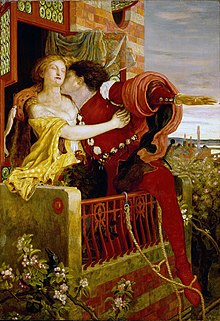
Ford Madox Brown Romeo and Juliet
Source Wikipedia


Ballet in the round is a very different experience from ballet on a proscenium stage. For a start there is so much space allowing dancers to build up momentum and elevation. The orchestra is not confined to a pit but occupies a platform above the dancers. The arena can accommodate scores of dancers for crowd scenes. At the same time it is also intimate. The dancers access the arena from different parts of the auditorium literally within inches of the audience.

English National Ballet's Romeo and Juliet is massive involving the whole company plus many artists who had been recruited especially for this production. According to the website, the cast is 120 strong and the list of names fills five columns of small print in the programme. Many of those who have been recruited for this show are considerable artists in their own right such as Sarah Kundi (see "Bye Bye and All the Best" 10 June 2013). Crowd scenes really did have crowds. The sheer number of combatants made the fights seem not only realistic but menacing. Quite a contrast to Ballet Cymru's Romeo a Juliet which I saw in Kendal just over a year ago ("They're not from Chigwell - they're from a small Welsh Town called Newport" 14 May 2013).

Although Romeo and Juliet is set against a background of inter family rivalry it is a love story and the focus is on the lovers. Those roles demand much from the principals who have to grow up before our eyes.   English National Ballet has very special dancers for Romeo and Juliet such as Carlos Acosta and Tamara Rojo, Vadim Muntagirov and Daria Klimentová, Arionel Vargas and Elena Glurdjdze, Friedemann Vogel and Alina Cojocaru.   If I had unlimited time and resources I would have seen them all but being obliged to make a choice I chose Vogel and Cojocaru.

I chose Vogel because he is from the Stuttgart Ballet which was founded by John Cranko. Cranko's Romeo and Juliet was the inspiration for Kenneth MacMillan's which is the version with which British audiences are most familiar. Cranko's artists were Richard Cragun and Marcia Haydée. I never saw them dance Romeo and Juliet but this YouTube clip gives an indication of the beauty of that production. English National Ballet's rehearsal video reminded me of that clip and suggested that Vogel with Cojocaru might be the next best thing. 

It was a good choice. They were excellent.  From the moment she entered the arena as a playful teenager teasing her nurse Cojocaru delighted her audience. She projected the excitement of a débutante at a first dance, the conflict of emotions on first seeing Romeo, her joy at the balcony scene and her determination to marry him come what may. Vogel was the perfect Romeo, ardent in love but also in anger after Tybault had despatched Mercutio. 

There were fine performances too from Arionel Vargas as Paris, a decent man who did not deserve to meet his end in the Capulet crypt at the hands of Romeo, Max Westwell as Tybalt, Fernando Bufalá as Mercutio, Luke Haydon as Friar Lawrence and Jane Howarth as a powerful Lady Capulet. All beautifully choreographed by Derek Deane.

Having seen this production I wondered why all ballets are not staged in the round. There are challenges for the designer, of course, because the focus is not on the stage but Roberta Guidi di Bagno's met them by projecting portraits and other scenes from renaissance Italy that complemented the more substantial edifices for the town scenes and balcony.  Coming from Holmfirth I am always proud to see Gavin Sutherland who trained at the University of Huddersfield and because the orchestra was resplendent on a platform I really could see him and them any time time I wanted to do so throughout the show. It is good to see the musicians from time to time for, as Christopher Wheeldon reminded us in The Winter's Tale, they perform too.

I have seen three productions of Romeo and Juliet in the last year from the Welsh, the Scots and now the English national companies. Each was very different from the others but I liked them all. My next performance will be Russian though with yet another Yorkshireman, Xander Parish, in the title role. I can barely wait.