
Dance News from around the UK and the Rest of the World
Showing posts with label Koen Kessels. Show all posts
Showing posts with label Koen Kessels. Show all posts
Monday, 30 December 2019
The Nutcracker #4 - Birmingham Royal Ballet at the Albert Hall
Standard YouTube Licence
Birmingham Royal Ballet The Nutcracker Royal Albert Hall, 29 Dec 2019 13:00
Having seen Sir Peter Wright's version of The Nutcracker for the Birmingham Royal Ballet several times in Birmingham as well as once at the Royal Albert Hall I had very high expectations of yesterday's performance. I am pleased to report that those expectations were exceeded. There are two reasons why I liked yesterday's matinee so much. The first was the sheer quality of the dancers and musicians with Celine Gittens and Brandon Lawrence in the leading roles and Koen Kessels conducting the orchestra. The second was the straightforward interpretation of Hoffman's story with great special effects but no creepiness or spookiness.
The performance began not with the familiar overture but sounds of industrial activity from Dr Drosselmeyer's workshop. Drosselmeyer (Tom Rogers) appeared on stage and introduced himself through the voice of Simon Callow. He explained that he is called a doll maker but prefers to call his creations "automatons" as he likes to think they have a touch of magic about them. Nowadays, that "touch of magic" might be called artificial intelligence and that was seen in the self-propelled toy mice that scurried about the Stahlbaums' sitting room as well as the humanoids Columbine, Harlequin, Jack-in-the-Box and, of course, the Nutcracker. Callow announced that he was bringing gifts for his delightful goddaughter Clara and her somewhat less agreeable brother Fritz. Beatrice Parma danced Clara. Wesley Mpakati, an 11-year old schoolboy from Tyseley according to Brum Pic, was Fritz,
After that introduction, the orchestra struck up and the ballet unfolded in the traditional way. The workshop was removed and replaced by a Christmas tree which became the centrepiece of the Stahlbaums' Christmas party. Guests arrived including Drosselmeyer and his assistant (Gus Payne). They distributed presents to the children: dolls to the girls and drums, rattles and war toys to the boys and the nutcracker to Clara. Fritz and his friends made thorough nuisances of themselves earning more than a few tickings off from Mr Stahlbaum (Jonathan Payn). At one point they grabbed the nutcracker from Clara and damaged it. Happily, Drosselmeyer was able to repair the damage. He demonstrated Harlequin (Hamish Scott), Columbine (Rosanna Ely) and the Jack-in-the-Box (Max Maslen) to the guests.
I took a particular interest in the Jack-in-the-Box because Joey Taylor tried to teach me that dance in KNT's Day of Dance last April (see Best "Day of Dance" Ever 23 April 2019). "And were you able to do any of that?" my companion asked. "Not much" I had to admit, "but then I am over 70." However, I am proud to say that several of my classmates who are also adult ballet students did very well even managing a couple of cartwheels. In yesterday's performance, Taylor was in the Spanish dance. As my box in the grand tier overlooked stage right, I shouted "Bravo Joey" at the end of the divertissement which I hope he heard. If not, he will know that I appreciated his performance should he ever get round to reading this review.
After the party, the Christmas tree expanded and giant baubles descended from the ceiling. Mice and toy soldiers appeared and fought a battle that the mice nearly won. Clara saved the day for the soldiers by clobbering the mouse king (Gabriel Anderson) with one of her pointe shoes. As a reward, she was transported to the land of sweets by a jet-propelled seagull. The expansion of the Christmas tree was achieved by massive side panels on either side of the stage. The same side panels showed rotating rotor blades in engines below the seagull's wings. In the land of sweets, Clara was treated to the Spanish, Arab, Chinese and Russian divertissements followed by the mirlitons, waltz of the flowers and the Sugar Plum pas de deux.
Gittens was excellent as ever Over the years I have seen her in most of the leading classical roles. I think that she is particularly good in The Nutcracker. I should mention in passing that she is this publication's ballerina of the year, her company is Terpsichore's "company of the year" and Ruth Brill is our choreographer of 2019. Finally, Birmingham Royal Ballet's former director, David Bintley, has been awarded a knighthood in the 2020 honours list. As he comes from the next village but one to mine in the Holme Valley I take particular pleasure in congratulating him on that accolade (see My Home and Bintley's 12 May 2015). Quite an annus mirabilis for the company.
Everybody danced well yesterday and I say that despite a couple of slips on the artificial snow. Lawrence partnered Gittens deftly and jumped impressively in the final pas de deux. Rogers was a splendid Drosselmeyer. Yijing Zhang was a delightful snow fairy. Anderson was a fine mouse king. Maslen made an impressive Jack-in-the-Box. Finally, it was good to see the musicians at work. Kessels, whom I met briefly at the Dutch National Ballet's gala in 2018, is almost a dancer in his own right and I was grateful for the monitor that remained focused on the maestro throughout the show.
There are three more performances of The Nutcracker before the season ends. Ticket prices are not cheap. Even the programmes cost £10. However, if you see no other ballet over the coming year this is the one to catch.

Sunday, 30 December 2018
The Nutcracker returns to the Royal Albert Hall
Standard YouTube Licence
Birmingham Royal Ballet The Nutcracker 29 Dec 2019 14:00 Royal Albert Hall
Each of the five largest ballet companies of the United Kingdom has a version of The Nutcracker in its repertoire. I have seen all of them at one time or another and the ones that I like best which are Scottish, Northern's and the Birmingham Royal Ballet's more than once. If I had to choose one it would be Peter Wright's production for the BRB. Last year I saw it in the Hippodrome in Birmingham. Yesterday I saw it upscaled fro the Royal Albert Hall.
This was not the first time I had seen ballet in that auditorium. On previous occasions, I had seen Romeo and Juliet and Swan Lake in the round performed by the English National Ballet. Birmingham Royal Ballet used the space quite differently. They created a stage at one end of the floor above which they positioned the orchestra. On either side of the stage, they placed enormous screens upon which all sorts of images such as pine branches and baubles to represent a growing Christmas tree and falling snow for the snow scene. Seating was installed in the part of the floor not used as a stage and the gallery was closed off altogether. My view from the centre of the Rausing circle was comparable to the view from the front of the amphitheatre at Covent Garden.
The libretto was very similar to the one for the version that I had seen at the Hippodrome last year and used about the same number of dancers. The one big difference was a voiceover by Simon Callow which was probably harmless enough but not particularly necessary. He was supposed to represent Drosselmeyer who was already represented in dance more than adequately by Rory Mackay. What rankled a little bit with me was that Callow spoke in a thick continental accent that made Drosselmeyer appear to be some kind of foreigner which was unlikely as he was Clara and Fritz Stahlbaum's godfather. Unlike Sir Peter Wright's production for the Royal Ballet, there was no subplot of the nutcracker being Drosselmeyer's nephew imprisoned in wood. Nor were there an,y angels in the Birmingham version.
The other three lead characters yesterday were the Sugar Plum danced by Celine Gittens, her prince Brandon Lawrence and Clara who was Arancha Baselga. On 26 June 2018, I had been captivated by Gittens's portrayal of Juliet although she had been one of my favourites for some time (see MacMillan's Masterpiece 29 June 2018). I chose yesterday's matinee specifically to catch Gittens and I am glad to say that she did not disappoint me. I was too far away to see her face which had been so eloquent when she danced Juliet but her elegance was unmistakable. As in June, she was partnered by Lawrence who demonstrated his strength and virtuosity. Baselga delighted her audience with her energy as she threw herself into the divertissements in Act II. I admired and liked her particularly in the Russians ance as she was tossed from dancer to dancer like a bag of cement.
Another of my favourites is Ruth Briill who danced Clara's grannie with Kit Holder. I had thought of auditioning for that role if and when Powerhouse Ballet ever performs that ballet but having seen Brill in Birmingham's production and Hannah Bateman in Northern's (see Northern Ballet's "The Nutcracker" - All My Favourite Artists in the Same Show 14 Dec 2018) that may be a little bit too ambitious. I had also contemplated auditioning for Mrs Stahlbaum until I saw Yvette Knight's impressive solo. Maybe I could be a rodent but not the rat king like Tom Rogers yesterday.
Plaudits are due to Harlequin, Columbine and the Jack in the Box danced by Gus Payne, Reina Fuchigami and Max Maslen, the Snow Queen (Alys Shee) and each and every one of the dancers in the divertissements in Act II. I particularly liked Laura Purkiss as the Spanish princess and Beatrice Parma as the rose fairy.
I must also congratulate the orchestra and its conductor Koen Kessels whom I had the pleasure of meeting ar the party following the Dutch National Ballet's gala on 8 September 2018. I attended the ballet with the nearest I have to a grandson and his mum who is the nearest I have to a daughter. She was particularly affected by the music saying that it had touched her in a way that previous performances of the score had not/. Clearly, I was not the only one to regard the music as special
Altogether it was one of the best performances of The Nutcracker that I have ever attended and a great way to end the year. It is in the running for my ballet of the year as indeed is the Birmingham Royal Ballet for company of the year. Upon the merger of my chambers with Arden Chambers earlier this year we acquired an annexe at Snow Hill in Birmingham which I intend to use to the full. As I shall be spending far more time in their city I hope to see even more of the Birmingham Royal Ballet and get to know it even better.
Saturday, 17 June 2017
Even more Sensational - Peter Wright's Coppelia
 |
| Nao Sakuma as Swanilda
Author Bill Cooper
© 2017 Birmingham Royal Ballet: all rights reserved Reproduced with kind permission of the company |
Birmingham Royal Ballet. Coppelia, Hippodrome, 16 June 2017, 19:30
When I last reviewed a performance by the Birmingham Royal Ballet of Sir Peter Wright's Coppelia, I described it as "sensational" (see Sensational 6 March 2015). Having seen the ballet again on the company's home turf the only way I can describe the performance is "even more sensational." Maybe that should not be surprising for who better to perform one of Sir Peter's greatest productions than Sir Peter's company.
I made up my mind to attend the ballet last night at the very last moment after a pig of a journey home. I had driven to London the night before to take delivery of a massive set of instructions that could not be carried on the train. While down there, I attended a chambers' garden party that continued until after midnight and two conferences, one of which began with a volley of emails between 05:00 and 06:00 and a phone call shortly before 07:00. I left Plumstead where I had parked my car and cleared the river after an epochal wait for the Woolwich ferry. There was heavy traffic on the North Circ and the M11. Congestion outside Cambridge on the A14. As the A14 leads eventually to the M6 the idea of breaking my journey in Birmingham occurred to me. I called the Hippodrome on the off-chance that they might still have space and was told that they had one isolated seat in the centre of the rear stalls. I grabbed it. After battling with more traffic all the way into Birmingham, I rolled up at the theatre hot, bothered and exhausted with 15 minutes to spare.
Dropping by the Hippodrome was one of the best calls I have ever made. The performance was magic. It was just what I needed. I had not had time to study the cast list but I knew we were in for a treat when I glimpsed the unmistakeable hair of Koen Kessels. He had conducted the orchestra of the Dutch National Ballet in Ted Brandsen's Coppelia last December. Nobody seems to understand Delibes's score better than Maestro Kessels. The curtain rose to Peter Farmer's village somewhere in Mitteleuropa. Nao Sakuma appeared. I started to clap but nobody followed. Nor did anyone clap Joseph Caley when he entered the stage. Clearly, the balletic tradition of welcoming the male and female leads with a brief burst of applause that happens in almost every other theatre in the world is not followed in Birmingham. That is surprising because all of Birmingham Royal Ballet's principals are good.
Sakuma was a gorgeous Swanilda. I loved the way she threw her book at Caley after catching him making eyes at the humanoid on the balcony across the square. "Sukkel" hissed Swanilde in Het's animation. How she gave him the hardest of hard times when the ear of wheat did not appear to rattle. How she led her pals into Dr Coppelius's workshop while he was in the pub recovering from his mugging. How she dared the faintest of faint hearts to approach Coppelia. How she coaxed the deluded doctor into believing his spell had worked as she sought to rescue her dopey (even at the best of times) boyfriend. And above all, I loved the final pas de deux in "Peace" which ends the ballet on a high. Whenever I see Coppelia I always wonder how long that marriage will last. Surely, such a brave, resourceful, spirited girl could surely have done so much better.
Of course, she falls for Franz because he is a hunk. The handsomest lad in a very small village in the middle of nowhere. Girls find him attractive and doesn't he just know it. After blowing kisses at a robot, he flirts with the leader of the czardas. Caley, whom I am sure is nothing like Franz in real life, fills the role perfectly. Even after nearly losing Swanilda he is silly enough to break into Coppelius's workshop. Good job there was no copper around (see R v Collins [1972] 2 All ER 1105, [1973] 3 WLR 243, [1972] EWCA Crim 1, 136 JP 605, 56 Cr App Rep 554, [1973] QB 100, a case that has entertained every law student in England for nearly 50 years). The silly twit deserved everything that happened to him. But Franz can dance. And how he can dance. All those great tours en l'air and entrechats and the final lift that left Swanilda dangling across his back in a curious sort of fish dive.
Dr Coppelius is a juicy character role and it was performed exquisitely by Michael O'Hare last night. Scorned as slightly screwy by the Burgermeister (Jonathan Payn) and the villagers when loud bangs and smoke erupt from his laboratory, he is surely more sinned against than sinning. Does he really deserve to be roughed up by the louts or have his home ransacked by girls on a hen night? I can quite see why he sought compensation from Swanilda's dowry.
We had a stellar cast last night. Many of my favourite dancers came on stage: Delia Mathews as Prayer and also one of Swanilda's friends along with Arancha Baselga, Karla Doorbar, Reina Fuchigami, Alys Shee and Yaoqian Shang; Rory Mackay as the publican and Old Father Time; Ruth Brill with Lewis Turner in Betrothal and earlier in the mazurka and czardas; William Bracewell in the call to arms with yet another favourite Brandon Lawrence from Bradford. Everyone in the cast was good and I congratulate them all whether I have mentioned them or not.
There was loud applause at the reverence but, sadly, no flowers. In another auditorium and perhaps at a different time the stage would have been ankle deep in cut flowers throw after a show like that. A massive bouquet of my county's reddest roses, then, to Sakuma. Flowers, too, for each and every lady soloist. Indeed, each and every lady who appeared on stage. And a resounding cheer for each and every one of the men who partnered them so gallantly. "You are so lucky to have this company in your city," I said to a lady who was at the ballet for the first time. "The Birmingham Royal Ballet is one of the great companies of the world." How I wish it could have made its home in Manchester instead.
Monday, 12 December 2016
Brandsen's Coppelia
Standard YouTube Licence
Dutch National Ballet Coppelia, Music Theatre, Amsterdam 11 Dec 2016, 14:00
With Mata Hari Ted Brandsen showed he was a master of tragedy (see Brandsen's Masterpiece 14 Feb 2016). With Coppelia he shows his mastery of comedy. I can't remember when I last laughed so much in a ballet or left a theatre more elated. It is without question the best dance show around this Christmas. While I recommend the three Nutcrackers or Hansel and Gretel from our four leading companies, Sir Matthew Bourne's The Red Shoes and Northern Ballet's Beauty and the Beast, if there is only time or money for one ballet this Christmas, this is the one to see. Though I had a horrendous journey from Amsterdam last night thanks to a lorry running into an aeroplane, easyJet's appalling customer service, immigration officers forcing us to use their useless and annoying e-passport machines when we eventually landed at Ringway and a 2 hour wait for a train home, the pleasure I got from that show more than made up for it.
I am usually pretty scathing about updates of well-loved ballets as readers of this blog well know. I don't like bikes on stage in Swan Lake. I bristle at shillelagh-wielding wilis. As I said in Manchester City Ballet's Coppelia 10 Dec 2016, Coppelia already addresses contemporary themes like coming to terms with artificial intelligence, low-level youth crime and elder abuse so why update it? With all these thoughts in mind, I was a little apprehensive as I entered the Music Theatre auditorium yesterday afternoon. I need not have been. Brandsen had made some changes to the story and he had set the scene int the present, but those changes were changes for a reason rather than change for change sake.
Brandsen has changed the names of the lead characters from Franz and Swanhilde to Frans and Zwaantje. He has given them jobs in a gym and a juice bar respectively. He has turned Dr Coppelius into a businessman with a chain of beauty clinics. He has introduced a lot of new characters including a demonic PA to Dr Coppelius called Anna Marx, a girl geek friend for Zwaantje called Emma, lots of relations, celebrities and two adorable dogs danced by children. On the other hand, he has retired Dawn, Prayer and Work as well as the duke and Burgermeister, He has given the last act a new sub-plot with Coppelia turning up in a wedding dress forcing Frans to choose between her and Zwaantje. Probably the best way to appreciate those changes is to watch the animation even though it is in Dutch. In all other respects, Brandsen has left the story unchanged and he has kept the score in its entirety.
Yesterday, the role of Zwaantje was danced by Anna Ol and Frans by Artur Shesterikov. Both are consummate virtuosos. Ol thrilled us with her fouettés, posés and chaînés. Shesterikov with his soaring and seemingly effortless leaps. They are also accomplished actors. Shesterikov held his head in his hands when he knew that Zwaantje had caught him making advances to Coppelia, a gesture known to every single woman in the audience who has caught her man doing something that he ought not to be doing and eliciting a ripple of knowing female laughter. More laughter from the audience as she dodged his embraces until she forgave him. Clearly too quickly because Frans allowed himself to be enticed into the clinic by Dr Coppelius and his assistant.
In Brandsen's version, Dr Coppelius was a major role which was danced yesterday by the soloist, Edo Wijnen. He was no eccentric old alchemist pottering about in his workshop but a powerful and unscrupulous businessman. He was energetic and guileful and very sinister. His assistant in his scheming was Weng Ting Guan who was as scary as her boss. It was she who produced a bottle laced with a drug that knocked Frans out cold. She wired him up to a machine which was to extract whatever it was that made him human and inject it into Coppelia.
Coppelia was danced by Nancy Burer whom I had first noticed when she danced Embers with Thomas van Damme on the opening night of the Junior Company's 2015 tour (see The Dutch National Ballet Junior Company's best Performance yet 8 Feb 2015). She had rather more to do in Brandsen's Coppelia than in most other productions who simply require their doll to sit and look beautiful and, occasionally, make short, jerky arm and leg movements. Brandsen made her into a seductress and a rather dangerous one. I think I saw more than a little of Mata Hari in Burer's depiction of Coppelia, resplendent in her strawberry blonde bouffant wig. There is, incidentally, a very amusing little video of Coppelia playing hide and seek with the security guard on the company's YouTube channel called Coppelia v The Night Watch with some lovely views of the Stopera or Music Theatre.
Van Damme, incidentally, also had a character role as a "glam rock star" or one of the dolls in the numbered boxes in the clinic. It was good to see him and other young dancers I follow such as Cristiano Principato, Emilie Tassinari, Giovanni Princic, Melissa Chapski and many others. There were opportunities for lots of fine young dancers such as Ahmad Joudah who danced the clergymen and indeed the students from the National Ballet Academy two of whom, Aafka Wolles and Wisse Scheele, danced the poodle and dalmatian. The final scene of the ballet with each of the characters taking a farewell bow the corps turning and the children doing balances brought each and every member audience (me included) to their feet. Standing ovations, which used to be rare when I first started watching ballet in the 1960s, have become increasingly common. More and more frequently I have to ask myself: "why?" I didn't yesterday. It was obvious. The audience's accolade was well and truly earned by everyone in the cast.
I should say a word for the creatives. Sieb Posthuma's set designs were exquisite. In addition to theatre design he had been an illustrator of children's books and the intention was to create the illusion of walking into a story book. Copies of that book were on sale in the foyer for just over 15 euros. I thought long and hard about buying a copy for Vlad the Lad but there was a lot of text in Dutch. The poor little boy is already expected to master his mother's Krio and his dad's Ga as well as major modern European languages and possibly the classics. François-Noël Cherpin did a magnificent job with the costumes. And who should be conducting the orchestra but our own dear Koen Kessels.
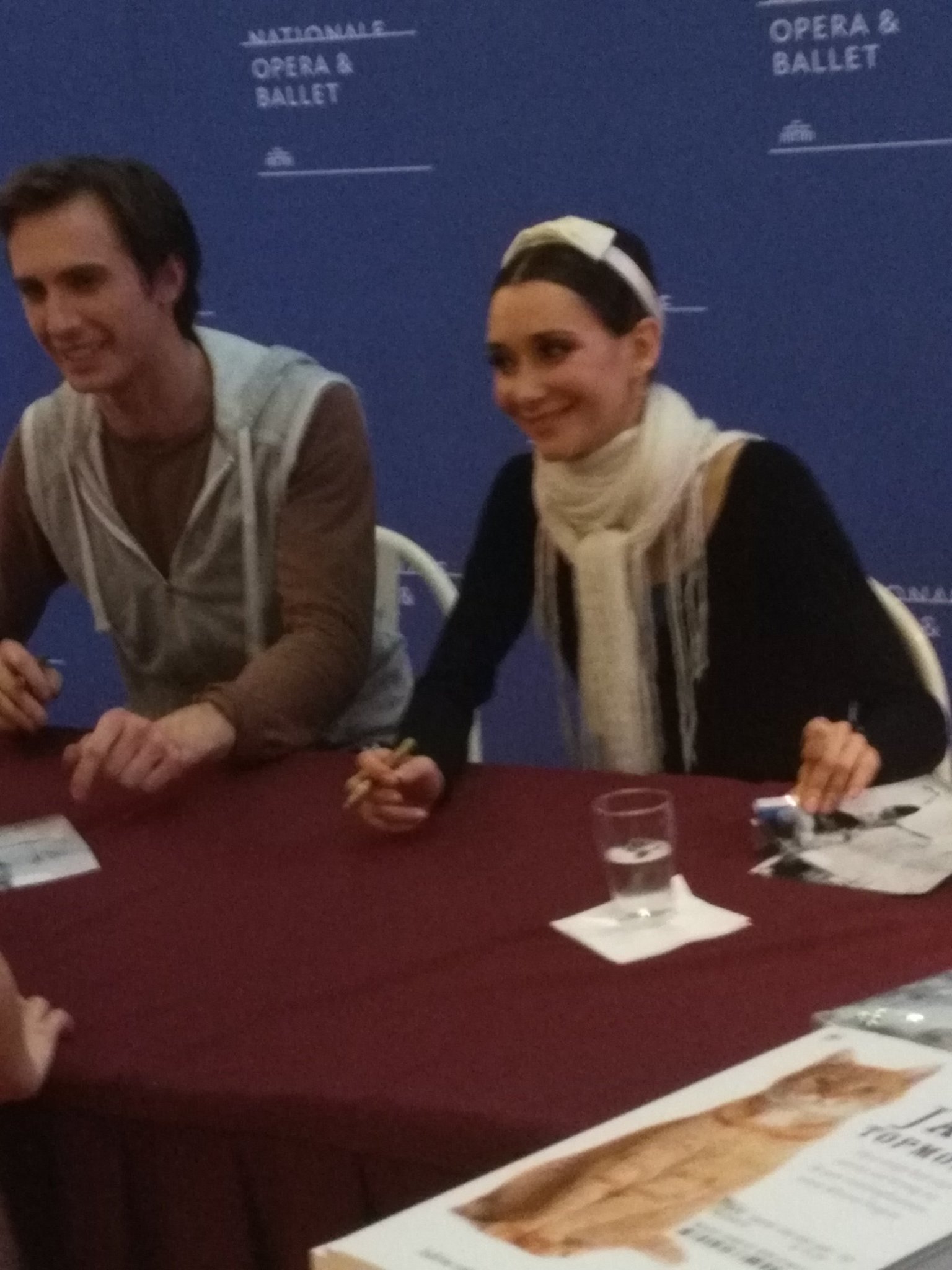 |
| Anna Ol and Artur Shesterikov
(c) 2016 Jane Lambert
All rights reserved |
Like most of my compatriots who follow ballet, my home is Covent Garden. There is nothing quite like the House on a ballet night. But, increasingly, I am finding a welcoming second home in the Dutch National Ballet's Music Theatre and I am beginning to know and love the Dutch National Ballet as I do the Royal Ballet.
Wednesday, 22 June 2016
Terpsichore votes "Remain"
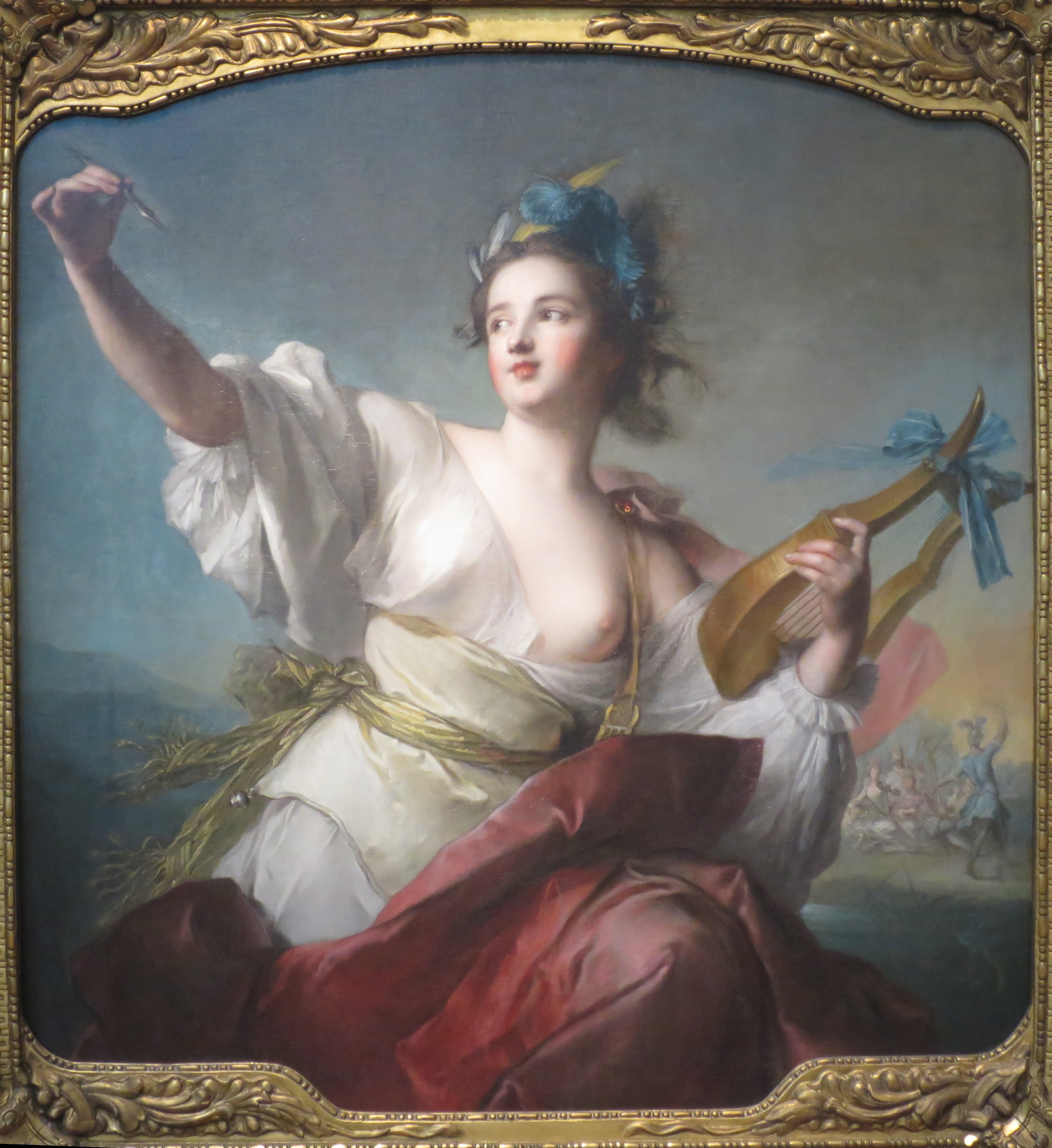 |
| Τερψιχόρη
Jean-Marc Nattier
|
Tomorrow I will vote "Remain" and one of the reasons why I shall do so is that I care about the arts and creative industries in general and the performing arts and ballet in particular.
The case for Remain was made eloquently by members of the Creative Industries Federation in their briefing note Why is EU membership so important for the health of UK’s arts, creative industries and cultural education? It was echoed in Ismene Brown's article The Royal Ballet and Sadler’s Wells explain how Brexit will hurt dance 13 June 2016 and supported by Jessica Duchen's I'm IN, and here's why you should be too 25 May 2016 JDCMB which I mentioned in my own article Should we stay or should we go? 30 May 2016.
Much of the steam for the Leave campaign has been generated by concern about immigration. There is some outright xenophobia in that sentiment but I believe that it is mainly a worry about shortages of housing, healthcare, education and other public services which could be overcome with proper planning and resourcing.
For the arts, free movement of labour is essential. Let me give just one example. Earlier this month the Scottish Ballet delighted audiences throughout Scotland and the North of England with David Dawson's Swan Lake (see Empire Blanche: Dawson's Swan Lake 4 June 2016). Dawson was born in London and trained at Tring Park and the Royal Ballet School but he has spent much of his career with the Dutch National Ballet where he is now an associate artists. He is not the only Brit there. The company's artistic director is Matthew Rowe who is another Londoner (in fact as there is a reference to him in the latest issue of The Pauline he may even have attended my old school).
Conversely many of Scottish Ballet's finest dancers come from France: Constance Deverney recently promoted to principal, Sophie Martin, Marge Hendrick, and Laura Joffre to name just a few. The same is true of our other leading companies. Where would the Royal Ballet be without Laura Morera or Federico Bonelli? The Birmingham Royal Ballet without Koen Kessels? English National Ballet without Tamara Rojo or Alina Cojocaru?
There are dancers from the EU also in our splendid regional companies like Giuliano Contadini and Kevin Poeung with Northern Ballet and Allegra Vianello and Andrea Battagia with Ballet Cymru. I could go on.
Those artists delight us. Let's continue to make them feel welcome tomorrow.
Sunday, 6 March 2016
A Good Outcome from an Unhappy Event - Singleton's Fine Performance
Romeo and Juliet 2016 tour trailer from Birmingham Royal Ballet on Vimeo.
The Birmingham Royal Ballet, Romeo and Juliet, The Lowry Theatre, 5 March 2016
Sometimes a good outcome can result from an unhappy event. There are countless tales of actors and sportsmen as well as dancers stepping into a role at the last minute and rendering a magnificent performance. That happened last night when Tyrone Singleton danced Romeo in Birmingham Royal Ballet's performance of Romeo and Juliet at the Lowry Theatre in Salford.
Singleton stepped in because Jamie Bond was indisposed. Apparently he sustained an injury minutes before the curtain rose. That came as a blow because Bond is one of my favourite dancers. I enjoyed his performance as Beliaev in A Month in the Country on 20 Feb 2016 and I had been looking forward to seeing him as Romeo ever since. But of course that is secondary to the welfare of a dancer. The company gave no details of the injury and I am sure that I speak for everyone in wishing him all the best.
However, although I was disappointed not to see Bond, Singleton made up for it. He is another of my favourites and I may be wrong but I think yesterday was the first time that he danced Romeo. He had danced Benvolio and Paris in Romeo and Juliet before so he would have known the ballet well but Romeo is a very demanding role requiring considerable dramatic as well as virtuosity. With four pas de deux - particularly the last one as Romeo carries Juliet's seemingly lifeless body around the stage - several big sword fights and lots of ecstatic solo jumping - there is more than enough demand for technical skills. All I can say is that he carried it off very well indeed and I congratulate him on his performance.
Of course a great Romeo needs an excellent Juliet and we had a particularly good one in Nao Sakuma. This is another challenging role for the dancer has to grow before the audience's eyes from playful infant into an adult with capacity for all consuming love and considerable courage and determination. This is one of the great theatrical roles not just in ballet but in any media and it is big challenge for any ballerina. I have seen Lynn Seymour and Margot Fonteyn dance those roles but I don't think either of them thrilled me more than Sakuma did last night. She has a real understanding of the character. The acid test of a great Juliet is her solo in her bedroom as she contemplates her options after the double shock of Romeo's departure and her parents' order to marry Paris sinks in. Sakuma emerged from it as pure gold.
There were lots of other fine performances last night.
Valentin Olovyannikov was a great Tybalt. Why do my fellow Mancunians boo fine artists after magnificent performances just because they dance the villain's role? Too many pantomimes, I guess. We all admired his performance. I hope he takes those boos as compliments for I am sure that was the intention. Also, is Tybalt really any worse than the other young hooligans in the Montague or Capulet families. I suppose he did stab Mercutio in the back but wouldn't Benvolio, Mercutio or even Romeo have done the same given the chance?
Talking of Mercutio and Benvolio, Mathias Dingman and Jonathan Caguioa gave fine performances of these roles.
So, too, did Steven Monteith as Paris. According to his twitter feed he is about to retire. He will be missed. In the first interval I bumped into Janet McNulty of BalletCo Forum and her companion. "I don't know why she bothered with Romeo when she had such a good looking Paris" Janet said. In view of Singleton's striking good looks, his height and slender, athletic frame that is quite a compliment. Again, I am sure I speak for everyone in wishing Monteith well in the next phase of his career.
As for the women, it is always a pleasure to see Delia Matthews. I was so sad to learn that she had been injured in Les Rendzvous (see Birmingham Royal Ballet in York 21 May 2015). It was lovely to see her back in top form as Rosaline. Ana Albutashvili was a fine nurse. I particularly loved her dance with Romeo and his mates as she tried to deliver Juliet's letter fending off the groping and bottom pinching but palpably relishing the kiss from Romeo. Yijing Zhang was a passionate Lady Capulet: spitting blood at Romeo after he had despatched Tybalt but still capable of at least some empathy for Juliet as her dad laid down the law. And although they were not on stage for long it was great to see Maureya Lebowitz who had impressed me as Lise (see Fille bien gardée - Nottingham 26 June 2014 26 Jan 2014) and Céline Gittens who was an adorable Swanilde (see Sensational 6 March 2015) again.
All danced well and this review would rival a telephone directory in length and turgidity if I were to give every dancer his or her due. I really wish I had brought flowers to throw on stage in the Covent Garden tradition even though I would probably have been bundled out of the Lowry and banned from ever returning. But it would have been worth it for all the artists danced so well. Maybe flower throws are a London practice we should import for shows like last night's as well as clapping when the principal appears. I clapped as Singleton and Sakuma appeared in scenes one and two but inaudibly. So frustrating!
This was the first time I had seen MacMillan's ballet without Nicholas Georgiadis's sets. They are so rich and add so much to the show. But although I prefer Georgiadis's designs simply because I associate them with some great productions in the past, Paul Andrew's worked well too.
The other great ingredient of this ballet is the music and Koen Kessels interpreted Prokofiev's difficult score magnificently.
Having moaned about my fellow Mancunians for booing Tybalt and not clapping the principals or throwing flowers I must commend them for turning out in force last night. I couldn't see a single empty seat. So different from the Hippodrome two weeks ago. In my review of the Ashton's Double Bill 21 Feb 2016 I wrote:
"For some reason or other the theatre was far from full which is disappointing for a performance by a company of the calibre of the Birmingham Royal Ballet. Although there were some cheers and bravos - mainly from me - and one or two people on their feet - there were not all that many curtain calls. It was a good show and BRB deserved more appreciation. I am sure they will do better when they bring Romeo and Juliet to the Lowry."I am so relieved that was the case. My birthplace is the second city of the United Kingdom not simply by dint of numbers but also in its appreciation of excellence.
Wednesday, 23 September 2015
Romeo and Juliet in the Cinema - the Royal Opera House gets it right
Embedded pursuant to the standard YouTube licence
In the past I have been rather critical of the Royal Opera House's live ballet transmissions to cinemas. In The Royal Ballet's Swan Lake - that's more like it 25 March 2015 I wrote:
"I have not been too kind about HDTV transmissions of the Royal Ballet's performances from Covent Garden ("¡Por favor! Don Quixote streamed to Huddersfield" 13 Oct 2013, Good Quality Hamburger at the Very Least - Giselle streamed from Covent Garden 27 Jan 2014" and "Manon Encore at the Huddersfield Odeon" 20 Oct 2014) though I recanted slightly over The Winter's Tale ("The Winter's Tale - Time to eat my Hat" 29 April 2014). In general I have much preferred Pathe-Live's transmissions from Moscow."March's Swan Lake was much better and yesterday's Romeo and Juliet was just right. It was as good as anything that has been transmitted from Moscow and I congratulate Ross MacGibbon and his team on the screening.
A large part of the reason for last night's success was the engagement of Ore Oduba. He is a skilled TV presenter in a way that Darcey Bussell is not. He has an easy manner and conveyed the sense of excitement and occasion of the man on the Clapham smartphone so much better than the stream of gushing tweets that had irritated me so much on previous occasions. Oduba also freed up Bussell for some important interviews. There were some interesting contributions from Lady MacMillan and Donald MacLeary whom I saw last year at the London Jewish Cultural Centre (see A Minor Miracle - Bringing Le Baiser de la fée back to Life 2 June 2015). I was also impressed by the interview with Garbiel Prokofiev who wrote the music for Shobana Jeyasingh's La Bayadère - the Ninth Life (see La Bayadère - The Ninth Life 29 March 2015). I also enjoyed the conversations with Koen Kessels and Kevin O'Hare as well as the snippets form Steven McRae, Sarah Lamb and others.
The great advantage of live transmissions is that you get to see the detail of the ballet from the close ups. These include facial expressions such as the shame on the faces of Romeo and his mates when they are ticked for brawling off by Escalus, the parties' disdain when they are forced to reconcile, Tybalt's permanent sneer and the vengeful grief of Lady Capulet. Cinema audiences also got a chance to examine the props such as Juliet's poppet in Act I and the vial of liquid that would suspend her animation which she approached with such enormous trepidation. The close ups also allowed me to concentrate on important parts of the choreography such as the courous en pointe as Juliet recoils from Paris the significance of which I had never appreciated on all the occasions that I have seen it on stage.
McRae and Lamb were magnificent in the title roles. I have always liked them in every ballet in which I have seen them perform. A special word of praise is due to Gary Avis who is another of my favourites. He danced Tybalt and was excellent. All were good - especially Alexander Campbell as Mercutio, Ryoichi Hirano as Paris, Elizabeth McGorian as Lady Capulet, Genesia Rosato as the nurse, Alastair Marriott as Friar Lawrence and Bennet Gatside as Escalus. It was also great to see Nicholas Georgiadis's rich designs again. They are as awesome now as they were when I first saw that ballet four and a half decades ago.
Romeo and Juliet is not a short ballet but seldom has an evening passed so quickly. Finally, although I promoted the screening in Centenary Square (see Ballet for Everybody in Centenary Square 4 June 2015) I actually saw it in the Pictureville cinema at the National Media Museum a few hundred yards away. There may well have been a party atmosphere in the Square and other big screens up and down the country and you can get in for free but it was a bit chilly on the first night of Autumn, the seats are hard and the screen and audio leave a lot to be desired. I like my comfort at my time of life and the Museum with its bar, restaurant and convenient parking is one of the most civilized venues I know anywhere in the world.
Postscript
Alison Penfold who lives in London drew my attention to the fact that the big screen in Centenary Square was out of action on Tuesday night. In response to my post:
"There was a quite a lot of price variation in Bradford where there was a big screen in Centenary Square and folk could see the show for free."She wrote:
"Except they couldn't: I believe there was some problem and the screening was cancelled?"That was news to me and I was only a few hundred yards from Centenary Square. It turns out that Alison was right. The Royal Opera House tweeted
The #BPBigScreens at Centenary Square Bradford has been cancelled due to technical difficulties. Apologies for the inconvenience ^H
— Royal Opera House (@RoyalOperaHouse) September 22, 2015
It is a great shame that that happened. Bradford has many different communities and cultures and Tuesday would have been a great opportunity to introduce ballet to folk who would never otherwise see it.Further Information
See Live Performances from the Bolshoi and Covent Garden 20 Sept 2015
Subscribe to:
Posts (Atom)