Wednesday, 2 March 2022

Acosta Danza "100% Cuban"

Standard YouTube Licence

Acosta Danza 100% Cuban  New Theatre, Hull, 25 Feb 2022, 19:30

Cuba may be a small Caribbean island with a population of 11.2 million but it has world-class national ballet and contemporary dance companies.  Joanna Goodman reviewed one of the Cuban National Ballet's performances of Swan Lake in its own theatre in 2014 (see "We are the dancers, we create the dreams: Ballet Nacional de Cuba’s El Lago de los Cisnes in Havana" 8 July 2014). I reviewed the national contemporary dance company when it visited the Lowry (see Danza Contemporanea de Cuba at the Lowry 19 Feb 2017).

Artists from Cuba have contributed not only to their own national companies but also to leading companies of other nations.  Probably the best known of those is Carlos Acosta. He is now the artistic director of the Birmingham Royal Ballet.  Previously he was a principal dancer with the Royal Ballet.  A glimpse at his website shows that Acosta is more than a dancer and choreographer. He is an entrepreneur, novelist and indeed impresario.

In 2016 Acosta established Acosta Danza which he has described as "Some of the finest Cuban dancers I have ever had the pleasure of working with."  The company is touring the United Kingdom and my friend and I caught up with it at the Hull New Theatre on Friday.  We were treated to the following:
These were very different works that showed off the versatility of the company.

Liberto was a duet created by Raúl Reinoso to the music of Pepe Gavilondo.  The programme contains the following note:
"The story of a cimarron, invites us to reflect on the faces of slavery, from ancient times to the present day. The meeting of the fugitive with the woman, beyond the beginning of a love story, is a moment of reflection and retelling, the possible discovery of the path to the utopian kingdom of total freedom."

I think cimarron must be the Spanish word for "Maroon" who were fugitive slaves.  They formed colonies in the Caribbean and some found their way to Freetown in Sierra Leone where I first learnt their story.  The ballet featured a couple. I am not sure of the identity of the man because the company did not publish a cast list. I asked for one in a Q & A that followed the show but the company's interpreter did not seem to know what I was talking about or why I needed one.   I think Reinoso danced the male role and believe the woman was Zeleidy Crespo but I cannot be sure. I remember a giant net from which the man struggled to escape.  The designs were by Alisa Peláez. The lighting was by Yaron Abulafia.

Like a football match, Hybrid was a combination of two halves. Quite literally because there was a point when the cast lined up for a curtain call, accepted the applause and then slowly started dancing again.  The inspiration for the work appears to have been the legend of Sisyphus:

“O my soul, do not aspire to immortal life, but exhaust the limits of the possible.
(The Myth of Sisyphus).  According to the programme, the piece was about a "universe where the real and the unreal blur their limits to reach our chimaeras." It continued:

"An approach to sensitive realities and imaginaries of a nation and its people, told from the strength of its culture and dance.
An island that unveils its mysteries on a path that goes from darkness to light"
The whole company or at least a large part of it seemed to be in the work. The music was by Jenny Peña and Randy Araujo, the choreography by Norge Cedeño and Thais Suárez, the designs by Celia Ledón and the lighting by Yaron Abulafia.

This was not to everyone's taste because the audience thinned out a little after the interval.

As the music was entitled Cuban landscape with rumba by Leo Brouwer and Cuban Landscape by Stefan Levin and the ballet was danced against a backdrop of growing crops, I understood Paysage, Soudain, La Nuit to be an appreciation of the Cuban countryside and those who worked in it.  This was another work in which the whole company participated.  The choreographer was Pontus Lidberg. Costumes were by Karen Young.  The lighting was by Patrik Bogårdh.

The most spectacular work was Impronta.  It was a solo by Crespo which she performed to the music of José V. Gavilondo. The show started with a mass of blue.  It was not clear whether that was a prop or a group of dancers.  It turned out to be a long flowing dress worn by the dancer. A tall, elegant and exceptionally supple woman, Crespo had bent her body almost to the floor so that her face appeared through the dress.  In the Q&A, Crespo explained that the dress represented the sea.  In answer to a  question from my friend, she said that the dance had been influenced largely by African rhythms.  The programme added:
"Catalan choreographer María Rovira created this solo in wich contemporary dance merges with Afro-Cuban folk dances."

Several audience members stood to applaud Crespo's performance at the end.  Others whooped with delight.  The reaction was well merited because it was impressive.

My favourite ballet was De Punto a Cabo.  I surmise that the title must refer to a seaside walk that is opposite Havana.  The backdrop was of a busy city separated by a stretch of water and a sea wall. Alexis Fernández's choreography to José White and Omar Sosa's music reminded me of the view of Manhattan in the last scene of Liam Scarlett's Age of Anxiety (see Bernstein Centenary  18 March 2018). The piece generated much the same energy and awe.   The website states in Spanish that the choreographer sought to transpose into dance his impressions of contemporary Cuba, a land of diversity and contrasts. He made that point by combining ballet with contemporary dance.  There were some spectacular fouettés from Penélope Morejón as well as contemporary expressions to African and Cuban rhythms.

In the Q&A we learnt that the morning company class alternates between ballet and contemporary. Each of the dancers was asked which style they preferred.  None expressed a preference except Morejón who seemed to glow as she talked about ballet.  There were the usual easily anticipated questions from the floor about the creative process, influences and how they liked the British weather. The best intervention came from a lady from Bridlington who had to dash for a train. She probably spoke for all of us in expressing gratitude for the pleasure the company had brought after a 2-year pandemic.

This was the first time I had attended the Hull New Theatre and my first impressions are good.  It is located on Kingston Square where there was plenty of free street parking.  There is a restaurant and bar which offered inter alia burgers and scampi and chips. It was not exactly gourmet food and slightly over-priced for what it was but it was very convenient.  The auditorium seemed well ventilated.  The seats were comfortable with enough legroom at least for me.

Acosta Danza is nearing the end of its UK tour.  They are at the Marlowe Theatre in Canterbury tonight and at the Theatre Royal in Plymouth at the end of the week. 

Thursday, 24 February 2022

Ballet Cymru's DUETS Programme and why it is important.

Standard YouTube Licence

The dancers in this film are students at Moorland Primary School in Cardiff and Ysgol Ty Ffynnon on Deeside. They participated in Ballet Cymru's DUETS programme. DUETS stands for "Delivering Unique and Exciting Training Strands".  It is a collaboration between Ballet Cymru, theatres, schools and community dance groups across Wales to bring ballet to children who would not otherwise have an opportunity to learn it.

I mentioned the programme in my review of Ballet Cymru's Giselle on 10 Nov 2021:
"Wales has a strong dance tradition as you can see from this grasshopper dance but it does not yet have a national ballet school or comprehensive nationwide facilities for developing balletic talen. There are good ballet teachers in the main towns and cities but most of Wales is rural. Ballet Cymru's Duets Programme goes some way to filling that lacuna."   
Before Giselle, children on the DUETS programme demonstrated what they had learnt in a very short time which earned them considerable applause from the Riverview Theatre audience.

I wrote about Ballet Cymru's work with local schools in Gwynedd in Ballet Cymru - Even Better than Last Year on 6 Dec 2019 and in How the Pontio Centre and M-SParc complement each other in the Social and Economic Development of Northwest Wales on 5 June 2020 in NIPC Wales.  My Welsh teacher from Nant Gwrtheyrn emailed me to say that her husband who is the headmaster of Llanllyfni School had appeared in that video, adding "Byd bach!!!" which means "small world."  

The dance authority that covers Llanllyfni and the Pontio Centre is Dawns i Bawb which means "Dance for Everyone".  It is one of Ballet Cymru's partners in DUETS.  Look up its YouTube channel for films like 'The Jungle' on refugees or "Dawnsio'r Degawdau" ("Dance the Decades") which addresses dementia as the companion film explains.  There are also some fun films like "Dosbarth Dawns i Bawb" ("Dance Class for All"), "Migldi Magldi Dolig" ("Christmas Migldi Magldi") and Dydd Mwsig Cymraeg 2021 (Welsh Music Day).

Some of the children from Llanllyfni, Cardiff or Deeside may be inspired to become performers or teachers but most will not.  However, their lives will be enriched by dance which is why DUETS is important.

Monday, 21 February 2022

Powerhouse Ballet's Reawakening

Standard YouTube Licence

The last two years have been tough for everyone in the arts but they have been particularly hard for adult ballet students who long to perform in public.  For Powerhouse Ballet which was founded just under 4 years ago, the lockdown was almost fatal.  We had been riding high with our very successful workshop with Yorkshire choreographer Alex Hallas and were looking forward to learning the snowflakes scene from The Nutcracker when everything was put on hold.

I feared that it would be the end of Powerhouse Ballet and probably all the other amateur companies in the United Kingdom because we could no longer meet for class.  But help came quite unexpectedly from Amsterdam when Maria Chugai of the Dutch National Ballet offered us an online class.  That class was very successful and showed that it was possible to train over Zoom.  I engaged all our regular teachers as well as Shannon Lilly, Beth Meadway and Krystal Lowe to give online classes.  When restrictions were relaxed in 2020 we held classes in studios in Birmingham and Leeds.   Though it was expensive and hard we never missed a monthly company class and, most importantly, we stayed together.

Now that the country is emerging from lockdown Powerhouse Ballet can rebuild.  My immediate aim is to stage a mixed bill which will include Terence Etheridge's Aria, Yvonne Charlton's Morning, Waltz of the Flowers and Snowflakes from The Nutcracker and part of the wilis' choreography from Act II of Giselle. Much of the preparation for this will be at a summer school in North Wales.  In the longer term, we plan to set up an associates class and I have engaged the assistance of someone with considerable experience in that area to advise me.

That leaves the tricky matters of funding and governance.  Over the last two years, it was easier for me to sponsor the company's activities and I will continue to do so but our plans will require more than I can afford.  In the medium term, we will need to reintroduce a subscription, seek grants and sponsorship.  Publications like this blog, the Stage Door and classes outside the North of England could generate revenue for Powerhouse Ballet.   Eventually, we shall seek charitable status for which we shall need trustees, a business manager and a full-time artistic director.

Returning to the present, if you want to meet us with a view to joining us, register for our company class at Dance Studio Leeds on 26 Feb 2022 from 15:30 until 17:00.   

Wednesday, 16 February 2022

Last Monday's Romeo and Juliet - a Cinematic as well as a Balletic Triumph

Author Russ London Licence CC BY-SA 3.0 Source Wikimedia Commons


Royal Ballet Romeo and Juliet Cinema 14 Feb 2022 19:30

Last Monday's screening of the Royal Ballet's Romeo and Juliet was quite different from previous ones and all the better for it.  Gone were the gushing tweets from cinema audiences around the world and the presenters' platitudes.  In its place were interviews with Edward Watson and Leanne Benjamin with Dame Darcey passing on her wisdom and experience to Anna Rose O’Sullivan. Exactly how I want to see one of the greatest ballerinas of my lifetime.

Not only that but there was very clever camera work that caught O'Sullivan's ecstasy in the balcony scene or James Hay's pain after his stabbing by Tybalt. I noticed details in the screening that I had missed before. Consequently, I learned a lot about the ballet on Monday even though I had been watching MacMillan's Romeo and Juliet on screen as well as on stage since the 1960s. 

Although I must have seen them many times I had never really noted Anna Rose O'Sullivan or Marcelino Sambé until now,  but I am a fan of both of them now.  There is something about O'Sullivan that reminded me of Antoinette Sibley.  Sambé is very different from Dowell but I think we may have seen on Monday the start of a partnership between him and O'Sullivan which will be remembered like that of Sibley and Dowell.

There were two other dancers who particularly caught my eye who happen to be my all-time favourite Drosselmeyers.  One was Thomas Whitehead who danced Tybalt with menace earning what appeared to be isolated pantomime villain boos at the reverence as well as cinema vibrating roars. The other was Gary Avis who danced Juliet's well-meaning dad, puzzled and exasperated by his teenage daughter's apparent inability to grasp in Paris a dishy, decent husband and a comfortable future. 

All in the cast danced brilliantly, James Hay as Mercutio, Nicol Edmonds as Paris, Kristen McNally as Lady Capulet, Philip Mosley as Friar Lawrence, Romany Pajdak as the nurse.    There were also Prince Escalus, harlots, mandolin dancers, knights and their ladies and the street folk of renaissance Verona.  All deserve commendation but if I mentioned more names this would look less like a review and more like a telephone directory.

Nevertheless, my review must acknowledge three of the creatives: Laura Morera who staged the show, the conductor Jonathan Lo who first came to my notice at Northern Ballet, and the late Nicholas Georgiadis whose designs remind me of the work of Leon Bakst.  If there was a weakness in the screening it was that the richness of Georgiadis's sets did not always come through. That always seems to be a problem with ballet on film.

Last Monday happened to be my birthday.  It was a delightful day with calls and cards and presents.  But the screening was definitely a high point.  So many thanks for that, Royal Ballet.  

Readers who missed the performance have a second chance on Sunday.   

Tuesday, 8 February 2022

The Dutch National Ballet's "Raymonda"

Copyright 2021 Dutch National Ballet Standard YouTube Licence

As I said in my review of the live-streaming of the Bolshoi's performance on 27 Oct 2019, Raymonda is not performed in this country very often.  Indeed, as English National Ballet noted on its website, no local company had performed the work in its entirety until its production opened at the Coliseum last month.  As ENB's version is set in the 19th-century Crimean war rather than the medieval crusades, it could be argued that we still have to wait for a British company to dance the whole work.

But if we want to see a full-length performance of the traditional ballet, we do not have to go very far or wait very long to see one.  That is because the Dutch National Ballet will premiere a new production of Raymonda at the company's auditorium in Amsterdam on 3 April 2022.   It has been created by the company's assistant artistic director, Rachel Beaujean, in collaboration with the artistic director, Ted Brandsen, and Grigori Tchitcherine of the National Academy.  Beaujean produced Giselle which impressed me greatly when I saw it at Heerlen on 9 Nov 2018 (see Mooie! 10 Nov 2018). Tchitcherine gained a thorough knowledge of Raymonda first as a student at the Vaganova, later as a dancer with the Mariinsky and most recently from his research into the original and subsequent productions of the ballet.   As the sets have been created by Jérôme Kaplan who also designed the sets for David Nixon's The Great Gatsby and as the orchestra will be conducted by Boris Gruzin I have very high hopes for this production.  

Although Beaujean will depart from Countess Pashkova's libretto in one regard in order to "devise a crown and setting that are relevant to today" HNB's website emphasizes that the "choreographic splendours" will be retained. Further reassurance in that regard is provided in an interview with Beaujean and Tchitcherine. They describe how they delved into the history of the ballet over the last two years. They examined the records of the original choreography that had been made by Vladimir Stepanov. He devised one of the earliest systems of ballet notation which he explained in Alphabet des mouvements du corps human, essai d'enregistrement des mouvements du corps humain au moyen des signes musicaux published in Paris in 1892.  They also examined Konstantin Sergeyev's choreography for the Kirov's revival in 1948 and concluded that it was probably closest to Petipa's. A member of HNB's cast who also knows the Mariinsky's version well tells me that it follows tradition.    

Beaujean's modification to the story is to characterize Raymonda as "a young woman who makes her own choices on the path of love" rather than tamely accepting her marriage to Jean de Brienne as inevitable.  She justifies the change on the ground that Petipa and Glazunov were not happy with the original libretto and made changes to it.  That is altogether different from writing a story about a different war, in a different country in a different century.

In making these observations I do not disparage Tamara Rojo's version in the least.   I missed the season at the Coliseum only because of pressing professional commitments and soaring omicron infections in London.   I am a Friend of English National Ballet and have attended its performances regularly ever since I was enchanted by one of its performances of The Nutcracker in the Festival Hall.  New versions of familiar ballets can work as David Dawson has shown with his Swan Lake for Scottish Ballet.  I look forward to watching Rojo's version when English National Ballet brings its Raymonda to Manchester or Liverpool.

I will see ENB's Raymonda after HNB's.  I have my ticket for the centre of the stalls 6 rows from the stage, a return rail ticket to Amsterdam via St Pancras and a reservation at my favourite hotel in Amsterdam.   I shall publish my review in early April.

Thursday, 3 February 2022

Northern Ballet's New Director

Copyright 2020 Royal Opera House  Licence YouTube Standard Licence


"Bravo bloody oh!" That was the reaction of one of my friends when I told her the news of Federico Bonelli's appointment as the next Artistic Director of Northern Ballet.  Other reactions have been a little less colourful but no less enthusiastic. I have been a fan of Bonelli for years and could not have wished for a better choice.  If you ever see him on stage or just watch this video you will understand why. 

Nevertheless, it was a very unexpected appointment.  Graham Watts tweeted:
"I definitely didn’t see this one coming - Northern Ballet has announced Federico Bonelli as the Company’s new Artistic Director."

Watts was not the only one.   Even though I am a fan of Bonelli he had not been on my radar.  Had anyone kept a book my money would have been on a brilliant young choreographer whose style reminds me of Cranko whose appointment would have recemented a link with Central or, possibly, on one of our leading female choreographers who has already contributed two much-loved ballets to the company.

Bonelli's appointment coincides with the publication of the government's "levelling up strategy".  It has promised to ensure that great cultural institutions play their part in spreading access to excellence:

"100% of the Arts Council England funding uplift announced at SR21 will be directed outside London, with support for theatre, museums and galleries, libraries and dance in towns which have been deprived of investment in the past. We will explore how more flagship national cultural institutions can support the strength of our historic cultural heritage in great cities such as Stoke and Manchester."

Not a bad time to make a move outside London. 

Sunday, 26 December 2021

The Nutcracker and The Mouse King

The Nutcracker and the Mouse King
Author Hans Gerritsen  (c) 2021 Dutch National Ballet (all rights reserved 


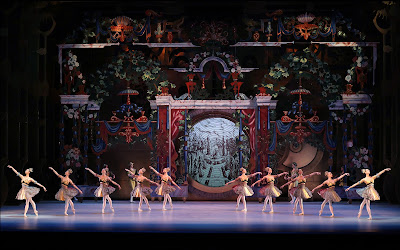
The Music Theatre The Nutcracker and the Mouse King 18 Dec 2021 and 24 Dev 2021 13:00

Between 1991 and 2003 Wayne Eagling was the Artistic Director of the Dutch National Ballet. In that role, he collaborated with Toer van Schayk to create The Nutcracker and the Mouse King.   On 18 and  24 Dec 2021 the work was live-streamed over the internet to audiences around the world. I watched both performances.

This ballet includes the Mouse King in the title for a reason. In other productions, the role of the mouse king is quite limited.  He leads his mice into battle against the toy soldiers and begins to gain the upper hand until Clara clobbers him.  In Eagling's version, he appears first at the Stahlbaums' party, later as a nightmare as Clara tries to sleep, next as the leader of the mice and finally in a duel with the prince.  The battle between mice and soldiers seems to symbolize a struggle between chaos and order which echoes in the boys' mithering their sisters or the Arabs dragging their captives.

Eagling's collaboration with van Schayk has led to all sorts of fantastic creations.   A giant pink-eyed monster rodent, an autonomous walking robot of a nutcracker and the fantastic machine with its circular centre-piece that at one point turns itself into a massive feline compete with a moving paw in the final confrontation with the mouse king and a ruined temple for the mirliton scene.   So much more compelling than a kingdom of the sweets with the Spanish, Arabs and Chinese dances representing chocolate, coffee and tea.

The two shows had different casts and each is to be congratulated.  Clara was danced by Maia Makhateli on 18 Dec and Riho Sakamoto on 24. Sakamoto has recently been promoted to principal which pleases me considerably as I have been following her progress ever since she joined the Junior Company in 2014 (see Riho Sakamoto promoted to principal).  Makhateli was magnificent as she always is and was partnered gallantly by Jakob Feyferlik,   Also impressive were Edo Wijnen who danced the nutcracker, Vito  Mazzeo who was Drosselmeyer and James Stout who was the mouse king.   Sadly I do not yet have a cast list for the Christmas eve matinee and I can't be sure who performed the leading roles other than Sakamoto.

Live screening is better than nothing but it is not the same as attending the theatre.   Theatre - particularly ballet - is two-way communication.  A good audience lifts the artists to new heights.   I am sure the dancers were aware that viewers like me around the world were cheering ourselves hoarse and clapping till our palms were sore but that's not the same as hearing us.  The Netherlands like the UK has had to cope with the "o" strain at the worse possible time and the season may have to be curtailed for public health reasons.  But one day the pandemic will be over in both countries.  When it is, my priority will be to watch this ballet live.