Showing posts with label Artur Shesterikov. Show all posts

Thursday, 7 October 2021

Toer

7th Symphony
Author Hans Gerritsen © 2021 Dutch National Ballet, All rights reserved


Dutch National Ballet  Toer  Streamed from the Music Theatre, Amsterdam, 25 Sept 2021, 19:15  and repeated 6 Oct 2021, 19:00

Toer is a double bill in honour of the celebrated choreographer, artist, designer and former dancer, Toer van Schayk.  It consists of two of his ballets: Lucifer Studies and 7th Symphony    Lucifer Studies is a new work which was premiered on 14 Sept 2021.  7th Symphony is described by the programme as one of van Schayk's most successful ballets.  He created it in 1986 and he was awarded the choreography prize of the Dutch Association of Theatre and Concert Hall Directors for the work within a year.   The programme was streamed over the internet from the Amsterdam Music Theatre on 25 Sept and repeated last night,   I watched both transmissions.

Both works were new to me.   They are very different.  The first contains studies that were intended to form part of a full-length ballet based on Vondel's Lucifer.   Work on the ballet has been interrupted by the pandemic but Van Schayk rightly considered that the studies were worth showing. The second piece is based on Beethoven's 7th symphony.   That symphony is one of Beethoven's most famous compositions.  Contrary to the opinion of an eminent ballet critic who really ought to know better that Beethoven is undanceable, the 7th symphony was crying out to be danced and van Schayk has choreographed it beautifully.  While I had to work hard to digest Joep Frannsens's Echoes for Lucifer Studies I could barely sit still and keep silent as the orchestra romped through Beethoven's exuberant work.

I like to think that I am reasonably well-read but I have to confess that until I saw Lucifer Studies I had never heard of Vondel or his play and I fear that few of my fellow Anglophones could claim otherwise.  There is a beautiful open space in the centre of Amsterdam known as Vondel Park and I wonder whether it was named after him.  Joost van den Vondel lived from 1587 to 1689 which encompassed the life of our great poet, John Milton, who lived from 1608 to 1674. I have now had a chance to acquaint myself with Lucifer. Even in translation, Lucifer is impressive and its subject matter is the same as Paradise Lost.  I know that poem well perhaps because I attended the same secondary school as Milton.  I am told by one of his former classmates that Matthew Rowe attended that school too.  Fragments of Milton's verse flashed through my mind as I watched the ballet. From the way the orchestra played, I sensed that Rowe was also inspired by Milton too and that he had communicated that inspiration to each and every musician.

Lucifer Studies
Author Hans Gerritsen © 2021 Dutch National Ballet, All rights reserved


Lucifer Studies had an all-male cast. As I suspect that each of the studies was intended to be danced by a principal or soloist in the full-length work, van Shayk selected some of the company's ablest young dancers.   They included Timothy van Poucke who has enjoyed a meteoric rise in the company winning the Radius prize within a very short time of graduating from the Junior Company.   Also in the piece was Martin ten Kortenaar whom I featured in 2014.   Others I recognized were Daniel Robert Silva, Nathan Brhane and Giovanni Princic.  That is not a complete list because I cannot recover the cast list for 25 Sept from the company's website.   Each and every one of those excellent young men impressed me greatly. 

Van Shayk designed the sets and costumes for Lucifer Studies.   The most striking feature of the costumes was that each of the dancers wore a differently coloured right sleeve.   Sometimes the colours of those sleeves were projected onto the backdrop focusing the audience's attention on the solo or duet in question.

Though Lucifer Studies lasts no more than 27 minutes it is a very absorbing work.   I had to watch it twice and discuss it with a dancer friend to get the measure of it.   After the world emerges from the pandemic I fervently hope that resources will be found to enable van Schayk to finish the full-length work.

Young Gyu Choi and Nancy Burer
Author Hans Gerritsen
© 2021 Dutch National Ballet: all rights reserved


It is not hard to see why 7th Symphony was an immediate success.  Van Schayk caught the exuberance of the score and amplified it.   The cast was split into two groups lettered "A" and "B".   I regret that I did not record the names of all the dancers on 25 Sept because I thought that the cast list would be available with the repeat   I remember that I admired the performances of Artur Shesterikov and Floor Eimers but there were many others some of whom I did not recognize.   Everyone danced well in that show and I congratulate each and every one of them.   Van Schayk designed the sets and costumes. The women's dresses must have been a joy to wear. 

Of all the online shows that I have seen since the start of the pandemic, this double bill was one of my favourites.  It was a fitting tribute to an extraordinary talent who celebrated his 85th birthday last month.

Sunday, 1 November 2020

"Live" - Van Manen's Narrative Ballet?

© 2020 Dutch National Ballet Licence Standard YouTube

inplayer Dutch National Ballet Live  10 Oct to 7 Nov 2020

Hans van Manen made it very clear that he does not do story ballets in a discussion that followed the first screening of the latest filming of Live.   To emphasize the point he added that that was why he had never created a full-length ballet.  It is true that there is no synopsis or libretto but you don't need a plot for a narrative ballet.  That was about the only point upon which a panel of experts on narrative dance was agreed when I asked that question at the "State of the Art Panel Discussion: Narrative Dance in Ballet" in Leeds some years ago.   For me, Live tells the story of a relationship at least as eloquently as any ballet.

It is also much more real and immediate.  Unlike the storybook ballets, Live is not confined to the stage.  It starts there bit spills into the audience's world.   It proceeds into the lobby of the Music Theatre and finally the streets.  The last scene shows the woman in red walking slowly along the banks of the Amstel towards the Waterlooplein underground station.  

Van Manen's Live is therefore just as much a work of cinema as it is of ballet.  On his foundation's website, van Manen lists Live as a "video ballet" rather than simply as a ballet.  He gives the cameraman equal billing with the dancers. That is likely to be because the cameraman is very much part of the action.  The interplay between dancer and cameraman is best appreciated in Altin Kaftira's film Diana Vishneva in 'LIVE' of Hans van Manen.  The cameraman is in the dancers' faces, particularly the woman's. At one point, she repels him by pressing her palm against the camera lens.  The other important element of the film is the music. Van Manen chose the following pieces by Liszt:  Sospiri, Bagatelle sans tonalité, Wiegenlied,  Vier kleine Klavierstücke and Abschied.

Live was filmed for the first time in 1979  Colleen Davis and Henny Jurriëns were the original dancers and Henk van was the cameraman.  It was filmed in the Carré because the Music Theatre had not been constructed at that time. The video has been remade several times with different dancers including, of course, Vishneva.  The film that has been released between the 10 Oct and 7 Nov 2020 casts  Maia Makhateli as the woman in red and Artur Shesterikov as her partner. 

I have long admired Shesterikov and Makhateli for their virtuosity but in the film I also saw superb acting.  There were moments when sparks seemed to fly.  The drama was heightened by the accompaniment of Olga Khoziainova.  After the screening, there was a short conversation about the film between van Manen, Rachel Beaujean and Davis.  Clips from the 1979 film were shown.  I was amazed to learn that Davis was only 19 when she danced the lady in red. Particularly as her successors in the role have included Vishneva and Makhateli.

Though he was much younger than the other choreographers and his work was very different, van Manen was one of the recurring names in the 1960s when I first started to follow ballet.  His works were reviewed in almost every issue of Dance and Dancers and The Dancing Times which I devoured when I was at university. His name was mentioned as frequently as those of Ashton, Balanchine, Cranko, Darrell, MacMillan and van Dantzig.  All those great choreographers have gone.  Only van Manen is left.  He must be well into his 80s but he still knows how to excite, surprise and delight.

The film may be viewed on the Dutch National Ballet's website until 7 Nov 2020.  The access charge is €2.95. 

Wednesday, 20 November 2019

Balanchine by the Seaside


Standard youtube Licence


Dutch National Ballet Best of Balanchine 17 Nov 2019 15:00  Zuiderstrbdtheater, The Hague  

The Best of Balanchine triple bill must have been a big deal for the Dutch National Ballet for they presented Symphony in Three Movements and Who Cares? at the opening night gala on 10 Sept 2019, performed it in Amsterdam for the last two weeks at the end of September and then took it on tour to the Dutch provinces in November.  I make no complaint about that because we do not see as much of Balanchine as we should in the United Kingdom. The Dutch dance Balanchine's works very well. From what I have seen, they dance his work as well as any company outside the United States.

Balanchine was born, trained and started his career in Russia but he made his formidable international reputation in the USA. The works in the triple bill reflected that history. Ballet Imperial to the music of Tchaikovsky was pure Russian whereas Who Cares? was a celebration of America. Symphony in Three Movements to a score by Stravinsky was a blending of the two. Created in America for American dancers but a tribute to another great Russian émigré.

I had intended to see the Best of Balanchine in Amsterdam on 29 Sept but a nasty fall down the steps to a car park in Birmingham the day before put paid to that plan. Instead, I saw it at the Zuiderstrandstheater (literally "the Southern Sands Theatre") on the coast a few miles outside The Hague on Sunday. That theatre is one of the most beautiful I have ever visited. It has an ample stage allowing a good view from every part of the auditorium. I was in the middle of row 17 of the stalls which was far enough back to take in the whole stage but near enough to see the dancers' features. Even more beautiful is its settling, literally yards from the sea behind a big sand dune on one side and overlooking a small harbour with a coastguard cutter at berth on the other.  This was only my second time in The Hague but I really took to it. The 28 bus from the railway station took me past the Netherlands Dance Theatre's home base, the Houses of Parliament and the royal palace, the International Court of Justice, several embassies and a lovely park before reaching the Zuiderstrand which, for some reason or other, is called "Norfolk."

The leading dancers in Ballet Imperial included three of my favourites - Maia Makhateli, Artur Shesterikov and Riho Sakamoto. I took particular delight in seeing Sakamoto because I featured her when she joined the Junior Company (see Meet Riho Sakamoto of the Dutch National Ballet Junior Company 6 Dec 2014).  I had an inkling then that she would do well and so she has. Another member of that cohort, Cristiano Principato, also had an important role in the pas de trois  It was also good to see some of the latest recruits in that work such as Leo Hepler, Sebia Plantefeve, Claire Tjoe-Fat and Wenjin Guo as well as Junior Company alumni such as Alexandria Marx and Conor Walmsley who are now élèves and Clara Superfine and Melissa Chapski who are in the corps. The work is created on Tchaikovsky's Second Piano Concerto which was played enchantingly by Michael Mouratch.

In Symphony in Three Movements the women dancers exchange their buns for ponytails which immediately relaxes the mood.  Not too much, however, for this ballet was intended as a tribute to Stravinsky who composed albeit innovatively in the classical style. It is a ballet that flows though some of the positions are quite angular. Parts of the ballet are explosive and exuberant.  Other parts such as the duets require almost mechanical precision. There are three principal couples - Sakamoto with Edo Wijnen who won the Radius prize this year; Qian Liu and Jared Wright; and Floor Eimers (another artist I follow closely) and Vito Mazzeo - and five solo couples. All were exquisite.
,
The finale, Who Cares? to the music of Gershwin as arranged by Hershi Kay was danced to a backdrop of Manhattan in the 1930s with the Chrysler Building, the Woolworth Building and other landmarks. The cast consists of one male lead - in this case, Constantine Allen - three female leads = Yuanyuan Zhang, Nina Tonoli and Maia Makhateli, five male soloists and five female and the corps. The ballet opened with the whole cast on stage. The next tune left only the corps. In the next scene, the female soloists in red and black costumes entered. They were followed by the male soloists in white shirts, ties and waistcoats.  There were some beautiful duets and solos. It was a great way to end the matinee but it was over far too quickly.

I had just one disappointment. Michaela DePrince appeared in the programme for Who Cares? There was no announcement that she was indisposed but I just do not remember seeing her in the show.  It was she who led me first to the Junior Company and then the Dutch National Ballet in 2913. I have not seen her in anything since the 2918 gala when she returned to the stage after a long recuperation from injury. I sincerely hope that there has been no recurrence of that injury. She is a beautiful dancer and I long to see her fly again.

Though again there was no mention of his name in the cast list, the orchestra was conducted by Matthew Rowe.  Always a pleasure to see him at the rostrum. 

I see a lot of ballets every year and have seen some particularly good ones this year but this matinee triple bill is among the best so far.

Friday, 19 October 2018

Van Dantzig's "Swan Lake"

Anna Ol and Artur Shesterikov
Author Michel Schnater
© 2018 Dutch National Ballet, all rights reserved
Reproduced courtesy of the company


Anna Ol and Artur Shesterikov White Swan Pas de Deux, Swan Lake Dutch National Ballet Gala, 8 Sept 2018, 19:30  Stopera

This year the gala for the opening night of the 2018-2019 ballet season was dedicated to Rudi van Dantzig. One of the works for which he is most admired is his production of Swan Lake which will be performed in March.  I have seen extracts before but not yet the whole ballet but the little bits that I have seen persuade me that this is special.  With van Dantzig's choreography, costumes by Toer van Schayk, how could it be otherwise?

On the opening night gala we saw two pas de deux from the ballet.  The first from the white act stars Artur Shesterikov and Anna Ol as Siegtied and  Odette.  The second was the seduction scene from the black act with Daniel Camargo and Maia Makhateli as Siegfried and Odile. I shall discuss that second extract tomorrow.

Friday, 1 June 2018

How to get to the Dutch National Ballet's Gala


Standard YouTube Licence

Tickets for the Dutch National Ballet's gala on Saturday, 8 Sept 2018 have just gone on sale and they are going like hot cakes.  Last year they sold out well before I got round to buying one.  This year I took no chances and ordered mine as soon as I could get onto the company's website. The tickets are not cheap but remember that there is a lovely party afterwards where you may get a chance to shake hands with such gigastars (if not terastars) as Artur Shesterikov and Sasha Mukhamedov.

I described the 2015 gala in The best evening I have ever spent at the ballet 13 Sept 2015 and Dutch National Ballet's Opening Night Gala - Improving on Excellence 8 Sept 2018.

So how to get to the gala.   Well it takes place in the Stopera in Amsterdam which doubles as the town hall and the national opera house.  The word "Stopera" is what we trade mark lawyers call a portmanteau combining the words "stadhuis" (or town hall) with "opera".  Be that as it may, the Stopera is in a splendid position overlooking the Amstel river and there is no better way of spending the interval than gazing out over the river. Every seat commands a good view of the stage which is cavernous. I once stood on that stage as part of a birthday treat in 2015 (see Double Dutch Delights 17 Feb 2015).  There is much less of a crush than at the Royal Opera House because the walkways and stairs are broad.   There is plenty of seating for the intervals. It is also a lot easier to get served at the bar than in the West End and you don't need a second mortgage to buy a round.

The Stopera is next door to Waterlooplein tube station which is served by thee lines all of which go to the Central Station.  From there you can get a train to just about anywhere on the continent and even to St Pancras via the channel tunnel nowadays.  It also serves the airport which is a major hub from where you can travel to just about anywhere in the world.

When I am in Amsterdam for business I like to stay at the Radison Blu which is on a street called "Rusland" that I think means "Russia".  It is a short walk from the Stopera.  It is also close to a the Hemelse Modder (literally "Heavenly Mud") which Ted Brandsen once told me is his favourite restaurant and it is certainly mine.   It is important to get a good meal inside you because there is no restaurant in the Stopera.   There is a pub next door but it is not particularly special and service is slow.  I recommend the Heavenly Mud and I have already reserved my table there.

If I am in Amsterdam for leisure I stay at one of the hotels in the Bastion chain. They are very like Travelodges, Fairly cheap and cheerful but not always in the best locations.  Probably the most convenient is at Duivendrecht which is about 6 stops on the underground from Waterlooplein.

To get around Amsterdam you can buy a combined bus, rail, tram, underground and ferry card known as an Amsterdam Travel Ticket starting at €16 for one day and  €21 for the weekend.  Remember to check in and check out every time you use a public transport service.

You can fly to Amsterdam from Leeds with Jet2 or from Liverpool and Manchester with easyJet.  There are probably more services from  London than you can shake a stick at and there is also a through train to Amsterdam from St Pancras.  I am sure there are good connections from Scotland, Newcastle, East Midlands, Birmingham, Bristol and Cardiff but I have never flown from any of those cities.  There are some excellent bargains from both airlines and Eurostar if you book far enough ahead.

The Dutch National Ballet is one of the most beautiful, friendly, innovative and thrilling companies that I know with some of the world's best dancers.   I do hope you can join me on 8 Sept.

Saturday, 31 December 2016

Terpsichore Titles: Company of the Year


Standard YouTube Licence


As Ted Brandsen, Ernst Meisner, David Dawson and Cristiano Principato were my choreographers of 2016 and Artur Shesterikov and Daniel Silva my outstanding male dancers it will come as no surprise that the Dutch National Ballet is my company of the year. How could it be otherwise?  I have seen three outstanding full-length ballets at the Music Theatre - Mata Hari in February, La Bayadere in November and Coppelia earlier this month - as well as a dazzling gala and the magnificent Junior Company at the Meervaart in February.  I congratulate everyone in the company and wish them all a happy and prosperous New Year.

Although the Dutch National Ballet is regarded as one of the world's top five ballet companies the above video shows that it is also a relatively new company.  It was founded in 1961 which was four years after the Royal Ballet received its royal charter, 20 years after the famous wartime tour of the Royal Ballet (then known as Sadler's Wells Ballet) to the Netherlands and 30 years after the formation of the company. It is also younger than English National Ballet, Scottish Ballet which started in Bristol as Western Theatre Ballet and, of course, the Birmingham Royal Ballet which is the Royal Ballet's sister company. Compared to the Paris Opera Ballet, the Royal Danish Ballet, the Bolshoi and the Mariinsky, the Dutch National Ballet is a mere stripling. To have achieved so much is so short a time is not far short of miraculous.

The complete list of Terpsichore Titles is as follows:

Company of the Year      Dutch National Ballet

Contemporary Company of the Year  Phoenix Dance Theatre

Choreographers of the Year   

- Full Length Works  Ted Brandsen
- Short Works Ernst Meisner
- Best New Work in the UK  David Dawson
- Young Choreographer  Cristiano Principato 

Ballet of the Year     Bolshoi's The Taming of the Shrew

Ballerina of the Year   Lauren Cuthbertson, Royal Ballet

Premier Danseur Noble of the Year    Artur Shesterivov, Dutch National Ballet

Outstanding Male Dancer (Smaller companies) Damien Johnson, Ballet Black

Outstanding Young Dancers

- Male   Daniel Silva, Dutch National Ballet

- Female  Gwenllian Davies, Ballet Cymru

This has been a tremendous year for Terpsichore, particularly this last month.  We have already received 25,369 page hits in December which is almost double the number of page hits we received in November which was itself a record month, and there is still the rest of the day to run. Our growth reflects a growing interest in adult dance (and particularly adult ballet) throughout the UK and indeed the rest of the world, We plan to do more to help those who want to dance to access classes, workshops and performances next year.

As this is my last post for 2016 I wish all my readers a happy New Year.

Thursday, 29 December 2016

Terpschore Titles: Outstanding Male Dancers


Standard YouTube Licence


I have decided to make two awards in this category:  one for principals and soloists of major companies who dance leading roles in full-length ballets and another for the rest. I do that to acknowledge brilliant performances in one act ballets and to avoid comparing the incomparable such as Alvin Ailey's Revelations with the Bolshoi's Swan Lake. In both categories I am looking for a male dancer who has spoken to me in a special way in 2016.

In the latter category, the choice is easy.  It is Damien Johnson of Ballet Black. I have described him as "one of the most exciting dancers on the British stage right now" and I repeat those words now.  I have seen him in no less than five shows this year - three of Ballet Black's triple bill and two of Dogs Don't Do Ballet and in rehearsal at the Barbican. In each performance he has delighted me whether as the Obama-like dad accompanying his excited daughter with her dog in tow to the theatre to see Madame Kanikova in Christopher Marney's Dogs or as the sailor in Christopher Hampson's Storyville which I reviewed for the first time in Ballet Black made my Manchester Day on 20 June 2016. Johnson is one of the reasons why I go to Ballet Black, why I support it not only with my pen (OK keyboard) but also with my widow's mite as a Friend and also why I love that company so.

But where do I start with the first category? There have been so many great performances this year starting with James Hay in Rhapsody and Alexander Campbell in The Two Pigeons in January (see The Royal Ballet's Double Bill 18 Jan 2016); continuing with Artur Shesterikov in Mata Hari, Joseph Caley as Oberon and Jamie Bond as Beliaev in Ashton's Double Bill in February; Tyrone Singleton's magnificent performance as Romeo where he stepped in for Bond at the last moment in March (see A Good Outcome from an Unhappy Event - Singleton's Fine Performance 6 March 2016); Federico Bonelli for his memorable performance as Albrecht (see Cuthbertson's Giselle 3 April 2016) and Vadim Muntagirov in The Winter's Tale a month later; Javier Torres as Cathy Marston's Rochester, Victor Zarallo as Siegfried and Nicholas Shoesmith as Benno in David Dawson's Swan Lake for Scottish Ballet (see Empire Blanche: Dawson's Swan Lake 4 June 2016), Yonah Acosta's Siegfried in English National Ballet's (see Swan Lake in the Round 13 June 2016) and Iain Mackay in The Taming of the Shrew (see Birmingham Royal Ballet performs my favourite ballet at last 21 June 2016) all of which took place in June; Rudy Hawkes as Siegfried in The Australian Ballet's Swan Lake (see The Australian Ballet's Swan Lake - Murphy won me over 17 May 2016). Ruslan Skvortsov as Siegfried in the Bolshoi's (see Grigorovich's Swan Lake in Covent Garden 31 July 2016) or Ty King Wall in Zatmansky's Cinderella, a great ballet that I forgot to discuss in my review of 2016 (see Ratmansky's Razzmatazz 24 July 2016) in July; Vladislav Lantratov as Petrucchio in  Jean-Christophe Maillot's The Taming of the Shrew in August (see Bolshoi's Triumph - The Taming of the Shrew 4 Aug 2016); Mackay and Singleton again in David Bintley's new ballet The Tempest in October; Jozef Varga as Solor in the Dutch National Ballet's La Bayadere in November and Shesterikov again in Coppelia.

There were a handful of performances that really stood out for me this year, namely Singleton's Romeo in March, Bonelli's Albrecht in April, Zarallo and Shoesmith in Dawson's Swan Lake, Varga's Solor and Shesterikov in Mata Hari and Coppelia. I have been twisting and turning all night trying to decide this issue - particularly between Bonelli and Shesterikov. A choice has to be made. I have chosen Shesterikov because of his mastery of two very different roles in two very different ballets. In making that choice I am comforted by the knowledge that I am in very good company for Shesterikov is also the most recent winner of the Alexandra Radius prize (see Principal Dancer Artur Shesterikov wins Radius Prize on the Dutch National Ballet website).

Thursday, 15 December 2016

Pictures of Coppelia

Frans and Zwaantje
Photo: Altin Kaftira
(c) 2016 Dutch National Ballet: all rights reserved
Reproduced with the kind permission of the company


Dutch National Ballet, Coppelia, The Music Theatre, Amsterdam, 11 Dec 2016, 14:00

On Monday I reviewed the Dutch National Ballet's performance of Ted Brandsen's Coppelia. On Tuesday I received these lovely photos of the performance from the company's press manager, Richard Heideman. Many thanks to him and the company for making these available to me.

I mentioned this production to our teacher and fellow members of our adult ballet class at Northern Ballet Academy yesterday after suggesting something from Delibes's Coppelia as an alternative to Minkus's La Bayadere.  Our teacher led us to believe that Coppelia may not have been her favourite ballet.  I replied that she might well change her mind if she could see Brandsen's. As it may not be possible for her to arrange a trip to Amsterdam before the end of the year I offer this article to her and also to my classmates in Leeds. It's a thank you to her for all that she has taught me this year and also to my classmates for their excellent company,

Frans and Zwaantje
Photo: Altin Kaftira
(c) 2016 Dutch National Ballet: all rights reserved
Reproduced with the kind permission of the company


Frans and Zwaantje
Photo: Altin Kaftira
(c) 2016 Dutch National Ballet: all rights reserved
Reproduced with the kind permission of the company


Frans and Zwaantje
Photo: Altin Kaftira
(c) 2016 Dutch National Ballet: all rights reserved
Reproduced with the kind permission of the company


Frans and Zwaantje
Photo: Altin Kaftira
(c) 2016 Dutch National Ballet: all rights reserved
Reproduced with the kind permission of the company


Frans and Zwaantje
Photo: Altin Kaftira
(c) 2016 Dutch National Ballet: all rights reserved
Reproduced with the kind permission of the company


Frans and Zwaantje's Wedding
Photo: Altin Kaftira
(c) 2016 Dutch National Ballet: all rights reserved
Reproduced with the kind permission of the company


Frans and Zwaantje in the final pas de deux
Photo: Altin Kaftira
(c) 2016 Dutch National Ballet: all rights reserved
Reproduced with the kind permission of the company

Monday, 12 December 2016

Brandsen's Coppelia


Standard YouTube Licence

Dutch National Ballet Coppelia, Music Theatre, Amsterdam 11 Dec 2016, 14:00

With Mata Hari Ted Brandsen showed he was a master of tragedy (see Brandsen's Masterpiece 14 Feb 2016). With Coppelia he shows his mastery of comedy. I can't remember when I last laughed so much in a ballet or left a theatre more elated.  It is without question the best dance show around this Christmas. While I recommend the three Nutcrackers or Hansel and Gretel from our four leading companies, Sir Matthew Bourne's The Red Shoes and Northern Ballet's Beauty and the Beast, if there is only time or money for one ballet this Christmas, this is the one to see.  Though I had a horrendous journey from Amsterdam last night thanks to a lorry running into an aeroplane, easyJet's appalling customer service, immigration officers forcing us to use their useless and annoying e-passport machines when we eventually landed at Ringway and a 2 hour wait for a train home, the pleasure I got from that show more than made up for it.

I am usually pretty scathing about updates of well-loved ballets as readers of this blog well know. I don't like bikes on stage in Swan Lake.  I bristle at shillelagh-wielding wilis. As I said in Manchester City Ballet's Coppelia 10 Dec 2016, Coppelia already addresses contemporary themes like coming to terms with artificial intelligence, low-level youth crime and elder abuse so why update it? With all these thoughts in mind, I was a little apprehensive as I entered the Music Theatre auditorium yesterday afternoon.  I need not have been. Brandsen had made some changes to the story and he had set the scene int the present, but those changes were changes for a reason rather than change for change sake.

Brandsen has changed the names of the lead characters from Franz and Swanhilde to Frans and Zwaantje. He has given them jobs in a gym and a juice bar respectively.  He has turned Dr Coppelius into a businessman with a chain of beauty clinics. He has introduced a lot of new characters including a demonic PA to Dr Coppelius called Anna Marx, a girl geek friend for Zwaantje called Emma, lots of relations, celebrities and two adorable dogs danced by children. On the other hand, he has retired Dawn, Prayer and Work as well as the duke and Burgermeister, He has given the last act a new sub-plot with Coppelia turning up in a wedding dress forcing Frans to choose between her and Zwaantje.  Probably the best way to appreciate those changes is to watch the animation even though it is in Dutch. In all other respects, Brandsen has left the story unchanged and he has kept the score in its entirety.

Yesterday, the role of Zwaantje was danced by Anna Ol and Frans by Artur Shesterikov. Both are consummate virtuosos. Ol thrilled us with her fouettés, posés and chaînés. Shesterikov with his soaring and seemingly effortless leaps.  They are also accomplished actors. Shesterikov held his head in his hands when he knew that Zwaantje had caught him making advances to Coppelia, a gesture known to every single woman in the audience who has caught her man doing something that he ought not to be doing and eliciting a ripple of knowing female laughter. More laughter from the audience as she dodged his embraces until she forgave him. Clearly too quickly because Frans allowed himself to be enticed into the clinic by Dr Coppelius and his assistant.

In Brandsen's version, Dr Coppelius was a major role which was danced yesterday by the soloist, Edo Wijnen. He was no eccentric old alchemist pottering about in his workshop but a powerful and unscrupulous businessman. He was energetic and guileful and very sinister. His assistant in his scheming was Weng Ting Guan who was as scary as her boss. It was she who produced a bottle laced with a drug that knocked Frans out cold. She wired him up to a machine which was to extract whatever it was that made him human and inject it into Coppelia.

Coppelia was danced by Nancy Burer whom I had first noticed when she danced Embers with Thomas van Damme on the opening night of the Junior Company's 2015 tour (see The Dutch National Ballet Junior Company's best Performance yet 8 Feb 2015). She had rather more to do in Brandsen's Coppelia than in most other productions who simply require their doll to sit and look beautiful and, occasionally, make short, jerky arm and leg movements. Brandsen made her into a seductress and a rather dangerous one. I think I saw more than a little of Mata Hari in Burer's depiction of Coppelia, resplendent in her strawberry blonde bouffant wig. There is, incidentally, a very amusing little video of Coppelia playing hide and seek with the security guard on the company's YouTube channel called Coppelia v The Night Watch with some lovely views of the Stopera or Music Theatre.

Van Damme, incidentally, also had a character role as a "glam rock star" or one of the dolls in the numbered boxes in the clinic. It was good to see him and other young dancers I follow such as Cristiano Principato, Emilie Tassinari, Giovanni Princic, Melissa Chapski and many others. There were opportunities for lots of fine young dancers such as Ahmad Joudah who danced the clergymen and indeed the students from the National Ballet Academy two of whom, Aafka Wolles and Wisse Scheele, danced the poodle and dalmatian. The final scene of the ballet with each of the characters taking a farewell bow the corps turning and the children doing balances brought each and every member audience (me included) to their feet. Standing ovations, which used to be rare when I first started watching ballet in the 1960s, have become increasingly common. More and more frequently I have to ask myself: "why?"  I didn't yesterday.  It was obvious. The audience's accolade  was well and truly earned by everyone in the cast.

I should say a word for the creatives. Sieb Posthuma's set designs were exquisite. In addition to theatre design he had been an illustrator of children's books and the intention was to create the illusion of walking into a story book.  Copies of that book were on sale in the foyer for just over 15 euros. I thought long and hard about buying a copy for Vlad the Lad but there was a lot of text in Dutch. The poor little boy is already expected to master his mother's Krio and his dad's Ga as well as major modern European languages and possibly the classics. François-Noël Cherpin did a magnificent job with the costumes. And who should be conducting the orchestra but our own dear Koen Kessels.

Anna Ol and Artur Shesterikov
(c) 2016 Jane Lambert
All rights reserved
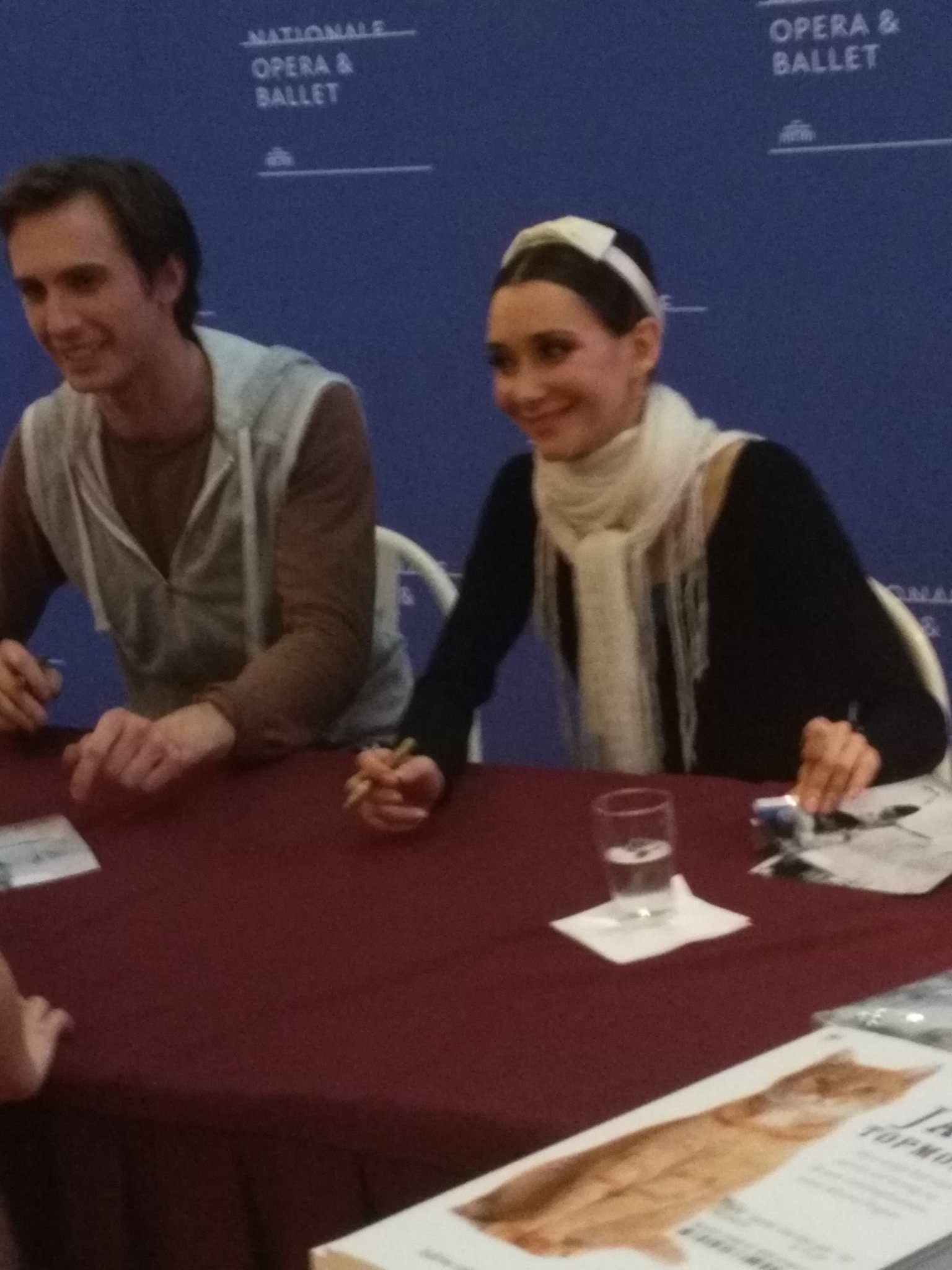
After the show, Ol and Shesterikov sat at a desk at the top of the stairs and signed programmes and merchandise for a lot of excited little boys and girls and their equally excited Mums and Dads. Signing after a matinee is a charming practice of the Dutch National Ballet which I wish dance companies in this country would follow. It would do more to bounce kids into regular exercise than anything else I know.

Like most of my compatriots who follow ballet, my home is Covent Garden. There is nothing quite like the House on a ballet night. But, increasingly, I am finding a welcoming second home in the Dutch National Ballet's Music Theatre and I am beginning to know and love the Dutch National Ballet as I do the Royal Ballet.

Monday, 12 September 2016

Three Days in Amsterdam

Cristiano Principato with the author
(c) 2016 Gita Mistry: all rights reserved
Reproduced by kind permission of the copyright owner


Although the opening night gala for the Dutch National Ballet was my main reason for coming to Amsterdam (see Dutch National Ballet's Opening Night Gala - Improving on Excellence 8 Sept 2016) it was not the only thing that I did there.

Immediately after the show there was a party at the Stopera where I met some of the outstanding young dancers I featured in Meet Ernst Meisner and his talented young dancers 6 Dec 2014). Many of them have been inducted into the main company while others have joined the Stuttgart and Hungarian and Norwegian national ballets.  One of the most promising is Cristiano Principato from Novara in Northern Italy who is making his mark as a choreographer as well as a dancer. Also, he has already demonstrated his potential as an artistic director by staging the Gala for Alessia in June which I covered in From Italy with Love on 1 July 2016. Two of his works were performed in that show including Palagio which the Dutch National Ballet danced in its New Moves programme.

Eight of Cristiano's colleagues from the Junior Company appeared in Night Fall which is described as the first virtual reality ballet in the world. They included Lisanne Kottenhagen and Emilie Tassinari whom I featured in 2014 as well as Nancy Burer whose performance in Embers I described as one of the most beautiful that I had ever seen in The Dutch National Ballet Junior Company's best Performance yet 8 Feb 2015 and Priscylla Gallo, Clara Superfine, Melissa Chapski, Hannah Williams and Belle Beasley whom I saw in Ballet Bubbles on 14 Feb 2016. Each and every one of those young dancers is special and I cherish them dearly.  In Night Fall, those eight young dancers supported the magnificent Anna Tsygankova who had danced Cinderella brilliantly at the Coliseum last year (see Wheeldon's Cinderella 13 July 2015) and Artur Shesterikov who received the Alexandra Radius prize at the gala.

I had tried to follow the instructions on the How Can I Watch the Night Fall page of the Dutch National Ballet's website but did not get very far (see Looking forward to the Gala and trying to get the Night Fall Video to work 31 Aug 2016). In response to that blog post the company advised my companion and me to try the Virtual Reality cinema next to Amsterdam Central Station which we did. Had I seen Night Fall on the stage I would have loved it. As a ballet it could not be faulted. However, as a technology, virtual reality still has a way to go.

The VR Cinema turned out not to be a cinema at all in the conventional sense but a bar with some side rooms equipped with a number of revolving chairs to which vizor like goggles and headsets were attached. Patrons were invited to don those items and relax in the chairs. As I had to remove my headset several times I noticed the heads of my fellow patrons lolling around like babies and gyrating in their chairs like dynamos. We were behind a plate glass picture window in full view of the public. No doubt a source of considerably amusement to the neighbourhood.

We were charged 12.50 euros each for a choice of films each of which lasted about 30 minutes. Drinks were expensive too and the cinema would only take cards for payment. I chose "Documentaries" which featured polar bears in the Arctic, a French artist who made a massive tableau of a chap with a John Cleese style silly walk and a trendy couple in he media making excuses to a fake TV crew for not taking care of a Syrian refugee after they had gone on record as saying that the migration crisis was everybody's problem and not just the authorities'. I had all sorts of problems with my goggles. First, they took a long time to start. When they did start they offered me the "Scary" programme and not "Documentaries" which I had ordered. Half way through the show the film cut out altogether. When it restarted the picture was so blurred that I could not recognize any of the dancers even though I know them all very well. Altogether, a bit of a swizz.

Having said that I do think there is a place for VR in ballet which I shall probably discuss in another blog post and there are better technologies.  While waiting for me to finish my video, my colleague was invited to try the goggles of a VR equipment supplier. She found the quality of that company's product (which happened to be British) to be greatly superior.

One of the delights of Amsterdam are the free lunch time concerts that are given in the small auditorium of the Concertgebouw most Wednesdays.  We were treated to a programme of Ravel, Piazzolla and Milhaud by the Colori Ensemble on 7 Sept. My favourite was Piazzolla's Verano porteno which was a percussion solo by Arjan Jongsma.  Tickets are distributed at 11:30 on a first come first served basis and there was already a bit of a queue by 10:40 when we arrived.  The auditorium can hold about 440 persons.

We did a lot in those three days without getting round to the Rijksmuseum or indeed any of the other art galleries. There is so much to see in Amsterdam and the Night Watch should still be there the next time we call.

Thursday, 8 September 2016

Dutch National Ballet's Opening Night Gala - Improving on Excellence


Standard YouTube Licence


The first time I saw the video of Ernst Meisner's No Time Before Time was in the Prix de Lausanne finals. I fell in love with it there and then.  When I saw it live for the first time in Ballet Bubbles at the Meervaart Theatre on my birthday on Valentine's day it was the best present anyone could possibly receive. I expressed my appreciation in Thank You Ernst a few days later. Ernst Meisner is an extraordinary choreographer. His Saltarello had been the highlight of the Junior Company's Stadsshouwburg show of 24 Nov 2013. The performance of Embers by Nancy Burer and Thomas van Damme to the haunting music of Max Richter was my favourite of the following year.  I described it my review as quite simply one of the most beautiful ballets I have ever seen. Well, No Time Before Time is Ernst's best work yet.

In Ernst Meisner’s Work with the Dutch National Ballet 2 Dec 2014 I remarked that although Ernst was a Dutch national who trained at the National Ballet Academy of Amsterdam before coming to London we still like to think of him as one of our own and English audiences have a great deal of affection for him. After he left our shores for the Dutch National Ballet, I thought I would never see him dance again. Yesterday I saw him on stage together with Floor ElmersJuanjo Arques, Rachel Beaujean, Marijn Rademaker, James StoutAlexander Zhembrovskyy and, of course, Vito Mazzeo and Igone de Jongh in an extract from van Manen's Kammerballett to celebrate de Jongh's 20th anniversary with the company.

I was led to the Dutch National Ballet by Michaela DePrince who entered the Junior Company in 2013 and is already a grand sujet  at age 21. Because I was married to a Sierra Leonean for more than 27 years I took an interest in her career before she joined the company (see Michaela DePrince 4 April 2013). When I saw her on stage for the first time I described her as "quite simply the most exciting dancer I have seen for quite a while." When I met her briefly at last year's gala "I left the Stopera thinking how that exceptionally talented young dancer was as gracious off stage as she is magnificent upon it." Michaela DePrince was as magnificent and exciting as ever yesterday in Balanchine's Tarantella Pas de Beux which she danced passionately with Remi Wörtmeyer. The applause was deafening. "They really love her" remarked my companion, We really do.

Earlier DePrince had been one of the dancers in the grand pas d'action from La Bayadere.  Having recently learned some of the choreography from Jane Tucker I took a particular interest in that work. Sasha Mukhamedov danced Nikiya and Daniel Camargo was Solor. It was a tantalizing taster for this Autumn's production which I look forward to seeing in full on 13 Nov 2016.

One of my favourite full length ballets so far this year  has been Ted Brandsen's Mata Hari which I reviewed in Brandsen's Masterpiece 14 Feb 2016. Yesterday was my chance to see the magnificent Anna Tsygankova in the title role again. She was partnered gallantly by Artur Shesterikov.  It was another opportunity to hear Tariq O'Reagan's beautiful score.

These were the highlights of the evening for me but there was so much more:

  • the Grand Defile or parade of the company and students of the National Ballet Academy starting with the first year students in light blue leotards and finishing with the principals;
  • the final pas de deux from Sir Peter Wright's Sleeping Beauty with Anna Ol  as Aurelia and Jozef Varga as the prince; 
  • Sinatra favourites with Anna Tsygankova and Matthew Golding in Twyla Tharp's Sinatra Suite;
  • the premiere of Remi Wörtmeyer's Penumbra with Anna Ol and Artur Shesterikov, and 
  • the final pas de deux from Balanchine's Theme and Variations with Igone de Jongh and Jozef Varga in the leading roles.
The evening celebrated not only Igone de Jongh's 20 years with the company but Toer van Schayk's long and distinguished career as dancer, choreographer and designer. Qian Liu and Young Gyu Choi danced in the world premiere of van Schayk's ballet Episodes van Fragmenten after showing a short film of his life and career.

As happened last year, the performance was followed by a party which was still going strong well after we left to catch the last tube to Central Station at which the stars mingled with us lesser mortals. I was particularly glad to meet some of the young dancers from last year's Junior Company who are now soaring in the company, their mentor Ernst Meisner and Esther Protzman, the wonderful teacher who inspired so many of the company's finest dancers. I have written many times about the importance of a great teacher and I know a little  about it because have been inspired by mine.

I described last year's gala as The best evening I have ever spent at the ballet. Could last year's excellence be exceeded? The answer is an emphatic "yes". Was yesterday's performance perfection?  I will tell you next year.

Sunday, 14 February 2016

Brandsen's Masterpiece


Dutch National Ballet, Mata Hari, Stopera, 13 Feb 2016

As Anna Tsygankova stood alone on stage for her curtain call after last night's performance of Ted Brandsen's Mata Hari every single person in the Amsterdam Music Theatre or Stopera rose as one. She would have got a similar standing ovation anywhere - even snooty old London - for her portrayal of the life of the tragic adventurer and dancer (Margaretha Geertruida "Margreet" MacLeod) was compelling It is not often that one sees theatre like that in any medium and I think the sounds and images of that performance will remain with me for the rest of my life.

Although Brandsen is artistic director of one of the world's great dance companies this was the first time I had seen any of his work. I very much hope it will not be the last for Mata Hari indicates that the man is a genius.  After the show I tweeted that the English language does not contain enough superlatives to praise that ballet. That was no mere flattery or sycophancy for I intended every word sincerely and these are the reasons why.

First, it was an act of genius to commission  Tarik O'Regan to compose the score. It is not often that a new composition grips me in the way this one did.  Readers can get some idea of its beauty from the trailer.  It has been echoing in my head all night.  So, too, has the percussive war scene as French and German soldiers batter it out. There has been a lot of new ballet to commemorate the centenary of the First World War and none of the music comes close to O'Regan's.

Another act of genius was the casting. Not just Tsygankova, powerful though her performance was, but also in the choice of Casey Herd who danced her dashing, handsome but in the end cruel husband, Artur Shesterikov who danced Vadime de Masloff, her last lover, Roman Artyushkin who danced Lieutenant Ladoux, her destroyer, Young Gye Cho who danced Shiva in her dreams and indeed all the dancers from the children who danced her son and daughter upwards. Many of my favourite dancers were in other roles in the show including Floor Elmers and, of course, Michaela DePrince, Nancy Burer and others whom I have followed since they were in the Junior Company.

Brandsen showed his genius in his choice of Janine Brogt as dramaturge who told a complex and tragic story in a simple and compelling way. Last June some of the great and the good of British ballet spent half an afternoon on a circumlocution about  narrative ballet (see My Thoughts on Saturday Afternoon's Panel Discussion at Northern Ballet 21 June 2015). My message to Graham Watts, Louise Levene, Tobias Batley et al and their audience is to come to Amsterdam if they want to see what narrative ballet is all about.

There was genius too in the set design and costumes. I did not like the backdrop at first because it reminded me of Amsterdam's Central Station but as the ballet progressed I appreciated why it had been designed as it was. It morphed from the MacLeods' home in Friesland. to the officers' mess in colonial Indonesia, to a Hindu temple, the Moulin Rouge, the rehearsal studio for Diaghilev's Les Sylphides and finally disintegrated in the war scene as it became the settling for her execution.

I appreciate  that this is the shortest and most superficial of reviews but I had a very long day yesterday travelling to Amsterdam by rail, watching the preview of the new season and a lot of tramping in the rain. More of the same today as I hope to tour the Stopera and see the Junior Company's Ballet Bubbles once I find the auditoorium and then dash off to Schipol for the last flight home. This is unlikely to be my last word on Brandsen's masterpiece.