Next, there is the presentation of the Alexandra Radius prize presented by the great ballerina. Last year it was awarded to Artur Shesterikov and the year before that to Maia Makhateli, Talking of which I am delighted to say that Ms Makhateli (who has been on leave this last year) tweeted today that she plans to be back for the gala:
After the presentation, we see extracts of the company's work for the coming and previous seasons, This year the National Ballet will be joined by guest stars, Diana Vishneva and Vladimir Malakhov. Then there will be a sumptuous reception to which the whole audience is invited.
The gala is a hard act to follow but this year it will be matched by an Ode to the Master, a celebration of Hans van Manen's career with the performance of a selection of his best-loved ballets:
On the Move;
5 Tangos
Sarcasm, and
Symphonieën der Nederlanden.
This will be the year in which van Manen celebrates his 85th birthday. "No choreographer has made such a big mark on dance in the Netherlands as Hans van Manen," says the website. I would say that no living choreographer has made such a big mark on dance anywhere. I will move heaven and earth to see that show,
Dutch Doubles is not a double bill as its name suggests but a dialogue between choreographers living in the Netherlands with a number of renowned musicians. The choreographers in question are Annabelle Lopez Ochoa, the creator of Scottish Ballet's Streetcar named Desire, Danza Contemporanea de Cuba's Reversible and Ballet Black's Little Red Riding Hood, Ernst Meisner and Hans van Manen. Ochoa's dialogue will be with Wende Snijders who is described by the company's website as "one of the best-known and most versatile singer-songwriters in the Netherlands." Meisner's is with Remy van Kesteren and van Manen's will be with a pianist still to be announced. A similar collaboration in 2014 appears to have been one of the reasons why the New York Times ranked the Dutch National Ballet as one of the world's top five ballet companies.
This season there will be a lot of work for the Junior Company. They will begin their annual tour of the Netherlands with In the Future which will feature the work of the same name by Hans van Manen. According to the website, this work was created by Hans van Manen in 1986 for Scapino Ballet and it has also been danced by Stuttgarter Ballett and Introdans Ensemble for Youth. It is described as "an energetic, swinging, amusing and surprising work, with wonderfully inventive costumes by Keso Dekker." They will also dance Narnia: the lion, the witch and the wardrobein which Ernst Meisner collaborated with Marco Gerris to produce a work that is described as "Hiphop meets Ballet." I saw a scene from this work in the 2015 gala and loved it. Finally, the Junior Company will celebrate its 5th anniversary in Junior Company 5 Yearswith a special gala at the Stadsschouwburg. Having attended one of the first (if not the first) of those galas in 2013 (see The Junior Company of the Dutch National Ballet - Stadsshouwburg Amsterdam 24 Nov 201325 Nov 2013) this will be a special performance for me too - if I can only get a flight and ticket for it.
Talking of the Junior Company, I introduced Timothy van Poucke and Salome Leverashvili in Missing Amsterdamon 18 Feb 2017. Tim and Salome have just released a fourth vlog entitled Life of a ballet dancer - VLOG#4 by Tim and Salome - Junior Companyin which they discuss their life in the company, how it differs from ballet school, their hopes for the future including prospective careers after they give up dance. Salome would love to dance on stage for ever and ever but realizes that will not be possible. However, she already sees a career for herself as a fashion designer including, perhaps, fashion for the ballet. Tim would like to be a teacher. He would be good at that, muses Salome, for he is always correcting her.
Tim is a fine young man. Salome a lovely young woman. They have all my betst wishes for the future as do all the other members of the Junior Company,
Standard YouTube Licence
Three awards this year and they all go to choreographers associated with the Dutch National Ballet. The first is for full-length ballets, the second for one act works or less and the third is for the best new full-length ballet in the United Kingdom. My choice for the first category is Ted Brandsen, for the second Ernst Meisner and for the third David Dawson.
Two of the highlights of my year were Mata Hari (see Brandsen's Masterpiece 14 Feb 2016) and Coppelia (see Brandsen's Coppelia12 Dec 2016 and Pictures of Coppelia15 Dec 2016) and they were both created by Ted Brandsen. I also saw two of my favourite young dancers, Cristiano Principato and Emilie Tassinari, in Brandsen's Replay when I went to Italy in June (see From Italy with Love1 July 2016). These were very different works but each and every one was a masterpiece in its own way. As I said in my last post, there has been some brilliant full-length works by Bintlley, Dawson, Maillot and Marston this year and they all have merits but Brandsen wins it on points.
If Brandsen won the full-length contest on points, Meisner won the short works title with a knockout. I fell in love with No Time before Time when I saw the video from Lausanne. I was amazed when I saw it at the Meervvart in Ballet Bubbleson 14 Feb 2016 and carried to my feet with the crowd's acclamation when I saw it at the gala in September. In my review of the gala I wrote:
"The first time I saw the video of Ernst Meisner's No Time Before Time was in the Prix de Lausanne finals. I fell in love with it there and then. When I saw it live for the first time inBallet Bubbles at the Meervaart Theatre on my birthday on Valentine's day it was the best present anyone could possibly receive. I expressed my appreciation in Thank You Ernsta few days later. Ernst Meisner is an extraordinary choreographer. His Saltarello had been the highlight of the Junior Company's Stadsshouwburg show of 24 Nov 2013. The performance of Embers by Nancy Burer and Thomas van Damme to the haunting music of Max Richter was my favourite of the following year. I described it my review as quite simply one of the most beautiful ballets I have ever seen. Well, No Time Before Time is Ernst's best work yet."
In the video above Ernst Meisner talks about his craft. It is well worth a listen.
Dawson's Swan Lake was so good that it has to be acknowledged (see Empire Blanche: Dawson's Swan Lake4 June 2016). It was the best new full-length work for a British company all year though Cathy Marston and David Bintley were not far behind. Dawson produced a work of which Peter Darrell would certainly have been proud and Petipa too perhaps.
Standard YouTube Licence In 2016 I saw no less than five versions of Swan Lake, three of Romeo and Juliet, and two each of Giselle, The Taming of the Shrew, The Sleeping Beauty and Coppelia as well as Makarova's La Bayadere andRatmansky's Cinderella. I saw new full-length ballets by David Bintley, Ted Brandsen and Cathy Marston. I took another look at Christopher Wheeldon's The Winter's Tale andDavid Nixon's Beauty and the Beast and found that I liked them rather better second time round. I attended performances by Alvin Ailey American Dance Theatre, the National Ballet of China and NDT2 as well as shows by Ballet Black, Phoenix Dance Theatre and Rambert. I attended the Dutch National Ballet's gala for the new ballet season in Amsterdam, Ballet Cymru's debut in the Wales Millennium Centre, one of the first performances of the Dutch National Ballet Junior Company's tour and a brilliant charity gala by some of the world's best young dancers in Italy. I saw Matthew Bourne's transposition of The Red Shoes to the stage. I watchedfine student performances by Ballet West and Northern Ballet School.
The performances of Swan Lake that I liked best were English National Ballet's Swan Lake in the Round at the Royal Albert Hall on 12 June 2016 (see Swan Lake in the Round13 June 2016) and David Dawson's for Scottish Ballet in Liverpool on 3 June 2016 (see Empire Blanche: Dawson's Swan Lake4 June 2016). The one I liked least was Nixon's for Northern Ballet, mainly for its libretto and changes to the score, though there was some excellent dancing by the cast (seeUp the Swannee 17 March 2016). I had not expected much of Graeme Murphy's Swan Lake for the Australian Ballet and was pleasantly surprised (see The Australian Ballet's Swan Lake - Murphy won me over17 July 2016). On the other hand, I was less than overwhelmed by the Bolshoi's despite the virtuosity of Anna Nikulina as Odette-Odile and Ruslan Skvortsov as Siegfried, possibly because I had arrived at Covent Garden confidently expecting it to be best in class (see Grigorovich's Swan Lake in Covent Garden31 July 2016). Again, changes to the libretto including the quite unnecessary anonymization of Siegfried as "the prince" and Rothbart as "the evil genius" and the rather dowdy designs disappointed me.
The three productions of Romeo and Juliet that I saw last year were by the Birmingham Royal Ballet (see A Good Outcome from an Unhappy Event - Singleton's Fine Performance6 March 2016), Northern Ballet (see Romeo and Juliet after the Shrew15 Oct 2016) and Ballet Cymru (see A Romeo and Juliet for our Times7 Nov 2016) and I liked them all. I suppose the winner on points was Birmingham Royal Ballet simply because that company is so powerful in every department and at every level but the most memorable was Ballet Cymru's largely for the remarkable performance of Gwenllian Davies. I wrote in my review:
"One of the reasons why I loved the show so much was Gwenllian Davies's remarkable performance as Juliet. Davies is in her first year with the company and this is her first job. Consequently, she is barely older than Shakespeare's Juliet. As I told her after the show, I have seen some of the world's greatest dancers in the role including Lynn Seymour and more recently Alina Cojocaru and Viktoria Tereshkina, but never have I seen a more convincing Juliet. Davies danced with passion and energy and, for a while, I saw in that talented young artist what Shakespeare must have imagined."
Every so often one spots a dancer with what I call the wow factor. Michaela DePrince had it when I first saw her in Amsterdam in 2013 and described her as "quite simply the most exciting dancer I have seen for quite a while" (see The Junior Company of the Dutch National Ballet - Stadsshouwburg Amsterdam 24 Nov 201325 Nov 2013). Davies has the wow factor too.
As Cranko is my favourite choreographer of all time and The Taming of the Shrew is my favourite of his ballets I had expected the Birmingham Royal Ballet's production of that work to be one of the highlights of the year (see Looking Forward to 201630 Dec 2016). It was indeed one of those highlights but, to my great surprise and delight, I found a version that I like even more. That was Jean-Christophe's for the Bolshoi (see Bolshoi's Triumph - The Taming of the Shrew4 Aug 2016). I was in the Royal Opera House for the premiere of that production in the United Kingdom and wrote:
"The Bolshoi Ballet has always been respected in this country but until last night I don't think it has ever been loved. There are many reasons for that, not least the fact that the company was seen as an instrument of Soviet soft power during the cold war coming to London as it did in the year the tanks rolled into Budapest. That may have changed with the London premiere of Jean-Christophe Maillot's The Taming of the Shrew for the audience really warmed to the show. Standing ovations are quite rare in the Royal Opera House but when Maillot appeared to take a bow several members of the audience (including yours truly) felt compelled to rise."
If I was slightly disappointed by the Bolshoi's Swan Lake that company more than made up for my disappointment with Shrew. There were brilliant performances by Ekaterina Krysanova as Kate, Vladislav Lantratov as Petrucchio. Olga Smirnova as Bianca, Artemy Belyakov as Kate and Bianca's father and Georgy Gusev as Grumio.
I think I saw the best Giselle ever in April with Cuthbertson in the title role and Bonelli as her Albrecht (see Cuthbertson's Giselle3 April 2016). I wrote:
"I am not a newbie when it comes to ballet. I have seen Giselle many times by several different companies with some of the world's greatest ballerinas in the title role. The best compliment that I can pay to Cuthbertson is that she unlocked the ballet for me much in the way that Ulanova appears to have done for Sir Peter. Yesterday I saw not a ballerina dancing Giselle but Giselle herself and for the first time I really understood the ballet which has far more substance than I had previously supposed."
I had been expecting something special from English National Ballet when I attended the premiere of Akram Khan's Giselle and although the production was not without its merits it simply did not live up to its hype (see Akram Khan's Giselle28 Sept 2016)
On 11 Dec 2016 I saw Ted Brandsen's Coppelia which in the running for my ballet of the year with two other HNB candidates, Brandsen's Mata Hari and Makarova's La Bayadere. Having seen David Nixon's Swan Lake and Akram Khan's Giselle I approached the Music Theatre somewhat gingerly. I wrote:
"I am usually pretty scathing about updates of well-loved ballets as readers of this blog well know. I don't like bikes on stage in Swan Lake. I bristle at shillelagh-wielding wilis. As I said in Manchester City Ballet's Coppelia10 Dec 2016, Coppelia already addresses contemporary themes like coming to terms with artificial intelligence, low-level youth crime and elder abuse so why update it? With all these thoughts in mind, I was a little apprehensive as I entered the Music Theatre auditorium yesterday afternoon. I need not have been. Brandsen had made some changes to the story and he had set the scene int the present, but those changes were changes for a reason rather than change for change sake."
It turned out to be excellent and I recommended it as the best Christmas show within easy travelling distance of most parts of the British Isles. Immediately before I flew to Amsterdam I was reminded of the traditional version by Manchester City Ballet's performances on the 9 and 10 Dec 2016 (see Manchester City Ballet's Coppelia10 Dec 2016).
Brandsen's Mata Hari was quite different. It was a study of the life of the Dutch adventurer and exotic dancer who was executed for espionage after a travesty of a trial in 1917 (see Brandsen's Masterpiece14 Feb 2016). Brandsen cast Anna Tsygankova as Mata Hari and she danced that role magnificently. I wrote:
"As Anna Tsygankova stood alone on stage for her curtain call after last night's performance of Ted Brandsen'sMata Hari every single person in the Amsterdam Music Theatre or Stopera rose as one. She would have got a similar standing ovation anywhere - even snooty old London - for her portrayal of the life of the tragic adventurer and dancer (Margaretha Geertruida "Margreet" MacLeod) was compelling It is not often that one sees theatre like that in any medium and I think the sounds and images of that performance will remain with me for the rest of my life."
There were also strong performances by Artur Shesterikov, Casey Herd, Roman Artyushkin and other members of the cast. Brandsen commissioned Tariq O'Reagan to compose a beautiful and haunting score, Clement & Sanôu to design the sets and Francois-Noël Cherpin to create the costumes.
"There were gasps, sighs and murmurs from members of the audience as the image of Nikiya appeared momentarily before a disconsolate Solor. Nobody tried to shush them. They could not help themselves. The scene was just so beautiful. I've seen a lot of ballet in my time but I can't (for the moment at any rate) think of a more beautiful production than the Dutch National Ballet's La Bayadere."
That production was created by Natalia Makarova who had created that work for American Ballet Theatre and staged it for the Royal Ballet. Solor was danced by Josef Varga and Nikiya by Sasha Mukhamedov.
The new full-length ballets that impressed me most were Brandsen's Mata Hari, Maillot's Taming of the Shrew, Dawson's Swan Lake, Bintley's The Tempest and Marston's Jane Eyre. I have already discussed the first three above. The Tempest appeared not long after Akram Khan's Giselle and was somewhat overshadowed by it which is a shame because I found Bintley's a stronger and much more satisfying work (see The Tempest 9 Oct 2016). Immediately after seeing it, I wrote:
"I think it is my favourite work by David Bintley so far. In fact, I can't remember a time when I was as excited as I am now about a new British full length ballet since the days of Sir Frederick Ashton."
I described Bintley's choreography as "sparkling" and there were strong performances by Iain Mackay as Prospero, Jenna Roberts as Miranda, Joseph Caley as Ferdinand. Mathias Dingman as Ariel and Tyrone Singleton as Caliban. It was perhaps no more than was to be expected of a company that I have already described as "powerful in every department and at every level" but it was still impressive.
"With one enormous break between 2004 and 2011 I have been following Northern Ballet ever since I returned to the North in 1985. The company has given us some lovely ballets over the years - Cinderella, A Christmas Carol, A Simple Man and, more recently, Madame Butterfly and A Midsummer Night's Dream. In my humble, rustic and simplistic opinion the company's golden age was 20 years ago. At least I thought so until this evening for tonight I saw them perform Jane Eyreat Richmond. I was reminded of their glory days which I never thought I would see again."
Northern Ballet lost some of its costumes in a flood and two of its "premier" or principal dancers took leave of absence this year. It launched its new season with Wuthering Heights and Maillot's Romeo and Juliet which it had last run in 2015 and has revived Beauty and the Beast which I liked somewhat better second time round (see Much Less Beastly - Indeed Rather Beautiful18 Dec 2016). It may be that Northern Ballet will have a better year next year with three new full-length ballets. I certainly hope so.
With so much excellence it was difficult for us to select a ballet of the year, choreographer of the year, male dancer of the year et cetera but we had to try. I listed by nominations in November (see The Terpsichore Nominations5 Nov 2016). Tomorrow I announce my first set of awards for young male and female dancers, choreographer of the year and so on,
Photo Marc Haegeman Copyright 2016 Dutch National Ballet, all rights reserved Reproduction licensed by kind permission of the company
After her marriage ended, Margaretha MacLeod moved to Paris where she performed in various music halls including the Moulin Rouge shown below
Moulin Rouge
Photo Marc Haegeman
Copyright 2016 Dutch National Ballet, all rights reserved
Reproduction licensed with the kind consent of the company
I can't recognize all the dancers but I think one is the talented Floor Eimers who is one of my favourites. I also seem to remember that Michaela DaPrince danced in that episode too but I don't think she is in this picture.
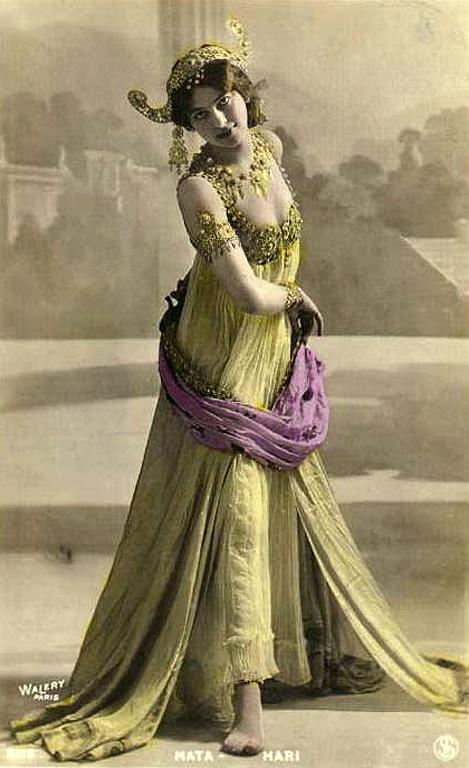
In Paris MacLeod found her niche as an exotic dancer under the stage name Mata Hari (Dawn or Sunrise). The photo at the top of this column shows Anna Tsygankova dancing that role. Although she enjoyed some success she was eventually overshadowed by other dancers including Isadora Duncan who was two years her junior.
MacLeod's career as a dancer ended abruptly with the first world war. As a citizen of a neutral country she was able to travel between the belligerents which made her useful to the intelligence services of both sides. The photo below shows her with her German controller, Major Roepell, danced by Jozef Varga.
Anna Tsygankova and Jozef Varga
Photo Marc Haegeman
Copyright 2016 Dutch National Ballet, all rights reserved
Reproduction licensed with the kind consent of the company
A particularly handsome officer as this photo shows.
Jozef Varga
Photo Marc Haegeman
Copyright 2016 Dutch National Ballet, all rights reserved
Reproduction licensed with the kind consent of the company
And of course she was also courted by the other side.
Anna Tsygankova and Artur Shestrikov
Photo Marc Haegeman
Copyright 2016 Dutch National Ballet, all rights reserved
Reproduction licensed with the kind consent of the company
Which, of course, led to her arrest and execution at Vincennes on 15 Oct 1917.
Anna Tsygankova
Photo Marc Haegeman
Copyright 2016 Dutch National Ballet, all rights reserved
Reproduction licensed with the kind consent of the company
This last photo shows her between the ranks of the Zouave firing party which shot her.
Mata Hari's vision of the god Shiva danced by Young Gyu Choi
Photo Marc Haegeman Copyright 2016 Dutch National Ballet All rights reserved
The Dutch National Ballet's Mata Hariended its run on Friday to rave reviews including one from me (Brandsen's Masterpiece14 Feb 2016). Here are some more photos of that the company has kindly allowed me to reproduce. In each instance Mata Hari is danced by Anna Tsygankova.
Mata Hari as a young woman in Frisia
Photo Marc Haegeman Copyright 2016 Dutch National Ballet All rights reserved
Mata Hari and her husband danced by Casey Herd
Photo Marc Haegeman
Copyright 2016 Dutch National Ballet All rights reserved
Mata Hari on station in the Dutch East Indies (Modern Indonesia)
Photo Marc Haegeman
Copyright 2016 Dutch National Ballet All rights reserved
Photo Marc Haegeman Copyright 2016 Dutch National Ballet, all rights reserved
Reproduction licensed by the company
In Brandsen's Masterpiece14 Feb 2016 in which I reviewed Ted Brandsen'sMata Hari I described Anna Tsygankova's portrayal of the life of the tragic adventurer and dancer, Margaretha Geertruida "Margreet" MacLeod, as compelling and observed that "it is not often that one sees theatre like that in any medium" I added that I thought the sounds and images of that performance would remain with me for the rest of my life.
Here is just one of those images. It shows the heroine advancing towards her place of execution on pointe. I believe that is significant. According to the British reporter, Henry Wales, who witnessed her death, Mata Hari showed remarkable courage and dignity as she approached the firing squad (see "The Execution of Mata Hari, 1917," EyeWitness to History, www.eyewitnesstohistory.com (2005)). She was not bound and refused a blindfold. The courage and dignity of the historical character is reflected in the choreography.
The Dutch National Ballet have sent me several other photos from that production which I shall make available over the next few days. But I will start with this one because it is the most compelling.
Dutch National Ballet, Mata Hari, Stopera, 13 Feb 2016 As Anna Tsygankova stood alone on stage for her curtain call after last night's performance of Ted Brandsen'sMata Hari every single person in the Amsterdam Music Theatre or Stopera rose as one. She would have got a similar standing ovation anywhere - even snooty old London - for her portrayal of the life of the tragic adventurer and dancer (Margaretha Geertruida "Margreet" MacLeod) was compelling It is not often that one sees theatre like that in any medium and I think the sounds and images of that performance will remain with me for the rest of my life.
Although Brandsen is artistic director of one of the world's great dance companies this was the first time I had seen any of his work. I very much hope it will not be the last for Mata Hari indicates that the man is a genius. After the show I tweeted that the English language does not contain enough superlatives to praise that ballet. That was no mere flattery or sycophancy for I intended every word sincerely and these are the reasons why.
First, it was an act of genius to commission Tarik O'Regan to compose the score. It is not often that a new composition grips me in the way this one did. Readers can get some idea of its beauty from the trailer. It has been echoing in my head all night. So, too, has the percussive war scene as French and German soldiers batter it out. There has been a lot of new ballet to commemorate the centenary of the First World War and none of the music comes close to O'Regan's.
Another act of genius was the casting. Not just Tsygankova, powerful though her performance was, but also in the choice of Casey Herd who danced her dashing, handsome but in the end cruel husband, Artur Shesterikov who danced Vadime de Masloff, her last lover, Roman Artyushkin who danced Lieutenant Ladoux, her destroyer, Young Gye Cho who danced Shiva in her dreams and indeed all the dancers from the children who danced her son and daughter upwards. Many of my favourite dancers were in other roles in the show including Floor Elmers and, of course, Michaela DePrince, Nancy Burer and others whom I have followed since they were in the Junior Company.
Brandsen showed his genius in his choice of Janine Brogt as dramaturge who told a complex and tragic story in a simple and compelling way. Last June some of the great and the good of British ballet spent half an afternoon on a circumlocution about narrative ballet (see My Thoughts on Saturday Afternoon's Panel Discussion at Northern Ballet21 June 2015). My message to Graham Watts, Louise Levene, Tobias Batley et al and their audience is to come to Amsterdam if they want to see what narrative ballet is all about.
There was genius too in the set design and costumes. I did not like the backdrop at first because it reminded me of Amsterdam's Central Station but as the ballet progressed I appreciated why it had been designed as it was. It morphed from the MacLeods' home in Friesland. to the officers' mess in colonial Indonesia, to a Hindu temple, the Moulin Rouge, the rehearsal studio for Diaghilev's Les Sylphides and finally disintegrated in the war scene as it became the settling for her execution.
I appreciate that this is the shortest and most superficial of reviews but I had a very long day yesterday travelling to Amsterdam by rail, watching the preview of the new season and a lot of tramping in the rain. More of the same today as I hope to tour the Stopera and see the Junior Company's Ballet Bubbles once I find the auditoorium and then dash off to Schipol for the last flight home. This is unlikely to be my last word on Brandsen's masterpiece.
To mark the 400th anniversary of Shakespeare's birth in 1964 Sir Frederick Ashton created The Dream. Antoinette Sibley was Titania and Anthony Dowell her Oberon, The Dream was one of the most beautiful ballets that Ashton ever created. Here is a snippet of the original production and another to a more recent performance by American Ballet Theatre with Alessandra Ferri and Ethan Stiefel. The ballet was part of a triple bill of works inspired by Shakespeare. The others were Kenneth MacMillan's Images of Loveand Sir Robert Helpmann's Hamlet. To commemorate the 400th anniversary of Shakespeare's death the Birmingham Royal Ballet will revive this iconic work at the Hippodrome between the 17 and 20 Feb 2016. If you see only one ballet this year this is the one you should not miss.
This is not the only contribution of the Birmingham Royal Ballet to the anniversary commemorations. The company will dance its Romeo and Julietthe following week in Birmingham before taking it on tour to the Lowry, Sunderland, Nottingham and Plymouth. The Northern touring section of the company will take pas de deux from Romeo and Juliet, The Dream and The Taming of the Shrew together with Wink, a new work by Jessica Lang and the Moor's Pavane to Durham, York and Shrewsbury on its Shakespeare Midscale Tour.
The Birmingham Royal Ballet's final contribution to the anniversary commemorations will be The Shakespeare Triple Billconsisting of Wink, The Moor's Pavane and David Bintley's The Shakespeare Suite at the Hippodrome between the 22 and 25 June 2016.
As Birmingham is just over 30 miles from Stratford on Avon and in the same historic country it is perhaps fitting that the Birmingham Royal Ballet should lead those commemorations but it is by no means the only company to dance works inspired by Shakespeare. The Royal Ballet will revive The Winter's Talein Spring. The Bolshoi will bring their version of The Taming of the Shrewby Jean-Cristophe Maillot to music by Shostakovich to London in the Summer (see Bolshoi Ballet to return to the Royal Opera House in summer 201611 Nov 2015 on the Royal Opera House website:
Bolshoi Ballet's Taming of the Shrew, Standard YouTube Licence
Yesterday I chose Scottish Ballet as my company of the year (see Highlights of 201529 Dec 2015) and they will certainly be in contention for the 2016 title if David Dawson'sSwan Lakeis as good as I expect it to be. Dawson is Associate Artist to the Dutch National Ballet and was its resident choreographer between 2004 and 2012. I saw his Empire Noir in the Dutch National Ballet's Cool Britannia triple bill and was most impressed (see Going Dutch29 June 2015 and David Dawson's Empire Noir18 June 2015). Swan Lake will open in Glasgow on 19 April 2016 and will visit Newcastle between 11 and 14 May 2016 and Liverpool between 1 and 4 June 2016 as well as Aberdeen, Inverness and Edinburgh.
Another new work to which I look forward immensely is Akram Khan's Giselle for English National Ballet. This work will be premièred at the Palace on 27 Sept 2016 and will be the centre piece of the Manchester International Festival. Having seen Kaash at the Lowry (see Akram Khan's Kaash - contemporary meets Indian classical7 Oct 2015) and Dust at the Palace (see Lest We Forget25 Oct 2015) I am intrigued. After Manchester the company will take the work to Bristol, Southampton and London.
Looking across the North Sea I tip Ted Brandsen'sMata Harifor the Dutch National Ballet(see Mata Hari30 Nov 2015) and Ballet Bubblesthe new season for the Durch National Ballet's Junior Company. The programme will include new works by Ernst Meisner and Charlotte Edmonds as well as pieces by Krzysztof Pastor, David Dawson and my favourite living choreographer Hans van Manen. Sadly the company will be unable to perform at the Linbury this year because it is closed for renovation. I have tried to persuade the company to consider other theatres in the UK but I am not confident that I have been successful. Other shows I should really like to see include Hans van Manen's Goldwhich will tour the Netherlands and Sasha Watts's Romeo and Julietto Berlioz;s score. Incidentally, if like me you are a van Manen fan but can't make it to the Netherlands you can see Birmingham Royal Ballet dance his Five Tangostogether with Solitaire, Four Scottish Dances and Monotones II in Cheltenham, Poole or Truro. I saw Scottish Ballet's performance of Five Tangos last April and enjoyed it very much (see No Mean City - Accessible Dance and Ballet 26 April 2016),
While it may not be possible to welcome the Junior Company to England this year we can at least look forward to visits by the Australian Ballet and the Bolshoi. The Australians are bringing Graeme Murphy's Swan Lake and Alexei Ratmansky's Cinderellato the Coliseum in July. The Bolshoi are bringing Maria Alexandrova, Ekaterina Krysanova, Olga Smirnova, Svetlana Zakharova, Semyon Chudin, David Hallberg, Denis Rodkin and others to delight us and will performDon Quixote, Swan Lake, The Flames of Paris and Le Corsaire as well as Maillot's Taming of the Shrew which I mentioned earlier.
I am aware that I have barely scratched the surface and I apologize for any omissions. On the eve of what promises to be an outstanding year for dance I wish all my readers a happy and prosperous new year.
Both English National Ballet and the New Zealand National Ballet have created works to commemorate the First World War (see Kia Ora! The Royal New Zealand Ballet in Leeds5 Nov and Lest We Forget25 Nov 2015), The Netherlands was neutral during the First World War but it lost at least one of its citizens to that conflict. Margaretha Geertruida Zelle, better known as Mata Hari, was executed by a French firing squad at Vincennes on 15 Oct 1917 after being convicted of espionage in a travesty of a trial in which her counsel was prevented from cross-examining the prosecution witnesses. On 6 Feb 2016 the Dutch National Ballet will present Ted Brandsen's ballet Mata Harion her life story.
The company's press manager, Richard Heideman, has described Mata Hari as "one of the most iconic women in Dutch history". His press release continues:
"Mata Hari was born to a well-to-do Frisian family in 1876 as Margaretha Zelle. Following an unhappy marriage, Zelle went to seek adventure in Paris. As the exotic, mysterious Mata Hari, she became one of the most famous dancers of her day. She travelled throughout Europe and had highly placed lovers everywhere, which made her an ideal spy during World War I. She was accused – rightly or wrongly – of being a double agent, and she died in front of a French firing squad in 1917.
Mata Hari was a passionate woman, for whom real life was too restrictive, which is why she was continually creating new images of herself and new guises.
................
The mysteries that surround her person and her dramatic, controversial death have made Mata Hari a welcome subject for the film industry. Famous actresses like Greta Garbo, Zsa Zsa Gábor, Marlène Dietrich, Jeanne Moreau, Sylvia Kristel and Maruschka Detmers have all played Mata Hari. There have also been stage versions, a television series and a Broadway musical about Mata Hari. She has been immortalised by painters like Isaac Israëls (1916) and John Singer Sargent (1906). And a great many books have been written about her life, ranging from serious biographies to Tomas Ross’ thriller The Tears of Mata Hari."
Brandsen's ballet focuses on Mata Hari's ability to keep ‘reinventing’ herself:
“She underwent many metamorphoses, like a Lady Gaga or Madonna of a hundred years ago”.
He is particularly moved by her survival instinct and her will to make something of her life no matter what.
Tarik O’Regan has been commissioned to compose the score, The sets will be by Clement & Sanôu, and the costumes by Francois-Noël Cherpin. If I can get to Amsterdam in February I will review the show.