Showing posts with label Dreda Blow. Show all posts

Sunday, 10 June 2018

Jane Eyre at the Lowry

The Lowry Theatre, Salford, Greater Manchester
Author: Skip88
Licence Creative Commons Attribution Share Alike 3.0 Unported
Source Wikipedia


Northern Ballet Jane Eyre 9 June 2018, 19:30, The Lowry

Yesterday, Northern Ballet gave their last performance of Jane Eyre of the current run at the Lowry Theatre.  It was also the last opportunity to see Dreda Blow and Victoria Sibson dance with the company. I attended the show for two reasons.  The first is that although I had never met either dancer I had seen them on stage many times. I wished to express my appreciation for all the pleasure that they had given me over the years. The second reason is that a dancer's farewell performance is often one of his or her best for he or she wants to leave on a high with the public wanting more. That in turn lifts the rest of the cast who also give of their best.

That is what happened yesterday.  Northern Ballet gave one of the strongest performances that I have ever seen from them.  They did so on one of the most spacious stages upon which they regularly perform.  They fielded a cast that included many of my favourite dancers in the company.  And, as I have said many times, Cathy Marston's Jane Eyre is by far the best work in their current repertoire.

As I have described the work already in Northern Ballet's Jane Eyre: the best new Ballet from the Company in 20 Years 2 June 2016 and Jane Eyre Second Time Round 18 April 2018 I shall avoid detail about the libretto, characters, designs and score. Edward Rochester was danced by Javier Torres who was my male dancer of the year last year (see 2017 in Retrospect 7 Jan 2018). Jane Eyre as an adult was, of course, danced by Dreda Blow who gave the strongest performance that I have ever seen her give in that role. Jane's younger self was danced by Antoinette Brooks-Daw and her tormenting cousins by Abigail Prudames, Abigail Cockrell and Matthew Koon. Mlindi Kulashe was a chilling Mr Brocklehurst (he plays baddies particularly well) and Ailen Ramos Betancourt an equally unpleasant Aunt Reed.

The novel, Jane Eyre, divides naturally into three parts yet the ballet splits into just two.  I think it would benefit from an interval immediately after the attempted bigamy scene.  Two much is funnelled into the second act. Valuable bits of the choreography such as the dance between Rochester and Blanche Ingram (Abigail Prudames) and Mr Rivers's proposal is overlooked even third time round.  That is because there is just so much going on and the senses can only take in so much.  Incidentally,  I have to congratulate Sean Bates for his role for his portrayal of Rivers as a kindly, sensitive but nevertheless lacking soul who would have driven Jane nuts.

The most important characters from the governess phase of Jane's life are the playful Adèle (danced charmingly by Rachael Gillespie) and the deranged Bertha.  Though her appearance is a short one it is probably the most important role in the ballet after Jane herself and it needs a fine dance actor.  The company had none better than Victoria Sibson. I had seen her in that role in Richmond and she had impressed me then but her performance last night was even stronger.  She threw herself into the last duet with Torres as the flames her flickered around her.  Strands of her hair - a gorgeous red - her whirling dress - merging in the flames. What a glorious way for her public to remember her!

The crowd clapped and cheered of course and quite a few of us rose to our feet but it was not quite the send off that I had expected when I penned Flowers for Dreda yesterday.  The Lowry's architecture does not lend itself to flower throws but I did expect massive bouquets for Blow and Sibson and possible one or two others. But then I reflected that this is a northern company and extravagance of that kind is not a northern thing to do. David Nixon entered the stage and gave a very good speech recalling some of her finest performances.  It clearly affected Dreda for she gave him a big, tight hug. Instead of flowers which would have faded in days he gave her a framed photo of herself.  From what I could glimpse from the centre of the stalls she was in red in full flight. "Something that will last" I thought. "She can hang it in her front parlour, perhaps." A sensible Northern gift from us no-nonsense northern folk.

Another thought that occurred to me as I stepped outside the theatre was that the company had come home.  Manchester was where it was born and it is sad that it ever felt it had to leave us. It now has a magnificent studio and theatre complex at Quarry Hill, of course, that it shares with Phoenix to their obvious, mutual, artistic benefit. But the Grand with its pillars and narrow creaky stairs and possibly raked stage never quite does it justice. The Lowry, on the other hand, certainly does. It is possible for a company to have more than one home as several American companies do.  I hope we shall see more of Northern here perhaps working with our CAT. The Lowry is not too far from Leeds. I spotted several of the great and good from Leeds sitting near me in the stalls.  Indeed, I chatted to one of my favourite artists from that city in the interval.  It is encouraging that Northern Ballet will return to the Lowry next year with Gatsby.  I hope it puts down some very deep roots there.

Saturday, 9 June 2018

Flowers for Dreda?

Dread Blow is leaving Northern Ballet this evening and we shall miss her so. I tweeted last night:
Of course, there is unlikely to be one.  For a start the Lowry is not Covent Garden and there are good health and safety reasons why members of the public should be discouraged from emptying their gardens on to the stage. Leanne Benjamin described it as "pretty scary" to be bombarded with blooms in Roslyn Sulcas's Tiptoeing (on Point) Through the Tulips 20 Nov 2014 NY Times.

And yet.  What a lovely way to say goodbye as London did to Zenaida Yanowsky last year:


Or to Sir Fred when he retired from the Royal Opera House on 24 July 1970. I was in the audience that night. Yes folks I really am that old.  That photo was taken before the flower throwers got into their stride for by the time the last bouquet was tossed the stage was ankle deep in flowers.

In the 1970s, when I first became interested in ballet, flowers seemed to be thrown at the end of almost every show.   It was easy to get them in those days because the flower market was in what is now the Paul Hamlyn Hall.  Roslyn Sukcas writes:
"The floral tradition at the Royal Ballet is also probably a result of the opera house’s proximity to the Covent Garden flower market before it moved and the possibility of buying leftover or spoiled flowers cheaply.
'Back in the day, the fans used to queue overnight for tickets, and there was a very striking woman, dressed in a black velvet cloak, who used to run the queue, collect money for flowers and organize throws from the amphitheater,' Mr. Welford said, referring to the tradition of pelting dancers with loose flowers from the topmost part of the theater."
You know, I think I can remember that woman in black.  Rumour had it that she had been a Russian ballerina, noblewoman or even a princess who somehow survived the butchery at Ekaterinburg.

I certainly remember a lingering smell of vegetation everywhere in the House that remained long after the wholesale market moved to Nine Elms. Covent Garden was not quite so posh or pricey in those days. Remember that the Royal Opera House had been used as a cinema, palais de danse and even furniture store within living memory.  The smell only disappeared after the extensive renovations of the 1990s during which time the company performed in a circus tent in Battersea Park.

Nowadays flower throws in London are organized by the Ballet Association for extra special occasions (see "About Us" on the Ballet Association's website).  That's probably a good thing but it has taken away the spontaneity of the gesture.

I once discussed the custom of throwing cut flowers with Ernst Meisner of the Dutch National Ballet. He was familiar with the tradition having trained at the Royal Ballet School and having danced for many years with the Royal Ballet. "It's a lovely custom," said Ernst, "but we have never done it here."  Well, actually, according to Julia Farron, it was Ernst's compatriots who started the custom for she remembers showers of daffodils and tulips the day that Sadlers Wells Ballet performed in the Hague (see David Bintley How World War 2 made British Ballet BBC website).

Whatever is to be arranged for Dreda (and if anyone is collecting for flowers, do get in touch with me for I would love to contribute) it will be a bitter-sweet occasion.  In many ways the curtain call is the most important part of the performance for it is the audience's opportunity to perform. The ballet should never be a passive experience. And tonight we shall perform. With tears. With cries and yells and Russian style roars. With thunderous applause.  And hopefully flowers. Because we love dear Dreda so.

Monday, 7 May 2018

Dreda Blow

Standard YouTube Licence


It is always sad to say goodbye to a dancer - especially a leading lady - but I for one will miss  Dreda Blow prticularly.  According to Northern Ballet's news item, Saying Farewell, she will dance with the company for the last time at the Lowry on 9 June 2018.

I have chosen a clip from Romeo and Juliet because it was the work in which I first appreciated her qualities.  In Northern Ballet's Romeo and Juliet - different but in a good way 8 March 2015 I wrote:
"I also saw another side of Dreda Blow. I had last seen her as Mina in Dracula in which I had admired her dancing but did not warm to her. .........  Casting Blow for the role was an inspiration. She was a perfect Juliet. Playful and feisty. Loving but conflicted. Brave but fearful. Blow is elevated to my pantheon of favourites."
I was of the same view when I saw her in that role a second time in Bradford 18 months later (see  Romeo and Juliet after the Shrew  18 Oct 2016).

Dreda Blow is a joy to watch.  She is of course a virtuoso but also so much more.  She has a lovely face with wonderfully expressive features.   Qualities that make her one of the finest dance actors that I know.  Some roles she has made her own.  I cannot imagine any other Jane Eyre but her.  When  I first saw her in that role in Richmond, I remarked:
"Hannah Bateman had tweeted that Blow was lovely in the title role and she was right. Blow is a fine dancer but I have never seen her dance better than she did tonight." (see Northern Ballet's Jane Eyre: the best new Ballet from the Company in 20 Years 2 June 2016)
I said very much the same when I saw her again in Sheffield last month (see Jane Eyre Second Time Round 18 April 2018). I have tried to think of the work in which I have liked her best,  The beautiful but vulnerable Bellino, perhaps, in Kenneth Tindall's Casanova perhaps or maybe her cheeky and playful role in Demis Volpi's Little Monsters (see Sapphire  15 March 2015).

The news bulletin does not say where she will go or what she will do after 9 June 2018 but I wish her all the best.  I thank her for all the pleasure she has given her audiences in her 11 or so years with the company.

PS   Dreda came to us from Amsterdam where she trained and began her career. Through the Junior Company I have made the acquaintance of several leading ballet teachers in the Netherlands. One of them added this lovely comment:


Wednesday, 18 April 2018

Jane Eyre Second Time Round


Standard YouTube Licence

Northern Ballet Jane Eyre 13 April 2018, 19:45  Lyceum, Sheffield

The first time I saw Cathy Marston's Jane Eyre I described it as "one of the best new ballets I have seen all year from any company and it is the best new work from Northern Ballet for many years if not decades" (see Northern Ballet's Jane Eyre: the best new Ballet from the Company in 20 Years 2 June 2016). I saw it again in Sheffield on Friday and I am still of that view.

Jane Eyre is a very long read.  It consists of 38 chapters and was first published in 3 volumes.  There is a good summary of the story in WikipediaAlthough it cannot have been easy to compress a book of that length into a two act ballet, Marston preserved its essence in her librettoMost of the characters of the novel are reproduced in the ballet.  Marston has also invented a set of male characters called the "D-men" who are danced by some of the company's most experienced members. They haunt Jane at critical moments of her life.  In that regard, they perform a role similar to that of the chorus in Greek drama.  I noticed a similar use of such characters in The Suit (see Excellence - Ballet Black's Double Bill 17 March 2018).

Many of the dancers I saw at Richmond in 2016 were in Friday's performance in Sheffield though some had different roles. Dreda Blow danced Jane as an adult on Friday as she had two years ago. Jane as a girl was danced by Rachael Gillespie who had been Adèle last time.  Victoria Sibson, who had been Bertha Mason in Richmond, was Aunt Reed in Sheffield. However, there was a different Rochester.  Joseph Taylor performed that role on Friday.

Each and every member of the cast performed well.  Blow is the only Jane I know.  The last time I saw her I wrote:
"Blow is a fine dancer but I have never seen her dance better than she did tonight."
I can only say the same about her performance on Friday.  Taylor delivered a confident and convincing performance as Rochester.  Gillespie is one of my favourite dancers in the company and her portrayal as the young Jane did not disappoint me.  However, the performance that impressed me most in Sheffield was Mariana Rodrigues's as Bertha.  She makes only a couple of brief appearances but her role is a key one.  The attempted bigamy scene has a lot in common with the mad scene in  Giselle and if she is ever cast as Giselle I should be very interested to see what she makes of it.  I think she is an artist to watch and I will make a point of looking out for her.

Once again I admired Patrick Kinmonth's sets - especially the Pennine backdrop with its dry stone walls. Also his costumes, especially Bertha's ragged dress.  The more I hear of Philip Feeney's music the more I like his work. He also wrote the score for The Suit  which was another successful collaboration with Marston.

I concluded my review of the performance in Richmond with the hope that the ballet would be revived as I had hoped to see it again.  I am very glad that Jane Eyre is back in Northern Ballet's repertoire and that it has been staged in major venues this time.  I am particularly glad that it is coming to the Wells and Lowry for I think it will do well in both of those theatres.

Sunday, 28 January 2018

Nixon's Little Mermaid - Perhaps His Best Work Yet


Standard YouTube Licence

Northern Ballet The Little Mermaid 19:15 2 Dec 2017 Sheffield Lyceum

In 2017 in Retrospect 7 Jan 2018 I chose Northern Ballet as my company of the year because of its three, new, full-length ballets:
"These were Kenneth Tindall's Casanova which I had expected to be good and was not disappointed (see Casanova - "it has been a long time since I enjoyed a show by Northern Ballet as much as I enjoyed Casanova last night" 12 March 2017 and Casanova Second Time Round 7 May 2017). Daniel de Andrade's The Boy in the Striped Pyjamas which I did not expect to like at all but was moved deeply (see The Boy in the Striped Pyjamas - "an impressive work that was danced splendidly by Northern Ballet" 10 Sept 2017) and David Nixon's The Little Mermaid which I have yet to review but is, perhaps, his best work yet."
Here is my promised review.

There are many reasons why I liked The Little Mermaid. First, the libretto which follows Hans Christian Anderson's story closely. Secondly, the score. I applaud Nixon's commissioning Sally Beamish who had also composed the music for David Bintley's work, The Tempest (see The Tempest 9 Oct 2016). Thirdly, his casting which provided an opportunity for Abigail Prudames and Joseph Taylor to shine in leading roles.  Lastly, but by no means least, I admired Kimie Nakano's sets and costumes very much, particularly the underwater scenes in the first act.

The quality of this ballet that impressed me most was the detailed study of the mermaid's psyche,  She exchanged a carefree life below the waves with friends and family for an excruciating and lonely existence on land.  She gave up all that she had for the love of a human.  She did that not once but twice.  She had an opportunity to sink a knife into the prince who had spurned her and thereby return to the sea as a mermaid.  An opportunity that some women would have seized willingly even without the reward of personal transformation. Instead. she chose a path that she thought would lead to self-annihilation.

Much was demanded of the dancer who was to perform that role.  It had to be one of the company's younger members for the mermaid, like Shakespeare's Juliet, was on the cusp of adulthood. Also like Juliet she had to project a range of emotions, some conflicting as she grew up almost overnight,  Prudames was impressive in that role. Earlier in the year I had seen her in the preview (see First Impressions of the Little Mermaid 27 July 2017).  I noted then:
"I also liked some of the extracts, particularly the solo when the mermaid. danced by Abigail Prudames, discovers her new legs. Stranded on the shore she experiences pain for the first time. Prudames communicated that sensation chillingly. Much as Edvard Munch does in The Scream."
Three months on and after several weeks of  performances on tour she was even more impressive.

Though less is demanded of the male lead emotionally, the audience has to understand why the mermaid was prepared to sacrifice so much for him.  He has to be magnetically attractive, dashing and handsome. Taylor showed all of those qualties and more. Brave in the storm and compassionate on finding a beautiful, solitary. voiceless young woman on the shore,  Though captivated by her dancing he remained faithful to his bride.

The bride was danced by Dreda Blow, one of the company's leading soloists. A pretty role that she performed delightfully.

Other important roles were the lord of the sea (Matthew Topliss) who supplied the potion that transformed the mermaid into a human being as well as the knife by which she would have changed back, the mermaid's sisters, Ayami Miyata and Rachael Gillespie, two of my favourite artists who are always a pleasure to watch and the mermaid's affectionate and faithful friend, the seahorse, Kevin Poeung, another dancer whom I like a lot.  The corps had important tasks in the ballet, as sea creatures (or, in some cases, as bearers of such creatures), as sailors, fishermen and villagers. Altogether it was a very polished performance.

I had enjoyed the extracts from Beamish's score in the preview.  Having heard the whole work I liked it even more than her music for The Tempest.  I particularly liked the Celtic allusions that Beamish inserted subtly much in the way that Løvenskiold had done in his score for La Sylphide. There were Scottish or Irish echoes in the men's kilts (plain material without tartans) and in the human characters' names: Adair, Dana and Brina.

This production will visit the Festival Theatre in Edinburgh between the 22 and 24 March 2018. I shall be interested to know what a Scottish audience makes of the kilts and Beamish's score. It will then move on to Milton Keynes (close to two of the company's most devoted fans) in April and round of its tour at Leicester in May. No new full length works this year but with tried and tested favourites like Cathy Marston's Jane Eyre and The Nutcracker the company can expect another good year.

Saturday, 2 September 2017

Bank Holiday Ballet: Wendy McDermott's Reflections on the latest Ballet Retreat

Wendy McDermott


The Ballet Retreat, Leeds, 26-26 Aug 2017

The August bank holiday was quite a special time for UK adult ballet dancers as the fourth Ballet Retreat of 2017 took place at Northern Ballet’s studios in Leeds, West Yorkshire. I think there have been five retreats altogether since emerging on the adult ballet scene around this time last year. I think all the ‘retreaters’ would agree that we are a pretty lucky bunch of adult dancers. We have the good fortune of using the Stanley and Audrey Burton Theatre for all three days, which is a studio space of around 30 metres in length (great for leaps, not so good for turns – oh the dizziness ), we are taught by professional dancers and have the added bonus of dancing to music performed by a live pianist.

As with other retreats, the day always starts with a warm up, led by the event’s organiser and producer Hannah Bateman (she’s also a Leading Soloist for Northern Ballet). There are plenty of standing and seated stretches, warming up of the spine, body and hip alignments, ports de bras and leg rotations to loosen the hips and prepare the muscles for the day’s dancing ahead. After a short loo/ballet bun/water break, we went straight into our 90 min technique class taken by David Kierce and musically accompanied by Northern Ballet’s company pianist, Andrew Dunlop.

Classes are always challenging but also injected with David’s humour and positivity. He does this in such a way that we’re able to keep the focus and concentration, particularly when giving group corrections. He has a very good knack of explaining the kinesiology, how the body works logically to stay aligned when performing everyday activities and what should (or shouldn’t) happen when rising onto demi pointe or standing with the working leg in retiré position for example.

Following class and before lunch we always start work on the repertoire and this time the female variation was Gamzatti’s Act 2 solo in La Bayadère. The men’s variation was Solor’s Act 2 coda. For days one and two the ladies had extra help in learning the rep from Dreda Blow another Leading Soloist at Northern. The men were not left out either and heartily welcomed back Gavin McCaig, now a third-year corps de ballet member after starting with the company as an apprentice (see Meet Gavin McCaig of Northern Ballet 3 Sept 2014).
Gamzatti’s variation is, I think, the longest that we have danced so far though it is less than a minute in length. That doesn’t sound long in the normal scheme of things and granted, some of the steps were modified to suit our abilities. But when you’re performing développés to relevé in retiré whilst also turning, then chassés into grands jetés, turning waltzes, turns in attitude to arabesque, posé turns into chaînés and then more grands jetés around the studio, with attitude on demi pointe to finish, this is no mean feat. Everyone did brilliantly.

As the August retreats are three days instead of two, we’re given the chance to experience a different kind of dance or movement on the second day. This year’s surprise taster class was no exception. We were given a sneaky hint when, a few days before the retreat, Hannah suggested that we follow Amaury Lebrun on Twitter. 
He is a contemporary dance teacher and choreographer, and new to Leeds. Whilst some of us may have guessed the connection I don’t think anyone was prepared for the hour long session ahead. I referred to the session on Twitter as the "Gaga Technique", but that is incorrect as it is a style created by Ohad Naharin. It is described as a ‘movement language’ that does not have a particular technique as we might think; ballet being the obvious one here. It is the antithesis, the renegade you might say. 
Amaury took our class, remarking that all that was required was our imaginations and to keep moving. Even on the spot, we did not stand still but very gently sway from side to side, shifting our weight from one leg to the other. He gave us mental images of water running through the fingers, snakes, balloons deflating in our bodies, walking through crowded streets of people without collision. With these thoughts, we moved either within our own space or around the studio imagining how we might move, or react, to that image. There was no right or wrong – just move. 
One of the last exercises was to lay in our own space, to think of something funny – a joke perhaps, and laugh out loud. We were all a little tentative, to begin with, but once the embarrassment subsided and encouraged by one or two more confident voices, we were able to release our inner reserved selves and release the laughter. Judging by people’s immediate reaction when the session ended I think it was a very successful class though perhaps a little avant-garde for some but most left feeling lifted and exhilarated.

The third and final day came around and again, following the morning class we had roughly an hour or so to put the whole variation together. This was easier for some to remember than others, partly I suspect (and confess) as nerves set in and the realisation that we’d shortly be performing to all the other dancers. We split into pairs and threes and each group performed the solo to all the other retreaters and everyone received rapturous applause.

Our final goodbyes were said, but not before a lovely lunch, vintage style with cut sandwiches, mini cream scones and an assortment of cakes and tea or coffee to drink. The tables were laid out beautifully and it was such a lovely end to what had been an amazing three days, and one which I am eager to repeat again.

Sunday, 12 March 2017

Casanova - "it has been a long time since I enjoyed a show by Northern Ballet as much as I enjoyed Casanova last night"


Standard YouTube Licence

Northern Ballet Casanova Grand Theatre, Leeds, 11 March 2017, 19:30

I started to take an interest in Northern Ballet when I first read about it in Dance and Dancers in 1969. I seem to remember that it was called Northern Dance Theatre in those days.  The first performance by that company that I actually saw was Gillian Lynn's A Simple Man in 1987 (see Northern Ballet's "A Simple Man" 14 Sep 2013). I have followed the company ever since - remaining loyal to it even after it moved to Halifax. I have therefore seen a lot of performances by Northern Ballet over the years. It is a very long time since I saw a show by Northern Ballet that I enjoyed as much as I enjoyed Casanova last night. It is certainly the best I have seen from Northern Ballet since the company crossed the Pennines.

Casanova is Kenneth Tindall's first full length ballet. He had already impressed the public and critics with his such works as The Architect and Luminous Junc•ture but as he agreed in his interview with me "the jump from one-act to full-length is an exponential and qualitative leap - not merely doubling or tripling of effort" (see "A Many Sided Genius" - Tindall on Casanova 4 March 2017). In my judgment Tindall has landed successfully in making that leap.  I liked every aspect of the production: Tindall's choreography, the story that he created with Casanova's biographer Ian Kelly, Kerry Muzzey's score, Christopher Oram's designs and, of course, the dancers.

The ballet focusses on two episodes of Casanova's life. The first is his youth in Venice where he is introduced by Father Balbi to the Kabbalah, a proscribed text, which brings him to the attention of the Inquisition or secret police. They imprison him in the Piombi. The second episode is his exile in France where he meets Madame de Pompadour and Voltaire. At various times women flit in and out of his life - two young girls Nanetta and Marta Savorgnan, a nun known as MM, Bellino and Henriette. Sex is in the story - it could hardly be avoided in view of the detail in which Casanova wrote about it and his popular reputation - but it is not the only story. The politics of the time, the repression of women of which Bellino and Henriette were victims, and other issues were also addressed.

Oram had cleverly projected Venice and Versailles in his set designs. I was reminded of the richness of St Mark's with a brief appearance of the Bridge of Sighs and the confines of the prison house crashing down on Casanova in the last scene of the first act. I was reminded of the Hall of Mirrors of Versailles in the second. Although it was not referred to as such in the programme, there was actually an epilogue representing his employment as a librarian in Prague, There he wrote his life story at the behest of his shrink as a therapy for depression. That episode was represented by a shower of falling paper and the entry of the characters he had encountered in his life.

Muzzey's score suited the story and decor well. It was rhythmic. I noticed several of those around me silently tapping out the beat with their fingers. I even caught myself doing it too at times. It was emphatic.  I particularly admired Muzzey's use of percussion. It was lyrical. In some of the softer scenes, he would repeat a refrain. Maybe not an earworm but nevertheless quite beautiful and memorable.

At the preview, Casanova Unmasked on 15 Feb, I realized that there was great depth and quite a lot of detail to Tindall's choreography. Not all of it is immediately obvious. The duet between Casanova and Bellino where Bellino tests Casanova and learns to trust him might well have escaped me had Tindall not explained it in the preview. However, there were some bits of the choreography that were eloquent. The binding of Bellino's breasts so that she could pose as a castrato and the joy of her womanhood that she expressed once those bandages had been removed. Of course, Bellino was not trans but it is a relief all trans-folk know.

Casanova was danced by Giuliano Contadini. A good choice, I thought. He is tall, athletic, muscular and, of course, Italian. I am not sure that he resembled the historical Casanova whose portrait accompanies my article but he was the right chap for Tindall's ballet. At the end of the performance, he was presented with flowers - a gesture that rarely happens in England but was entirely appropriate on this occasion. My only regret is that his leading ladies, Dreda Blow who danced Bellino, and Hannah Bateman, his Henriette, did not get any for they deserved flowers as well.  So, too, did the other women in Casanova's life such as Abigail Prudames and Minju Kang, Casanova's young initiators and Ailen Ramos Betancourt who danced the nun, MM. There were powerful performances by Javier Torres as Casanova's patron, Brigadin, and Mlindi Kulashe as his persecutor.  As I said earlier today in Facebook, at another time and in another place, yesterday's performance might well have earned a flower throw.

There has been a lot of hype for Casanova as there was last Autumn for Akram Khan's Giselle but in this case, the hype was entirely justified. All my expectations were met. All my hopes fulfilled. Northern Ballet danced in a way that I had not seen them dance for many years. I was not in the most receptive mood for ballet when the show started as I had run from Quarry Hill in my least comfortable but most fashionable heels over slippery pavements having languished for 45 minutes in a traffic jam caused, so far as I could see, quite gratuitously by appalling traffic management on the part of the local authority. It is to the artists' credit that I left the theatre on a high.

Saturday, 4 March 2017

"A Many Sided Genius" - Tindall on Casanova

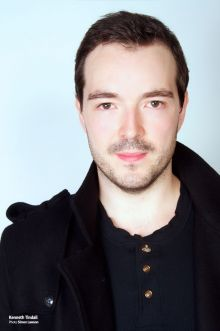
Kenneth Tindall
(c) 2015 Northern Ballet: all rights reserved
Reproduced wth kind permission of  Northern Ballet


Next Saturday will be the first night of Casanova which Northern Ballet will launch at Leeds Grand Theatre. Between the 11 March and 13 May 2017, the company will dance the ballet at Leeds, Edinburgh, Sheffield, Norwich, Milton Keynes, Cardiff, The Lowry and Sadler's Wells. Last Monday, the choreographer of the ballet, Kenneth Tindall, gave me an exclusive interview in which we discussed the ballet, his interests and hopes for the future. 

What impressed me most in my conversation with Kenneth Tindall was not so much what he said but the way he said it. Though he spoke softly he did so confidently, with a clear vision, and a determined focus. Tindall is still a young man and Casanova is his first full-length commission. It is obvious from the costumes on display at the Casanova Unmasked preview and from the number of venues in which this ballet is to be performed that a lot rides on this production. Tindall readily acknowledged the risks when I put it to him that this project could make or break Northern Ballet. Yet where others might see risk he sees opportunity. He emphasized the strengths of his dancers and of his creative team. He spoke enthusiastically of their capacity to deliver a quality of performance and production to be surpassed by none.

That enthusiasm was infectious. I must admit to some private concern when I first wrote about Casanova on 24 May 2016. Tindall had created one act ballets like The Architect and Luminous Junc*ture that had appealed to audiences and critics (including Mel, Joanna and me) but, again as he agreed when I put it to him, the jump from one-act to full-length is an exponential and qualitative leap - not merely doubling or tripling of effort.  However, after 45 minutes with Tindall my concerns evaporated. I am as confident as I can be of anything in ballet that this production will succeed spectacularly.

Tindall is used to overcoming odds. He was one of 8 children to be selected from 250 candidates at his audition for the Central School of Ballet. The nation’s ballet schools are full of talented students but only a handful find employment in a top regional ballet company. Of that handful only a few become principals (or, as Northern calls them, “premier dancers”). As a premier dancer, he had a considerable following. He was especially admired for his roles as Wadjet in Cleopatra and Heathcliff in Wuthering Heights. When his retirement was announced in the Friends of Northern Ballet newsletter. I wrote in Kenneth Tindall on 28 Feb 2015 that it:
“contained a headline that made me root for a tissue - just for a second - before I also raised a smile. The headline was "Kenneth Tindall is retiring" and that was the bit that made me sad for he is one of my favourite dancers but my sadness was tempered with the words ‘award-winning Kenneth is moving on to a career as a Freelance Choreographer after gaining recognition for his work with Northern Ballet and other artists.’"
I amplified the reason for my smile in the last paragraph:
“He has an international following which was brought home to me when I visited Amsterdam earlier this month (see The Dutch National Ballet Junior Company's best Performance yet 8 Feb 2015). His name came up whenever I mentioned Northern Ballet or Leeds at the party after the show. Perhaps not so surprising for a choreographer who has already won a fistful of awards and nominations. He is still a young man and his career - though meteoric - has only just begun. I look forward to great things.”
I believe that Casanova will be the first of those great things.

At Casanova Unmasked on 15 Feb 2017 Tindall had told us that a ballet on the life of Giacomo Casanova had been one of three ideas that he had pitched to Northern Ballet’s artistic director, David Nixon. Nixon liked the idea and invited Tindall to refine his proposal. Tindall did some reading and came across Ian Kelly’s biography. He approached Kelly for a licence but he and Kelly got on so well that he invited Kelly to help him develop the story. Though Kelly is an actor and dramatist this is the first time he will have worked on a ballet. I asked Tindall how he came to hear of the historical Casanova. He replied that he had seen some film or TV footage and an article in the New York Times.

I had asked Tindall about his collaboration with his composer Kerry Muzzey at Casanova Unmasked recalling historical accounts of Petipa’s collaboration with his composers. Tindall had replied that unlike Petipa’s relationship with his composers his relationship with Muzzey had been a two-way process. In the interview I asked him to elaborate on his answer as he was in Leeds and Muzzey was in Los Angeles. In the early days, Tindall said, there had been Skype calls at least three time times a week. These had tapered off to two a week and were continuing at that rate right up to the present. I asked whether these conversations ever involved Kelly. Tindall replied that they did. He might play some music to Kelly who might reply with an observation such as “I can really feel Venice.” That was important as he and Kelly aimed to create a ballet about the times of Casanova as well as on his life.

Tindall emphasised more than once the importance of the story. 
“You need to have a libretto,” he said, “that is everything.” 
The plot is based on Kelly’s book but, he explained, yet it is not the book. 
That prompted me to ask about one of the main characters in the ballet, Father Balbi. According to the synopsis, the ballet opens with:
“A mass in honour of the new French Ambassador Cardinal de Bernis. Among the church clerics is aspiring priest Giacomo Casanova who has arrived late with his pupils the Savorgnan sisters. In the congregation is Father Balbi who has with him a book forbidden by the church. Balbi gives the book to a curious Casanova. After the mass the Three Inquisitors accost Balbi believing him to be still in possession of the forbidden book”
From what I could remember from my own reading, Casanova first met Balbi in gaol. Balbi had facilitated Casanova’s escape from the Piombi (or “the Leads”) prison that adjoins the Doge’s palace. Casanova’s life was surely colourful enough without inventing incidents, I suggested. What about his relationship with his mother? Kelly had told us at Casanova Unmasked that Casanova had been born while his mother was in a play. Immediately after he had been delivered she returned on stage for the next act.

Tindall replied that Balbi had been introduced early in the ballet to illustrate the repression of ideas by the Inquisition, the thought police of 18th century Venice. The book that Balbi handed to Casanova in the ballet was the Kabbalah, the Jewish theological work that had been proscribed by the Venetian authorities. Both Balbi and Casanova had read the Kabbalah, Tindall added. It was quite possible for Casanova to have known Balbi and even for Balbi to have given Casanova a copy of the Kabbalah before they met in prison.

Tindall and Kelly had thought about including Casanova’s relationship with his mother in the context of his treatment of women but had rejected it because this ballet is not just about sex. Sex is important, Tindall continued, because Casanova had written so much about it and so explicitly in his life story, but he was a many-sided genius. The imperative was to show different sides to that life. Tindall noted that Casanova’s conquests averaged 4 a year which was not much for a libertine. Thinking of Leporello’s catalogue of his master’s conquests in Don Giovanni, I could not help but agree:
“In Italia seicento e quaranta;
In Alemagna duecento e trentuna;
Cento in Francia, in Turchia novantuna;
Ma in Ispagna son già mille e tre.”
“In Italy 640;
In Germany 231;
100 in France, 91 in Turkey;
But in Spain, 1003 and counting.”

Casanova’s philanderings had been on quite a different scale. I reminded Tindall of my speculation on whether Casanova might even be regarded as a proto-feminist. Quite possibly, he replied. Casanova said that he had never conquered a woman’s heart. He had always submitted.

That led us to the first of the extracts that we had seen at the preview on the 15 Feb 2017 where Casanova (danced by Giuliano Contadini) had met Bellino (Dreda Blow) and the way Tindall had represented by mime and dance the dropping of the mask and the developing of trust. I remarked that that had reminded me very much of Christopher Gable and Lynn Seymour in the balcony scene from MacMillan’s Romeo and Juliet (see Rachel Thomas Romeo and Juliet Dance Highlight: The Balcony pas de deux 3 Sept 2015 Royal Opera House website). Tindall willingly accepted that possibility. He had after all been trained in Central which had been founded by Gable and Gable had directed Northern Ballet. Gable had been an important influence on his work. “But” he added with emphasis, “so was David Nixon”. 

At Casanova Unmasked Nixon had said that “he had been allowed to play with Kenny toys” in that he was acting as Tindall’s ballet master. “Quite a role reversal having been directed by Nixon for 14 years” I suggested. Tindall agreed adding that Nixon was performing the role of ballet master to perfection.

We talked about the role of choreographer which Tindall compared to that of a film director. The roles were similar and maybe even converging as techniques and technology that had been developed for the cinema were increasingly used in ballet. I recalled the filming of The Architect to which project I had contributed (see Tindall's Architect - How to Get a Piece of the Action - Literally! 7 June 2014). I asked whether another film might result from Casanova. Tindall’s eyes sparkled. No concrete plans as yet, he said, but would it not be splendid to film Act I in Venice and Act II in Paris.
“How do choreographers learn their trade?” I asked.
“They ask as they go along” was the reply. “For instance, they ask the lighting designer why he places a spot there? and ‘what would happen if he changed a filter here?”
I was reminded of my conversation with Cristiano Principato in Trecate (my Outstanding Young Choreographer of 2016 28 Dec 2016). He told me that he even had to operate the lighting himself.
“He is quite right,” added Tindall. His message to Principato and any other aspiring choreographer was:
“a choreographer has to know everybody’s job. For instance, I asked Christopher Oram our designer ‘How do you start with scenery or a character’s clothes.”
I have never been a dancer but I have done several intensive workshops where we started with floor exercises at 10:00, then 90 minutes class followed by wall to wall rehearsals until cool down at 17:00. That was exhausting enough for me but dancers have to pack in a performance on top and maybe even a matinee as well. 
“How do you fit all that in?” I asked.
“When you take on a project like this you put your life on hold” Tindall replied.  “You are always thinking about it, running scenes through your mind, even in your sleep.”
“But you need to turn it off occasionally” he quickly added, “otherwise you would go insane”
I asked Tindall how he switched off. “Meditation” was the reply, “and the cinema.” Tindall added that he is a great film buff. He even refers to the cinema as “church.”

We talked about the promotion of the ballet. “You see posters for the ballet everywhere in Leeds” I noted. He replied that it had been marketed very cleverly and that advanced ticket sales at all venues had been encouraging.
“This ballet will compare with anything that could have emerged from the Royal Opera’s workshops” but at a fraction of the cost.”
I reflected that the sets and costumes have to be robust to be brought out time and time again then packed away in a lorry for another destination, possibly on the other side of the country. I noted that Oram had never designed for the ballet before. Tindall saw that as an advantage. Oram will bring a fresh approach to his task as Kelly has done with the libretto.

“So what’s your next project?” I asked, “if you can tell me without risking commercial confidentiality.”
The answer was a triple bill in Germany 8 days later.

As for the longer term, Tindall would love his work to be performed in America.
“You never know” I replied, “only this weekend we have made contact with a company in Miami that seems to have a lot in common with Northern Ballet (see Miami City Ballet 26 Feb 2017. “I would cross the Atlantic to see your work in the USA” I added.
I asked him whether he aspired to be a resident choreographer somewhere. He replied that he had thought of it.
“How about forming his company or directing an existing one?”
That, too, was a possibility but for now he was content with freelancing.

“And how about film?” I suggested. “You would not be the first choreographer to cross over to that medium? Look at Helpmann, Shearer........”
“And Gable” he added.
Yet again his eyes lit up.
We discussed the convergence of film and ballet, experiments in 360 and other technologies. I mentioned Peter Leung’s Night Fall and the Royal Ballet’s The Nutcracker (see Virtual Reality in Ballet 13 Sep 2016 We could have explored that topic alone for at least another 45 minutes and maybe longer but Tindall had to prepare for a rehearsal.

Kenneth Tindall is much more than a choreographer. At the risk of embarrassing him, I would say that he, like the subject of his ballet, is a many-sided genius.

I shall be at the premiere next week and my review will appear next Sunday.  I wish the casts of this production "chookas", "toi-toi-toi" or whatever greeting theatrical and balletic tradition permits.

Thursday, 16 February 2017

Casanova Unmasked

Venice, Birthplace of Giacomo Casanova
Photo Cocao
Source Wikipedia
Creative Commons Licence


Northern Ballet, Casanova Unmasked Stanley and Audrey Burton Theatre, Leeds, 15 Feb 2017, 18:00 - 19:30

In my capacity as a Friend of Northern Ballet, I attended Casanova Unmasked last night. It was a preview of the work by the choreographer, Kenneth Tindall, and two of his collaborators, Ian Kelly his dramaturge and David Nixon his ballet master.  They were assisted by Giuliano Contadini, Dreda Blow, Hannah Bateman, Gavin McCaig and other dancers of the company.

The proceedings were streamed live over the internet and have been recorded at Northern Ballet - Casanova Unmasked on the company's YouTube channel. Unfortunately, the sound quality is not perfect. The sound is very faint throughout the video and appears to have been lost altogether at several points. However, the video is still worth watching. This article is intended to help those who were not in the theatre to appreciate that film. I have also written a brief introduction to the subject matter of Tindall's ballet and provided links to some of his source materials in Casanova, 24 May 2016.

The company's artistic director, David Nixon, made a short speech in which he introduced Kenneth Tindall. He spoke of his early recognition of Tindall's choreographic talent and how he had fostered it. Tindall had been a principal of the company and knew it well. It was, therefore, fitting that Northern Ballet should commission Tindall's first full-length ballet.

Tindall, in turn, introduced Ian Kelly. Tindall explained that Kelly had written the definitive biography of Casanova. He had approached Kelly for a licence but Kelly showed such interest in the project that Tindall invited Kelly to collaborate with him instead. In a fascinating presentation delivered without notes, Kelly brought to life the historical Casanova. Casanova is remembered nowadays as a libertine but he was so much more. He was a polymath with interests ranging from mathematics to gastronomy. He is remembered for his sexual exploits because he described them in minute detail (together with a lot of other things) in his autobiography which he wrote for therapy rather than publication. Kelly told us that Casanova's relationship with women was not as exploitative as might be thought. Intriguingly, Kelly said that Casanova had helped the women he knew "along their way". That gave me the impression that in some respects Casanova was a proto-feminist.

Among Casanova's relationships that Kelly discussed was the one with Bellino,  She is described on Northern Ballet's website as a "woman masquerading as a man in order to work as a castrato (castrated male) singer." Casanova and Bellino were represented on stage by Giuliano Costadini and Dreda Blow. In an exceptionally clever piece of choreography that I might never have interpreted without Tindall's commentary, the dancers recreated the couple's meeting, the tentative relaxing of their masks and the creation of trust between them. The development of trust was demonstrated by some rather scary looking tombés (I use that term in the loosest possible sense because I do not know how else to describe her fall) by Blow into the arms of Costadini. In the questions and answers that followed, Blow was asked how she felt when she performed that step. She replied that it was not easy at first but she had worked with Costadini before and gradually perfected it.

After the Q and A in which Bateman and McCaig joined Contadini and Blow. we were shown another extract from the ballet. This was by members of the corps representing Casanova's fellow seminarians when he was studying for the priesthood. There followed a fencing exercise which somehow transformed itself into a music lesson, the foils becoming violin bows. Altogether very ingenious and very attractive choreography.

There was another Q & A, this time with Tindall, Kelly and Nixon.  I asked Tindall about the mechanics of his collaboration with the composer Kerry Muzzey who was following the event in the United States. I asked him whether he worked as Petipa had with his composers specifying the phrases he needed for particular steps. Tindall replied that the collaboration went both ways. Having written music for film, Muzzey could envisage the interpretation of his work which Tindall had found useful.

After the presentations, Nixon invited the audience to drinks.  In some ways, this was the most valuable part of the evening because it afforded an opportunity to meet the collaborators and dancers informally and explore the work in greater depth. I had a particularly rewarding conversation with Ian Kelly about his methodology as history is forensic but theatre is expressive. Kelly well understood the difference having read history as a first degree.  I expect his work to be scholarly as well as entertaining.

The drinks were served in the atrium of Northern Ballet and Phoenix Dance Theatre's studios at Quarry Hill. Those who have entered the building will remember a landing where costumes are occasionally exhibited. Last night costumes from Casanova were arranged along that landing. Nixon reminded us that these come at a cost and that there is an appeal for wigs and costumes to which I invite all my readers to contribute.

Saturday, 15 October 2016

Romeo and Juliet after the Shrew


Standard YouTube Licence


Northern Ballet Romeo and Juliet, Alhambra, Bradford 14 Oct 2016, 19:30

I have to be frank. It was the Bolshoi who sold me my ticket to Northern Ballet's Romeo and Juliet last night with their exquisite performance of The Taming of the Shrew at the Royal Opera House in the summer (see Bolshoi's Triumph - The Taming of the Shrew 4 Aug 2016). It was they who turned me into a Maillot fan (see Jean-Christophe Maillot 5 Aug 2016 and World Ballet Day: Les Ballets de Monte Carlo 10 Oct 2016).

Had it not been for the Bolshoi I think I would have used my precious ballet going weekend to see Ballet Black last night and then hop on a train to London to see the matinee performance La Fille mal gardee today. No disrespect to Northern Ballet which is a fine company but I had already seen its Romeo and Juliet twice last year (see Northern Ballet's Romeo and Juliet - different but in a good way 8 March 2015 and Leebolt's Juliet 13 March 2015). Fille is one of Ashton's masterpiece which is performed only by the Royal Ballet and Birmingham Royal Ballet and then not every year.

Now there is a lot of difference between the massive 240 year old company founded by Prince Ursov with all the resources of the Russian state and a mid-size 41 year old company in Leeds and I came to the Alhambra wondering whether I had done the right thing in letting Lise and Colas go for a year or so. I am glad to say that I think I did for Northern Ballet danced very well  last night. It was far better than either of the performances that I had seen in 2015 even though the cast was the same it was as the first time that I had seen the show.

Perhaps one of the reasons why yesterday's performance was so good is that they danced in the Alhambra before a Bradford crowd. From the theatre goer's point of view it is the best dance venue in Yorkshire and second only to the Lowry in the North. The Grand at Leeds is all very well but there are pillars and all sorts other obstructions to spoil the view, the bars are crowded and leg room in the cheaper seats is terrible. The Quarry at West Yorkshire Playhouse has none of those disadvantages but its capacity is limited to 750. I also find that a Bradford audience is generally more discriminating and appreciative. The Alhambra is on the circuit for world class touring companies like NDT II and Alvin Ailey. Also, they are that much closer to Manchester and thus more likely to see Birmingham Royal Ballet, English National Ballet and other visitors to the Lowry and Palace.

The title roles yesterday were danced by Tobias Batley and Dreda Blow. Blow fits naturally into Juliet's role. As I said in Northern Ballet's Romeo and Juliet - different but in a good way:
"She was a perfect Juliet. Playful and feisty. Loving but conflicted. Brave but fearful. Blow is elevated to my pantheon of favourites."
That was still my view of her last night. Batley has to work at Romeo.  We are used to seeing him as mature men such as Heathcliff, Marc Antony and Gatsby rather than as a callow, headstrong, teenage boy, but he did work at it and was quite convincing in the balcony and bedroom pas de deux. However, the most arresting scene was Lady Capulet's explosion of rage and that will be the image that I will retain from the show. Hannah Bateman was magnificent in that role. Also impressive was Mlindi Kulashi who portrayed Tybalt as a bit of a thug. Rather unusual perhaps but quite logical when you think about it. Antoinette Brooks-Daw won the crowd's affection as the loyal, long suffering, much put upon nurse. Abigail Prudames was an adorable Rosaline. At least three people including Romeo would still be alive had Romeo stuck with her. Joseph Taylor interpreted Friar Lawrence's role quite differently from Isaac Lee-Baker whom I had previously seen in that role. Maillot had invested some of the authority that in other productions is vested in the duke in the friar's role. Yesterday we saw Taylor as the guardian of the public interest crumble as the corpses piled up from his loss of control.

That brings me back to the reason why I was in the theatre. As I explained in  Northern Ballet's Romeo and Juliet - different but in a good way Maillot's production is quite unlike Lavrosky's, MacMillan's, Nureyev's or any other production of Romeo and Juliet and that is because he has rewritten the play. He did very much the same even more successfully with The Taming of the Shrew.  He is now working on an interpretation of Midsummer Night's Dream called Le Songe which, despite using Mendelssohn, appears to be as different from Ashton's Dream as his Shrew is from Cranko's and his Romeo and Juliet from MacMillan's. The glimpses of the rehearsal on his World Ballet Day slots were tantalizing. Maillot appreciates Shakespeare and understands him but that does not stop him from taking the occasional liberty with him - and getting away with it.

Friday, 9 September 2016

Northern Ballet's "Wuthering Heights" at the West Yorkshire Playhouse


Standard YouTube Licence

Northern Ballet, Wuthering Heights, West Yorkshire Playhouse, Leeds 6 Sep 2016

Guest Contributor  Janet McNulty

The West Yorkshire Playhouse (WYP) has always been a special performance space for Northern Ballet since their first season there in the early noughties. Most of the productions performed there have been created there and only A Midsummer Night's Dream has toured extensively to the Company's more usual theatres.

Wuthering Heights is a first for the Company as it is a main stage production transferring to the much more intimate space of the West Yorkshire Playhouse. Since the news was first announced I, and many other fans, have been waiting eagerly to see how this ballet favourite would transfer to WYP.

Well the wait was finally over last night when Northern Ballet opened a short season of Wuthering Heights at the WYP. There was a lovely sense of anticipation as the house lights went down...

I was not disappointed. Wuthering Heights looked every bit as wonderful as I expected it to in this terrific theatre. The orchestra was hidden away behind the set but their playing of the score, under the baton of John Pryce-Jones was splendid. The positioning of the orchestra also meant that the audience was very close to the action and we were able to take in every tiny gesture of the dancers.

Opening night was led by Dreda Blow as Cathy and Javier Torres as Heathcliff. Dreda was a wild Cathy, adoring Heathcliff from the start but also being swayed by the riches of Thrushcross Grange. She was totally hemmed in to her marriage to Edgar (exquisitely danced and acted by Nicola Gervasi). Javier was everything we would expect from Heathcliff - darkly brooding and very passionate in his feelings towards Cathy. One of my favourite moments of this work is the red duet when we have seen a subdued dance between Cathy and Edgar who cannot express their feelings to each other and as they part Heathcliff bursts into the garden. Their duet is exciting and passionate and last night I forgot to breathe!

We were very privileged to see Rachael Gillespie make her debut as Isabella last night - she was just exquisite. She was a total innocent abroad and it was easy to see how she fell for Heathcliff's rough charm.

The ballet starts with Mr Earnshaw bringing the foundling Heathcliff into his house and shows young Cathy's growing attraction to him as Hindley becomes neglected and embittered. Kevin Poeung and Ayami Miyata portrayed the young loves incredibly expressively. Kevin's facial expressions were subtle and a joy to behold. Giuliano Contadini gave a very nuanced performance as Hindley from enthusiastic young boy to embittered sadist and sad drunk. Victoria Sibson and Hiro Takahashi brought all their experience to the roles of devoted Ellen and the devout Joseph. I particularly noticed Victoria's devastation during Cathy's death scene.

One of the joys of watching Northern Ballet is to glance around the stage and see how involved all the dancers are, no matter how small their roles and last night was no exception.

It really was a terrific start to Northern Ballet's Autumn season!

Thursday, 2 June 2016

Northern Ballet's Jane Eyre: the best new Ballet from the Company in 20 Years

Jane Eyre and her Aunt Reed
Author FH Townsend

Source Wikipedia


Northern Ballet, Jane Eyre, Richmond Theatre. 1 June 2016

With one enormous break between 2004 and 2011 I have been following Northern Ballet ever since I returned to the North in 1985. The company has given us some lovely ballets over the years - Cinderella, A Christmas Carol, A Simple Man and, more recently, Madame Butterfly and A Midsummer Night's Dream. In my humble, rustic and simplistic opinion the company's golden age was 20 years ago. At least I thought so until this evening for tonight I saw them perform Jane Eyre at Richmond. I was reminded of their glory days which I never thought I would see again.

Cathy Marston has done wonders with this company.   It is one of the best new ballets I have seen all year from any company and it is the best  new work from Northern Ballet for many years if not decades. The story follows the novel pretty faithfully and the portrayal of several of the characters was just as I had imagined them when I first read the book as a child. In particular Adele danced beautifully by Rachael Gillespie and the first Mrs Rochester danced chillingly by Victoria Sibson. There was some very clever choreography and even cleverer direction,  Especially effective was the flashback scene at the beginning of the performance where Jane's early life - related by Antoinette Brooks-Daw as young Jane  - was echoed by adult Jane, Dreda Blow, behind a screen.

I was a little unsure about Philip Feeny's score at first because it sounded very like Schoenburg's for Wuthering Heights at first (or at least it did to me) but I warned to it especially in the second act. The discordance as Mrs Rochester advanced towards the altar was gripping.  So, too, was the music for the duet as Rochester tried to rescue his mad first wife. I have not enjoyed everything that Feeney has composed in the past but this time he has created a masterpiece.

Great music was equalled by great sets and costumes. Patrick Kinmonth's backdrops reminded me of low Pennine hills and dry stone walls. His costumes, particularly Adele's and Mrs Rochester's, helped project the story.

Hannah Bateman  had tweeted that Blow was lovely in the title role and she was right. Blow is a fine dancer but I have never seen her dance better than she did tonight.   Javier Torres was an excellent Rochester.  He showed arrogance as the squire but also vulnerability and sensitivity in his reverses.   It was a surprise to me that he can do vulnerability as he commands attention on stage and off but crouched in a foetal position clutching his eyes he nearly drew tears. Jessica Morgan was a horrid Aunt Reed and Mlindi Khulashe a fearsome master.

Last night and the day before will be the ballet's only showing in London.  A pity because the house was full and the audience was appreciative. Aylesbury will be its next stop and then a tour of the Midlands.  I hope it will be revived soon. I should love to see it again.

Saturday, 24 October 2015

1984 Second Time Round


Embedded pursuant to a standard YouTube licence

Northern Ballet, 1984, Palace Theatre, Manchester, 17 Oct 2015, 19:30

As I had expected, I liked Northern Ballet's 1984 very much more the second time around. There are two reasons for that. The first is that I knew what to look out for having seen the show in Leeds on 11 Sept 2015 (see My First Impressions of 1984 12 Sept 2915). The second is that Isaac Lee-Baker and Dreda Blow came very close to my picture of Winston Smith and Julia.

There is only so much that the senses can absorb when one attends the theatre.  The first time I saw the show I concentrated on the plot in order to understand the ballet rather than the sound and movement through which the story was expressed.  There was a lot of movement in this ballet - the choreography, of course, but also spectacular electronic displays on a massive "telescreen". Knowing the sequence of the ballet I was better able to appreciate Jonathan Watkins's choreographyAndrzej Goulding's telescreen, Simon Daw's sets and costumes, Alex Baranowski's score and some exquisite dancing.

Lee-Baker as Smith and Blow as Julia were perfect casting in my recollection of Orwell's novel. Smith is a young chap, very impressionable and somewhat naive - the sort who might have been turned by Stalin had he worked in the Foreign Office in the late 1940s rather than the Ministry of Truth in 1984. Such a role requires a young dancer but one with considerable ability. A role tailor made for Lee-Baker who had triumphed as Friar Lawrence in Maillot's Romeo and Juliet earlier in the year (see Northern Ballet's Romeo and Juliet - different but in a good way 8 March 2015) and as Wilson in Gatsby last year (see Northern Ballet at its best: The Great Gatsby in Bradford 16 Nov 2014).

As I recall the novel, Julia is a temptress and I intend it as a compliment when I say that Blow was a very sexy lady. She is another dancer that I began to appreciate for the first time in Romeo and Juliet.  When I saw her as Juliet I wrote:
"Casting Blow for the role was an inspiration. She was a perfect Juliet. Playful and feisty. Loving but conflicted. Brave but fearful. Blow is elevated to my pantheon of favourites."
Julia is a very different role from Juliet but Blow was an excellent choice. She is perhaps Northern's best actor. She was sultry. She was seductive. She was my idea of Julia.

The third leading character in Watkins's ballet is O'Brien, the senior apparatchik who tricks Smith and Julia into dropping their guard and then betrays them. Javier Torres danced that role in September and he was excellent. He saved that show for me on that occasion.  Last Saturday it was Ashley Dixon who was a very different O'Brien but no less convincing. He projected menace and oiliness even in the privacy of his apartment when entertaining his young quaries with a silent telescreen.

It was good to see some of my favourites in the company - Hiranao Takehashi as Charrington, Jeremy Curnier as O'Brien's assistant, Victoria Sibson as the lead female prole and Rachael GillespieAbigail Prudames and Mlindi Kulashe who danced in the crowd scenes as party faithful and proles but still shone - as did all in the cast last Saturday night.

Orwell's satire is not an obvious choice for a ballet. In the Q & A that followed the show in Leeds on 11 Sept 2015 Watkins was asked why he had chosen that work as the subject of a ballet. He replied that
"he had read the book as a teenager and had been affected by it. He had contemplated how it could be translated into dance for some time. The same had happened with the Ken Loach film Kes which he first saw about the same time. That film resonated with him because it was set in the area in which he had spent his childhood. Last year he had the chance of stage it for The Crucible in Sheffield. By staging Kes and 1984 he had achieved two longstanding ambitions."
As you can see from the synopsis Watkins followed Orwell pretty faithfully. The sets, costumes, music, choreography, dancing came together beautifully. I don't think that this will ever be one of my favourite ballets but it it one that I now understand, appreciate and recommend.

The company will perform 1984 today in Sheffield for one last time in the North before they take it to the rest of the country. I had hoped to see it in Sheffield with Giuliano Contadini and Antoinette Brooks-Daw in the leading roles but they were dancing on the nights when Jane Tucker teaches the improvers and I was due to see Rambert at The Alhambra. Perhaps I can catch that cast at Sadler's Wells in May. Londoners tend to like Northern Ballet perhaps even more than we Mancunians and I am sure they will enjoy this show.