
 |
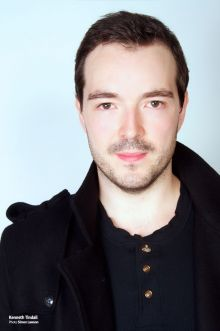
| Kenneth Tindall
(c) 2015 Northern Ballet: all rights reserved
Reproduced wth kind permission of Northern Ballet |
Next Saturday will be the first night of Casanova which Northern Ballet will launch at Leeds Grand Theatre. Between the 11 March and 13 May 2017, the company will dance the ballet at Leeds, Edinburgh, Sheffield, Norwich, Milton Keynes, Cardiff, The Lowry and Sadler's Wells. Last Monday, the choreographer of the ballet, Kenneth Tindall, gave me an exclusive interview in which we discussed the ballet, his interests and hopes for the future.
That enthusiasm was infectious. I must admit to some private concern when I first wrote about Casanova on 24 May 2016. Tindall had created one act ballets like The Architect and Luminous Junc*ture that had appealed to audiences and critics (including Mel, Joanna and me) but, again as he agreed when I put it to him, the jump from one-act to full-length is an exponential and qualitative leap - not merely doubling or tripling of effort. However, after 45 minutes with Tindall my concerns evaporated. I am as confident as I can be of anything in ballet that this production will succeed spectacularly.
“contained a headline that made me root for a tissue - just for a second - before I also raised a smile. The headline was "Kenneth Tindall is retiring" and that was the bit that made me sad for he is one of my favourite dancers but my sadness was tempered with the words ‘award-winning Kenneth is moving on to a career as a Freelance Choreographer after gaining recognition for his work with Northern Ballet and other artists.’"I amplified the reason for my smile in the last paragraph:
“He has an international following which was brought home to me when I visited Amsterdam earlier this month (see The Dutch National Ballet Junior Company's best Performance yet 8 Feb 2015). His name came up whenever I mentioned Northern Ballet or Leeds at the party after the show. Perhaps not so surprising for a choreographer who has already won a fistful of awards and nominations. He is still a young man and his career - though meteoric - has only just begun. I look forward to great things.”I believe that Casanova will be the first of those great things.
At Casanova Unmasked on 15 Feb 2017 Tindall had told us that a ballet on the life of Giacomo Casanova had been one of three ideas that he had pitched to Northern Ballet’s artistic director, David Nixon. Nixon liked the idea and invited Tindall to refine his proposal. Tindall did some reading and came across Ian Kelly’s biography. He approached Kelly for a licence but he and Kelly got on so well that he invited Kelly to help him develop the story. Though Kelly is an actor and dramatist this is the first time he will have worked on a ballet. I asked Tindall how he came to hear of the historical Casanova. He replied that he had seen some film or TV footage and an article in the New York Times.
I had asked Tindall about his collaboration with his composer Kerry Muzzey at Casanova Unmasked recalling historical accounts of Petipa’s collaboration with his composers. Tindall had replied that unlike Petipa’s relationship with his composers his relationship with Muzzey had been a two-way process. In the interview I asked him to elaborate on his answer as he was in Leeds and Muzzey was in Los Angeles. In the early days, Tindall said, there had been Skype calls at least three time times a week. These had tapered off to two a week and were continuing at that rate right up to the present. I asked whether these conversations ever involved Kelly. Tindall replied that they did. He might play some music to Kelly who might reply with an observation such as “I can really feel Venice.” That was important as he and Kelly aimed to create a ballet about the times of Casanova as well as on his life.
Tindall emphasised more than once the importance of the story.
“You need to have a libretto,” he said, “that is everything.”
The plot is based on Kelly’s book but, he explained, yet it is not the book.
That prompted me to ask about one of the main characters in the ballet, Father Balbi. According to the synopsis, the ballet opens with:
“A mass in honour of the new French Ambassador Cardinal de Bernis. Among the church clerics is aspiring priest Giacomo Casanova who has arrived late with his pupils the Savorgnan sisters. In the congregation is Father Balbi who has with him a book forbidden by the church. Balbi gives the book to a curious Casanova. After the mass the Three Inquisitors accost Balbi believing him to be still in possession of the forbidden book”From what I could remember from my own reading, Casanova first met Balbi in gaol. Balbi had facilitated Casanova’s escape from the Piombi (or “the Leads”) prison that adjoins the Doge’s palace. Casanova’s life was surely colourful enough without inventing incidents, I suggested. What about his relationship with his mother? Kelly had told us at Casanova Unmasked that Casanova had been born while his mother was in a play. Immediately after he had been delivered she returned on stage for the next act.
Tindall replied that Balbi had been introduced early in the ballet to illustrate the repression of ideas by the Inquisition, the thought police of 18th century Venice. The book that Balbi handed to Casanova in the ballet was the Kabbalah, the Jewish theological work that had been proscribed by the Venetian authorities. Both Balbi and Casanova had read the Kabbalah, Tindall added. It was quite possible for Casanova to have known Balbi and even for Balbi to have given Casanova a copy of the Kabbalah before they met in prison.
Tindall and Kelly had thought about including Casanova’s relationship with his mother in the context of his treatment of women but had rejected it because this ballet is not just about sex. Sex is important, Tindall continued, because Casanova had written so much about it and so explicitly in his life story, but he was a many-sided genius. The imperative was to show different sides to that life. Tindall noted that Casanova’s conquests averaged 4 a year which was not much for a libertine. Thinking of Leporello’s catalogue of his master’s conquests in Don Giovanni, I could not help but agree:
| “In Italia seicento e quaranta; In Alemagna duecento e trentuna; Cento in Francia, in Turchia novantuna; Ma in Ispagna son già mille e tre.” | “In Italy 640; In Germany 231; 100 in France, 91 in Turkey; But in Spain, 1003 and counting.” |
Casanova’s philanderings had been on quite a different scale. I reminded Tindall of my speculation on whether Casanova might even be regarded as a proto-feminist. Quite possibly, he replied. Casanova said that he had never conquered a woman’s heart. He had always submitted.
That led us to the first of the extracts that we had seen at the preview on the 15 Feb 2017 where Casanova (danced by Giuliano Contadini) had met Bellino (Dreda Blow) and the way Tindall had represented by mime and dance the dropping of the mask and the developing of trust. I remarked that that had reminded me very much of Christopher Gable and Lynn Seymour in the balcony scene from MacMillan’s Romeo and Juliet (see Rachel Thomas Romeo and Juliet Dance Highlight: The Balcony pas de deux 3 Sept 2015 Royal Opera House website). Tindall willingly accepted that possibility. He had after all been trained in Central which had been founded by Gable and Gable had directed Northern Ballet. Gable had been an important influence on his work. “But” he added with emphasis, “so was David Nixon”.
At Casanova Unmasked Nixon had said that “he had been allowed to play with Kenny toys” in that he was acting as Tindall’s ballet master. “Quite a role reversal having been directed by Nixon for 14 years” I suggested. Tindall agreed adding that Nixon was performing the role of ballet master to perfection.
We talked about the role of choreographer which Tindall compared to that of a film director. The roles were similar and maybe even converging as techniques and technology that had been developed for the cinema were increasingly used in ballet. I recalled the filming of The Architect to which project I had contributed (see Tindall's Architect - How to Get a Piece of the Action - Literally! 7 June 2014). I asked whether another film might result from Casanova. Tindall’s eyes sparkled. No concrete plans as yet, he said, but would it not be splendid to film Act I in Venice and Act II in Paris.
“How do choreographers learn their trade?” I asked.
“They ask as they go along” was the reply. “For instance, they ask the lighting designer why he places a spot there? and ‘what would happen if he changed a filter here?”
I was reminded of my conversation with Cristiano Principato in Trecate (my Outstanding Young Choreographer of 2016 28 Dec 2016). He told me that he even had to operate the lighting himself.
“He is quite right,” added Tindall. His message to Principato and any other aspiring choreographer was:
We talked about the role of choreographer which Tindall compared to that of a film director. The roles were similar and maybe even converging as techniques and technology that had been developed for the cinema were increasingly used in ballet. I recalled the filming of The Architect to which project I had contributed (see Tindall's Architect - How to Get a Piece of the Action - Literally! 7 June 2014). I asked whether another film might result from Casanova. Tindall’s eyes sparkled. No concrete plans as yet, he said, but would it not be splendid to film Act I in Venice and Act II in Paris.
“How do choreographers learn their trade?” I asked.
“They ask as they go along” was the reply. “For instance, they ask the lighting designer why he places a spot there? and ‘what would happen if he changed a filter here?”
I was reminded of my conversation with Cristiano Principato in Trecate (my Outstanding Young Choreographer of 2016 28 Dec 2016). He told me that he even had to operate the lighting himself.
“He is quite right,” added Tindall. His message to Principato and any other aspiring choreographer was:
“a choreographer has to know everybody’s job. For instance, I asked Christopher Oram our designer ‘How do you start with scenery or a character’s clothes.”I have never been a dancer but I have done several intensive workshops where we started with floor exercises at 10:00, then 90 minutes class followed by wall to wall rehearsals until cool down at 17:00. That was exhausting enough for me but dancers have to pack in a performance on top and maybe even a matinee as well.
“When you take on a project like this you put your life on hold” Tindall replied. “You are always thinking about it, running scenes through your mind, even in your sleep.”
“But you need to turn it off occasionally” he quickly added, “otherwise you would go insane”
I asked Tindall how he switched off. “Meditation” was the reply, “and the cinema.” Tindall added that he is a great film buff. He even refers to the cinema as “church.”
We talked about the promotion of the ballet. “You see posters for the ballet everywhere in Leeds” I noted. He replied that it had been marketed very cleverly and that advanced ticket sales at all venues had been encouraging.
“This ballet will compare with anything that could have emerged from the Royal Opera’s workshops” but at a fraction of the cost.”I reflected that the sets and costumes have to be robust to be brought out time and time again then packed away in a lorry for another destination, possibly on the other side of the country. I noted that Oram had never designed for the ballet before. Tindall saw that as an advantage. Oram will bring a fresh approach to his task as Kelly has done with the libretto.
“So what’s your next project?” I asked, “if you can tell me without risking commercial confidentiality.”
The answer was a triple bill in Germany 8 days later.
As for the longer term, Tindall would love his work to be performed in America.
“You never know” I replied, “only this weekend we have made contact with a company in Miami that seems to have a lot in common with Northern Ballet (see Miami City Ballet 26 Feb 2017. “I would cross the Atlantic to see your work in the USA” I added.
I asked him whether he aspired to be a resident choreographer somewhere. He replied that he had thought of it.
“How about forming his company or directing an existing one?”
That, too, was a possibility but for now he was content with freelancing.
“And how about film?” I suggested. “You would not be the first choreographer to cross over to that medium? Look at Helpmann, Shearer........”
That, too, was a possibility but for now he was content with freelancing.
“And how about film?” I suggested. “You would not be the first choreographer to cross over to that medium? Look at Helpmann, Shearer........”
“And Gable” he added.
Yet again his eyes lit up.
We discussed the convergence of film and ballet, experiments in 360 and other technologies. I mentioned Peter Leung’s Night Fall and the Royal Ballet’s The Nutcracker (see Virtual Reality in Ballet 13 Sep 2016 We could have explored that topic alone for at least another 45 minutes and maybe longer but Tindall had to prepare for a rehearsal.
Kenneth Tindall is much more than a choreographer. At the risk of embarrassing him, I would say that he, like the subject of his ballet, is a many-sided genius.
I shall be at the premiere next week and my review will appear next Sunday. I wish the casts of this production "chookas", "toi-toi-toi" or whatever greeting theatrical and balletic tradition permits.
Yet again his eyes lit up.
We discussed the convergence of film and ballet, experiments in 360 and other technologies. I mentioned Peter Leung’s Night Fall and the Royal Ballet’s The Nutcracker (see Virtual Reality in Ballet 13 Sep 2016 We could have explored that topic alone for at least another 45 minutes and maybe longer but Tindall had to prepare for a rehearsal.
Kenneth Tindall is much more than a choreographer. At the risk of embarrassing him, I would say that he, like the subject of his ballet, is a many-sided genius.
I shall be at the premiere next week and my review will appear next Sunday. I wish the casts of this production "chookas", "toi-toi-toi" or whatever greeting theatrical and balletic tradition permits.
