According to its website, The Lowry is holding an open day on 6 Aug 2023. It has not published any details yet though it has posted a video about the event in 2021. As we have a company class in Leeds on 5 Aug 2023 and I shall be speaking at the Cambridge IP Law Summer School between 7 and 11 Aug 2023 I would have given the event a miss had I not received an email about it from the Birmingham Royal Ballet last week.
That email carried an image of Carabosse doing her worse towering over a smaller image of Désiré and Aurora at their wedding above the banner headline "Join us at The Lowry Open Day on Sunday 6 August". The email announces that the Birmingham Royal Ballet will attend the open day between 10:00 and 17:00 bringing costumes for The Sleeping Beauty that visitors can try on. Between 11:00 and 14:00 there will be workshops where attendees can learn some of the choreography.
The Birmingham Royal Ballet returns to Salford to dance Sir Peter Wright's production of The Sleeping Beauty between 7 and 9 March 2024, Readers can view the trailer here. Companies around the world dance that production and I have seen performances of that work by the Hungarian and Dutch National Ballets. The best that I have ever seen was in Amsterdam on 17 Dec 2017 with Maia Makhateli as Aurora, Daniel Camargo as the prince and Igone de Jongh as Carabosse (see The Dutch National Ballet's "The Sleeping Beauty" - I have waited nearly 50 years for this show20 Dec 2017). That bit of ballet history will never be repeated but I have very high hopes of BRB's visit to the Lowry in the Spring.
Birmingham Royal Ballet. Coppelia, Hippodrome, 16 June 2017, 19:30 When I last reviewed a performance by the Birmingham Royal Ballet of Sir Peter Wright's Coppelia, I described it as "sensational" (see Sensational 6 March 2015). Having seen the ballet again on the company's home turf the only way I can describe the performance is "even more sensational." Maybe that should not be surprising for who better to perform one of Sir Peter's greatest productions than Sir Peter's company.
I made up my mind to attend the ballet last night at the very last moment after a pig of a journey home. I had driven to London the night before to take delivery of a massive set of instructions that could not be carried on the train. While down there, I attended a chambers' garden party that continued until after midnight and two conferences, one of which began with a volley of emails between 05:00 and 06:00 and a phone call shortly before 07:00. I left Plumstead where I had parked my car and cleared the river after an epochal wait for the Woolwich ferry. There was heavy traffic on the North Circ and the M11. Congestion outside Cambridge on the A14. As the A14 leads eventually to the M6 the idea of breaking my journey in Birmingham occurred to me. I called the Hippodrome on the off-chance that they might still have space and was told that they had one isolated seat in the centre of the rear stalls. I grabbed it. After battling with more traffic all the way into Birmingham, I rolled up at the theatre hot, bothered and exhausted with 15 minutes to spare.
Dropping by the Hippodrome was one of the best calls I have ever made. The performance was magic. It was just what I needed. I had not had time to study the cast list but I knew we were in for a treat when I glimpsed the unmistakeable hair of Koen Kessels. He had conducted the orchestra of the Dutch National Ballet in Ted Brandsen's Coppelia last December. Nobody seems to understand Delibes's score better than Maestro Kessels. The curtain rose to Peter Farmer's village somewhere in Mitteleuropa. Nao Sakuma appeared. I started to clap but nobody followed. Nor did anyone clap Joseph Caley when he entered the stage. Clearly, the balletic tradition of welcoming the male and female leads with a brief burst of applause that happens in almost every other theatre in the world is not followed in Birmingham. That is surprising because all of Birmingham Royal Ballet's principals are good.
Sakuma was a gorgeous Swanilda. I loved the way she threw her book at Caley after catching him making eyes at the humanoid on the balcony across the square. "Sukkel" hissed Swanilde in Het's animation. How she gave him the hardest of hard times when the ear of wheat did not appear to rattle. How she led her pals into Dr Coppelius's workshop while he was in the pub recovering from his mugging. How she dared the faintest of faint hearts to approach Coppelia. How she coaxed the deluded doctor into believing his spell had worked as she sought to rescue her dopey (even at the best of times) boyfriend. And above all, I loved the final pas de deux in "Peace"which ends the ballet on a high. Whenever I see Coppelia I always wonder how long that marriage will last. Surely, such a brave, resourceful, spirited girl could surely have done so much better.
Of course, she falls for Franz because he is a hunk. The handsomest lad in a very small village in the middle of nowhere. Girls find him attractive and doesn't he just know it. After blowing kisses at a robot, he flirts with the leader of the czardas. Caley, whom I am sure is nothing like Franz in real life, fills the role perfectly. Even after nearly losing Swanilda he is silly enough to break into Coppelius's workshop. Good job there was no copper around (see R v Collins[1972] 2 All ER 1105, [1973] 3 WLR 243, [1972] EWCA Crim 1, 136 JP 605, 56 Cr App Rep 554, [1973] QB 100, a case that has entertained every law student in England for nearly 50 years). The silly twit deserved everything that happened to him. But Franz can dance. And how he can dance. All those great tours en l'air and entrechats and the final lift that left Swanilda dangling across his back in a curious sort of fish dive.
Dr Coppelius is a juicy character role and it was performed exquisitely by Michael O'Hare last night. Scorned as slightly screwy by the Burgermeister (Jonathan Payn) and the villagers when loud bangs and smoke erupt from his laboratory, he is surely more sinned against than sinning. Does he really deserve to be roughed up by the louts or have his home ransacked by girls on a hen night? I can quite see why he sought compensation from Swanilda's dowry.
We had a stellar cast last night. Many of my favourite dancers came on stage: Delia Mathews as Prayer and also one of Swanilda's friends along with Arancha Baselga, Karla Doorbar, Reina Fuchigami, Alys Shee and Yaoqian Shang; Rory Mackay as the publican and Old Father Time; Ruth Brill with Lewis Turner in Betrothal and earlier in the mazurka and czardas; William Bracewell in the call to arms with yet another favourite Brandon Lawrence from Bradford. Everyone in the cast was good and I congratulate them all whether I have mentioned them or not.
There was loud applause at the reverence but, sadly, no flowers. In another auditorium and perhaps at a different time the stage would have been ankle deep in cut flowers throw after a show like that. A massive bouquet of my county's reddest roses, then, to Sakuma. Flowers, too, for each and every lady soloist. Indeed, each and every lady who appeared on stage. And a resounding cheer for each and every one of the men who partnered them so gallantly. "You are so lucky to have this company in your city," I said to a lady who was at the ballet for the first time. "The Birmingham Royal Ballet is one of the great companies of the world." How I wish it could have made its home in Manchester instead.
Next, there is the presentation of the Alexandra Radius prize presented by the great ballerina. Last year it was awarded to Artur Shesterikov and the year before that to Maia Makhateli, Talking of which I am delighted to say that Ms Makhateli (who has been on leave this last year) tweeted today that she plans to be back for the gala:
After the presentation, we see extracts of the company's work for the coming and previous seasons, This year the National Ballet will be joined by guest stars, Diana Vishneva and Vladimir Malakhov. Then there will be a sumptuous reception to which the whole audience is invited.
The gala is a hard act to follow but this year it will be matched by an Ode to the Master, a celebration of Hans van Manen's career with the performance of a selection of his best-loved ballets:
On the Move;
5 Tangos
Sarcasm, and
Symphonieën der Nederlanden.
This will be the year in which van Manen celebrates his 85th birthday. "No choreographer has made such a big mark on dance in the Netherlands as Hans van Manen," says the website. I would say that no living choreographer has made such a big mark on dance anywhere. I will move heaven and earth to see that show,
Dutch Doubles is not a double bill as its name suggests but a dialogue between choreographers living in the Netherlands with a number of renowned musicians. The choreographers in question are Annabelle Lopez Ochoa, the creator of Scottish Ballet's Streetcar named Desire, Danza Contemporanea de Cuba's Reversible and Ballet Black's Little Red Riding Hood, Ernst Meisner and Hans van Manen. Ochoa's dialogue will be with Wende Snijders who is described by the company's website as "one of the best-known and most versatile singer-songwriters in the Netherlands." Meisner's is with Remy van Kesteren and van Manen's will be with a pianist still to be announced. A similar collaboration in 2014 appears to have been one of the reasons why the New York Times ranked the Dutch National Ballet as one of the world's top five ballet companies.
This season there will be a lot of work for the Junior Company. They will begin their annual tour of the Netherlands with In the Future which will feature the work of the same name by Hans van Manen. According to the website, this work was created by Hans van Manen in 1986 for Scapino Ballet and it has also been danced by Stuttgarter Ballett and Introdans Ensemble for Youth. It is described as "an energetic, swinging, amusing and surprising work, with wonderfully inventive costumes by Keso Dekker." They will also dance Narnia: the lion, the witch and the wardrobein which Ernst Meisner collaborated with Marco Gerris to produce a work that is described as "Hiphop meets Ballet." I saw a scene from this work in the 2015 gala and loved it. Finally, the Junior Company will celebrate its 5th anniversary in Junior Company 5 Yearswith a special gala at the Stadsschouwburg. Having attended one of the first (if not the first) of those galas in 2013 (see The Junior Company of the Dutch National Ballet - Stadsshouwburg Amsterdam 24 Nov 201325 Nov 2013) this will be a special performance for me too - if I can only get a flight and ticket for it.
Talking of the Junior Company, I introduced Timothy van Poucke and Salome Leverashvili in Missing Amsterdamon 18 Feb 2017. Tim and Salome have just released a fourth vlog entitled Life of a ballet dancer - VLOG#4 by Tim and Salome - Junior Companyin which they discuss their life in the company, how it differs from ballet school, their hopes for the future including prospective careers after they give up dance. Salome would love to dance on stage for ever and ever but realizes that will not be possible. However, she already sees a career for herself as a fashion designer including, perhaps, fashion for the ballet. Tim would like to be a teacher. He would be good at that, muses Salome, for he is always correcting her.
Tim is a fine young man. Salome a lovely young woman. They have all my betst wishes for the future as do all the other members of the Junior Company,
Standard YouTube Licence Those who like The Nutcracker have a choice of three versions this year since all three of our flagship companies are staging the ballet this Christmas. The Royal Ballet and the Birmingham Royal Ballet offer their own versions of Sir Peter Wright's production in London and Birmingham respectively while English National will tour with Wayne Eagling's.
My first choice is the Royal Ballet's. I prefer the story where the fight between the mice and toy soldiers is confined to a dream in Act I and Act II is one great divertissement. In Wayne Eagling's the battle is central to the story and continues into Act II as the mouse king follows Clara and Drosselmeyer by grasping the gondola of their balloon. In the Dutch National Ballet's version, which is also by Eagling and most recently performed last year, the work is actually called The Nutcracker and the Mouse King. I suppose it becomes a sort of metaphor for the struggle between good and evil. Another big difference between Wright's versions and Eagling's is that Clara morphs into the Sugar Plum in the latter.
There are some differences between the Birmingham and London versions of Wright's ballet. The Royal Ballet's designs are by Julia Trevelyan Oman whereas BRB's are by John Macfarlane. There are also differences between Eagling's versions for the Dutch and English National Ballets in that ENB's designs are by Peter Farmer whereas Het's are by Toer van Schayk. However, van Schayk influences the choreography of the English version.
Audiences who want to see the Royal Ballet can catch it at Covent Garden between the 23 Nov and 12 Jan 2017. It will also be streamed to cinemas throughout the UK and the rest of the world on 8 Dec 2016. BRB's will run from 25 Nov 2016 to 13 Dec 2015 at the Birmingham Hippodrome. English National's will start in Milton Keynes between 23 and 26 Nov 2016, proceed to the Liverpool Empire between 29 Nov and 3 Dec 2016, and finish its run at the Coliseum between 14 Dec and 7 Jan 2017. It will also be performed in Southampton between 29 Nov and 2 Dec 2017.
It has been some time since I last saw either of Sir Peter's versions because I could find no reviews in the archives of my blog but I can offer you a review of Eagling's for ENB from three years ago (see Cracking14 Dec 2013). I remember that performance particularly because it was almost the last time that I saw Vadim Muntagirov and Daria Klimentova dance together. I have seen and reviewed several other versions since including the revival of Peter Darrell's for Scottish Ballet (see Like meeting an old friend after so many years4 Jan 2015) and David Nixon's for Northern (see Northern Nutcracker19 Dec 2015) but neither of those companies is running a version of The Nutcracker this year. There is also some background information on The Nutcracker on my resource page for the ballet which I really should update.
I have just returned from a most delightful evening at the National Liberal Club. The occasion was a talk and party to celebrate the 70th anniversary of the formation of the London Ballet Circle. The Circle must have been formed just a few weeks after Sadler's Wells Ballet danced The Sleeping Beauty at Covent Garden (see The Sleeping Beauty (1946)Royal Opera House Collections On-line) and like the Royal Ballet, Birmingham Royal Ballet and the Royal Ballet School it owes much to its first patron, Dame Ninette de Valois.
I can't tell you what was said in the discussion because a rule similar to the Chatham House Rule applies to meetings of the London Ballet Circle but I can say that many of the great names of British ballet contributed to that discussion or were in the audience to hear it. Before the discussion began, our chairperson, Susan Dalgetty Ezra announced that Kevin O'Hare and Cassa Pancho had been appointed Vice-Presidents of the Circle. The latter announcement delighted me so much that I clapped so vigorously that a lady in the front tow turned round to see who was responsible for the racket. Cassa Pancho and her delightful dancers are among my very favourite people in the arts. Indeed anywhere.
At the party I met some of my heroes and heroines. There was Dame Beryl Gray whose company's performances of The Nutcracker in the Festival Hall every Christmas attracted me to ballet when I was very young. Sir Peter Wright whom I had met for the first time in Budapest on 17 April was there too. So, too was Dame Monica Mason, one of my all time favourite ballerinas. Also, Gary Avis, the best Drosselmeyer ever, as gracious and handsome off stage as he is on it. I wish him all the best with Dance for Suffolk which I hope to review in Terpsichore. Last but not least Cassa Pancho whose company I had seen twice at the weekend and I take this opportunity to congratulate her.
There were warm words for great names who were not there. Among the people I spoke to Ernst Meisner's occurred more than once. As one of his fans, it was gratifying to note the enormous affection as well as respect with and in which he is held in this country.
To start its next 70 years The London Ballet Circle has arranged two Borealian treats. It has invited Javier Torres to speak on 23 May 2016 and Jonathan Watkins who created the delightful Northern Trilogy and 1984 for Northern Ballet will speak on 6 June. I shall be there to cheer them on.
Zero Ballet Contemporary Dance Studio, Budapest, Standard YouTube Licence
Just under two years ago I met a dancer called Mel Wong (see Introducing Mel27 June 2014). I met her in Sheffield and gave her a lift to Lincoln where we attended Chantry Dance Company's Sandman and Dream Dance workshop (see Chantry Dance Company's Sandman and Dream Dance10 May 2014). That was a memorable day for me because I made the acquaintance not just of Mel Wong but also of the organizers of the workshop, Paul Chantry, Rae Piper and Gail Gordon. It was also the first time I danced on stage in an improvisation. Gail made a film of us which encouraged me to put my name forward for Northern Ballet Academy's end of year show when I had the time of my life.
Mel shares my passion for dance but knows far more about it than I do. She has a real prospect of making a career in the art even though she has come to it late. She was offered training at some of the leading contemporary dance schools in the UK but had to raise vast sums of money for her fees at very short notice which proved to be impractical. Last year she received an offer of training and employment in Hungary which she accepted. On our last trip back to Yorkshire together from KNT's Saturday class where we both trained I told her that the London Ballet Circle was planning a trip to Budapest to attend the première of Sir Peter Wright's production of The Sleeping Beauty for the Hungarian National Ballet at the Budapest Opera House and that I would join that trip to visit her in April if she liked and we could see the performance together (see The Hungarian National Ballet's Sleeping Beauty24 Feb 2016). Mel said that she would like that very much so I made arrangements to keep that promise as soon as details of the show appeared in the Circle newsletter.
I must admit that the prospect of visiting Hungary filled me with some trepidation. I had been there in 1987 when the Communist Party was still in power and I did not like it one little bit. My late spouse and I had boarded a coach in Vienna early in the morning and drove the few miles to the Hungarian border where we crossed yards and yards of razor wire and watch towers till we reached a customs post. There we had to surrender our passports while officials checked our luggage and paperwork refusing admission to several members of our group for no apparent reason. That process took hours and we had to wait in a dreary, overpriced cafeteria where we could buy the most unappetising refreshments for US dollars. When we were eventually allowed on our way we passed through a flat and dusty landscape punctuated by the occasional moribund looking village until we reached the equally depressing capital.
There we were housed in an uncomfortable overpriced hotel where the food was awful, the floor show was worse and the plumbing didn't work. We were escorted on a boat trip by a minder who took every opportunity to remind us of the supposed superiority of her country's economic system ("every Saturday afternoon is a holiday here except for essential workers" she crowed). There was nothing to buy except in dollar shops where we would have been fleeced mercilessly. I was fleeced once in a restaurant for ordering some Hungarian brandy for my late spouse who fancied a digestif. Everyone we met had been surly and some, like several bus loads of Soviet conscripts at Buda castle, were downright offensive. One lot nearly capsized their bus gawping and pointing at my spouse. Clearly the first time they had ever seen a black person. I hated Budapest with a passion and was never more relieved to get out of a country when our coach eventually pulled away from the Austrian border after another long wait at the customs post where our remaining tatty Hungarian bank notes had to be surrendered.
Although I surmised that things must have changed since PerestroikaI couldn't help thinking that I was giving up a lot to visit Hungary. Had I stayed in England I would have seen English National Ballet's She Saidand Reimagining Giselleat the Royal Opera House and the Chantry Dance studio naming ceremony in Grantham (see What's in a Name?22 Apr 2016). However,I was buoyed up by Mel's invitation to attend her adult ballet class with Imre Andrási which was to take place between 10:00 and 11:30 on the day after our arrival. As you can see from his CV, Imre trained at the Hungarian National Dance Academy and has had a distinguished career as dancer, teacher and choreographer. The list of pieces that he has choreographed is truly impressive and he has worked abroad as well as in Hungary.
The flight from Luton with Wizzair had been OK - a notch or two above easyJet certainly - but I was reminded of the old order more than once when the transfer bus showed up late and the receptionist on the front desk of our hotel told me that the deal that I thought I had made through Booking.com was not in fact available. There were more reminders of the ancien regime the next morning when a text from Mel warned me that she was running late because buses had been diverted for a half marathon. Then I got a call that she could not make it at all and could I find my way to the studio. She directed me to an intersection called Octagon where I was to take a tram to a stop called Mechwart liget. Not knowing a word of Hungarian and not finding anyone who could speak a word of English, French, German, Spanish or Italian, Silly Me got on the wrong tram and ended up outside the synagogue before realizing that I was going in the wrong direction.
When I eventually reached Mechwart liget, Mel fetched me from the tram stop and led me to the dance studio. I had missed the warm up and pliés though I was very well exercised by the stiff walk and climb up several flights of stairs to the dance studio which, I think, is the the same as in the video. I changed into my leotard, tights and shoes, shook hands with Imre and took my place at the barre in time for tendus. Mel stood next to me and guided me through Imre's instructions which were very much the same as I would have expected in Leeds or Manchester except that there was a lot more work on demi-pointe. Mel explained to me that was a feature of training in Hungary which had been influenced heavily by Agrippina Vaganova. The idea was to build up strength in preparation for pointe work but it was also useful for jumping. The centre work included a nice adagio, some balancés, a soutenu and then a pirouette from fourth. We then did some chaînésand posés, a few warm up jumps followed by some changements and glissades. All too soon it was time for the reverence.
There were some six or seven of us including me. All were very pleasant young women, very like the members of Karen and Ailsa's classes in Manchester or Jane Tucker's in Leeds. I had bought some sweets in a union jack tin with a photo of Buck House at the duty free shop in Luton to share with my fellow students. I am glad to say they seemed to like them. I also bought some Scotch for Imre because I remembered from my previous trip that whisky had been like gold dust in Hungary. Imre charged 1,500 florins for his 90 minute class which is £3.82 at current rates of exchange. The class took place in an incubator called Inkubator Ház which houses a number of interesting dance companies including Zéró Balett in whose studio we trained. Mel has drawn my attention in particular to Eva Duda, the Workshop Foundation and Inversedance/Zoltan Fodor Company. Clearly, some good work takes place in that incubator as you can see from the video above. Mel told me that she had gained much from working with those organizations.
After class Mel guided me to the Déryné Bistro near her home where we consumed a most delicious meal alfresco. I ordered Wiener Schitzel and was served the largest that I have ever seen in my life together with some lettuce and lime sauce while Mel had an enormous freshwater fish. The bus to the restaurant took us past the castle and I noticed for the first time just how beautiful Budapest had become. The city had blossomed since my first visit. Folk were smart and relaxed. There were panhandlers sleeping rough but no more than in Leeds or Manchester. I found much less surliness than I had found before and although the restaurant meals and seats in the Opera House were not exactly cheap nobody tried to fleece me. Above all the dollar shops had gone as well as the apparatchiks who had been so tedious last time.
The meal left very little time for us to get ready for The Sleeping Beauty which started at 18:00. Fortunately, my hotel was almost next door to the Opera House so I didn't need long. The Budapest Opera House is tiny compared to Covent Garden but it is decorated beautifully. It reminded me a lot of the Stadsschouwburg in Amsterdam. Mel and I were in the centre of the fifth row of the stalls so enjoyed the best view in the house. The performance was very good and I shall review it soon. During the intervals I explored the theatre and found a shop where I bought a t-shirt and Degas fridge magnets for one of my ballet teacher's daughters and a theatre bar.
Ten of us from the United Kingdom including Mel had come to see the show and Sir Peter Wright is the London Ballet Circle's patron. He had invited us to meet him back stage after the show. We arrived to find a party in progress. Sir Peter introduced us to the Artistic Director who invited us to join in. After speeches by the Director and Sir Peter and photographs we all tucked into the food and drink.
Sir Peter Wright and Jane Lambert
(c) 2016 Mel Wong: all rights reserved
Reproduced with the kind permission of the author
As you can see from the photo I got to talk to one of the great names of British ballet as well as Denis Bonner, Aliya Tanykpayeva who danced Aurora, Dmitry Timofeev who was Prince Florimund, the talented young Canadian dancer Danielle Gould who danced the white cat and will be featured in a future article and many of the other dancers and staff of the theatre.
Sadly, I did not meet Ryosuke Morimoto who used to be a member of Ernst Meisner's Junior Company, as he was not in The Sleeping Beauty but he seems to be doing very well for he is dancing in Space Fantasy (Planet in Turmoil; The Martian Chronicles)which is opening tonight. I am sure all his chums in Amsterdam and elsewhere will join me in wishing him chukkas for the show. If the YouTube trailer is anything to go by it should be quite a performance.
It was good to see Mel again and see her doing so well. A lot of friends including her teachers at KNT, Hype and Northern Ballet had sent their love and she returned it to them. My visit to Hungary was a very fleeting one but my impression of the country had made a complete about turn. Budapest is a fine city, the Opera House is a beautiful theatre and the National Ballet is definitely one to watch. I hope it comes to the UK soon but in any event I look forward to returning to Budapest and seeing it there again soon.
Standard YouTube Licence Royal Ballet, Giselle, Royal Opera House, Covent Garden, 2 April 2016
In an interview with the journalist Mark Moynihan which is transcribed in the Royal Ballet's programme notes for this season's Giselle, Sir Peter Wright said:
"When I first saw Giselle way back in the early 1940s I used to think: 'That's silly. That doesn't make sense. So when John [Cranko] asked me to do Giselle my first reaction was, 'Oh no, I couldn't do that - that poor young girl going mad'. The ballet always seemed rather inconsistent to me and sometimes downright stupid."
Until last night that had been my reaction too. I had always been troubled by the libretto (possibly for the same reason as Wright for he had been brought up as a Quaker and I have become one) as the second act is very dark, superstitious, even a little satanic, or so it had appeared to me for many years. My coping mechanism until last night had been to put the story out of my mind and concentrate on the dancing as thought it were an abstract work like Jewels or Les Sylphides.
However, Sir Peter changed his mind about Giselle and so have I. In Sir Peter's case it was only when he saw the great Russian ballerina Galina Ulanova's interpretation of the role of Giselle when the Bolshoi first came to London that he realized what an extraordinary work it could be. That is because the libretto is coded or perhaps, more accurately, on more than level. There is all the difference in the world between knowing the story of a ballet and understanding it. Sir Peter needed Ulanova to unlock the work for him and it was Lauren Cuthbertson last night who did the same for me.
I am not a newbie when it comes to ballet. I have seen Gisellemany times by several different companies with some of the world's greatest ballerinas in the title role. The best compliment that I can pay to Cuthbertson is that she unlocked the ballet for me much in the way that Ulanova appears to have done for Sir Peter. Yesterday I saw not a ballerina dancing Giselle but Giselle herself and for the first time I really understood the ballet which has far more substance than I had previously supposed. Giselle was not stupid but in love - or least infatuated - and infatuation makes fools of us all. I have seen what it has done to my friends and it is actually one of the stories on my favourite radio soaps right now as Helen ignores the danger signs that are so obvious to her friend, Kirsty - just as Giselle ignores the tampering with the petals and the other indicators that were so clear to her mum and, of course, Hilarion.
What is it about Cuthbertson's performance that was so special last night? I don't know. I had seen her several times before and admired her artistry and virtuosity. I had listened to her talk to the London Ballet Circle and even managed to meet her brielfy afterwards to say how much I enjoyed her work. It may be that her horrendous injury has made her an even greater artist (see Nowness's video London's Royal Ballet I Portrait of a Dancer: Lauren Cuthbertson) but if that were so, why? Perhaps she was in the right place at the right time to interpret Giselle for me.
One of the hitherto exasperating points of Giselle had been that Albrecht, the cad, survived the wilis but Hilarion who lost the girl also had to die. But actually that is one of the points of the ballet that Wright's production and Cuthbertson's dancing brought out last night. Nobody is beyond redemption - not even after death. Albrecht showed remorse for his treachery and Giselle forgave him and, who knows, was perhaps redeemed herself by sustaining him through his trial. There is a crucial bit of the choreography that I had missed in the past where Giselle stands before Albrecht with her hands outstretched in the form of a cross from which Myrtha and the other wilis are forced to turn away. They recover, of course, and continue their persecution until the exhausted Albrecht is saved, quite literally, by the bell.
And Hilarion? Well he was jealous and let his jealousy get the better of him which caused Giselle to stab herself (at least in Sir Peter's version). He did visit her grave but he fell asleep and ran into the woods as lights flashed and wilis darted across the stage. It was perhaps his lack of courage, his lack of resolve and his jealousy and selfishness that condemned him.
Great though Cuthbertson was last night she needed a strong partner and Federico Bonelli partnered her magnificently. "Wasn't that so beautiful!" whispered the lady next to me during a moment for applause, "he held her as if she were a feather." It was indeed beautiful and I was close to tears. I have to think long and hard in my half century of ballet going to remember a pas de deux that has moved me as much. Sibley and Dowell perhaps? But I can't for the moment think what that could have been.
A strong performance, too, from Benet Gartside as moody, sulky, vengeful and in the end irresolute, Hilarion. As I say, I had always felt sorry for the gamekeeper in the past but I had less sympathy for him in Gartside's interpretation of the role - though I still find it hard to understand why he had to die. Berthe (Giselle's mum) danced by Elizabeth McGorian was crucial to the story. Usually she is the spoil sport - Madame Simone transposed - who stops her daughter dancing but yesterday she showed she had good reason as she predicted her daughter's suicide in mime. Spine chilling performances, also, from Claire Calvert as the icy, imperious, heartless, spiteful queen of the wilis and from Elizabeth Harrod as Moyna and Meaghan Grace Hinkis as Zulme. In fact, the whole cast was great. The only reason I have not mentioned more names are the usual limitations of time and space.
Regrettably I had to leave the Opera House, Cinderella like, after the first few curtain calls to catch my train back to Yorkshire but the clapping and cheers were deafening even outside the auditorium. When the flower market was next door the stage would have been knee deep in flowers after a performance like last night's. The dancers - Cuthbertson in particular - were extraordinary and I hope this review does justice to them all.
According to Wikipedia the company was established in 1884 with the opening of the Budapest Opera House which seems to be a magnificent auditorium. The theatre has an excellent internet radio station called Operadio Budapest to which I am listening right now.
I regret to say that I do not yet know much about the company. The only dancer I know is Ryosuke Morimoto who has recently joined the corps de ballet. The reason I know him is that he was a member of the Dutch National Ballet's Junior Company last year. I included him in my feature on the Junior Company (see Meet Ryosuke Morimoto of the Dutch National Ballet Junior Company3 Dec 2014). I had the pleasure of meeting him briefly at a reception that followed the Junior Company's performance at the Stadsshouwburg on the 6 Feb 2015 and found him to be a very personable young man as well as a fine dancer. I am delighted that he has landed a job with the Hungarian National Ballet.
In staging the Sleeping Beauty Sir Peter has been assisted by Dennis Bonner and Miyako Yoshida from the Birmingham Royal Ballet. Sets and costumes have been designed by Philip Prowse. The cast has not been announced but the orchestra will be conducted by István Dénes.
Members of the Circle who want to attend are expected to make their own way to Budapest. Tickets for the show can be booked online. The top price is 25,000 florints (about £62.50 at current rates of exchange) and there are plenty of cheaper seats. The low cost airline Wizzair flies several times a day from Luton. Yhe K & K Opera Hotel which is a few yards from the opera house charges £190 for a 2 night stay,
Reproduced under standard YouTube licence Birmingham Royal Ballet, Swan Lake, The Lowry 24 Sept 2015
I like a traditional Swan Lake. The productions by David Nixon,Christopher Moore and Matthew Bourne are all quite admirable in their way but I want my swans to be girls, the same ballerina to dance Odette and Odile with 32 fouettés in act III and the action to take place somewhere in Central Europe rather than the United States. Peter Wright's production for the Birmingham Royal Ballet was of the traditional kind and it was one of the best I have ever seen.
Even though it followed tradition Sir Peter did add some original touches which I think worked quite well. During the overture the curtain lifted on a funeral cortège for Siegfried's father. Suddenly the 21 year old has to assume state responsibilities including marriage to a princess who will bear children to continue the royal line. The weight of those responsibilities come home to him as he dances alone towards the end of the first act. Such a Siegrfied meeds to be a young, sensitive dancer and that role was danced exquisitely by Joseph Caley.
Such a Siegried also needs a very special Swan Queen. A fragile and vulnerable Odette and a wily and wilful Odile. Such roles are not always combined well. Some ballerinas soar as swans but are utterly unconvincing seductresses. For other it is the other way round. On Thursday night Momoko Hirarata excelled in both. Her solo in the pas de deux in the third act with all those turns was breathtaking. How could any prince resist her even if he had been aware that she was Rothbart's daughter.
I was delighted to see Celine Gittens as the Polish princess who is one of my favourites in the company. Ruth Brill, another favourite was also there as one of Siegrfied's attendants. Valentin Olovyannikov made a formidable Rothbart and Matthias Dingman a faithful Benno.
I should say a word for Philip Prowse's designs which were magnificent I was particularly impressed with the lakeside scene with the moonlight reflected by the ripples on the surface. It was a beautiful romantic setting enchanting but also slightly forbidding.
Having attended KNT's summer intensive last month I took a particular interest in the dances that I had learned. I relived every temps levé and arabesque of the swans, the pas de chats and changements of the cygnets, my feeble attempts to pirouette and turn in the air in Siegfried's solo and the stately czardas. That course enhanced my appreciation of the ballet a hundred thousand times. I wish I could do a similar workshop for every ballet I see.
In the first interval I met Janet McNulty in the temporary bar area. She was as enthralled by the performance as much as I had been. She had already seen Gittens and Tyrone Singleton the night before for which I really envy her. I wish I could have seen the other casts but I was also performing today and had to rehearse for my show. However I love this production and was well satisfied with Thursday night's show. I hope to see it again with the other casts at one of the other venues this season,
Yesterday was my first visit to the Hippodrome but it won't be the last
It seems only yesterday that I read in About the House or it may have been the Dancing Times that the Sadler's Wells Royal Ballet would move to the Birmingham Hippodrome and be known as the "Birmingham Royal Ballet". I was bemused. As a Mancunian I have never had much time for Birmingham. "If they want to move out of London" I said to myself "there are far better cities. How about Manchester? The second city though we Mancunians say that honour actually belongs to London. Or if not Manchester another town with character, history and fine architecture with lovely countryside nearby. Edinburgh, perhaps, Bristol, Newcastle or even Liverpool which, despite a century of relative economic decline, still has the magnificent Pier Head as well as the Phil with its exquisite gents' loo. Mais pourquoi Birmingham!"
Although I have followed the Birmingham Royal Ballet ever since it was known as the touring company and never miss a season when it visits The Lowry I had never been to The Hippodrome before. I have been to opera houses all over the world including The Teatro Colón in Buenos Aires, the Sydney Opera House, the Semperoper in Dresden, Lincoln Center and, of course, Palais Garnier in Paris. I had seen the Birmingham Royal Ballet on its trips to its old home at Sadler's Wells but it never occurred to me to visit the company in its new home until a year ago.
It was Ruth Brill who put me right. She gave a talk to the London Ballet Circle. She spoke about the Hippodrome and its audience and how they cherish the Birmingham Royal Ballet. I listen to her because I admire her dancing so. She is such fun. She loves to dance and she communicates her joy to her audience. So I made a mental note to see the Birmingham Royal Ballet in the Hippodrome one day.
That day arrived yesterday because it was the 25th anniversary of the company's move to Birmingham and the 20th anniversary of David Bintley's appointment as the company's artistic director. Earlier in the day I had been in Leeds watching the Northern Ballet in class and listening to a discussion on narrative ballet by a panel that included Christopher Hampson and Graham Watts (see Three into Two won't go20 June 2015). Sadly I had to miss the choreographic sharing with new works by Kenneth Tindall and Constant Vigier which I had expected to be (and Gita confirmed was) the best part of a very long day. But it was worth it for I would not have missed last night's show in Birmingham for the world.
The advertised performance was a double bill - The King Dances which I had discussed in my post of the 23 May 2015 and Carmina Burana which was Bintley's first work after his appointment as artistic director. I will review the performance of those works but not here because they each deserve a post of their own. The evening began with an unfamiliar overture which we learned was Prospero's theme. It is part of a new score by Sally Beamish for The Tempest and it had never been performed in public before. The curtain rose with Robert Parker standing by a lectern. "I wish I could say that that fanfare was for me" said Parker who flies aeroplanes as well as being artistic director of Elmhurst but it was for another. A photo of Bintley flashed on screen to thunderous applause. For the next few minutes Parker summarized Bintley's life and career with pictures of scenes from his ballets. The summary ended with a photo of the great man in Aston Villa's colours. Birmingham is where he has made his home and brought up his children, explained Parker, and it is where where he supports one of the city's great football teams.
There was a pause of a minute or so before the curtain rose on The King Dances and to say that that was special is an understatement. It was one of the most enthralling performances I have ever experienced in the theatre. As I said above I will save the details of the review for another day but I don't think I have ever experienced anything more chilling than the images of hell conjured up in The Third Watch or anything more dazzling than the sight of William Bracewell glimmering in gold before the rising sun.
The evening continued with Carmina Burana and the company danced their hearts out. Although Bintley has made his home in Birmingham he comes from Honley which is almost the next village to mine (see My Home and Bintley's22 May 2015). I long suspected that he had been influenced by the Choral. I actually asked about the artistic influences on his life when he visited the London Ballet Circle last month. Carmina Burana confirmed my suspicion for much of the glory of that ballet comes from the soaring voices to Orff's score.
After the curtain fell the crowd went wild. The applause was deafening. They yelled. They cheered. They whooped. They clapped till their palms were sore. Several in the audience, including me, felt compelled to rise. There was the usual reverence with its succession of curtain calls for the principals and then Michael Clarke, chair of the company's directors, walked on stage. He gestured to us to stop clapping. "That applause wasn't bad" he said "but the next round will be thunderous for I have found David Bintley," He beckoned Bintley onto the stage and the crowd erupted even louder than before. Bintley joined hands with the conductor and dancers and the applause exploded like a cannonade. Clarke told us that Peter Wright was in the audience. It was a very special moment.
I was a bit dazed after exiting the theatre. It is in the Chinese quarter of Birmingham which I think must be the fun part of town. There were crowds in the streets. Everyone seemed to be having a great time. The Hippodrome is a lovely theatre. There are plenty of bars serving all kinds of refreshments. I ordered an espresso before the show and a very interesting soft drink consisting of squeezed apple juice and cinnamon for the interval and had plenty of change out of a fiver. The seats were comfortable. The acoustics were good. The staff were courteous. I found free street parking a few hundred yards from the theatre. Would you believe that they charge for parking on waste ground up to 22:00 in Leeds even on a Sunday. I can quite see why the Birmingham Royal Ballet made its home at the Hippodrome. Yesterday was my first visit to that theatre but it will certainly not be the last.
Outside London ballets are like buses. You wait for ages for a show and then three come along at once. In Leeds Northern Ballet were dancing Jean-Christophe Maillot Romeo and Juliet last night. In Southport Richard Alston Dance Company were performing at The Atkinson. At The Lowry the Birmingham Royal Ballet brought us Peter Wright's Coppelia.
Which to see? Northern Ballet is almost family to me. I know many of its dancers. I take classes in its studios. Its new production received rave reviews from the Scottish press. But it is on for over a week though until yesterday nobody knew the casting. Richard Alston was in the North for only one day but Southort is not close and his company will be back. Coppélia is a ballet I know well and love and Tyrone Singleton and Céline Gittens were cast as Franz and Swanilde. These are two of my favourite dancers and while I had seen them individually many time before I had never before seen them dance in principal roles together. Yesterday was almost the 20th anniversary of its entering the Birmingham Royal Ballet's repertory, In the end it was the prospect of seeing two of my favourite dancers dance in one of my favourite ballets with sparkling choreography and Peter Farmer's designs that proved irresistible.
I am so glad I chose Salford because yesterday's performance was sensational. It takes a lot to get an English audience to its feet, particularly in Manchester because we Mancunians have a distressing habit of cutting the tall poppies down to size. Especially anything from Birmingham which has the preposterous temerity to claim to be the second city when everybody else acknowledges Manchester's superiority in just about everything except ballet. But there were members of the audience other than me standing and clapping at the end of the show. Not everybody it is true and the theatre was by no means full but the buzz and chatter in the foyer and on the tram back to town indicated that everybody loved the show and that we had seen the company at its best.
Why was that? Much of the credit must go to the principal dancers, Singleton and Gittens, who danced magnificently. Tall and slender and almost indecently good looking Singleton is one of the best male dancers this country has produced. Athletic and accomplished he is a thrill to watch and the choreography provides ample scope for his virtuosity. Particularly the pas de deux in the last act. Gittens was an adorable Swanilde. Spirited and feisty, how we burned with indignation as she watched her fiancé eye up the talent just before their wedding day. And how our hearts almost missed a beat as she and her mates prowled around Dr Coppélius's workshop setting off one automaton after another. Brave girl. Alone in the presence of a madman intent on sucking the life force out of the drugged and slumbering Franz she mimicked the movements of the robot wearing its clothes as she tried to revive him.
Yesterday morning I had tweeted:
@CelineGittens and @ty_sing are two favourites but I've never seen them dance principal roles together. I think they'll be sensational.
— Terpsichore (@jelterps) March 5, 2015
And indeed they were but so was everybody else. Maureya Lebowitz (another favourite as you can see from my review of her Lise in La Fille mal gardée) was a gorgeously sexy gypsy. Small wonder that Franz could not keep her eyes off her. Samara Downs, Angela Paul, Feargus Campbell and Mathias Dingman danced a great mazurka and czárdás in Act I. Rory Mackay was a fine burgomeister and Jonathan Payn a doughty publican rescuing poor old Dr Coppélius from his muggers.
Act III is one long divertissement around the tolling of the bell - hence the title Dance of the Hours. Brandon Lawrence, yet another favourite, danced Father Time, Karla Doorbar Dawn, Yijing Zhang Prayer, Ruth Brill (one of three very special dancers in different companies who are not yet principals but who nevertheless somehow make my spirits soar) led Work, Laura Purkis and Max Maslen danced Betrothal and Oliver Till led War.
But the character who dances in all three Acts and holds the ballet together is Dr Coppélius. His role was performed brilliantly by Valentin Olovyannikov. Coppélius is a complex character - part villain, part clown, part victim - brilliant but just a little mad, tragic but in the end redeemed riding immediately behind the happy couple on the cart as they and the bell leave the stage. Olovyannikov portrayed his character beautifully.
Having seen English National Ballet's Coppéliain Oxfordrecently I thought I might compare them but I can't because they are such different works and I can't say that I like one more than the other. Each production has its own strengths and delights and in each company there are some very special dancers. Coppélia is not danced anything like as often as it should be because it has an interesting plot and stunning choreography. The ballet going public have been treated this year to two magnificent productions.
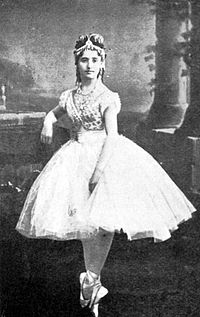
Adèle Dumilâtre (1821-1909) as Myrtha, Source Wikipedia
The performances of Giselle with Carlos Acosta and Natalia Osipova that I saw at Covent Garden on the 18 Jan and in the cinema on the 27 Jan were outstanding and will take their place in my memory alongside magnificent performances that I saw over 40 years ago by Margot Fonteyn and Rudolf Nureyev, Antoinette Sibley and Anthony Dowell and Carla Fracci and Erik Bruhn. However, I always feel uneasy after seeing Giselle - not just this performance but any. I hear my father's reproaches that time once lost can never be recovered,
The reason I have a problem with Giselle is the story. It is not that it is a silly story. Compared to Swan Lake and The Nutcracker it makes perfect sense. An impressionable young girl who has a steady relationship with the village gamekeeper is seduced by a playboy aristocrat in disguise who is already engaged to another woman. She shows him off to her mother and her friends and she is crowned queen of the wine pageant. The aristocrat's connections visit the village and he is exposed as a philanderer by the gamekeeper. Betrayed and humiliated the girl loses her reason and goes into a frenzy in which she either dies or kills herself. So far so good. The story could have come out of The Archersand I would not be surprised if something like it has not been run at some stage over the last 60 years.
But then the plot loses me because Giselle is buried in unconsecrated ground where her spirit joins those of other women who have been seduced and die before their wedding day. They have it in for men and if any man is unfortunate enough to stray across their path as the gamekeeper did they kill him (though having said that I have seen one performance, though I cannot remember which company, where the gamekeeper survives and the curtain falls on his shaking hands with the playboy). That is a pretty unpleasant as well as fantastic story and offends my sensibilities as a Quaker as well as an aesthete.
Interestingly I see from the programme notes that Peter Wright had similar reservations about the story when asked to stage Giselle and it is only in the last day or so that I find that he was also brought up as a Quaker. You see the idea of burying in a forest a young woman who has died of a broken heart or even killed herself appals us and the idea of hateful and vengeful forest spirits is .... well let's not go there. All this is of course a product of romanticism which produced great art but it also had a dark side which degenerated into nationalism, racism and, ultimately, fascism.
Of course all this was wonderful material for the Soviet authorities. Look at what used to happen in older superstitious times and count yourselves lucky that you now live in a modern socialist state that has no place for the likes of Albrecht. No wonder Giselle remained in the the repertoires of both the Kirov and Bolshoi and was indeed developed by them.
Yet Adam's music is so beautiful and the choreography of the second act is so compelling that I can't keep away from Giselle. I am ashamed to say it but it is my favourite ballet, And I leave the theatre after a good performance like the one on the 18 Jan damming the waves of tears. How do I sit through it despising myself for harbouring those emotions yet unable to walk away? The solution - and it is one that partially works for me any may not for anyone else - is to put the story out of my mind. To absorb the music and dancing as pure abstraction as though they were the work of Balanchine.
Further Reading
Adult Beginner Giselle8 Feb 2014 A very interesting and perceptive view of a performance of the Royal New Zealand Ballet by a blogger from Los Angeles.


.jpg)