Showing posts with label Royal New Zealand Ballet. Show all posts

Sunday, 15 November 2020

World Ballet Day Highlights #2 - The Royal New Zealand Ballet

Standard YouTube Licence

The Royal New Zealand Ballet had a very successful tour of the UK five years ago.  I attended and reviewed their performances of A Passing Cloud in Leeds on 4 Nov 2015 and Giselle in High Wycombe on 7 Nov 2015.   Their contribution to World Ballet Day on 29 Oct 2020 was one of my highlights of that day.  

Since their visit to this country, the company has appointed Patricia Barker as Artistic Director and it was she who welcomed the audience to the company's studios.  For the first 17 minutes, we saw the company's class taken by one of its ballet masters, Nicholas Schutz.  Schutz, like Barker, comes from the United States. So, too, does his wife Laura, who is one of the company's ballet mistresses.  It will be interesting to see whether they influence the company's repertoire and choreography.

World Ballet Day coincided with the opening night of The Sleeping Beauty which is touring New Zealand.  Barker led us to the rehearsal studio where she directed Kate Kadow and suitors in the rose adagio.  Schutz reappeared with Clytie Campbell, the other ballet mistress, to demonstrate how they create the scene where the lilac fairy leads Florimund to the sleeping Aurora.

The last scene was the technical rehearsal at the Wellington Opera House.  Kadow, already in costume for Aurora's 16th birthday, greeted her internet audience in her dressing room. The camera followed her down to the stage pursued by beaming students waving excitedly.  The very last scene showed Aurora's entry, a bit of the rose adagio and one of the scariest Carabosse entries I have ever seen. Judging by the volume of applause I think the last scene must have been the first night in Wellington.

Though New Zealand has been much more successful than most countries at controlling coronavirus the company has not been unaffected by the pandemic.   According to the News page, it has had to endure theatre closures and cancel a visit to London. On World Ballet Day, sunlight streamed through the windows of the rehearsal studios. The dancers trained without face coverings.  The applause in the theatre was thunderous.  While the main reason the RNZB's slot was one of my highlights of World Ballet 2020 is that the company is good it was also because it projected light and hope. Those of us about to enter the Northern Winter were shown an image of ballet in a post-pandemic world, Just as the prince was shown an image of the sleeping Aurora by the lilac fairy.

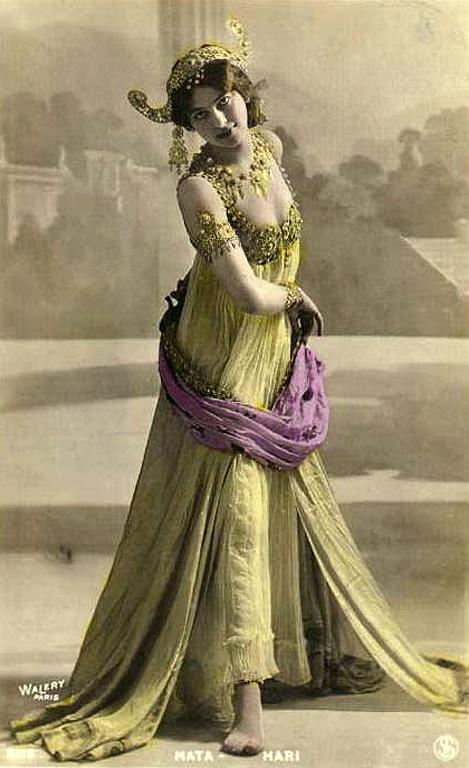
Monday, 30 November 2015

Mata Hari

Mata Hari
Author: Lucien Walery
Source Wikipedia


Both English National Ballet and the New Zealand National Ballet have created works to commemorate the First World War (see Kia Ora! The Royal New Zealand Ballet in Leeds 5 Nov and Lest We Forget 25 Nov 2015), The Netherlands was neutral during the First World War but it lost at least one of its citizens to that conflict.  Margaretha Geertruida Zelle, better known as Mata Hari, was executed by a French firing squad at Vincennes on 15 Oct 1917 after being convicted of espionage in a travesty of a trial in which her counsel was prevented from cross-examining the prosecution witnesses.  On 6 Feb 2016 the Dutch National Ballet will present Ted Brandsen's ballet Mata Hari on her life story.

The company's press manager, Richard Heideman, has described Mata Hari as "one of the most iconic women in Dutch history". His press release continues:

"Mata Hari was born to a well-to-do Frisian family in 1876 as Margaretha Zelle. Following an unhappy marriage, Zelle went to seek adventure in Paris. As the exotic, mysterious Mata Hari, she became one of the most famous dancers of her day. She travelled throughout Europe and had highly placed lovers everywhere, which made her an ideal spy during World War I. She was accused – rightly or wrongly – of being a double agent, and she died in front of a French firing squad in 1917.
Mata Hari was a passionate woman, for whom real life was too restrictive, which is why she was continually creating new images of herself and new guises.
................
The mysteries that surround her person and her dramatic, controversial death have made Mata Hari a welcome subject for the film industry. Famous actresses like Greta Garbo, Zsa Zsa Gábor, Marlène Dietrich, Jeanne Moreau, Sylvia Kristel and Maruschka Detmers have all played Mata Hari. There have also been stage versions, a television series and a Broadway musical about Mata Hari. She has been immortalised by painters like Isaac Israëls (1916) and John Singer Sargent (1906). And a great many books have been written about her life, ranging from serious biographies to Tomas Ross’ thriller The Tears of Mata Hari."
Brandsen's ballet focuses on Mata Hari's ability to keep ‘reinventing’ herself:
“She underwent many metamorphoses, like a Lady Gaga or Madonna of a hundred years ago”. 
He is particularly moved by her survival instinct and her will to make something of her life no matter what.

Tarik O’Regan has been commissioned to compose the score, The sets will be by Clement & Sanôu, and the costumes by Francois-Noël Cherpin.  If I can get to Amsterdam in February I will review the show.

Wednesday, 25 November 2015

Lest We Forget

Commemorating World War 1
Photo Andrew Davidson
Source Wikipedia
Creative Commons Licence


English National Ballet, Lest we Forget Palace Theatre, Manchester, 24 Nov 2015

Yesterday's performance of Lest we Forget in Manchester was superb. It was not an easy watch and for that reason I can't say that I enjoyed it but I was moved by it in a very special way. This was ballet at its best. It showed the unique power of dance to comprehend and find beauty in one of the greatest tragedies of human history. The end of the performance brought some members of the audience to their feet. I guess the only reason why more did not join in was that the audience was emotionally drained by the end.

The performance consisted of Liam Scarlett's No Man's Land, Russell Maliphant's Second Breath and Akram Khan's Dust. That was a shorter programme than the one premièred at the Barbican last year in that it omitted George Williamson's Firebird which I hope to see one day. All three were impressive works but the one that stood out for me was Scarlett's No Man's Land.

I had already seen a recording of Scarlett's Viscera earlier in the month (see Au Revoir but not Adieu 19 Nov 2015) and was keen to compare it to No Man's Land.  The two works could not have been more different. Set to excerpts from Franz Liszt's Harmonies Poétiques et Religieuses that had been arranged by Gavin Sutherland No Man's Land was haunting and lyrical. The work remembered not only the men who served in the forces but the women who stayed behind to make the munitions in appalling and sometimes dangerous conditions. The setting for this work was a damaged but still operational building - possibly a factory or maybe a ruin on the front. The women were in simple flowing dresses. The men in green or brownish tunics with steel helmets at one point in the ballet. There was enchanting dancing by Begoña Cao, Junor Souza, Alison McWhinney, Fabian Reimair, Shiori Kase and Fernando Bufalá.

Maliphant's Second Breath was an opportunity for Tamarin Stott and Joshua McSherry-Gray to shine and they were incandescent in their duet though the supporting dancers were important too. The work was set to a score by Andy Cowton but not easy to absorb. There were pulses of sound that I found quite alarming though that was possibly the composer's idea. There were snatches of barely audible and even less comprehensible speech in the piece followed by a pretty clear rendering of Dylan Thomas's Do Not Go Gentle into That Good Night which seemed to be delivered by the author himself. Dark and disturbing this was the work that required most work on the part of the audience.

The most dramatic work of the evening was Khan's Dust. It began with an execution - or possibly the nightmare of an execution for the victim continued to writhe on the ground. There was some impressive human sculpture where the dancers' limbs became waves or possibly a production line. It was Khan's Kaash at the Lowry that prompted me to book for Lest we Froget but this work was very different in that any South Asian influences were much less noticeable to me at an rate. The music for this work was by Jocelyn Pook who also wove speech into her score. There was what seemed to be a phrase of Auld Lang Syne repeating itself on a scratched record. The lead dancers were Erina Takahashi with Reinar and Bufala, This piece won Khan a number of awards last year and its success seems to have led to his commission to create a Giselle. I look forward to it immensely.

The centenary of the First World War inspired the Royal New Zealand Ballet to create Salute, another mixed bill focusing in war. They two of their ballets from that production to Leeds which I reviewed in  Kia Ora! The Royal New Zealand Ballet in Leeds 5 Nov 2015 earlier this month. The Netherlands which was neutral in the conflict is commemorating the war in a different way with Ted Brandsen's Mata Hari who was also a victim of that conflict.

Anyone who thinks that dance is a frivolous, frothy superficial art form incapable of dealing with difficult matters should think again. It is the synthesis of many arts and the whole is almost always greater than the constituent parts.

Tuesday, 10 November 2015

Royal New Zealand Ballet's Giselle


Embedded under YouTube's terms of service


Royal New Zealand Ballet. Giselle, Swan Theatre, High Wycombe, 7 Nov 2015

Last Thursday the Royal New Zealand Ballet showed its prowess with four modern works (see  Kia Ora! The Royal New Zealand Ballet in Leeds 5 Nov 2015). On Saturday it performed Giselle, one of the oldest works in the modern repertoire.

The version that the company danced on Saturday had been staged by its former artistic director, Ethan Stiefel and the former Royal Ballet principal, Johan Kobborg.  They added some original and dramatic touches to the work such as a grieving Albrecht at the beginning and the end and two new characters in a bride who tossed her bouquet to Giselle and her groom who danced an important pas de deux.  Another interesting twist, which may or may not have been coincidental was that Bathilde, who had been cheated by Albrecht, was danced by Abigail Boyle who re-emerged in the second act as Myrtha, the vengeful queen of the wilis. That made me wonder whether Albrecht's treachery had killed Bathilde too.

On Saturday Giselle was danced by Mayu Tanigaito who showed considerable skill in her dancing though perhaos rather less in her acting.  It may well have been a result of the direction but it was hard to detect emotion upon discovering that the boy who had courted her was a cheat.  Tanigaito's coolness and precision in act 1 was just what was needed for act 2. She danced with a rare lightness which when combined with Kendall Smith's skilful lighting really did produce an ethereal impression.

Albrecht was danced by Carlo di Lanno who is with the San Francisco Ballet. He came over very smooth but also very sleazy. Handsome undoubtedly but how any girl could have been taken in by that cove beats me. However, di Lanno can dance and he showed his virtuosity in both acts.  I was particularly impressed by a solo in the first act where he, Hilarion and the bridegroom show what they can do.

As to the other major roles, Paul Matthews was a convincing Hilarion, Abigail Boyle a superb Myrtha and Bronte Kelly and Shane Urton a joyful bride and groom. I should also say a word for Alayna Ng who came over well as a caring rather than a batty mum. Berthe's is not a big role in the ballet but Ng made it an important one.

The ballet was performed to a less than full auditorium which was a pity because the company danced well. I felt they needed a lift so I stood at the reverance and I am glad to say that more than a few people in the stalls followed me.

Thursday, 5 November 2015

Kia Ora! The Royal New Zealand Ballet in Leeds


Royal New Zealand Ballet: "A Passing Cloud", Stanley and Audrey Burton Theatre, 4 Nov 2015


The Maori name for New Zealand is Aotearoa which means the Land of the Long White Cloud which perhaps explains why the name of the Royal New Zealand Ballet's mixed bill was A Passing Cloud. I saw it last night at the Stanley and Audrey Burton Theatre in Leeds. The company played to a packed house which included one of this country's best choreographers as well as a fair number of dancers and dance students. Judging by the whoops and ululations with which each curtain call was greeted I would say that this visit to the UK by New Zealand's dancers is every bit as successful as last month's visit by its rugby players.

The show consisted of four works by the following choreographers:
These are four very different pieces with very different moods each of which tugged on a different emotion in a different way.

Before I saw Aotearoa-New Zealand for myself in 1996 I imagined it as a parallel Britain on the other side of the world. Nothing could be further from the truth. They speak our language, play our sports (often much better than we do), live by similar laws and there are odd bits of architecture in Christchurch and Dunedin which reminded me of home but their seasons, climate, terrain and vegetation could not be more different. If you want a crash course in what makes New Zealand special and distinctive you could do worse than attend this ballet.

The first ballet paid tribute to the people who first settled New Zealand. They were Polynesians whose achievements in exploration and navigation were comparable to the Vikings. They settled in Hawaii and Easter Island as well as New Zealand and just about every island in between.  They have a beautiful rhythmic language and haunting music all of which was used by de Frutos in his ballet. But although the music and verse was  Polynesian every jump, step and turn was classical.  Petipa would have recognized it all. Well almost all. This was a happy piece. Lots of primary colours. A great deal of jumping and plenty of joy. The audience loved it and none more than me.  Anatomy formed part of Made to Move when it was first performed two years ago and you can get a taste of it in the first frames of this YouTube video.

The next two works were drawn from Salute which were the company's contribution to New Zealand's World War I commemoration. As the first work drew smiles the next two drew tears, particularly Passchendale  which was about fighting, gas and death. In both ballets the music was provided by the New Zealand Army band who showed tremendous musicality. I wish we could have seen them as we did the works and colliery bands in Mark Baldwin's Dark Arteries last week (see Cock a Doodle Doo - Rambert's Rooster 27 Oct 2015).  Now that I think of it Mark Baldwin comes from the Antipodes, doesn't he.

I was reminded of another Rambert work momentarily in Selon désir in that Foniadakis like Jeyasingh in Terra Incognita had dressed his boys in kilts but that was where the similarity ended.  Selon désir was an explosion of energy. Thrilling to watch it must have been exhausting to dance. This work will form part of the company's Speed of Light  programme in the new year. All I can say is that the folks back home in New Zealand are in for a treat.  Set to Bach's St John's and St Matthew Passions, this work soars. As I had been stranded in Geneva by fog on Monday night I was amused to see that this work like Bruce's Rooster was first shown at the city's Grand Theatre (see Geneva Nutcracker 26 Oct 2015).

The Royal New Zealand Ballet has left Leeds for High Wycombe where I plan to see its Giselle on Saturday. Then Canterbury, the Linbury and Italy. If you get the chance to see these wonderful dancers grab it with both hands.

Sunday, 11 October 2015

Giselle in Moscow, Amsterdam, Edinburgh, High Wycombe and Manchester


Dutch National Ballet's Giselle


This afternoon at 16:00 the Bolshoi Ballet's Giselle will be transmitted to cinemas across the United Kingdom and many other countries (see Live Performances streamed from the Bolshoi and Covent Garden 20 Sept 2015). I shall watch it at the National Media Museum in Bradford but I believe it will be shown by the Odeon, Cineworld and most of the other nationwide chains. It should be a very good performance. Svetlana Zakharova dances Giselle, Sergei Polunin Alnrecht, Denis Savin Hans (aka Hilarion) and Yekaterina Shipulina as the queen of the wilis. I shall review the show tomorrow.

Much closer to home the Dutch National Ballet is staging Giselle in Amsterdan between 13 Oct and 15 Nov. Tsygankova, Makhateli, de Jongh, Wotmeyer and Shesterikovare in the cast together with many other of my favourite dancers. That will be good too.

Another Giselle will come to us from New Zealand.  Adult Beginner wrote a great review of that ballet when the Royal New Zealand Ballet visited Los Angeles last year (see Giselle 8 Feb 2015 Adult Beginner). The company will dance that ballet in Edinburgh between 27 and 31 Oct and High Wycombe between 6 and 7 Nov where I shall see it.

Finally, our very own Manchester City Ballet (the performing company of Northern Ballet School) will dance Giselle at the Dancehouse between 10 and 12 Dec 2015. Tickets are on sale on Ticketline.

Thursday, 8 October 2015

More from World Ballet Day - Akram Khan's Dust


Footage from World Ballet Day, English National Ballet's rehearsal of Akram Khan's Dust, Embedded under YouTube standard licence


Having been bowled over by Kaash on Tuesday night (see Akram Khan's Kaash - contemporary meets Indian classical 7 Oct 2015) I am keen to see more of Akram Khan's work. I shall get my chance when English National Ballet perform Dust as part of Lest We Forget triple bill in Manchester on 24 Nov 2015. I got a taster of the work this morning when I watched the above clip from World Ballet Day. The dancers are Erina Takahashi and James Streeter.

It will be interesting to compare Lest We Forget with the Royal New Zealand Ballet's Dear Horizon by Andrew Simmons and Paschendale by Neil Ieremia which also commemorate the First World War. These will be performed in Leeds as part of  The Anatomy of a Passing Cloud programme on 3 and 4 Nov 2015,

Friday, 29 May 2015

A Post Script from New Zealand

In The All Blacks of the Art World are coming to Leeds I wrote that the Royal New Zealand Ballet will visit the UK in the Autumn and they are bringing two of their works to this country: Giselle which they are dancing in Edinburgh, High Wycombe and Canterbury and a mixed bill entitled The Anatomy of a Passing Cloud which they will perform at the Stanley and Audrey Burton Theatre in Leeds and the Linbury in Covent Garden.

The mixed bill will contain several ballets from Salute which opened in Wellington on 22 May and is now in Christchurch on the second leg of the company's tour of New Zealand. @tweeting_nik who lives in New Zealand kindly brought the following video by the Royal New Zealand Ballet to my attention:


Check out some footage of our premiere in Wellington and make sure you get your tickets http://www.rnzb.org.nz/shows-and-events/salute/dates-venues/
Posted by Royal New Zealand Ballet on Wednesday, 27 May 2015
She also kindly offered to identify the individual works shown in the clip which offer I gratefully accepted:
Clearly, we in this country are in for a treat. I am grateful to the company for publishing this clip and providing an embed code and to @tweeting_nik for her commentary.

Monday, 25 May 2015

The All Blacks of the Art World are coming to Leeds


On the 3 and 4 Nov 2015 the Royal New Zealand Ballet will dance in the Stanley and Audrey Burton Theatre in Leeds. A visit by a national ballet company is a great compliment to Yorkshire especially as the dancers are coming to Leeds before touring High Wycombe, Canterbury and London.

The New Zealanders are bringing two works to this country:
  • Giselle which the inimitable Adult Beginner reviewed in This is what happens when you don’t read the plot synopsis 3 Feb 2014 and Giselle 8 Feb 2014 when they visited Los Angeles last year; and
  • The Anatomy of a Passing Cloud, a mixed bill consisting of Javier de Frutos's ballet of that name, Andonis Foniadakis's Selon Desir and Neil Ieremia's Passchendaele.
The last of those works is to mark the centenary of the First Word War and New Zealand's participation in that conflict and honours the mant New Zealand troops who fell in Passchendaele. The company has performed that ballet with the band of the New Zealand army as part of Salute a tribute to that nation's war dead.

The company will dance Giselle in Wycombe and Canterbury and The Anatomy of a Passing Cloud in Leeds and London. I don't know whether it is a coincidence but the Maori name for New Zealand is Aotearoa which translates literally as the "land of the long white cloud".

I visited that beautiful country in February 1992 and travelled everywhere from Cape Reinga in the North to Bluff in the South. I saw a great performance of The Mikado in the Aotoa Centre in Auckland. Equally remarkable was the sight of two young women meeting on a pedestrian crossing in Wellington Street Auckland and two lines of traffic at 18:00 at the height of the rush hour waiting patiently for them to finish their conversation. Not a single motorist hooted his horn. I do hope the New Zealand dancers don't try to do that in Wellington Street in Leeds. Our motorists just wouldn't understand.

I am no expert on rugby but I believe that the All Blacks are one of the best national sides in the world.  If the Royal New Zealand Ballet aspires to be the All Blacks of the art world I think we are in for a treat.

Post Script

@tweeting_nik who lives in New Zealand has just tweeted
I responded to her tweet as follows:

Nik has just pointed out that the mixed bill will also include "Dear Horizon" which has recently been premièred in  New Zealand.