Showing posts with label First World War. Show all posts

Monday, 30 November 2015

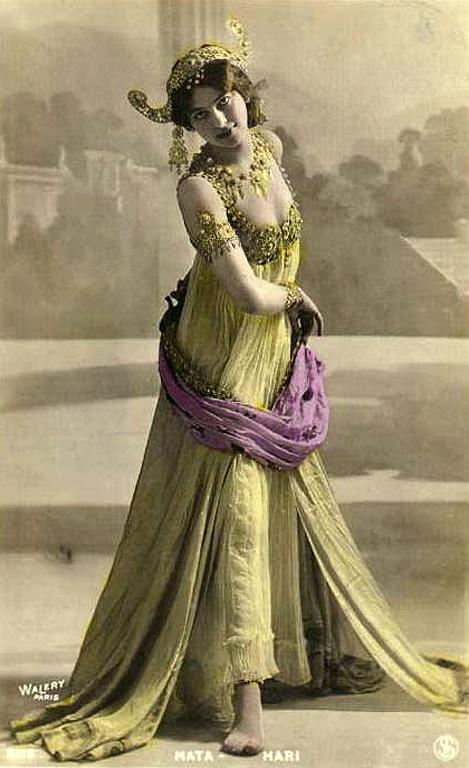
Mata Hari

Mata Hari
Author: Lucien Walery
Source Wikipedia


Both English National Ballet and the New Zealand National Ballet have created works to commemorate the First World War (see Kia Ora! The Royal New Zealand Ballet in Leeds 5 Nov and Lest We Forget 25 Nov 2015), The Netherlands was neutral during the First World War but it lost at least one of its citizens to that conflict.  Margaretha Geertruida Zelle, better known as Mata Hari, was executed by a French firing squad at Vincennes on 15 Oct 1917 after being convicted of espionage in a travesty of a trial in which her counsel was prevented from cross-examining the prosecution witnesses.  On 6 Feb 2016 the Dutch National Ballet will present Ted Brandsen's ballet Mata Hari on her life story.

The company's press manager, Richard Heideman, has described Mata Hari as "one of the most iconic women in Dutch history". His press release continues:

"Mata Hari was born to a well-to-do Frisian family in 1876 as Margaretha Zelle. Following an unhappy marriage, Zelle went to seek adventure in Paris. As the exotic, mysterious Mata Hari, she became one of the most famous dancers of her day. She travelled throughout Europe and had highly placed lovers everywhere, which made her an ideal spy during World War I. She was accused – rightly or wrongly – of being a double agent, and she died in front of a French firing squad in 1917.
Mata Hari was a passionate woman, for whom real life was too restrictive, which is why she was continually creating new images of herself and new guises.
................
The mysteries that surround her person and her dramatic, controversial death have made Mata Hari a welcome subject for the film industry. Famous actresses like Greta Garbo, Zsa Zsa Gábor, Marlène Dietrich, Jeanne Moreau, Sylvia Kristel and Maruschka Detmers have all played Mata Hari. There have also been stage versions, a television series and a Broadway musical about Mata Hari. She has been immortalised by painters like Isaac Israëls (1916) and John Singer Sargent (1906). And a great many books have been written about her life, ranging from serious biographies to Tomas Ross’ thriller The Tears of Mata Hari."
Brandsen's ballet focuses on Mata Hari's ability to keep ‘reinventing’ herself:
“She underwent many metamorphoses, like a Lady Gaga or Madonna of a hundred years ago”. 
He is particularly moved by her survival instinct and her will to make something of her life no matter what.

Tarik O’Regan has been commissioned to compose the score, The sets will be by Clement & Sanôu, and the costumes by Francois-Noël Cherpin.  If I can get to Amsterdam in February I will review the show.

Wednesday, 25 November 2015

Lest We Forget

Commemorating World War 1
Photo Andrew Davidson
Source Wikipedia
Creative Commons Licence


English National Ballet, Lest we Forget Palace Theatre, Manchester, 24 Nov 2015

Yesterday's performance of Lest we Forget in Manchester was superb. It was not an easy watch and for that reason I can't say that I enjoyed it but I was moved by it in a very special way. This was ballet at its best. It showed the unique power of dance to comprehend and find beauty in one of the greatest tragedies of human history. The end of the performance brought some members of the audience to their feet. I guess the only reason why more did not join in was that the audience was emotionally drained by the end.

The performance consisted of Liam Scarlett's No Man's Land, Russell Maliphant's Second Breath and Akram Khan's Dust. That was a shorter programme than the one premièred at the Barbican last year in that it omitted George Williamson's Firebird which I hope to see one day. All three were impressive works but the one that stood out for me was Scarlett's No Man's Land.

I had already seen a recording of Scarlett's Viscera earlier in the month (see Au Revoir but not Adieu 19 Nov 2015) and was keen to compare it to No Man's Land.  The two works could not have been more different. Set to excerpts from Franz Liszt's Harmonies Poétiques et Religieuses that had been arranged by Gavin Sutherland No Man's Land was haunting and lyrical. The work remembered not only the men who served in the forces but the women who stayed behind to make the munitions in appalling and sometimes dangerous conditions. The setting for this work was a damaged but still operational building - possibly a factory or maybe a ruin on the front. The women were in simple flowing dresses. The men in green or brownish tunics with steel helmets at one point in the ballet. There was enchanting dancing by Begoña Cao, Junor Souza, Alison McWhinney, Fabian ReimairShiori Kase and Fernando Bufalá.

Maliphant's Second Breath was an opportunity for Tamarin Stott and Joshua McSherry-Gray to shine and they were incandescent in their duet though the supporting dancers were important too. The work was set to a score by Andy Cowton but not easy to absorb. There were pulses of sound that I found quite alarming though that was possibly the composer's idea. There were snatches of barely audible and even less comprehensible speech in the piece followed by a pretty clear rendering of Dylan Thomas's Do Not Go Gentle into That Good Night which seemed to be delivered by the author himself. Dark and disturbing this was the work that required most work on the part of the audience.

The most dramatic work of the evening was Khan's Dust. It began with an execution - or possibly the nightmare of an execution for the victim continued to writhe on the ground. There was some impressive human sculpture where the dancers' limbs became waves or possibly a production line. It was Khan's Kaash at the Lowry that prompted me to book for Lest we Froget but this work was very different in that any South Asian influences were much less noticeable to me at an rate. The music for this work was by Jocelyn Pook who also wove speech into her score. There was what seemed to be a phrase of Auld Lang Syne repeating itself on a scratched record. The lead dancers were Erina Takahashi with Reinar and Bufala, This piece won Khan a number of awards last year and its success seems to have led to his commission to create a Giselle. I look forward to it immensely.

The centenary of the First World War inspired the Royal New Zealand Ballet to create Salute, another mixed bill focusing in war. They two of their ballets from that production to Leeds which I reviewed in  Kia Ora! The Royal New Zealand Ballet in Leeds 5 Nov 2015 earlier this month. The Netherlands which was neutral in the conflict is commemorating the war in a different way with Ted Brandsen's Mata Hari who was also a victim of that conflict.

Anyone who thinks that dance is a frivolous, frothy superficial art form incapable of dealing with difficult matters should think again. It is the synthesis of many arts and the whole is almost always greater than the constituent parts.