Showing posts with label Iain Mackay. Show all posts

Sunday, 24 September 2017

Birmingham Royal Ballet's Aladdin nearly Five Years on


Standard YouTube Licence


Birmingham Royal Ballet Aladdin The Lowry, 23 Sept 2017, 19:30

Shortly after I started this blog I reviewed Birmingham Royal Ballet's Aladdin (see my review of 1 March 2013). I saw it just after I had started taking ballet lessons with Fiona Noonan several months before I entered the over 55 class at Northern Ballet. Although I had seen a lot of ballet before 2013 I had not actually done very much. I have since learned that however much ballet you see from the stalls or dress circle you really don't know what you are talking about until you try your hand at it. Then your admiration for those who make their living from the art soars beyond bounds.

In March 2013 I wrote:
"Having developed my love of ballet while Frederick Ashton was the Royal Ballet's choreographer I am very hard to please. But pleased I was. The pas de deux that Bintley created for Aladdin and the Princess danced yesterday by Jamie Bond and Jenna Roberts reminded me a lot of Ashton. So did the powerful roles for the djinn (Matthias Dingman), Mahgrib and Sultan (Rory Mackay). Also, the sweet role for Aladdin's mother danced delightfully by Marion Tait - no Widow Twankey she. Other lovely touches - and very familiar to Manchester with our famous Chinese quarter - were the lion and dragon dances. It is probably unfair to single out any of the other dancers because all excelled but I was impressed particularly by Céline Gittens who danced Diamond. Finally, Davis's score with its oriental allusions was perfect for Bintley's choreography."
I saw many of the same dancers in the same roles last night. Would I still like it especially as I had been looking forward to Stanton Welch's La Bayadère which had to be axed when Birmingham City Council reduced its grant to Birmingham Royal Ballet? (see A Birmingham Bayadère 26 Nov 2016 and How Nikiya must have felt when she saw a snake 31 Jan 2017)

Well, I am glad to say that I liked Aladdin even more last night and I think I have to thank my teachers in Leeds, Manchester, Huddersfield, Sheffield, London, Liverpool, Cambridge, Budapest and, half a century ago, St Andrews for that as they taught me how to appreciate ballet. As before I loved Carl Davis's score. I was impressed by Sue Blane's costumes, Dick Bird's sets and Mark Jonathan's lighting. I was thrilled by David Bintley's choreography. Most of all I was dazzled by the dancing.

César Morales was a perfect Aladdin alternating from an awkward adolescent to the sultan's splendid sun in law. Jenna Roberts was as lovely as she had been when I had last seen her in that role. Iain Mackay was a magnificent magician (why does Salford feel it has to boo him at the curtain call just because he is cast as a baddie?)  Aitor Galende. clad and coloured from head to toe in blue was a noble djinn. Tom Rogers was every inch a sultan.  Marion Tait is always a delight. One of my all-time favourites. It was appropriate that many of my other favourites appeared as jewels for gems they are. The incomparable Céline Gittens, glittered as a diamond, Chi Cao glowed as an emerald, Samara Downs and Alys Shee gleamed as gold and silver, Yasuo Atsujii and Yijing Zha radiated as rubies, Karla Doorbar shone as onyx as indeed did the whole cast.

I attended the performance with a friend who has seen a lot of ballet and attended a lot of classes though she likes the other performing arts and other dance forms at least as well. She also saw the 2013 show with me and said she enjoyed last night's performance even more. Sitting next to us were a couple for whom ballet was still a new experience. In fact, for one them it was his first live show. I was curious to see whether he would take to it. He told me that he found difficulty with the first act but enjoyed the second and third very much. On balance he enjoyed the whole experience.

I hope to see Stanton Welch's La Bayadère one day even if I have to fly to Texas to do so.  As one of my favourite young dancers has just moved from HNB to the Houston Ballet I hope to do so soon, I was sad to learn that the company had suffered so much from Hurricane Harvey.  As I said in Houston Ballet  30 Aug 2017 we in the North know the damage flood water can do. I am sure that company will emerge stronger than ever as Northern Ballet did. I shall look out for the Houston Ballet on World Ballet Day and give it a special cheer.

Sunday, 9 October 2016

The Tempest


Birmingham Royal Ballet, The Tempest, The Hippodrome, Birmingham, 8 Oct 2016, 19:00

Even before the curtain rose I knew I was in for a treat. The clues lay in the blue curtain with its lines suggesting a swirling ocean with a tiny bejewelled model barque in the centre together with the cries of seagulls and a gentle lapping of waves. The lights dimmed and the silhouette of a seemingly floating figure approached the model and carried it away. The curtain rose and the scene changed to a ship's bridge with jolly, dancing mariners whose mood swiftly changed as flashes of light indicated that their ship was entering a storm.

It often takes time for me to get to like a new ballet. It took two years for me to appreciate Christopher Wheeldon's The Winter's Tale (see Royal Ballet "The Winter's Tale" 14 April 2014 and The Winter's Tale Revisited - Some Ballets are better Second Time Round 20 April 2016) and I am still not there with Jonathan Watkins's 1984 (see My First Impressions of 1984 12 Sept 2015 and 1984 Second Time Round 24 Oct 2015).  The Tempest is different in that it was love at first sight. I think it is my favourite work by David Bintley so far. In fact, I can't remember a time when I was as excited as I am now about a new British full length ballet since the days of Sir Frederick Ashton.

David Bintley's libretto follows Shakespeare pretty faithfully (see "The Plot" in Wikipedia's entry on The Tempest). It makes powerful roles for ProsperoMiranda, Ferdinand, Ariel and Caliban. Prospero's masque for Miranda and Ferdinand provides a splendid opportunity for a delightful divertissement that included charming dancers for Ceres and Juno as well as other classical deities. The antics of the drunkards provide another opportunity, especially when they discover the dressing up box in Prospero's cave after which they are set upon by a pack of dog shaped spirits. 

Although the ballet - like the play - is about raw human emotions such as greed, resentment, ambition as well as love it is leavened by those divertissements.  The need for such relief in the form of divertissements was understood by Petipa and indeed by Ashton and Bintley as it was by Shakespeare. The complete absence of such relief, as in Akram Khan's Giselle, makes for a very drab work indeed. As I noted in my review of the remake:
"At least in the traditional Giselle there are some happy bits such as the crowning of Giselle as harvest queen. There was nothing like than in Khan's. Just a morose folk dance for the landlords who were heralded by blasts that sounded like factory sirens or perhaps fog horns. Very intense and just a little depressing."
The freshness and exuberance of the work continued even into the reverence which was a little ballet in itself. The dancers did not simply bow or curtsy.  They danced into their applause. This performance really did deserve a standing ovation and I was one of several who rose at the curtain call.

Last night, Prospero was danced magnificently by Iain Mackay, Miranda delightfully by Jenna Roberts and Ferdinand plaintively by Joseph Caley. Mathias Dingman was a great Ariel and Tyrone Singleton a fine Caliban. It was good to see Michael O'Hare as Alonso and Céline Gittens as Ceres and Delia Matthews as Juno and Prospero's wife. There was superb character dancing from James Barton a the jester and Valentin Olovyannikov as the drunken butler.  As I say so frequently whenever I see this magnificent company, everyone in the show danced well.

Bintley's choreography was (as always) sparkling. There were spectacular chaînés and  fouettés for Ariel, beautiful pas de deux for Ferdiand and Miranda after they first met and as their love developed, delightful dances for Ceres and Juno and plenty of arabesques and opportunities to admire the corps. According to Gerald Dowler's programme note this ballet had been 30 years in the making and the reason for the long gestation is that Bintley had been waiting for the right composer. Quoting Bintley, Dowler wrote:
"I heard Sally Beamish's music in 2012 and it all seemed to fall into place."
It was well worth the wait. Beamish's score was enchanting. I particularly liked her use of the flute to indicate voices or underscore excitement. Equally impressive were Rae Smith's designs. The waves and ship were even more realistic than in The Winter's Tale. The peacock throne was especially impressive. All the more remarkable as the sets have to be portable as this ballet is to be taken on tour.  Combined with Bruno Poet's lighting, something close to magic was created on stage.

Now this ballet really will last. It was created in collaboration with the Houston Ballet Foundation and the Houston Ballet will present it to American audiences in Spring.  If I know Americans - and as a graduate of one of their finest universities and have made many trips to their shores I think I do - they will relish this production at least as much as I do. So, too, will audiences in the rest of the world.

Tuesday, 21 June 2016

Birmingham Royal Ballet performs my favourite ballet at last

Birmingham Royal Ballet
(c) John Lambert 2016: all rights reserved


Birmingham Royal Ballet, The Taming of the Shrew. Birmingham Hippodrome, 18 June 2016

John Cranko created some of his most best known works including The Taming of the Shrew for the Stuttgart Ballet but he trained at Sadler's Wells School and started his career at the Sadler's Wells Ballet part of which is now the Birmingham Royal Ballet. Despite its shared connection with Cranko it was only on the 16 June 2016 (some 47 years after the premiere in Germany) that the Birmingham Royal Ballet was able to stage this work in this country.

For me that is a matter of regret because Cranko appeals to me more than any other choreographer and The Taming of the Shrew is the work that I love most. Even more than The Prince of the Pagodas, Onegin and Pineapple Poll. So if anybody were to ask me which is my favourite ballet I would have to say that it is this one.  I first learned about the work in Dance and Dancers in 1969 and have longed to see it ever since (see Cranko's "Taming of the Shrew": Now's our chance to see one of the Ballets everyone should see before they die 21 Sept 2013). I got my chance on 23 Nov 2013 when the Stuttgart Ballet visited London (see Stuttgart Ballet's "Taming of the Shrew" - well worth the Wait 25 Nov 2013).

I think the reason I love the ballet so much is that I love the play and the reason I love the play is that I love paradox. I began to appreciate the paradox upon seeing snippets of Meryl Streep's performance as Katherina in New York City many years ago (see Kiss me Petrucchio (1981) Meryl Streep and Raul Julia - A Documentary from 1981 on YouTube). I never saw that show but I do remember her explaining the work in a feminist context. I am also enjoying the serialization of Anne Tyler's The Vinegar Girl on Radio 4 just now. In her programme note, Pas de Dukes, Katherine Barber who runs Tours en l'Air (see Tours en l'Air a Really Useful Resource  23 Feb 2014) draws parallels with Romeo and Juliet:
"But The Taming of the Shrew is in many ways the 'anti-Romeo and Juliet.'  Silly (with an inspired silliness and comic. It mirrors its solemn and tragic sibling sometimes scene for scene: a tender wedding with the wise Friar Lawrence becomes a farcical free-for-all with a cartoonish priest; bridesmaids who are an ironic harbinger of death in the one are chased around by a baulky and belligerent bride with a limp lily in the other; a pas de trois depicting exuberant high spirits of young men in Verona becomes a vaudeville trio of Chaplinesque buffoons in Padua. Both ballets end in tears, though in one they are tears of sorrow and the other tears of laughter."
An interesting idea and one that had not occurred to me before though I caution against drawing too many parallels because all love stories and the ballets derived from them share at least some of those elements.

Although the Birmingham Royal Ballet uses Cranko's choreography and Kurt-Heinz Stolze's score the designs are different. Elisabeth Dalton designed the sets and costumes for Stuttgart (see her obituary in The Stage) while Susan Benson designed Birmingham's. One the whole I think I preferred Benson's as they gave an even greater freshness and touch of joy to the Birmingham production. In a post to BalletcoForum Barber suggested that Birmingham Royal Ballet had used the National Ballet of Canada's costumes and it is certainly the case that Benson contributed the designs to the Canadian production (see The National Ballet's Ballet Notes for its 2007 season which incidentally also publishes Barber's article sub nom The Taming of the Shrew: Shakespeare in Motion).

The reason I took notice of the ballet in 1969 is that Cranko deployed a stellar cast:
The dancers in Saturday's matinee were pretty impressive too. 

Kate was danced by Elisha Willis. I count myself as one of her biggest fans and I had been led to believe by a clipping in the Birmingham Mail that Saturday's would be her last performance (see Roz Laws Birmingham Royal Ballet star Elisha Willis on ditching dancing for stitching 14 June 2016). I have since learned that she will dance at least one more show in Bristol. I shall miss Willis and I wish her all the best for the future. 

Willis was partnered brilliantly by Iain Mackay. Jenna Roberts was a sweet but not too sugary Bianca while Brandon Lawrence was her Lucentio. I also enjoyed Rory Mackay's performance as Gremio (particularly his wooing of Bianco and his discomfiture by Kate), Chi Cao's as Hortensio and Delia Matthews's and Angela Paul's as their wives and Jonathan Payn's as Baptista. However, I should say a special word for Valentin Oloyyannikov who doubled as the publican and priest. He is a great character dancer and his characterization of the cleric was nothing short of brilliant.

The play has inspired Jean-Christophe Maillot to create another version of The Taming of the Shrew for the Bolshoi which was screened to British audiences in  January (see Competition for Cranko: The Bolshoi's Taming of the Shrew streamed from Moscow 25 Jan 2016). I enjoyed the screening very much and I look forward to seeing it live when the Bolshoi bring it to Covent Garden.

Thursday, 23 October 2014

A Second Miracle

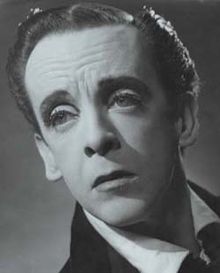
Sir Robert Helpmann
Photo Wikipedia
In Dancing in the Blitz: How World War 2 Made British Ballet David Bintley spoke of Sadler's Wells Ballet's contribution to maintaining morale during the second world war. Much of the credit belongs to Sir Robert Helpmann who was one of the few male dancers to avoid conscription. He was also a considerable choreographer creating  ComuHamlet, The Birds and Miracle in the Gorbals during that period. The last of those ballets was a particular favourite possibly because it was a story about the conflict between good and evil which would have reminded the public why they were fighting.

The story is based on Jerome K. Jerome's Passing of the Third Floor Back which is a Christian allegory. Jerome's work is set in London and is about the efforts of a Christ figure ("the stranger") to improve the lives of the residents of a boarding house that had been made miserable by a grasping landlady and a well off businessman. The residents listen to the stranger and follow his advice. That upsets the businessman who bribes the residents to turn against the stranger.

Jerome's short story was transposed to Glasgow by Helmpann's partner Michael Benthall who wrote the scenario for the ballet. A young woman throws herself in the river and is dragged out unconscious. A clergyman tries unsuccessfully to revive her.  He covers her with a shroud and leaves her for dead. A stranger appears and revives her. The crowd acclaims the stranger as a miracle worker much to the annoyance of the clergyman whose shortcomings are revealed when he follows a prostitute to her lodging.  He encourages some local gangsters to set about the stranger who is left to die alone on stage with only the a beggar for company.

The music for the ballet was provided by Sir Arthur Bliss a recording of which you can hear on YouTube.   The sets and costumes were designed by Edward Burra (see Pallant House Gallery's Painting the Stage). The cast of the first performance on the 26 Oct 1944 at The Prince's theatre (now the Shaftesbury) included Moira Shearer, Leslie Edwards, Celia Franks, Gerd Larsen, Stanley Holden, Gillian Lynne and Helpmann himself who danced the stranger.

The ballet was included in the repertoire every year between 1944 and 1950 and was taken on tour. It then disappeared from the Sadler's Wells Ballet's repertoire though critics were still referring to it when I first took an interest in ballet in the late 1960s. For some reason the public forgot it in contrast to Martha Graham's Appalachian Spring which was first performed in Washington just four days later and which has much in common with Helpmann's work. No doubt that is because Helpmann developed his acting career though I have seen him dance with Sir Frederick Ashton in Cinderella in the early 1970s. He also compeered Sir Frederick's retirement gala on 24 July 1970 which I was lucky enough to attend.

It was therefore something of a second miracle to see the revival of this work at Sadler's Wells on 18 Oct 2014. Revival is perhaps not quite the right word for as Dame Gilian Lynne said in The Inspiration which was reprinted in the programme: "There are very few people left alive from that 1944 creation and not one of us remembers a step." Lynne has re-created the ballet to Bliss's music in the style of Helpmann and it certainly looks authentic to me. It appears that Burra's set and costume designs did not survive but Adam Wiltshire seems to have come close. The sense of period was conjured by the sounds of an air raid - the drone of an aircraft, explosions, anti-aircraft fire and a siren - all in total darkness before the first few bars of Bliss's score.

Miracle was sandwiched between MacMillan's La Fin du Jour and Bintley's Flowers of the Forest as part of Birmingham Royal Ballet's Shadows of War programme. Each of those ballets is an important work in its own right and therefore merits a separate review. The company had cast some of its strongest dancers for the performance. The stranger was danced by César Morales, the clergyman by Iain Mackay, the prostitute by Elisha Willis and the suicide victim by Delia Matthews.   Even some of the minor roles were danced by accomplished dancers - Marion Tait and Ruth Brill as two of the old ladies - and Yatsuo Atsuji, Brandon Lawrence, Rory McKay and Valentin Olovyannikov as gangsters.

The only other work of Lynne's that I have seen is "A Simple Man" which she choreographed for Northern Ballet to mark the centenary of L S Lowry's birth nearly 30 years ago (see "Northern Ballet's 'A Simple Man'" 14 Sept 2013). That is another ballet set in the back streets of another great industrial city in times gone by. There is much in Miracle that reminds me of A Simple Man. I wonder how much of Simple Man derives from Helpmann.

Other Reviews

Robert Hugill  Miracle in the Gorbals 18 Oct 2014 Planet Hugill