Showing posts with label matinee. Show all posts

Sunday, 8 March 2020

The Royal Ballet's "Onegin"


Standard YouTube Licence


Royal Ballet Onegin Royal Opera House 18 Jan 2020, 13:30

The last time I saw the Royal Ballet's Onegin, I wrote:
"That night I saw something wonderful. Cranko's Onegin danced by Matthew Golding in the title role, Natalia Osipova as Tatiana, Matthew Ball as Lensky and Bennet Gartside as Prince Gremin. It was quite simply the most enjoyable performance by the Royal Ballet that I had seen since the days of Sibley and Dowell." (See Onegin: the most enjoyable performance that I have seen at the House since Sibley and Dowell 21 Feb 2015).
Although I knew what to expect and saw a very different interpretation with Thiago Soares in the title role, Itziar Mendizabal as Tatiana, David Donnelly as Lensky and Meaghan Grace Hinkis as Olga, I was as thrilled second time around as I had been the first time I saw the ballet.

As before, it was the choreography that thrilled me.  In my 2015 review, I described John Cranko as my favourite choreographer of all time and so he remains.   I said: "Cranko understood and interpreted music in a way that produces a fluency that is instantly recognizable but hard to describe".  But that was not all.  I added:  "He was also a great storyteller with a sense of humour."  Not so much humour perhaps as in The Taming of the Shrew which remains my favourite work by Cranko but there is a great story of which many of us in the English speaking world would otherwise have been unaware.

Soares's Onegin was very different from Golding's.  I had described Goldring's portrayal as "steely, amoral but ultimately foolish" but I saw complexities in Onegin's character that I had missed before.  I believe that he was conflicted and he had certainly matured between his duel with Lensky and his reacquaintance with Tatiana in St Petersburg.  Maybe I would have picked that up from seeing the ballet again but I am not sure.  Soares has the ability to communicate mood and maybe even thought.

I also learnt something new about Tatiana from Mendizabal. With Osipova I sensed revenge in the last act but Mendizabal seemed much more conflicted. It was if she still had feelings for Onegin despite the way he had humiliated her at her party and the quite unnecessary duel with Lemsky. She must have known that running away with him would have ruined her.  She would have thought that if he was capable of dropping her once he could do it again.  She had a good husband.  All that anyone could want.  And yet,  She was tempted.  Happily, she listened to her head rather than her heart and sent Onegin packing.  Some ballets do have a happy ending.

Grace Hinkis was a great Olga and Donnelly a loyal but headstrong Lensky.  Watching the run-up to the duel was like watching a video of a train crash in slow motion. A bit like the scene in Romeo and Juliet where Mercution picks a fight with Tybalt that possibly end well.     

There are some steps for the corps that must require lots of rehearsing. For instance, the folk dance towards the end of Act I with the girls' jetés on the arms of their partners who march off stage but do not run.

Jurgen Rose's set designs, particularly of the outdoor scenes and especially the venue for the duel, impressed me as much as they did the first time I saw them. The first rays of dawn were a triumph of lighting design.  The costumes were gorgeous.  I am not a big fan of rearranging music that was never intended for dance I make an exception for Kurt-Heinz Stoltze's score.

I had expected the matinee to be eclipsed by English National Ballet's gala at the Coliseum which I saw a few hours later but, if anything, it was the other way round.  Onegin is a great classical ballet created in our own time which is why so many leading companies around the world stage it.

Monday, 25 March 2019

Van Dantzig's "Swan Lake"


Standard YouTube Licence

Dutch National Ballet Swan Lake The Music Theatre, Amsterdam, 24 March 2019, 14:00

Rudi van Dantzig is one of three towering geniuses who have given Dutch ballet its reputation for excellence,  The others are Hans van Manen and Toer van Schayk.  Van Dantzig and van Schayk collaborated in the 1980s to stage one of the best versions of Swan Lake that I have ever seen.

As I entered the auditorium, I saw a screen bearing a likeness of Tchaikovsky, his name and the title of his ballet in Dutch and Russian.  As the house lights faded and the orchestra struck up, the principal characters of the drama appeared behind the screen. The tale of Odette's enchantment by Von Rothbart is sketched out.  The screen rose to reveal the palace gardens where Prince Siegfried's coming of age took place.  From there until the final act the ballet proceeds in the same way as most other versions of Swan Lake until the last act.  There, the story deviates.

According to the programme notes:
"Von Rothbart tries to drive Siegfried away from the lake, but although Siegfried manages to defy him, he drowns in the waters."
That appears to be an accident rather than a deliberate sacrifice by Siegfried and Odette to break von Rothbart's spell as in other versions.   The drowning is represented by a pale blue sheet of silky material suddenly fanned across the stage.  The lifeless Siegfried is carried ashore by his companion, Alexander. The programme concludes:
"In Alexander, Siegfried's ideals will live on."
That is how the ballet ends.   No epilogue of lovers ascending to heaven on a swan-shaped barque as in the versions with which we are familiar.

Every performance of Swan Lake turns on its lead ballerina.  She has to assume two very different personalities in the same work.  There are some who dance Odette well but are less convincing as Odile and vice versa.   The superabundantly talented Maia Makhateli can do both.  She is pure and delicate as Odette and brazen and explosive as Odile. Never have I seen Legnani's 32 fouettés performed with greater aplomb. Her virtuosity is thrilling and her acting was compelling. She was perhaps the best Odette-Odile I have seen since Sibley.

Sibley was partnered in Swan Lake by Sir Anthony Dowell who later created a beautiful version of Swan Lake for the Royal Ballet. Comparisons are odious but Camargo does have a lot in common with Dowell.   He is equally graceful and just as strong.  His solo in the seduction scene was a thrill to watch emphasized by a single fiddler striking out his tune.

Swan Lake is a struggle between good and evil as personified by von Rothbart.  Liam Scarlett portrays von Rothbart as a treacherous courtier as well as a magician. Indeed the costume and makeup department make him look like the real-life head of a nuclear-armed potential adversary.    In that regard, he was truly scary. Van Dantzig dressed his evil one in a suit of green which is the colour of reptiles, slime and decay.  Jared  Wright flapped his wings with menace and paced the floor with foreboding.

Jane Lord, a former principal with the National Ballet who is now with the National Ballet Academy, danced Siegfried's mother.  Tall and elegant she exuded regal authority.  Her role is pivotal.   By insisting on his contemplating marriage and acknowledging his state responsibilities, she started a chain of events that ended with the drowning of her son.  The tragedy is that she brought about this catastrophe out of an abiding sense of duty.  That prompted home thoughts from abroad about another female leader courting catastrophe as a result of such a sense of duty.

Van Danzig has expanded the role of the prince's companion.  The companion is called "Alexander" in this work and the role was danced by Semyon Velichko.  Alexander comforts the prince as he bemoans his approaching adulthood and state responsibility.  He is with the prince when he is asked to choose a bride.  He tries to warn the prince that Odile might not be Odette. Finally, as I observed above, it is he who retrieves Siegfried's body from the water.  Benno plays a similar role in David Dawson's Swan Lake for Scottish Ballet (see Empire Blanche: David Dawson's Swan Lake 4 June 2016).   Since seeing van Dantzig's work I have been wondering just how far his Alexander inspired Dawson's Benno.

I was pleased to see that many of the dancers whose careers I follow closely were in yesterday's show.  Maria Chugai (whom I had featured most recently in Meet Maria Chugai of the Dutch National Ballet on 8 March 2019) appeared with Vera Tsyganova as one of the two lead swans in act two.  Chugai also led the Hungarian dance with Dario Elia. The czardas happens to be one bit of the ballet that I know well (see KNT's Beginners' Adult Ballet Intensive - Swan Lake: Day 1 18 Aug 2015). I watched it particularly intently.

There were some interesting little touches in van Dantzig's ballet that I have not seen elsewhere. I have already mentioned the fiddler in the prince's solo during the seduction scene. Here is another. One of the prospective brides breaks from the others and hides.  She is coaxed back by one of the other girls. When she dances, she does so with flamboyantly and energetically.  On the other hand, no images of Odette fluttered onto the screen during the seduction scene or after the palace is destroyed.

I was delighted to see the pas de six which is often cut from other productions and I must congratulate  Tsyganova, Martin ten Kortenaar, Jingjing Mao, Sem Sjouke, Floor Eimers and Timothy van Poucke on their performances.   I liked all the divertissements but I think we do the Neapolitan dance better than HNB or, at least, Wayne Sleep did.  Here is a clip of Sleep and Rosemary Taylor in that piece.  I am glad to see that English National Ballet retains that choreography.

Yesterday's matinee was a stupendous performance that was aptly rewarded by a standing ovation, but not by many curtain calls.   Had the show taken place in London there may not have been a standing ovation but there would have been umpteen curtain calls many for the lead dancers and the stage would have been covered with flowers. A bouquet certainly for Makhateli and probably also for Lord and several of the other female dancers who richly deserved them.  Amsterdam and London are very close but we have very different ballet traditions.  A ripple of applause meets a principal when he or she appears for the first time.   We count Legnani's fouettés and explode with applause and roars on the 28th turn - never on the 27th nor the 29th. There was applause for Makhateli but it started just as Camargo got into his stride.

I could not say that this is my favourite Swan Lake.  Derek Deane's for English National Ballet is very hard to beat (see English National Ballet's Swan Lake: Kanehara conquers the Empire 25 Nov 2018) and I also love David Dawson's for Scottish Ballet. However, it is certainly up there with them.

This show will continue until 2 June. There are convenient and inexpensive flights to Amsterdam from most British airports.  My seat in the centre of row 14 of the stalls cost a mere €87 and that includes the programme.  I have paid more than that for the amphitheatre before now.   Tariffs for hotel accommodation, food, drinks and public transport are about the same as in Manchester.  It would be a shame to miss this show.

Sunday, 4 November 2018

Nothing Wrong with this La Bayadère


Standard YouTube Licence


Royal Ballet La Bayadère Royal Opera House 3 Nov 2018 13:30

It is often said that only the Russians can do La Bayadère.  In one online forum to which I subscribe, I have read the suggestion that the Royal Ballet should not even bother to stage that ballet "because the Russians do it so much better." While it is true that only the Russians did  La Bayadère until very recently I find it a very curious argument.   Nobody says anything like that in respect of Swan Lake, The Sleeping Beauty, The Nutcracker or any of the other 19th century Russian classics.  As it is set in Golkonda in India by a French-born choreographer to an Austrian composer's score, the ballet is not actually all that Russian.

Yesterday's matinee performance of La Bayadère by the Royal Ballet is the fourth that I have seen. The others were by the St Petersburg Ballet Theatre in August 2015, the Dutch National Ballet in November 2016 and the Mariinsky last year.  Each of those productions including yesterday's had its good points.   The Royal Ballet's lay in the set and projection designs except for the appearance of a Buddha in what was supposed to be a Hindu temple.  I watched the show with one friend who is a Hindu and another who comes from Japan which is a predominately Buddhist country and I don't think either was impressed by that solecism.  Notwithstanding that niggle, it was a very slick and polished production with a well-rehearsed corps and particularly good performances by the shades (Yuhui Choe, Fumi Kaneko and Beatriz Stix-Brunell) and the bronze idol (Valentino Zuchetti).

I could not fault the lead dancers, Sarah Lamb, Ryoichi Hirano or Claire Calvert who were Nikiya, Solor and Gamzatti respectively.  At the curtain call, Lamb was presented with a very respectable bouquet from which she selected one rose for Hirano and another for the conductor, Boris Gruzin but Calvert received even bigger bouquets (presumably from a well-wisher in the audience) which is something I have never seen before in over half a century of ballet going.  The lead dancers were well supported by Yorkshireman Thomas Whitehead as the brahmin (earning an especially loud cheer at the reverence from our little section of the stalls on account of his Borealian provenance), Bennet Gartside as the rajah and Liverpudlian Kristen McNally as the aya.

Although I liked yesterday's show I preferred the Dutch National Ballet's two years ago.   I think that is because of the superb performance by Sasha Mukhamedov who will always be my Nikiya.  The Royal Ballet's production like the Dutch National Ballet's was created by Natalia Makarova. There is another version of the ballet by Stanton Welch for the Houston Ballet with designs by Peter Farmer and an arrangement of the score by John Lanchberry that I would love to see.   Birmingham Royal Ballet appealed for funding to bring it to the UK to which I actually contributed (see A Birmingham Bayadère 26 Nov 2016) but that idea was abandoned when the local authority cut its funding to the company (see How Nikiya must have felt when she saw a snake  21 Jan 2017).

Yesterday was my first opportunity to see the result of the building works that have been carried out around the Royal Opera House over the last few years. We snuck downstairs to the Linbury bar and lobby which now looks very smart and we had a cup of tea at the new cafeteria at the entrance to the lobby which also doubled as a cloakroom.   All very new and shiny but a little confusing.  One obvious inconvenience was the ladies' loo has been moved and there was inadequate signage to its new location.   Another is that there is nothing like enough space in the cafeteria. As free wifi is provided, I suspect that some of those spaces were occupied by folks with laptops with no particular interest in opera and ballet, but that may not be a bad thing.

On the whole, we three musketeers from the North had a good day in London and it was good to meet in the interval a worthy D'Artganan, namely Marion Pettet who was until recently the chair of the Chelmsford Ballet upon which Powerhouse Ballet is modelled.   Marion has given us a lot of tips and encouragement over the last few months and it was good to see her again.

The ballet will be screened to cinemas in the UK on 13 Nov 2018 and I recommend it strongly. It may not be the very best (but then there is only one Mukhamedov) but it is still a very good production.  Lots of drama, some beautiful solos, the mesmerizing descent into the kingdom of the shades, some great projection technology.   There is nothing wrong with our Bayadère and if the Russians, Dutch or Texans do better ones, never let the best be the enemy of the good.

Saturday, 8 April 2017

Gems

Lauren CuthbertsobRoyal Ballet Jewels Royal Opera House
Photo Helen McDonough
© 2017 Helen McDonough, all rights reserved
Reproduced with kind permission of the author


Helen McDonough

The Royal Ballet, Jewels, Royal Opera House, 1 April 2017, 14:00

Last Saturday I went to ROH to see the matinee of Jewels. It was wonderful I really enjoyed it and I came away ever grateful to Mr B for looking in that window at Van Cleef & Arpels in New York 50 years ago and being inspired to create this ballet - one of my all time favourites!

Emeralds
Photo Helen McDonough
© 2017 Helen McDonough, all rights reserved
Reproduced with kind permission of the author

Emeralds was beautiful I really love that piece for its elegant dancing and the gorgeous Faure score which I find so calming. Yasmine Naghdi and Matthew Ball were the main couple and danced like it was second nature to them and not their debut! I thought Yasmine was really beautiful. Itizar Mendizabal did the other lead with the clock-work like arm and leg moves - she was nice but Leanne Benjamin, whom I saw years ago, is the one to get those moves spot on. I really enjoyed watching the corps with all the patterns and intricate weaving in and out that Balanchine so loves.
Rubies
Photo Helen McDonough
© 2017 Helen McDonough, all rights reservedReproduced with kind permission of the author

In Rubies we had Tierney Heap as the "Tall Girl" - she was very good. The couple was danced by Alexander Campbell and Akane Takada. They were all great. It is such a fun piece and at one point though Tierney ran out of music! She was still dancing but the orchestra had finished the music - Pavel Sorokin conducting perhaps did not have his eye quite on the dancers?! Alexander Campbell had a lot of fun especially where he danced with the male corps being chased by them - he was not quite as fast as Steven McRae with the spins but that is Steven's speciality I think! Akane Takada was a surprise choice for me in Rubies as I thought Emeralds might be more "her". However, she danced beautifully as she always does.

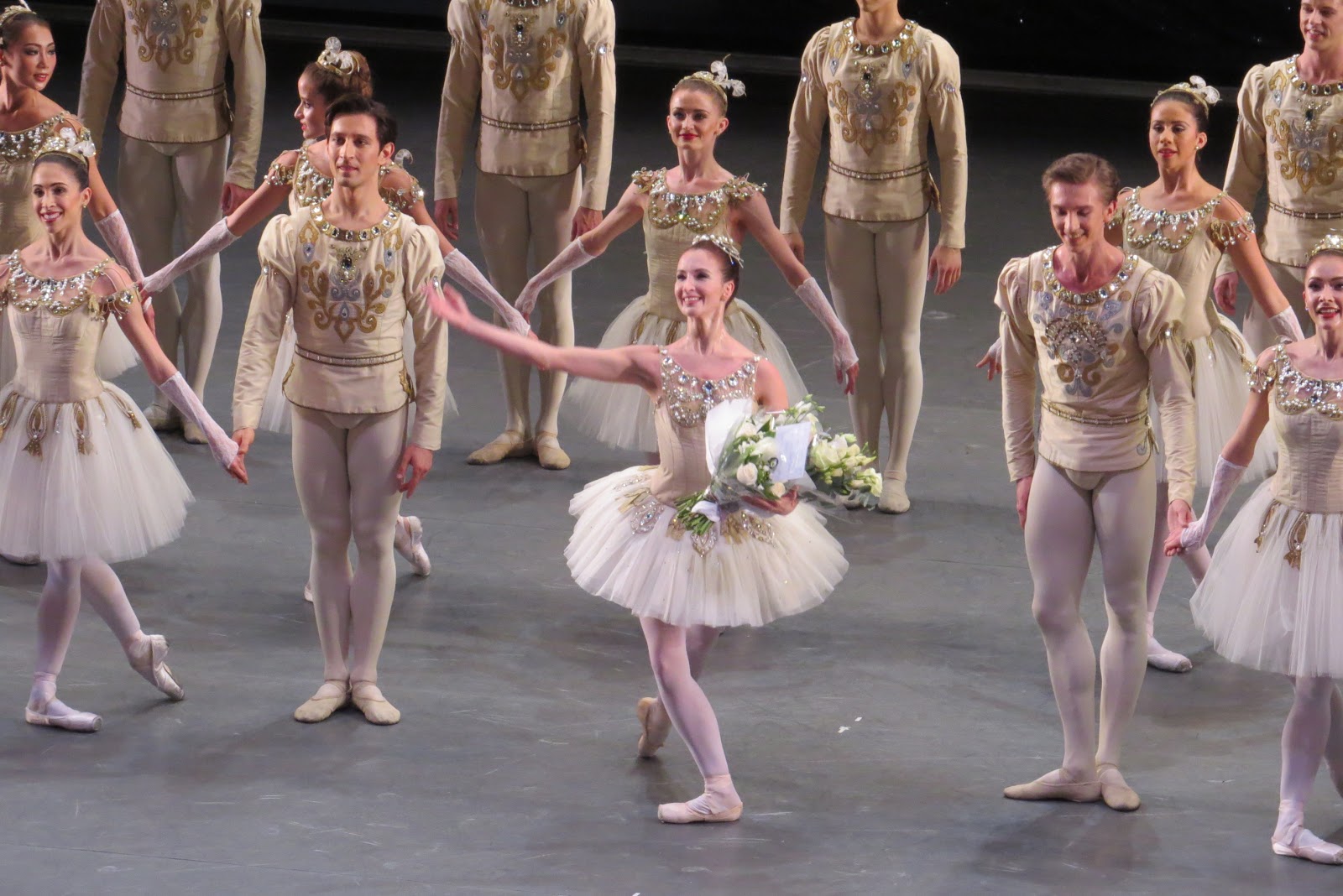
Diamonds on this occasion was my favourite piece it was just stunning. I was mesmerised by it. Lauren Cuthbertson and Vadim Muntagirov danced the lead couple and their grand PDD was just fabulous. The brush of hands, very light touches and regal elegance of their dance was just gorgeous to watch. Vadim has really matured since I last saw him in a major performance and his command of the stage has grown. He did some amazing tours en l'air in a large circle and landed so softly from all his jumps. His partnering of Lauren was always very considerate - a real "danseur noble" as they say! It was such a refreshing change for me to see these 2 dance Diamonds as previously I always seem to have seen Marianela Nunez and Thiago Soares who are good, but I needed a change and yesterday I got it in spades. The corps de ballet were great in Diamonds and the choreography was so wonderful to watch with its complex patterns - all best seen from above as per my seat. It is a credit to all the dancers and repetiteurs that the patterns worked so well - squares, lines, crisscrossing over, circles you name it it is in there - what a genius Mr B was! Then the finale with the crescendo of music was just spine tingling and really left me wanting more. 

For some reason, there was no "red run" at the end of any piece which was a pity, but the applause was enthusiastic for all three pieces. I shall be going to the cinema relay next week to see the main cast, but I would really love to see this cast again, I was so impressed. If you can get a ticket I would highly recommend seeing this run of Jewels as The Royal Ballet seem to be on really good form with lots of the younger dancers coming up and doing really well. The future looks very bright at ROH at the moment!