At the end of July and the first few days of August 1970. American Ballet Theatre visited the Royal Opera House. They brought such great names as Cynthia Gregory, Sallie Wilson, Han Enelaar and Erik Bruhn. But the greatest of all was Carla Fracci. I saw her at the height of her career in her greatest role one balmy August night nearly 51 years ago.
Although I was only 21 at the time I had already seen several productions of Giselle by the Royal Ballet and other companies. And I have seen countless productions since then. Many of these have been good and some have been great such as Lauren Cuthvertson's of 2 April 2016 (see Cuthbertson's Giselle 3 April 2016). None of them has equalled Fracci's performance that evening in August. I can't remember who was her Albrecht. I think it must have been Bruhn but I didn't pay him or for that matter, any other dancer much attention because Fracci commanded the stage in a way that I had never seen before or since. Every detail of every scene from her exit from the cottage in Act I to her descent into her grave in Act II is recorded in my memory as though it were a film.
When I saw that performance of Giselle I was a Young Friend of Covent Garden. As such I received 2 sheets of ticket vouchers every month that enabled me to sit in the L to Ps of the amphitheatre stalls for just a few shillings. I think I visited the House just about every night. I remember a very rich and varied programme that included Swan Lake and Giselle but also Balanchine, de Mille and Tudor. But nothing stuck in my memory like Fracci's Giselle. She literally took my breath away. For her acting which you can see in this clip as well as her virtuosity.
I never saw Fracci again after that tour. I think the company returned in 1977 to celebrate the Queen's silver jubilee but I don't remember Fracci. An army of obituarists and biographers have charted her career since her death 4 days ago. It would have been necessary to refer to their work to write one of my own. In this blog, I try to be original. There is happily a lot of video footage of Fracci at the height of her career which I am gratefully working through now, Misquoting Nero, qualis artifex obiit.
Standard YouTube Licence The Royal Ballet The Nutcracker17 Dec 2019 19:39 Screened to cinemas worldwide
Yesterday I discussed the screening of the Bolshoi's version of The Nutcracker on 15 Dec 2019 in The Nutcracker #2 - The Bolshoi Screening.Two days later the Bolshoi's screening, the Royal Opera House screened a recording of the Royal Ballet's version of The Nutcracker. For the reasons that I explained yesterday the twp productions are very different. The Bolshoi's records Marie's transition into womanhood while the Royal Ballet's is a fantasy with more than a little in common with Alice in Wonderland and Alice Through the Lookingglass.
The Royal Ballet's production was created by Sir Peter Wright who took a bow at the end of the show. The recording was made in 2016 which coincided with Sir Peter's 90th birthday. In Sir Peter's version, the nutcracker is Drosselmeyer's nephew who is imprisoned in wood. He can come back to life only through the love of a young woman. This is an adaptation of ETA Hoffmann's story of The Nutcracker and the Mouse Kingand it is a detail that most versions of the ballet overlook. This makes Drosselmeyer a much less sinister and more likeable character than in the Bolshoi's or most other versions of the ballet. Sir Peter's ballet opens in Drosselmeyer's workshop as he wraps up his present for Clara. The workshop is also where the show ends as the nephew - restored to human form - embraces his uncle.
Sir Peter's ballet requires two ballerinas, namely the young girl known as Clara and the Sugar Plum Fairy, and two premiers danseurs nobles, that is to say, the nutcracker and the Sugar Plum Fairy's prince or cavalier. There are also meaty roles for the mouse king, Harlequin and Columbine in the first act and the soloists in each of the divertissements of the second. The climax of the production is the pas de deux of the Sugar Plum Fairy and her beau. Probably, the most famous dance of the whole ballet is the Sugar Plum Fairy's solo to the slightly otherworldly sounds of the celesta.
In the recording, Drosselmeyer was danced by the company's principal character artist, Gary Avis whom I once had the pleasure of meeting at the London Ballet Circle's 70th-anniversary celebrations. I can report that he is as gracious in real life as he is graceful on stage. Clara was danced by Francesca Hayward who was perfect in the role. Her nutcracker was Alexander Campbell who, like Xander Parish, shares my passion for cricket as well as dance. The Sugar Plum Fairy was danced by Lauren Cuthbertson, my dancer of the year in 2016. and she was partnered by Federico Bonelli, another favourite. With an orchestra was conducted by Maestro Gruzin it is hard to think of a stronger cast by any company anywhere in the world. The sets, costumes and technical effects match the choreography and dancing. It is a sumptuous production.
On Sunday I shall see Sir Peter Wright's production for the Birmingham Royal Ballet at the Royal Albert Hall. That will be the last Nutcracker that I shall see this season and indeed the last ballet of this year. The version that is staged at the Hippodrome is my favourite version of The Nutcracker. If the Hippodrome version can be scaled up forthe Royal Albert's stage I suspect Birmingham Royal Ballet's will be my favourite Nutcracker for this year.
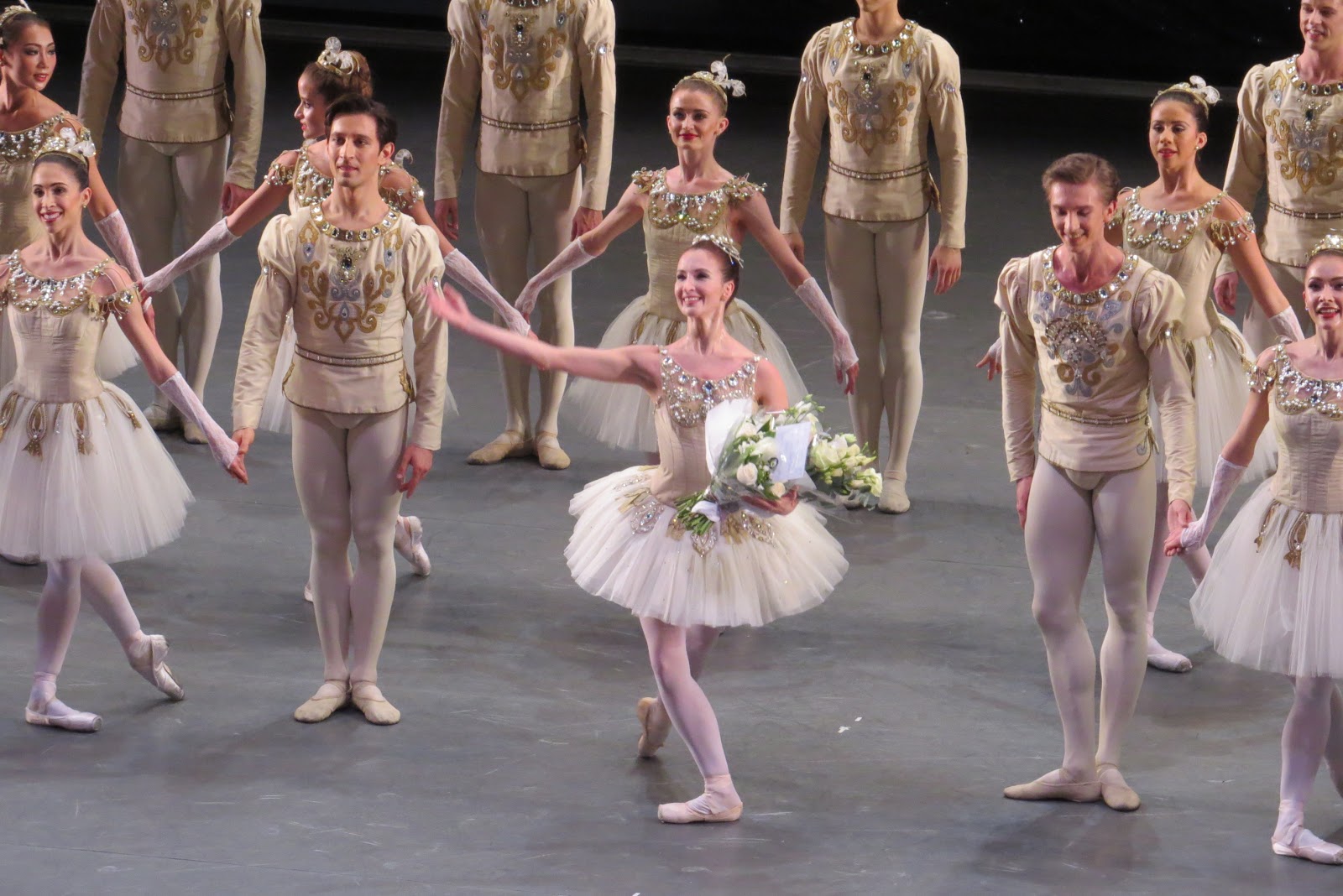
The Royal Ballet, Jewels, Royal Opera House, 1 April 2017, 14:00
Last Saturday I went to ROH to see the matinee of Jewels. It was wonderful I really enjoyed it and I came away ever grateful to Mr B for looking in that window at Van Cleef & Arpels in New York 50 years ago and being inspired to create this ballet - one of my all time favourites!
Emeralds was beautiful I really love that piece for its elegant dancing and the gorgeous Faure score which I find so calming. Yasmine Naghdi and Matthew Ball were the main couple and danced like it was second nature to them and not their debut! I thought Yasmine was really beautiful. Itizar Mendizabal did the other lead with the clock-work like arm and leg moves - she was nice but Leanne Benjamin, whom I saw years ago, is the one to get those moves spot on. I really enjoyed watching the corps with all the patterns and intricate weaving in and out that Balanchine so loves.
In Rubies we had Tierney Heap as the "Tall Girl" - she was very good. The couple was danced by Alexander Campbell and Akane Takada. They were all great. It is such a fun piece and at one point though Tierney ran out of music! She was still dancing but the orchestra had finished the music - Pavel Sorokin conducting perhaps did not have his eye quite on the dancers?! Alexander Campbell had a lot of fun especially where he danced with the male corps being chased by them - he was not quite as fast as Steven McRae with the spins but that is Steven's speciality I think! Akane Takada was a surprise choice for me in Rubies as I thought Emeralds might be more "her". However, she danced beautifully as she always does.
Diamonds on this occasion was my favourite piece it was just stunning. I was mesmerised by it. Lauren Cuthbertson and Vadim Muntagirov danced the lead couple and their grand PDD was just fabulous. The brush of hands, very light touches and regal elegance of their dance was just gorgeous to watch. Vadim has really matured since I last saw him in a major performance and his command of the stage has grown. He did some amazing tours en l'air in a large circle and landed so softly from all his jumps. His partnering of Lauren was always very considerate - a real "danseur noble" as they say! It was such a refreshing change for me to see these 2 dance Diamonds as previously I always seem to have seen Marianela Nunez and Thiago Soares who are good, but I needed a change and yesterday I got it in spades. The corps de ballet were great in Diamonds and the choreography was so wonderful to watch with its complex patterns - all best seen from above as per my seat. It is a credit to all the dancers and repetiteurs that the patterns worked so well - squares, lines, crisscrossing over, circles you name it it is in there - what a genius Mr B was! Then the finale with the crescendo of music was just spine tingling and really left me wanting more.
For some reason, there was no "red run" at the end of any piece which was a pity, but the applause was enthusiastic for all three pieces. I shall be going to the cinema relay next week to see the main cast, but I would really love to see this cast again, I was so impressed. If you can get a ticket I would highly recommend seeing this run of Jewels as The Royal Ballet seem to be on really good form with lots of the younger dancers coming up and doing really well. The future looks very bright at ROH at the moment!
"Her Albrecht was Cesar Corrales who was a wonder to watch. Charming and athletic I can see why Giselle begged clemency from Myrtha and danced with him to keep him alive. In other productions, I feel Albrecht gets off lightly compared to Hilarion, but not this time. His jumps were thrilling - especially some spectacular entrechats just before the bell struck 4 where his legs interweaved like shuttles."
I was so impressed with this young chap that I looked him up and noted that he was one of the Prix de Lausanne prize winners in 2013. You can see a video of his performance on YouTube (see Cesar Corrales - 2013 Selections - Contemporary variation). Four years on he is already a first soloist in English National Ballet.
The finals of this year's Prix de Lausanne starts tomorrow and the winners will be announced on Saturday. There were 338 candidates 5 of whom came from the UK and, interestingly, a young woman from Iran and two others from Turkey (see the list of nationalities represented and selected). Sadly none of our young dancers got through to the last stage. I may be wrong but I think Natasha Watson of Ballet West was the last British dancer to be selected (see Natasha Watson in Lausanne 15 Nov 2014). This year, the biggest contingents came from Japan (89 entered and 13 selected), Australia (48 entered and 10 selected) and the USA (45 entered and 5 selected). Rather more successful were the Chinese who entered 16 and 7 got through. Here is a list of the finalists with details of their nationality and ballet school. I wish them all well both in the competition and their subsequent studies and careers.
It seems a very interesting programme, particularly on the last day when there will be performances by the German National Youth Ballet who will perform an original creation of John Neumeier called “John’s Dream” (see 2017 Interlude) and Lauren Cuthbertson and Alexander Jones of the Zurich Ballet (see 2017 Interlude II). There will also be talks, an exhibition, networking, cocktails and doubtless much more. All the great and the good from the ballet world are going. I wish I was.
Standard YouTube Licence As Ted Brandsen, Ernst Meisner, David Dawson and Cristiano Principato were my choreographers of 2016 and Artur Shesterikov and Daniel Silva my outstanding male dancers it will come as no surprise that the Dutch National Ballet is my company of the year. How could it be otherwise? I have seen three outstanding full-length ballets at the Music Theatre - Mata Hari in February, La Bayaderein November and Coppeliaearlier this month - as well as a dazzling gala and the magnificent Junior Company at the Meervaart in February. I congratulate everyone in the company and wish them all a happy and prosperous New Year.
Although the Dutch National Ballet is regarded as one of the world's top five ballet companies the above video shows that it is also a relatively new company. It was founded in 1961 which was four years after the Royal Ballet received its royal charter, 20 years after the famous wartime tour of the Royal Ballet (then known as Sadler's Wells Ballet) to the Netherlands and 30 years after the formation of the company. It is also younger than English National Ballet, Scottish Ballet which started in Bristol as Western Theatre Ballet and, of course, the Birmingham Royal Ballet which is the Royal Ballet's sister company. Compared to the Paris Opera Ballet, the Royal Danish Ballet, the Bolshoi and the Mariinsky, the Dutch National Ballet is a mere stripling. To have achieved so much is so short a time is not far short of miraculous.
The complete list of Terpsichore Titles is as follows:
This has been a tremendous year for Terpsichore, particularly this last month. We have already received 25,369 page hits in December which is almost double the number of page hits we received in November which was itself a record month, and there is still the rest of the day to run. Our growth reflects a growing interest in adult dance (and particularly adult ballet) throughout the UK and indeed the rest of the world, We plan to do more to help those who want to dance to access classes, workshops and performances next year.
As this is my last post for 2016 I wish all my readers a happy New Year.
"As Anna Tsygankova stood alone on stage for her curtain call after last night's performance of Ted Brandsen'sMata Harievery single person in the Amsterdam Music Theatre or Stopera rose as one. She would have got a similar standing ovation anywhere - even snooty old London - for her portrayal of the life of the tragic adventurer and dancer (Margaretha Geertruida "Margreet" MacLeod) was compelling It is not often that one sees theatre like that in any medium and I think the sounds and images of that performance will remain with me for the rest of my life."
It is not often that one sees a performance like that.
But on the 2 April 2016 I saw Lauren Cuthbertson in Giselle. That ballet had always been a problem for me as I explained in Cuthbertson's Giselle3 April 2016:
"In an interview with the journalist Mark Moynihan which is transcribed in the Royal Ballet's programme notes for this season's Giselle, Sir Peter Wright said:
'When I first saw Giselle way back in the early 1940s I used to think: 'That's silly. That doesn't make sense. So when John [Cranko] asked me to do Giselle my first reaction was, 'Oh no, I couldn't do that - that poor young girl going mad'. The ballet always seemed rather inconsistent to me and sometimes downright stupid.'
Until last night that had been my reaction too. I had always been troubled by the libretto (possibly for the same reason as Wright for he had been brought up as a Quaker and I have become one) as the second act is very dark, superstitious, even a little satanic, or so it had appeared to me for many years. My coping mechanism until last night had been to put the story out of my mind and concentrate on the dancing as though it were an abstract work like Jewels or Les Sylphides."
However, Sir Peter changed his mind on Giselle. He saw Galina Ulanova dance Giselle when the Bolshoi first came to London and realized what an extraordinary work it could be. I explained that that is because the libretto is coded or perhaps or rather subsists on more than level. I added: "Sir Peter needed Ulanova to unlock the work for him and it was Lauren Cuthbertson last night who did the same for me."
"The star of Swan Lake is, of course, Odette-Odile. It is a role that not every ballerina can dance convincingly because it requires the projection of two personalities from the same body. I may be wrong but I should imagine the easier part is probably the seductress Odile despite all those fouettés because she is manifestly human. It must be far more difficult to become a swan. Bethany Kingsley-Garner, who has recently been elevated to principal, was perfect in both. She first came to my notice as Cinderella in Edinburgh (see Scottish Ballet's Cinderella 20 Dec 2015) and she has already entered my canon of all time greatest ballerinas. The only other Scottish dancer in that rare company is Elaine McDonand (see Elaine McDonald in her own Words 11 March 2014)."
So how do I choose between those three? In my review of Giselle, I asked myself what was so special about Cuthbertson's performance. I could not put my finger on it but, as I noted at the time, "I saw not a ballerina dancing Giselle but Giselle herself and for the first time I really understood the ballet." Eight months on, I would qualify that remark by saying that I am beginning to understand and appreciate that ballet but I owe my understanding and appreciation to Lauren Cuthbertson.
For that reason, Cuthbertson has to be my ballerina of 2016.
The Royal Ballet, The Nutcracker, streamed to cinemas 8 Dec 2016 Immediately after watching the preview of Calyxand mingling with the artists and guests on 8 Dec 2016 I galloped down to Leeds central station, jetéon to a train to Wakefield Kirkgate where I had left my car the previous day for a dash down to London to give a talk on IP Planning for Brexit and chasséd on over to Cineworld which was streaming the Royal Ballet's The Nutcracker live from Covent Garden. I arrived at the cinema at 17:29 and presented my driving licence as proof of my antiquity to claim an old age pensioner's concessionary ticket for the show.
"You're too late, love" said the man at the ice cream concession dourly. "Picture started about 'half an 'hour ago. You'll have to come back tomorrow."
Would you believe that Wakefield, originally called Waca's Field, was once known as the "Merrie City"? No neither would I. Never believe everything in Wikipedia. On the other hand, having observed the young folks of Wakefield on the Saturday night pub crawl that the proprietor of the Springfield Beauty Salon once told me was known locally as the "Westgate Run", I would not be at all surprised to learn that its name derives from "Whackers' Field."
"It's not on, tomorrow", I protested. "It's not a picture but a ballet screening. And the only thing that I am likely to have missed is Darcy Bussell's patter, twitter hashtags and trailers for forthcoming shows."
"Oh well suit tha'sane, love", said the jolly ice cream vendor as he took my money
I entered the auditorium just as the orchestra was striking up the first notes.
According to the trailer on the Royal Ballet's website,
"The Royal Ballet celebrates Peter Wright’s 90th birthday with his much-loved production of this beautiful classical ballet, danced to Tchaikovsky’s magnificent score."
Sir Peter Wright is amazing. I met him briefly at the cast party after the Hungarian Ballet had premiered his version of The Sleeping Beauty at Budapest Opera House (see My Trip to Hungary21 April 2016). He moved about the stage like a 20-year old as the cast took curtain call after curtain call and then gave an excellent impromptu speech to the cast, guests and production crew. In our brief conversation, he asked me where I came from and what I did for a living. To my great surprise, he had remembered that information for he introduced me at our next meeting which was the London Ballet Circle's 70th-anniversary celebration to a lady whom I shan't identify with a son who is reading law in Manchester (see 70 Years of the London Ballet Circle10 May 2016).
As I said in The Good Nutcracker Guide31 Oct 2016 we are spoilt for choice for versions of The Nutcracker this year but my first choice is the Royal Ballet's. If you can't make it to Amsterdam to see Ted Brandsen's Coppeliathen Sir Peter Wright's Nutcracker really is the next best thing. Having said that, Birmingham's is pretty good, Wayne Eagling's is not bad if you don't mind the transposition of the Stahlbaums to the banks of the Thames and the rodent king's reappearance in Act II (see Cracking 14 Dec 2013). As for the other Christmas shows, Christopher Hampson and Scottish Ballet can do no wrong in my book (see Scottish Ballet's Hansel and Gretel23 Dec 2013 and the last Act of Northern Ballet's Beauty and the Beast impressed me when I saw it in 2011 (see Jane Lambert Ballet and Intellectual Property - my Excuse for reviewing "Beauty and the Beast"31 Dec 2011 IP Yorkshire).
There seem to have been a few changes to the Royal Ballet's Nutcracker since the last time I saw it. There is a new Chinese dance in the divertissements in Act II and the sets and costumes seem a bit fresher. Francesca Hayward was a beautiful Clara. I like versions where Clara (or, if you prefer, Marie) has something to do but I never want her to morph into the Sugar Plum. It's quite a demanding role because (a bit like Juliet) she has to persuade her audience that she is still a young girl but the dancing requires the skills and expertise of a principal. She was partnered admirably by Alexander Campbell as the Nutcracker. Two of my all time favourite dancers, Lauren Cuthbertson and Federico Bonelli dazzled us in the final pas de deux. I shouldmention in passing that there is a young man from Novara who reminds me very much of Bonelli with the Dutch National Ballet as well as a young woman from Bologna with more than a little of Ferri's flair. And my favourite of the show? Well, how could it be anyone other than Gary Avis as Drosselmeyer? He was also at the London Ballet Circle's 70th where I was able to tell him how much I had enjoyed his work when I shook his hand.
I have learned from experience that the best is the enemy of the good. Having seen Brandsen's Coppelia it is probably not a good idea for me to see any of the other Christmas shows just yet. In any case, the Royal Ballet's The Nutcracker was sold out weeks ago. But I will be well over that when Scottish Ballet bring Hansel and Gretel to Newcastle in February.
Author Deborah Hustic Source Wikipedia/Random Dance Company Creative Commons Licence
Royal Ballet Chroma, Multiverse and Carbon LifeRoyal Opera House 17 Nov 2016. 19:30 To celebrate the 10th anniversary of his appointment as resident choreographer at Covent Garden, the Royal Ballet has staged a short season of Wayne McGegor's works. These include two of his most popular creations, Chromaand Carbon Life, and a new work, Multiverse, which was performed for the first time just over a week ago. McGregor is remarkable for the volume of work that he has created, for the awards and distinctions that he has achieved for such work and for being the first contemporary choreographer to become a resident choreographer at Covent Garden.
Chroma is a work that I already know quite well having seen it several times, most recently by the Dutch National Ballet as part of their Cool Britannia programme (see Going Dutch29 June 2015). The Dutch National Ballet is not the only company to perform that work. According to McGregor's website it has been danced by many other leading companies including the Australian Ballet, the San Francisco Ballet and the Bolshoi. One company that dances it particularly well is Alvin Ailey's American Dance Theatre as can be seen from the YouTube video below.
In all three works that we saw last night, McGregor offered not just choreography (thrilling though it was) but total theatre particularly in the set designs and lighting. In Chroma, for instance, John Pawson's simple geometric shapes were bathed in subtly changing lights beautifully engineered by Lucy Carter. The importance of lighting - another principal in the show - is obvious from the title. The programme notes began with the dictionary definition:
"The purity of a colour or its freedom from white or grey
Intensity of distinctive hue, saturation of a colour"
When combined with Moritz Junge's costumes and Joby Talbot and Jack White III's score, this work excites all the senses. Clearly, that explains why the work is loved so much by audiences as well as admired.
Multiverse was more challenging, at least for me, even though similar techniques were used and Junge and Carter contributed the costume designs and lighting. The performance began quite unexpectedly with the curtain rising on a set with two figures against a plain geometric set of two high walls while the house lights were still on. The hubbub from the audience continued for a few seconds after the curtain rose until the realization that the show had started sank in. The house lights dimmed gradually and the words of a street preacher in San Francisco from over 50 years ago began to fill the auditorium:
"After a while - it's gonna rain after a while! For forty days and for forty nights! And the people didn't believe him. And they began to laugh at him! And they began to mock him! And the began to say 'It aint gonna rain.'"
In his famous work from 1965, It's Gonna Rain, which was written at the height of the cold war when the risk of thermonuclear war threatened to wipe out life on earth in the way that environmental catastrophe had threatened the world at the time of Noah, Steve Reich chops up that recording until it becomes percussive and repetitive. Not easy listening as anyone who plays the YouTube Steve Reich - It's gonna rain will probably agree. But although the movements against the stark towering walls seem angular in the beginning the piece begins to soften. The walls break down into slabs of colour like the sides of a Rubik cube and eventually elements of a painting. It's Gonna Rain ends and the more soothing Runner takes its place. Reich is said to be America's greatest living composer. I have not heard enough of his work to judge but I have heard his Drumming several times which was used by Arthur Pita in Ballet Black's Cristaux (see Ballet Black in Doncaster3 Nov 2016) and that work has definitely grown on me.
My favourite work of the evening was Carbon Life which began almost magically with the artists behind a gauze screen lit only by what appeared to be fairy lights. Music was provided by a live band on stage including a rapper called Dave who earned an enormous titter from the audience with his dig at President-elect Trump. Each scene presented something exciting and something new. The dancing was vigorous and exuberant. Carter provided the lighting once again and Gareth Pugh's costumes bordered on the fantastic. I particularly liked the colour combination such as the green stripes against the black. Sadly, it came to an end all too soon. I felt compelled to rise to my feet as first the dancers and then the musicians appeared on stage to take their bow. Standing ovations do not happen every day at Covent Garden but these folks deserved it and I am glad to say one or two people in the stalls and more in the slips and circles seemed to follow my example.
I floated out of the Opera House on a cloud which carried me off to Holborn tube, followed me down the escalator onto the Piccadilly line and even on to the 23:30 train back to Doncaster. Not even the exorbitant £20.90 parking charge (£5 more than my train fare from London) which the Frenchgate Centre extracted because all the spaces in the section reserved for rail passengers had bee full spoilt my evening. On the train back I read in the programme that McGregor came from Stockport which is just across the Mersey from Didsbury where I was born. Yet another reason to like him, I'd say.
Just a bit of fun inspired by the National Dance Awards and not to be taken at all seriously but at the end of every year I do a review of the best work that I have seen in the previous 12 months (see Highlights of 201529 Dec 2015). At the end of the post I set out my favourites which were:
Ballet of the Year Ballet Cymru's Cinderella, runner up Ballet Cymru's Tir
Company of the Year Scottish Ballet, runners up Dutch National Ballet and the Royal Ballet
Small Companies of the Year Ballet Black and Ballet Cymru
Contemporary Company of the Year Phoenix Dance Theatre
Male Dancer of the Year Denis Rodkin in La Bayadere, runner up Matthew Golding in the Royal Ballet's Onegin and the Dutch National Ballet's Cinderella
Female Dancer of the Year Laura Morera as Lise runners up Anna Tsygankova and Bethany Kingsley-Garner as Cinderella
Choreographers of the Year Christopher Hampson for Perpetuum Mobile for Northern Ballet and Ernst Meisner for Embers for the Dutch National Ballet's Junior Company
Dancers to watch Floor Elmers of Dutch National Ballet, Krystal Lowe of Ballet Cymru, Marie-Astrid-Mence of Phoenix Dance Theatre and Gavin McCaig of Northern Ballet
Promising Newcomers Bart Engelen, Norwegian Ballet, Cristiano Principato and Emilie Tassinari, Dutch National Ballet Junior Company, Tim Hill of Ballet Cymru and Prentice Whitlow of Phoenix Dance Theatre
This year we shall do it a little differently. I invite everyone who has contributed to Terpsichore in the last year or so (that is to say Alison Winward, David Murley, Gita Mistry, Janet McNulty, Joanne Goodman and Mel Wong (happy birthday Mel by the way) to nominate for each category. Then I shall hold a ballot for the readers.
I have not quite made up my mind yet but provisionally Jean-Christophe Maillot is leading the way in the best full-length ballet stakes with his Taming of the Shrewfor the Bolshoi pursued hotly by Ted Brandsen's Mata Hari, David Dawson's Swan Lakeand Cathy Marston's Jane Eyrein that order.
In the one-act ballets category, it is a dead heat between Ernst Meisner's No Time before Time and Christopher Hampson's Storyville.
My classical company of the year is the Durch National Ballet though I was impressed by the Australians and the Bolshoi when they came to London and the Royal Ballet and English National Ballet are always near the top of my lists.
My nominations for best small company are Ballet Black and the Dutch National Ballet Junior Company,
Having seen a lot of contemporary dance, this year I can't make my mind up between Netherlands Dance Theatre and Rambert though Phoenix and the National Dance Company of Wales are also on my list. I am not sure how to classify Alvin Ailey but they definitely deserve an award.
Best male dancer this year has to be Federico Benelli for his Albrecht in Giselleand Lauren Cuthbertson as best female in the same production, However, I would make special personal awards to Bethany Kingsley-Garner for her Odette-Odile in Liverpool and Anna Tsyganlova for her Mata Hari.
Dancers to watch? There are so many but I think we shall be seeing a lot of Cristiano Principato of the Dutch National Ballet who proved his worth as a choreographer, artistic director and chief cook and bottlewasher as well as dancer in Trecate earlier this year, Daniele Gould in Hungary who was an enchanting Puss in Boots and Mthuthuzeli November here.
I would also like to add a special adult ballet education award to Karen Sant of KNT Danceworks for organizing wonderful intensive workshops for adult ballet beginners in Swan Lake, Romeo and Juliet, La Bayadere and The Nutcracker and Jane Tucker for teaching them.
Alison, David, Gita, Janet, Joanne and Mel are invited to let me have their nominations (if any by 17:00 on 30 Nov) and then we shall offer it to the readers for a vote.
Standard YouTube Licence Royal Ballet, Giselle, Royal Opera House, Covent Garden, 2 April 2016
In an interview with the journalist Mark Moynihan which is transcribed in the Royal Ballet's programme notes for this season's Giselle, Sir Peter Wright said:
"When I first saw Giselle way back in the early 1940s I used to think: 'That's silly. That doesn't make sense. So when John [Cranko] asked me to do Giselle my first reaction was, 'Oh no, I couldn't do that - that poor young girl going mad'. The ballet always seemed rather inconsistent to me and sometimes downright stupid."
Until last night that had been my reaction too. I had always been troubled by the libretto (possibly for the same reason as Wright for he had been brought up as a Quaker and I have become one) as the second act is very dark, superstitious, even a little satanic, or so it had appeared to me for many years. My coping mechanism until last night had been to put the story out of my mind and concentrate on the dancing as thought it were an abstract work like Jewels or Les Sylphides.
However, Sir Peter changed his mind about Giselle and so have I. In Sir Peter's case it was only when he saw the great Russian ballerina Galina Ulanova's interpretation of the role of Giselle when the Bolshoi first came to London that he realized what an extraordinary work it could be. That is because the libretto is coded or perhaps, more accurately, on more than level. There is all the difference in the world between knowing the story of a ballet and understanding it. Sir Peter needed Ulanova to unlock the work for him and it was Lauren Cuthbertson last night who did the same for me.
I am not a newbie when it comes to ballet. I have seen Gisellemany times by several different companies with some of the world's greatest ballerinas in the title role. The best compliment that I can pay to Cuthbertson is that she unlocked the ballet for me much in the way that Ulanova appears to have done for Sir Peter. Yesterday I saw not a ballerina dancing Giselle but Giselle herself and for the first time I really understood the ballet which has far more substance than I had previously supposed. Giselle was not stupid but in love - or least infatuated - and infatuation makes fools of us all. I have seen what it has done to my friends and it is actually one of the stories on my favourite radio soaps right now as Helen ignores the danger signs that are so obvious to her friend, Kirsty - just as Giselle ignores the tampering with the petals and the other indicators that were so clear to her mum and, of course, Hilarion.
What is it about Cuthbertson's performance that was so special last night? I don't know. I had seen her several times before and admired her artistry and virtuosity. I had listened to her talk to the London Ballet Circle and even managed to meet her brielfy afterwards to say how much I enjoyed her work. It may be that her horrendous injury has made her an even greater artist (see Nowness's video London's Royal Ballet I Portrait of a Dancer: Lauren Cuthbertson) but if that were so, why? Perhaps she was in the right place at the right time to interpret Giselle for me.
One of the hitherto exasperating points of Giselle had been that Albrecht, the cad, survived the wilis but Hilarion who lost the girl also had to die. But actually that is one of the points of the ballet that Wright's production and Cuthbertson's dancing brought out last night. Nobody is beyond redemption - not even after death. Albrecht showed remorse for his treachery and Giselle forgave him and, who knows, was perhaps redeemed herself by sustaining him through his trial. There is a crucial bit of the choreography that I had missed in the past where Giselle stands before Albrecht with her hands outstretched in the form of a cross from which Myrtha and the other wilis are forced to turn away. They recover, of course, and continue their persecution until the exhausted Albrecht is saved, quite literally, by the bell.
And Hilarion? Well he was jealous and let his jealousy get the better of him which caused Giselle to stab herself (at least in Sir Peter's version). He did visit her grave but he fell asleep and ran into the woods as lights flashed and wilis darted across the stage. It was perhaps his lack of courage, his lack of resolve and his jealousy and selfishness that condemned him.
Great though Cuthbertson was last night she needed a strong partner and Federico Bonelli partnered her magnificently. "Wasn't that so beautiful!" whispered the lady next to me during a moment for applause, "he held her as if she were a feather." It was indeed beautiful and I was close to tears. I have to think long and hard in my half century of ballet going to remember a pas de deux that has moved me as much. Sibley and Dowell perhaps? But I can't for the moment think what that could have been.
A strong performance, too, from Benet Gartside as moody, sulky, vengeful and in the end irresolute, Hilarion. As I say, I had always felt sorry for the gamekeeper in the past but I had less sympathy for him in Gartside's interpretation of the role - though I still find it hard to understand why he had to die. Berthe (Giselle's mum) danced by Elizabeth McGorian was crucial to the story. Usually she is the spoil sport - Madame Simone transposed - who stops her daughter dancing but yesterday she showed she had good reason as she predicted her daughter's suicide in mime. Spine chilling performances, also, from Claire Calvert as the icy, imperious, heartless, spiteful queen of the wilis and from Elizabeth Harrod as Moyna and Meaghan Grace Hinkis as Zulme. In fact, the whole cast was great. The only reason I have not mentioned more names are the usual limitations of time and space.
Regrettably I had to leave the Opera House, Cinderella like, after the first few curtain calls to catch my train back to Yorkshire but the clapping and cheers were deafening even outside the auditorium. When the flower market was next door the stage would have been knee deep in flowers after a performance like last night's. The dancers - Cuthbertson in particular - were extraordinary and I hope this review does justice to them all.
This morning our Over 55 class at Northern Ballet Academy was taught by Elizabeth Rae. As you can see from her biography on Northern Ballet's website she has enjoyed a glittering career as a dancer, teacher, choreographer and author. It was a pleasure and a privilege to be taught by her.
We have two classes on Tuesday: an hour of barre and exercises in the centre and then an extra 30 minutes for those of us who want to improve (or in my case learn) pirouettes and jumps. It was quite challenging for all of us and particularly for me but Elizabeth gave us lots of useful tips and information which she delivered with considerable wit. For instance, always keep your little finger in view when doing grands pliés because you keep your back straight and transfer your weight to the ball of your foot and not the heel when doing turns. Although I have been trying my best for ages I still can't do pirouettes properly and I get really frustrated with them but Elizabeth's exercises really helped. She taught us to do tours lents in retiré and while I was a long way from getting it right I was a closer to getting it right than ever before.
After class we gathered round to thank her for her teaching and in a short conversation that followed she spoke to us briefly about her career. She danced many important roles with Frankfurt Ballet and there is a lovely picture of her with Richard Sykes of that company on her Northern Ballet web page. I googled her and found that she danced as Lisa Rae when she was on the stage and I found lots of other beautiful images of her.
Copyright owner: Consumer Reports Licence Creative Commons Attribution Share Alike 4.0 International Source Wikipedia
I am just about to place a couple of hats in the microwave. One is The Winter's Tale which I damned with the faintest of praise in Royal Ballet "The Winter's Tale" 14 April 2014. The other are the Royal Opera House's HDTV transmissions which I described as "good quality hamburger" in Giselle and I was even less polite about Don Quixote. Tonight I floated out of the Huddersfield Odeon after watching the HDTV transmission of The Winter's Tale with a smile from ear to ear. Act I, which had dragged last time, simply flew for me. The tension was palpable. Act II, which had saved the ballet for me the first time I saw it revealed fresh delights. Act III with the triple reconciliation was sublime.
Now this is how I should have felt on 12 April 2014 when I saw the same show in Covent Garden. This is the reason why I think I got it this time but not then. Act I, the longest of the three Acts, is crucial to the appreciation of this ballet and the key to appreciating that Act are the contortions of Leontes's body and the expressions on his face. These were prominent on screen but I missed them entirely when I was in the House. It may be that the interviews before the show - particularly the one with Watson - were helpful for they alerted the audience as to what to look out for. Wheeldon had remarked how Watson could turn his body into the most remarkable shapes to express his anguish and so he did. Those contortions and facial expressions exerted enormous tension. In the second interval Wheeldon had described his cast as "actors who dance" rather than the converse. Leontes's build up of jealousy and loathing until his explosion of rage exemplifies those qualities magnificently.
Having cracked Leontes's emotions I found myself appreciating the other features of Act I. The complex textures of Joby Talbot's score, Bob Crowley's designs and Natasha Katz's lighting. I even got to see the bear. Its muzzle, which was so clear on screen, was just a length of cloth when I saw it live. I was already looking forward to Act II but I found new detail in the dancing, new rhythms in the score and best of all the expression on Lamb's face when McRae asked her to marry him. I had also liked Act III on 12 April but this time I took in Cuthbertson's final pas de deux with Watson properly. As an expression of love it was simply beautiful.
I noticed from the tweets that I was not the only one who enjoyed the transmission more than the live show. This was a particularly good broadcast, much better than Giselle or Don Quixote. I think this is a ballet that does work well for cinema but I also think it is a work that needs to be seen more than once to be appreciated properly.
I love the Royal Ballet very much having followed it for nearly 60 years. I love the House more than any other theatre in the world. I love all the dancers who have ever trod its boards. It is so good to be able to write this review.
"Pursued by a Bear" Royal Ballet "A Winter's Tale" 12 April 2014
I expected so much of The Winter's Tale. I had been looking forward to it for months. A new work by Christopher Wheeldon based on Shakespeare by a fine choreographer for our national company with a stellar cast. It should have blown me off my feet. Well I quite liked the show but blown off my feet? I wasn't.
Perhaps my expectations were too high. Had I thought about it more I would have concluded that Shakespeare is very difficult to set to ballet. I can think of only two ballets based on Shakespeare that really work. One is Macmillan's Romeo and Juliet and the other is Cranko's Taming of the Shrew (see "Stuttgart Ballet's "Taming of the Shrew" - well worth the Wait" 25 Nov 2013). Northern Ballet's "A Midsummer Night's Dream" also works but only because Nixon has gutted the play and written his own plot based on a post war touring company's train journey to Edinburgh (see "Realizing Another Dream" 15 Sept 2013). Had I thought more about the topic I would have reminded myself that A Winter's Taleis one of Shakespeare's least performed and least read plays and that is for a reason. It is best known for the stage direction for Antigonus: "Exit pursued by a bear." A Winter's Tale is not one of Shakespeare's best works and it is very difficult to get into.
And so it was on Saturday with the ballet. Now I have to say that I was not in the most receptive frame of mind when I entered the Royal Opera House. I had a horrible journey down to London and I had been working late throughout the previous night. I had skipped breakfast and had only a light lunch. Consequently I was tired and hungry. Had I not paid a lot of money for my ticket I would have gone straight to bed. Moreover, the reason that I had to work through the night was that I had spent a couple of hours in Huddersfield town hall listening to the Choral's performing one of the most memorable concerts I have ever attended or am ever likely to attend. It may be that anything after that concert was going to be an anticlimax.
I say all this because Act I left me quite cold. Well perhaps not quite cold because Edward Watson and Lauren Cuthbertson are always exciting and Bob Crawley's designs were impressive, especially the galleon in full sale. But the story was very heavy going and the accompanying music by Joby Talbot did not help. The ballet is very long. It starts at 19:30 and ends at 22:30 and the longest bit is Act I which lasts 49 minutes.
Act II is very different. Set around a gnarled moss covered tree there is a festival with exuberant dancing accompanied by the most infectiously vibrant music. Perdita danced by Sarah Lamb and Florizel by Stephen McRae fall in love. They are spied on and discovered by Polixenes, king of Bohemia, who threatens to kill them but they set sail to Sicily with the king of Bohemia in hot pursuit. Little details like the fact that Bohenia is landlocked don't seem to have bothered Shakespeare or even Wheeldon. However there is such a thing as poetic licence and this is a case where it applies. Nevertheless, this is is the best bit of the ballet and that is possibly because it is the part that owes least to Shakespeare.
The final Act like the first is set in Sicily with a chastened Leontes (Watson) visiting the graves of Hermione and their son. The Act ends with his visiting a statue of Hermione who suddenly springs to life Don Juan style - oh brother - but she, her daughter Perfita and Loeontes reconcile in a most beautiful pas de trois which prompted the lady next to me to fish for a tissue and even I found moving.
So did this ballet live up to expectations? Well not exactly. But it was not bad. I want to see it again but I want to take a break before I do. It will be broadcast on HDTV to cinemas around the nation on 28 April.
Last Sunday some of our finest performers gave up their evening (and no doubt a lot more rehearsal time) to dance, sing and make music at a gala at the Britten Theatre for Ashanti Development. This is a charity set up by Ghanaians living in London to raise money for development in the Ashanti region of Ghana. It has done some remarkable work in health care, sanitation, education and income generation. It was a wonderful evening and I for one am doubly grateful to the artists not only for their magnificent performances but also for supporting a very worthwhile cause.
The evening consisted of 14 items introduced by Harriet Thorpe. Though now an actor Thorpe said that she had studied at the Royal Ballet School. "That training never leaves you" said Thorpe and she offered to stand in for any dancer who might be indisposed. Happily, nobody was indisposed but I have no reason to doubt that she would have risen to the occasion had she been put to the test.
Ceremony of Innocence by Marcelino Sambé choreographed by Valentino Zucchetti to Benjamin Britten's Variations on a Theme of Frank Bridge Op 10; and
Ashton's Rhapsody Pas de Deux by Yuhui Choe and Zucchetti to Rachmaninov's Rhapsody on a Theme by Paganini.
Two ballets were premièred on Sunday - Avant la Haine and Clair de Lune - and we saw Volver, Volver only a few days after MEN IN MOTION's première and these were three of the works that impressed me most. It was the first time I had seen choreography by Ondiviela and Zucchetti and I am certainly looking froward to seeing more. Avant la Haine means Before the Hatred and if I understood the ballet correctly it tracks the breakup of a relationship. I had last seen Whitehead in Giselle (see "Giselle - Royal Ballet 18 Jan 2014" 20 Jan 2014) and I may be biased because he comes from Bradford but Whitehead has become one of my favourite dancers. In this ballet he appears to fight with Bracher actually delivering what seemed to be a rabbit punch. Far worse than just spilling the beans about a philanderer but don't get me started on Giselle because I know my views are unpopular.
Zucchetti's Clair de Lune was one of the most delightful new ballets I have seen for some time. Part of the credit must go to Debussy whose music like Aaron Copland's is particularly apt for ballet but much must got to the lyrical choreography and the elegance by which it was interpreted by the dancers. I hope to see this work again.
Watson was, of course, magnificent. It devolved in a fascinating way which I won't reveal from those who are to see MEN IN MOTION. I was urged to go by Susan Dalgetty who pressed a flyer into my hands at the London Ballet Circle AGM. I did not buy a ticket largely because one can't see everything, especially if it means trekking to London but I think I made the wrong choice. When I see a dancer like Watson I am reminded of the remark attributed to Einstein about dancers being "the athletes of God."
And what of the rest? I had decided not to go to this gala until I saw Dave Wilson's post on BalletcoForum that Glurdjidze was to dance the Dying Swan. This was a ballet that I had always wanted to see but have never managed to catch. When she was a little girl my mother saw Pavlova dance it in Leeds and the impression never left her. I have seen some flickering footage of Pavlova many times but I have always wanted to see it on stage (see "In Leeds of All Places" 18 Sept 2013). Owing to a problem with the Royal College's e-commerce system I feared I would not get a ticket for the show but thanks to Josephine and Bangor Ballet Boy they put me in touch with a lady who had a ticket to sell. It was a good seat too right in the centre of the dress circle. I am so grateful to all concerned. Well Dying Swan lived up to my expectations. It was danced beautifully. I became pretty emotional earlier in the day when I saw Antoinette Sibley again for the first time in decades. Tears do not come to me easily but I felt the tears welling up when I saw this ballet. It was good that we had Wagner and Strauss before more dancing.
But my favourite work of the evening was Cuthbertson's Requiem. I admire her greatly. More perhaps than any ballerina in the Royal Ballet since Sibley. Indeed she reminds me a little of Sibley. She shows the same grace. In this work she danced to a voice that complemented her movement remarkably. I long to see this work again and preferably with the same artists.
The evening was over too quickly. But the show did not exactly end there. On the way out there was more music and dance from two Ghanaian ladies with collection buckets rattling their containers to a rhythm and chant "Thank you! God bless you!" My only surprise and slight regret was that there were no Ghanaians on stage and few even in the audience. Well it was a sell out and ballet is only beginning to establish itself in Sub-Saharan Africa. But it is taking root there as I have mentioned elsewhere (see "Michaela dePrince" 4 April 2013 and "What can be achieved by a good teacher" 3 March 2013). I hope to see a Ghanaian ballerina or premier danseur noble step out on stage in my lifetime. There is already a Sierra Leonean on her way to the Linbury on the 28 and 29 May 2014.