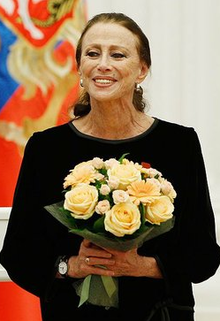
A lot of good things happened on 2 May 2015 for me personally in that I saw an outstanding performance by Ballet Central in Leeds (see Dazzled3 May 2015) and for the public in general in that the Duchess of Cambridge gave birth to a daughter. But for me it was all overshadowed by the sad news from Moscow that the prima ballerina assoluta Maya Plisetskaya had died in Germany.
Though I never met her I felt the loss deeply. When I first took an interest in ballet in the 1960s there were two great names: Dame Margot Fonteyn in this country and Maya Plisetskaya in the Soviet Union. Of the two I found Plisetskaya by far the more interesting,
Here is a film about Plisetskaya and her art made at about that time I first heard of her. It shows her at her peak dancing in some of her most famous roles: Odile, Juliet, the Dying Swan and above all Phrygia. It also has some shots of her as a young student,
I admired her as an artist but also as a human being. She had an old fashioned loyalty to her country (which siome would say was misplaced as she lost her father in one of Stalin's purges) but she was not afraid of asserting herself from time to time.
In 1958 Plisetskaya married the composer Rodion Shchedrin who composed the score to The Little Humpbacked Horse and arranged several other works for her. Their marriage continued until the day she died.
She was a ravishingly beautiful woman even in her eighties as the photograph shows. Like Fonteyn she continued to perform long after the age most dancers have retired.
Nobody can live for ever. She had a very good innings. But that does not stop me from feeling very, very sad at her passing.
A Legend of Love is not well known in the UK which is a pity because there is a lot to like about the ballet. A fine score by Arif Malikov, spectacular choreography by Yury Grigorovich and striking set and costume designs by Simon Virsaladze. It was first performed by the Kirov (now the Mariinsky) Ballet in Leningrad (St Petersburg) in1961. Grigorovich introduced it to the Bolshoi when he moved to Moscow. The Bolshoi performed it for the first time in 1965 with Maya Plisetkaya and Maris Liepa in the leading roles.
My first encounter with the ballet was watching a rehearsal during World Ballet Day on 1 Oct 2014. I saw an HDTV transmission from Moscow at the Wakefield Cineworld this afternoon. An HDTV transmission is not the same as watching a ballet in the theatre but Pathé Live's broadcasts are the next best thing. Although the Royal Ballet's transmissions are getting better they are still some way behind Pathé Live (see "Manon Encore at the Huddersfield Odeon"20 Oct 2014).
The scenario for the ballet was contributed by the Turkish poet and playwright Nâzım Hikmet who based it very loosely on the 12th century Persian poem The Labours of Ferhad. There is a synopsis on the Bolshoi's website but the point to remember is that the hero, Ferkhad, chose to sacrifice his love for the beautiful Princess Shireen in order to secure a water supply for his drought ridden neighbours. Very public spirited. Indeed very socialist minded. Just the sort of thing that Stakhanov might have done.
Grigorovich inserted some exhausting looking jumps for the men, particularly the jester in act II and at least as many fouettés for the Queen as in Don Quixote or Swan Lake. Indeed, he really put that character through her paces forcing her to adopt the most awkward, angular poses including one that resembled a table with one leg thrusting in the air like a flag post, Nearly all her movements were en pointe even in the reverence at the end. The effect was spectacular - one feat after another - just as in a firework display.
The most remarkable thing about this ballet is that it was created by very young men. Malikov was in his late twenties when he wrote the score and Grigorovich was in his early thirties when he choreographed it. Both of those gentlemen are still alive and Malikov was in the audience. He was interviewed by Katerina Novikova in the second interval and it was wonderful to see him as he rose to acknowledge applause in his box when a spotlight beamed on him just before the start of the third act. He took a bow to thunderous applause at the end of the show when the conductor invited him onto the stage.
In her interview Ms Novikova asked him about his teachers and mentors. He listed a number of distinguished composers and musicians culminating with Shostakovich. Charmingly and not at all cheesily he noted that the title of the ballet was A Language of Love and wished everybody a little bit of love in their lives.
One of the reasons for the success of Pathé Live's transmissions is the remarkable Ms Novikova. Always elegant - today she wore a smart blue top and trousers - fluent in French and English and very knowledgeable her discussions and interviews are as unmissable as the dancing. As well as Malikov she spoke to Rodkin who was down in Moscow from the Mariinsky. She got him to talk about how the great dancers of the past, Liepa and Plisetkaya, had inspired him and how he had realized his ambitions of dancing Spartacus and Ferkhad by the age of 24.
Last week I was driven to the hot dog stand after the umpteenth gushing tweet about "Federico" and "Marianella" not to mention the platitudes of the presenter. The Bolshoi and Pathé Live know they are good. They have sufficient self-confidence not to need such endorsements. They make good use of the intervals. They don't refer to their principals as Denis and Maria as though they were the neighbours from number 36. They have what the Americans call class and therein lies the difference.
Post Script
I posted an edited version of this article on the BalletcoForum blog and received the following responses from a lady I know only as "Amelia" and a gentleman called "Bruce Wall".
"Thank you, Terpsichore, for your tribute to this remarkable ballet, which, in my view, should be seen on the Bolshoi's historic stage.
I just want to mention that the 24-y-o Rodkin has never been a Mariinsky's dancer. The Bolshoi has been his only employer since 2009."
I replied:
"Thanks for that information, Amelia.
I was foxed by the absence of a hypertext link to Mr Rodkin on the Bolshoi cast list but the presence of a link to him on the Mariinsky's site. I should be grateful if you could shed some light on the apparent anomaly.
I am afraid that I do not follow either company as closely as I should wish because I see them only when they visit London (and even then only once or twice a season because I live 200 miles from the capital).
You on the other hand do follow the Russian companies much more closely and I am always grateful for your information and opinions."
"Terspichore, Denis Rodkin was one of the two prized private students of Nikolai Tsiskaridze, when he was still with the Bolshoi prior to becoming the Acting Rector of the Vaganova School. The other was Angelina Vorontsova ...... She is by all reports a lovely dancer and......, is now with the Mikhailovsky Ballet and features prominently in that company's NYC season at the Koch theater next month frequently dancing with I. Vasiliev."
I thanked him for that information as well.
If anyone else can assist us with information about Denis Rodkin's background and antecedents I should be glad to hear from them. I know this blog is read in Russia so I should be particularly glad to hear from anyone who follows ballet closely in that country.