Showing posts with label Bolshoi. Show all posts

Tuesday, 29 October 2019

"Raymonda" from Moscow


Standard YouTube Licence


Bolshoi Ballet Raymoda  Streamed from Moscow to cinemas worldwide 27 Oct 2019 15:00

Although Act III of Nureyev's production is in the current repertoire of the Royal Ballet, Raymonda is not a ballet that we see very often in this country. That is a pity because it has a pretty score by Alexander Glazunov and plenty of exciting choreography. It was after all created for Pierina Legnani who pioneered the 32 fouettés in the seduction scene in Swan Lake. Also, Sergei and Nicolai Legat, Olga Preobrajenska and Giuseppina Cecchetti were all in the first show. It was one of Petipa's last ballets and it has a fin de siȅcle feel to it. By that, I mean that it is close to the border in artistic as well as chronological terms between the age of the Imperial Ballet and that of Diaghilev's Ballets Russes.

The action is set in medieval Europe at the time of the Crusades. The male lead is Jean de Brienne who was a real historical character. He was king of Jerusalem for a while and even took over Constantinople but none of that features in the ballet except in so far as he follows Andrew II of Hungary on crusade. I can find no reference to a historical Raymonda, Abderakhman or even Castle Doris where the ballet is set.  But then I suppose Lidiya Pashkova, who wrote the libretto, would have claimed to be writing historical fiction rather than history.

As ballets go, it is quite a good story. Raymonda is betrothed to Jean de Brienne who visits her in Castle Doris just before he is due to go on crusade. After he has left she falls asleep and dreams of an eastern prince called Abderakhman who declares his love for her.  She wakes up in a cold sweat and finds that it was all a nightmare.  In the second Act, however, the real Abderakhman appears and offers to carry her away.  She politely turns him down but Abderakhman will not take "no" for an answer. He and his followers try to adduct her but are interrupted by de Brienne. They fight each other with swords and de Brienne kills his rival. In the last Act, Raymonda weds de Brienne and they all enjoy a long Hungarian divertissement.

On Sunday's transmission, Olga Smirnova was Raymonda, Artemy Belyakov was de Brienne and Igor Tsvirko was Abderakhman.  All performed well as did the rest of the cast.  I particularly liked Tsvirko who was the most realistic of the leading characters. I have seen him several times in London as well as on screen. Ekaterina Novikova who is an excellent interlocutor switching effortlessly between her own language and English and French interviewed him while he was still in costume in the second interval. Tsvirko showed real emotion when Raymonda rejected him.  It seemed he was tearing out his heart - a gesture that his followers echoed by waggling their shields. There was some great jumping for Belyakov and some moves that must have required considerable stamina as well as skill from Smirnbiva.

The costumes were gorgeous but I was not taken with the set design.   The orchestra played well under Pavel Klinichev, their conductor.  Apart from a couple of seconds when the sound was lost temporarily the transmission was good.  Altogether it was a successful start to the Bioshoi and Pathé Live's new cinema season which is about to celebrate its 10th anniversary. 

Monday, 18 June 2018

Plato's Cave - the Live Transmission of the Royal Ballet's Swan Lake

Plato's Cave
Author Jan Sanraedam according to Cornelos van Harlaam
Source Wikipedia


Royal Ballet Swan Lake 12 June 2018 Live streaming to cinemas worldwide from Covent Garden

I was lucky enough to see the Royal Ballet's Swan Lake from the stalls of the Royal Opera House on 22 May 2018 and reviewed the performance in Scarlett's Swan Lake 23 May 2018. I saw it again last Tuesday at the Leeds Showcase against my better judgment and really wish I hadn't.

In Flowers for Dreda 9 June 2018 I wrote that ballet should never be a passive experience and that is the difference between watching ballet in the cinema and watching it live. You can marvel at Legnani's 32 fouettés from your local flicks just as much as you can in the theatre. Arguably you can even get a better view.  Certainly more than you would in rows L to Q of the amphitheatre. But however loudly you clap or cheer Nuñez or Nikulina can't hear you.  They are 200 or in the case of the Bolshoi 1,500 miles away and their dialogue is with the living, breathing, thinking audience a few feet away.  Not the hot dog munchers or cola quaffers of Birstall, Bergen or Brescia.

There are some advantages to ballet in the cinema.

You can see details that you might want to see such as the dancer's facial expressions, Rothbart's picking up the crown at the end of act III or Odette's mime in act IV when she breaks the news that they have to spend the rest of their lives floating around a slimy pond because Siegfried has blown it. On the other hand you also see some details that you don't like the brush strokes or bricks on the backdrop or loose threads on the costumes.

The other big advantage of cinema is that audiences can gain insight into the production or performance that they would never get in the theatre by interviewing the choreographers, composers or designers who created the work or the conductors and dancers who are about to perform it.  Generally, that is something that Pathé  Live and the Bolshoi do so much better than Covent Garden. One of the reasons the Bolshoi get it right is that they employ a multilingual journalist with good dress sense and an excellent knowledge of the ballet.

One feature of the Royal Ballet's transmissions that I wish they would drop are the gushing tweets.  Most seem to state the obvious - namely that ballet is a remarkable spectacle (it wouldn't be worth watching otherwise) plus their locations. Social media could have a role.  For example, it could be used to put questions to the creatives. I would love to have quizzed Liam Scarlett on why and how he developed  von Rothbart's role.  Covent Garden just seem to use it as a marketing tool or perhaps just simple vanity.

In watching the cinema transmission I was reminded of the story of Plato's cave.

Standard YouTube Licence

I first heard of it from my father long before I started to learn Greek.  Live transmissions of ballet are rather like the shadows of reality from the fire in the cave.  They may be better than nothing and they have their place but don't let anyone tell you that they are ballet because they are not. The analogy works quite well with live transmissions because some things that look good in the theatre just so not show up well on screen. John Macfarlane's designs are a case in point.  The screen images did not do justice to them.

I expressed these views on a ballet goers' website some years ago and got roasted. I was accused of elitism by a lady who makes her living from translating foreign  language patent specifications and was excoriated a man of the cloth.  I was reminded of the fate of the man who broke free of the cave and tried to warn the remaining troglodytes and gave that website a miss for many years. I am now very careful about what I post to that website confining myself to reviews of performances that most subscribers would not have seen lest I be offered a pint of hemlock.

Thursday, 12 April 2018

Bolshoi's Giselle Second Time Round


Standard YouTube Licence

Bolshoi Ballet  Giselle 8 April 2016 Pathé Live

The recording of Giselle (for which the Huddersfield Odeon charged me £15.15 even with a 10% discount) was first performed on 11 Oct 2015.  I reviewed that performance in The Bolshoi does the Business - Giselle streamed from Moscow the next day.  I liked it then and I still liked it when I saw the recording on Sunday though I would have much preferred to have seen a live work.  The Bolshoi was dancing Spartacus on Sunday with Denis Rodkin in the title role, Lantratov as Crassus, Zajharova as Aegina and Nikulina as Phrygia.  Now why couldn't the Bolshoi and Pathé Live have shown us that?

However, it was good to see Zakharova, Polunin, Shipulina, Tsvirko and Khokhlova again.  In contrast to his Swan Lake about which I had expressed reservations in Grigorovich's Swan Lake in Covent Garden 31 July 2016 after I saw it in London, Grigorovich's Giselle is one of the best I have ever seen.  I explained why in my 2015 review: a superlative cast, a fin orchestra and although I found the backdrops somewhat dowdy in contrast to the Royal Ballet's they are a good deal better than the sets for the Bolshoi's Swan Lake.

I am writing this article at a time of increasing tension between my government and the government of Russia following events in Syria and Salisbury.  Though I agree reluctantly with the decisions that my government have taken in solidarity with its international partners on those issues, I am and always have been a great admirer of Russia and its people for their contributions to science and technology as well as the arts.  I have never been to that country or learned Russian but have always wanted to do so. I look forward to better days.

While watching the recording of Giselle I received an email from Kirklees Active Leisure accepting my booking of the dance studio from at Huddersfield Leisure Centre from 15:00 to 16:30 on 26 May 2018 (see We now have a studio 8 April 2018 Powerhouse Ballet). If you would like a free 90 minute ballet class in Huddersfield with an inspiring teacher click the button marked "Register" below.  You will find more details in the Powerhouse Ballet blog.


Sunday, 18 June 2017

Natalia Kremen Ballet Foundation Gala "I Have a Dream"

Giovanni Princic in Ballet 101
Photo Michel Schnater
Copyright 2016 Dutch National Ballet
All rights reserved
Reproduced with kind permission of the company


In you are in, or can get to. London this evening, you may wish to see two fine young dancers. Giovanni Princic and Melissa Chapski of the Dutch National Ballet. They are taking part in the Natalia Kremen Ballet Foundation Gala, I Have a Dream at the Cadogan Hall at 19:00 this evening. I am a big fan of Giovanni and Melissa. I know it is short notice but I have only just learned about this gala from Facebook.  Had I known of it sooner I would have contrived to be there or would have arranged for someone to attend and review the show for this blog at the very least.

I googled "Natalia", "Kremen", "Ballet" and "Foundation" and found this page on the NK Ballet School website.  The author, whom I assume to be Ms Kremen, writes:
"NK Foundation is a non-profit organisation that provides financial support to ballet students of exceptional talent but limited means. 
The principal goals of NK Foundation are:
  •  to assist children and young peopled with a talent for classical ballet and dance in their technical, artistic and creative development in the UK and abroad;
  • to preserve and develop cultural values and traditions of classical ballet, including through providing financial support to students with a potential for excelling in this art form.
Our scholarships and bursaries give students a chance to attend ballet classes as well as to perform in stage productions, participate in examinations, attend numerous ballet events organised by Natalia Kremen Ballet School (NKBS) and cover expenses for ballet uniforms and equipment."
The website lists the trustees one of whom is Ms Kremen who danced with the English National Ballet after several years with the Stanislavsky Ballet in Moscow while another describes herself as the co-founder of BalletCo Forum.

Giovanni and Melissa will appear with two more of my other favourite dancers, Brandon Lawrence from Bradford and Delia Mathews of the Birmingham Royal Ballet. Other performers include Kristina KretovaMarianna Ryzhkina and  Andrei Merkuriev from the Bolshoi and Igor Kolb and Andrei Batalov of the Mariinsky and there will also be artists from the Vienna State Ballet, the Berlin City Ballet, the Paris Opera Ballet, La Scala and  Kyiv Modern Ballet.

Ticket prices range from £15 to £70. If you think £70 is a bit steep for a Sunday night performance in a concert hall, please remember that the object of the exercise is to raise money to enable talented kids of limited means to learn ballet.

I wish Giovanni, Melissa, Brandon, Delia and all the other artists toi-toi and chookas for this evening. I also wish Ms Kremen and her staff and students well with their school and foundation. If anyone who attends tonight's show would like to review it for me, I shall be pleased to consider his or her review for publication.

Monday, 10 April 2017

A Hero of our Time


Standard YouTube Licence


Bolshoi Ballet A Hero for our Time streamed from Moscow, 9 April 2017

I could not help wondering whether I was letting my love of ballet get the better of me as I drove for nearly an hour to the nearest cinema to show the Bolshoi's A Hero of our Time on the first really good day of the year, especially as the forecast for the rest of the week is nothing to write home about. But I am very glad I did because this was one of the best live screenings that I have ever seen. It was the Bolshoi Ballet at its very best.

One of the reasons why I trekked to the Pictureville cinema at the Science + Media Museum in Bradford is that I read Lermontov's short stories in translation when I was at school. It was just after I had made the acquaintance of Leon Bakst and other late 19th and early 20th century artists who in turn led me to Diaghilev and eventually to ballet. I had read Princess Mary with particular attention because the death of Grushnitsky in a duel with Pechorin foretold the manner of the author's own death. Lermontov was only 26 when he died. He had published A Hero of our Time the year before his death and it was already in a second edition in his lifetime. Think what he might have achieved and he lived as long as Tolstoy.

A young man's novellas need to be interpreted by a young composer and that is precisely what we got with Ilya Demutsky's score. Demutsky speaks English well having studied in San Francisco and he discussed his work in that language with the presenter Katya Novikova in the interval. He told her that this was his first full-length ballet which makes it all the more remarkable. Novikova had noticed that he opened each ballet with a single instrument on stage: a clarinet for Bela, a cello for Taman and a cor anglais for Princess Mary. Demutsky explained that was to set the atmosphere. For instance, Lermontov had described Taman as "the nastiest little hole of all the seaports of Russia". Demutsky spoke how he had expressed that nastiness in his music.

Lermontov's book is a collection of novellas or long short stories centring around the adventures of Pechorin, a young army officer, who makes his way through the Caucasus mountains which were then the frontier of the Russian empire. The choreographer, Yuri Possokhov, has taken three of those stories, Bela, Taman and Princess Mary. Rather than repeat the plot word for word I shall leave it to my readers to consult the excellent introduction on the "About Performance" and synopsis pages on the Bolshoi's website.

As Pechorin appears in all three ballets, it would have been asking far too much of one dancer to perform that role through the whole show. Especially as there were was a lot of jumping to be done, The role was therefore split between Igor Svirko in Bela, Artem Ovchanrenko in Taman and Ruslan Skvortsov in Princess Mary. Readers will remember that Skvortsov impressed me particularly for his performance as Siegfried in Swan Lake when the company visited London last year.

The Bolshoi fielded three of their best leading ladies with Olga Smirnova dancing the beautiful, tragic Bela,  Yekaterina Shipulina the enticing and ultimately treacherous Undine and the magnificent Svetlana Zakharova as Mary. All three ballerinas were impressive but Zakharova showed her genius in one prolonged camera shot immediately after a duel where her face expressed her complex emotions more completely than any poem or novel. I have never seen this in a dancer before and rarely in an actor, Truly an artiste sans pareil.

There were several other memorable performances in Princess Mary. Denis Savin as the unhappy Grushnitsky. How my heart leapt out to him as he flinched from aiming at his friend Pechorin who seemed to have no qualms in dispatching Grushnitsky. Why is duelling so prominent in Russian literature? There is another in Pushkin's Onegin. Duelling is homicide no less. Kristina Kretova was a compelling Vera. Yet another victim of Pechorin. Finally, the wheelchair dancers deserve a cheer. They are every bit as polished and graceful as the rest of the cast.

I should say a word for the set designer Kirill Serebrennikov and the lighting designer Simon Donger. The conjuring up of ripples of water on the backdrop in Taman impressed me particularly. So, too, of course, did the sanitorium in Princess Mary.  

I am not sure when the Bolshoi will return to Covent Garen but I hope that they will bring A Hero of our Time when they do.

Friday, 3 March 2017

Sergei Polunin

There is a difference between appreciation of excellence and the cult of celebrity. The former is to be encouraged but not the latter.  The distinction between the two is not always clear. Sometimes the former leads to the latter. Rarely, if ever, does it work the other way round.

I have seen Sergei Polunin only once since I started this blog. That was at the gala for the Yorkshire Ballet Summer School on 29 Sept 2013 (see  More Things I do for my Art - Autumn Gala of Dance and Song 30 Sept 2013). Polunin had jetted in from Moscow earlier in the day to perform a solo at the gala and had a taxi was waiting in Rosebury Avenue to whisk him back to Heathrow for his return flight. I didn't write anything about his performance at the time.  I remember a lot of jumps and turns and the loud applause at the end.

The reason I have not seen Polunin since that gala is that he has not been very visible on this country.   In Dancer which I saw yesterday at the Huddersfield Odeon, there were shots of his winning a TV competition in Moscow in 2012 called Bolshoi Ballet though I think "bolshoi" (which I understand to mean "big" in Russian) was used in its descriptive sense rather than to suggest a connection with the famous Moscow ballet company and of his performing with the Stanislavsky Ballet in Moscow, at the Novosibirsk Opera House and in Hawaii where he made the video "Take Me to Church" by Hozier, which was directed by David LaChapelle.

I enjoyed Dancer and I warmed towards him in a question and answer session which followed the screening of the film and a live performance by Polunin of Take me to Church on the stage of the London Palladium. I particularly liked two of his answers - one which revealed a sense of internationalism and a hate of visas and the other a hint that his relationship with the Royal Ballet was improving and that we might one day see him in Covent Garden again.

I had a question for the question and answer session but it was not picked up by the interviewer:
The reason I asked that question was that the film opened with shots of Polunin's birthplace in Ukraine. The landscape reminded me of the countryside around Newark on Trent. He had trained locally and was then whisked off to White Lodge at age 13. The move to London would have been startling enough for a kid from the East Midlands. How much more traumatic for a child who had to master a new language and to accustom himself to quite different social norms.

It is true that Russia is not Ukraine but it is Slavonic and Russia is the country where he has spent much of his time since leaving the Royal Ballet. Maybe his career would have been smoother, possibly we would have seen more of him in the world's opera houses and, most importantly, perhaps this extraordinarily gifted artist would have been happier, and he trained and made his career in Moscow or St Petersburg.

While at the Royal Ballet School Polunin made friends with Jade Hale-Christofi. He had partnered Sarah Kundi in Dépouillage which I described in Sarah Kundi and Jade Hale-Christophi dancing in the same Ballet again 18 July 2014 as "to my mind one of the most beautiful clips on the internet." Christofi, who had worked with Polunin on Take me to Church, was a major contributor to Dancer.  It was good to hear him speak.

Finally. the current London Ballet Circle newsletter notes that the film will be launched on DVD on 24 April 2017 and contains some very interesting information and links about the making of the film and Polunin generally.

Friday, 30 December 2016

The Terpsichore Titles: Ballet of 2016


Standard YouTube Licence


John Cranko is my all time favourite choreographer and my favourite of his ballets is and has always been The Taming of the Shrew (see Cranko's "Taming of the Shrew": Now's our chance to see one of the Ballets everyone should see before they die 21 Sept 2013). But in January I was introduced to another ballet also called The Taming of the Shrew to which I took an immediate shine (see Competition for Cranko: The Bolshoi's Taming of the Shrew streamed from Moscow 25 Jan 2016);

When the Bolshoi visited Covent Garden I was in the audience for the British premiere. It was an extraordinary night and the applause exploded. Especially when Jean-Christophe Maillot appeared to take his curtain call. In Bolshoi's Triumph - The Taming of the Shrew 4 Aug 2016 I wrote:
"The Bolshoi Ballet has always been respected in this country but until last night I don't think it has ever been loved. There are many reasons for that, not least the fact that the company was seen as an instrument of Soviet soft power during the cold war coming to London as it did in the year the tanks rolled into Budapest. That may have changed with the London premiere of Jean-Christophe Maillot's The Taming of the Shrew for the audience really warmed to the show. Standing ovations are quite rare in the Royal Opera House but when Maillot appeared to take a bow several members of the audience (including yours truly) felt compelled to rise."
Cranko remains my all time favourite choreographer and Shrew had my favourite of his works but, as I said in my review, there are features of Maillot's production that I think I prefer.Cranko's work and Maillot's are very different but each has its strengths.

There have been so many fine new ballets this year. The Tempest by David Bintley,  David Dawson's Swan Lake, Ted Brandsen's Mata Hari and Cathy Marston's Jane Eyre not to mention shorter works such as Chris Marney's To Begin, Begin, Wayne McGregor's Multiverse and Carbon Life. In any other year I would have chosen any of them as my ballet of the year. But Jean-Christophe Maillot's Taming of the Shrew made a special impression on me and it would have been unjust not to recognize it.

Friday, 23 December 2016

So what is the rest of Europe watching over Christmas?

Author Ssolbergj
 Source Wikipedia
Creative Commons Licence


"Christmas wouldn't be Christmas without the Royal Ballet's Nutcracker" exclaims the Royal Ballet's trailer. The Birmingham Royal Ballet and English National Ballet seem to agree for they are staging the ballet too (see The Good Nutcracker Guide 31 Oct 2016). There are, of course, alternatives. The Royal Ballet itself is staging The Sleeping Beauty from today as well as The Nutcracker on other days and there is also The Red Shoes at Sadler's Wells which I reviewed when it was at the Lowry in the metropolitan borough of Salford in the county of Greater Manchester (see Red Shoes Bourne Again 3 Dec 2016) and The Red Shoes Second Time Round 4 Dec 2016).

Outside London Scottish Ballet are dancing Hansel and Gretel in Edinburgh which will be wending its way around Scotland early in the New Year before making an appearance in Newcastle where I hope to see it and Belfast in February. I saw the ballet in 2013 and enjoyed it very much (see Scottish Ballet's Hansel and Gretel 23 Dec 2013). Elsewhere in England Northern Ballet's Beauty and the Beast is in Leeds (see Much Less Beastly - Indeed Rather Beautiful 18 Dec 2016) and Ballet Theatre UK will resume their tour of England with Romeo and Juliet after Christmas.

From my Pennine eyrie just to the east of Manchester the great continental cities are nearly as accessible as London and in many cases rather less expensive when you get there.  I have already expressed the view that the Dutch National Ballet's Coppelia at the Music Theatre in Amsterdam is the best Christmas show within reasonable travelling distance of Manchester (see Brandsen's Coppelia 12 Dec 2016 and Pictures of Coppelia 15 Dec 2016).

Both the Bolshoi and the Mariinsky are staging The Nutcracker over the Christmas and New Year holiday season (see the Bolshoi's Schedule of Performances and the Mariinsky Theatre's Playbill) but the Royal Danish Ballet offer Christopher Wheeldon's Alices Adventures in Wonderland, the Paris Opera Jiri Kylian at the Garnier and Nureyev's Swan Lake at the Bastille, the Stuttgart Ballet Don Quixote and La Scala Macmillan's Romeo and Juliet.

Two other bits of news.  

Our contributor Mel Wong who has spent the last 15 months in Hungary is now back in the UK - for the time being at any rate. She is working on an article on Ballet Eifman which we look forward to reading.

In a circular announcing that today is the fifth anniversary of the formation of BalletcoForum, Simonetta Dixon of that forum wrote proudly that "a real community has been established" and "friendships have been forged through BalletcoForum."  I can certainly attest to that. Mel is one of those I met in that way. Linda Morris is another. Aileen is a third.  Helen or Don Q Fan is one more.  Michelle Richer yet another. And, of course, last but not least, Janet McNulty. There are several others who are friends on Facebook and followers on twitter. Today also happens to be the third anniversary of my subscribing to the forum. Although I have had the odd run-in with a moderator and a heated exchange of views with subscribers from time to time I always read my daily email from BalletcoForum with interest. Well done them and long may they continue.

Wishing all my readers around the world a merry Christmas and happy New Year. 

Tuesday, 8 November 2016

A Bright Stream but not exactly a Live Stream


Standard YouTube Licence


Bolshoi Ballet, The Bright Stream, The New Stage, Bolshoi Theatre, Moscow, 29 April 2012 shown at cinemas on 6 Nov 2016


On Sunday afternoon, cinema audiences around the UK were treated to a recording of a performance of Alexei Ratmansky's revival of The Bright Stream that had taken place on the new stage of the Bolshoi Theatre over 4 years ago. The performance was not actually called a recording though the words "Captured live on Apr 29, 2012" do appear at the bottom of the description of the ballet on Pathe Live's website. The Nottingham Showcase cinema, where I saw The Bright Stream, charged me £12 (even after my over 65 concession) to see the film which is not noticeably less than I would have expected to pay for a live transmission from Covent Garden or Moscow.

Having said all that, the film was still worth watching for it was an opportunity to see a rare example of socialist realism in dance.  Dimitri Shostakovich's score is magnificent and Ratmansky's choreography for this work is just as dazzling as his other creations. In addition, Boris Messerer created some gorgeous sets with biplanes and a steam train crossing the stage at various points. However, the plot is not up to much and the jokes are hardly riveting. Even if Stalin had not taken against Shostakovich for his Lady Macbeth of Mtsenskit is hard to see how this work could have remained in any company's repertoire for long.

The history of the ballet was set out by Judith Mackrell in an article for The Guardian entitled Dance of Death which the Bolshoi theatre reproduced on its website. Mackrell tells us that the work was originally choreographed by Lord Keynes's brother in law, Fedor Lopukhov, which connection probably saved his life. The unfortunate dramaturge,  Adrian Piotrovsky, disappeared with millions of others in Stalin's reign of terror. Shostakovich's career was blighted by Soviet officials before and after the second world war but he stayed alive and was spared the labour camps. The reason for Stalin's displeasure is explained in Lady Macbeth of Mtsensk and the muddle surrounding Shostakovich's opera, an article by Mackrell's colleague Ed Vulliamy which appeared on 25 Sept 2015.

In Dance of Death Mackrell wrote:
"In the mass of Shostakovich centenary events that have taken place this year, ballet fans haven’t had much to celebrate. It’s not that the composer ignored the form — between 1929 and 1935, he wrote a trio of full-length ballet scores: The Golden Age, The Bolt and The Bright Stream. All three, though, were banned shortly after their premieres, leaving Shostakovich’s reputation so damaged, he was reluctant ever to write for the lyric stage again.
It’s a cause of great regret for Russia’s monolithic ballet companies, the Kirov and the Bolshoi. Both are aware that, had Shostakovich been given full artistic freedom, he may have become one of the great modern ballet composers — as inspirational for the dance-makers of Soviet Russia as Stravinsky was for choreographers in the west."
She is right. Shostakovich's music is so danceable. Even though he never received another commission to write a ballet score his life's work which includes music for film has been a rich mine for dance makers as Jean-Christophe has shown with his Taming of the Shrew (see Bolshoi's Triumph - The Taming of the Shrew 2 Aug 2016). Shostakovich wrote the music for the piece that my over 55 ballet class at the Northern Ballet Academy performed in Leeds on 28 June 2014 (see The Time of My Life 28 June 2014 which Mel Wong reviewed so generously in The Dance DID go on - Northern Ballet Academy Show 2014 28 June 2014).

The main characters in the ballet are Zina, a former dance student who had married Pyotr an agriculture student and buried herself in the countryside, her friend from ballet school who had stuck with ballet and become a dancer with a touring dance troupe and the male lead in the company who appears in plus fours. There are some lovely bits of mime when Zina recognizes her old friend and they catch up on each other's news. "Look at you!" Zina gestures pointing to her friend's clothes. "Are you married?" asks the dancer by pointing to her ring figure, "and do you have any children?" patting three imaginary heads. "And how about you?" "Oh no! Haven't had an opportunity to meet the right bloke" motions the dancer. Pyotr meets the dancer and becomes infatuated leaving Zina quite desolate which is the only bit of drama in the ballet. Happily the ballet dancer is a good sort and agrees to an elaborate subterfuge to teach her erring husband a lesson. The story gets a bit silly after that with the male lead exchanging his plus fours for a tutu. Better than political satire in Soviet eyes, I suppose, but not really the uplifting stuff that might have inspired Stakhanov and his pals to chisel out a few more lumps of coal each day.

On 29 April 2012 Zina was danced by Svetlana Lunkina, the lead female dancer by Maria Alexandrova, Pyotr by Mikhail Lobukhin and the male lead by Ruslan Skvortsov. I had last seen Skvortsov as Siegfried (see Grigorovich's Swan Lake in Covent Garden 31 July 2016). It was good to see him again in a very different role.

Finally, a message to Janet McNulty whose views on Nixon's Swan Lake are somewhat different from mine. The Bright Stream is another ballet with bikes. If you have not seen it you should. You may like it.

Monday, 17 October 2016

The Golden Age

Standard YouTube Licence

Bolshoi Ballet The Golden Age, streamed from the Bolshoi Theatre, 16 Oct 2016, 16:00

The history of The Golden Age is almost as fascinating as the ballet itself and could easily be the plot of a ballet in its own right.  As Katerina Novikova told cinema audiences briefly in the interval, this ballet was originally about football. It was originally a three act ballet which was choreographed by Vasili VainonenLeonid Jacobson and V. Chesnakov and first performed in Leningrad (St Petersburg) at the Kirov (Mariinsky) Theatre on 26 Oct 1930.

Wikipedia gives the following information on the plot:
"The ballet is a satirical take on the political and cultural change in 1920s' Europe. It follows a Soviet football team in a Western city where they come into contact with many politically incorrect bad characters such as the Diva, the Fascist, the Agent Provocateur, the Negro and others. The team fall victim to match rigging, police harassment, and unjust imprisonment by the evil bourgeoisie. The team are freed from jail when the local workers overthrow their capitalist overlords and the ballet ends with a dance of solidarity between the workers and the football team."
The score was composed by Dmitri Shostakovich when he was only 24. He wrote a profusion of danceable music as  Jean-Christophe Maillot has shown with his masterly The Taming of the Shrew (see Bolshoi's Triumph - The Taming of the Shrew 4 Aug 2016). Even I have danced to one of his works, namely Shostakovich's Waltz for Flute, Clarinet and Piano "The Return of Maxim"1937 Op 45 (see The Time of My Life 28 June 2014 which Mel reviewed very generously in The Dance DID go on - Northern Ballet Academy Show 2014 28 June 2014). Apart from being a great composer, Shostakovich was something of a football fan describing the so called "beautiful game" as the "ballet of the masses". Rather more flattering than John Osborne's description of ballet as "poofs' football" (see page 387 of John Heilpern's John Osborne: A Patriot for Us Google Books).

Apparently the original ballet was performed 18 times before it was pulled by the Soviet authorities and never staged again. Shostakovich's beautiful score remained forgotten for many years like The Sleeping Beauty until it was revived in 1982 by Yuri Grigorovich and Isaak Glikman. They produced a new libretto based on the rivalry between Boris, a young fisherman, and the criminal, Yashka, for the heart of Rita, a cabaret dancer which is complicated by the jealousy of Yashka's moll, Lyuska, who competes with Rita for Yashka's attention. The synopsis is set out in some detail on the Bolshhoi's website.

The fascinating part of Grigorovich's plot is that it is set in 1923 immediately after the civil war when Lenin revoked some of the controls of war communism to incentivize agricultural and industrial production in order to feed the Soviet who were suffering a catastrophic famine. That relaxation was known as the New Economic Policy ("NEP"). It achieved its economic objectives very quickly but led to all sorts of inequalities and imbalances and ultimately crime which are the backdrop to the ballet. The NEP was reversed in 1928 after Joseph Stalin came to power and many of those who responded to the incentives provided by the policy were destroyed over the next few years in Stalin's purges.

In their version of The Golden Age, Grigorovich and Glikman created powerful roles for the protagonists, Boris, Rita, Yashka and Lyuska, as well as some great character roles and some spectacular dances for the corps. Simon Virsaladze created some gorgeous sets and costumes for the 1982 production. I caught the tail end of Ms Novikova's conversation with a wardrobe mistress who described how those costumes had been lovingly preserved all those years in the hope of a revival. Audiences were given a glimpse of the workmanship in close ups of the dancers while waiting to take their curtain calls at the end of the show. Grigoroivch appears to have borrowed some of Shostakovich's music from other shows - or perhaps the other way round - for I recognized Tea for Two which ends The Taming of the Shrew at the start of Act II of The Golden Age.

Boris was danced by Ruslan Skvortsov whom I had last seen as "the prince" (otherwise known as Siegfried) in Swan Lake in London (see Grigorovich's Swan Lake in Covent Garden 31 July 2016). Nina Kaptsova danced Rita. I think yesterday was the first time I had seen her but I hope it will not be the last. More familiar was Mikhail Lobukhin who danced Yashka.  I had seen him before at least in HDTV transmissions.  Another face that I think I recognized was Ekaterina Krysanova who was Lyushka.

The choreography had so many breathtaking lifts and jumps not to mention spectacular fouettes, grands jetes en tournant and other virtuosity not only for the principals and soloists but also for the corps that it is hard to single anything out for special attention. However, I loved the first pas de deux between Boris and Rita in Act I where they fell in love and was riveted by Lyushka's passion at the end of Act II where she throws herself at Yashka and is stabbed for her pains. We are used to praising the Bolshoi's dancers for their technique but the four principals are also superb dance actors.

The ballet appeared to receive a rapturous curtain call in Moscow which must have been echoes in cinemas around the world. There was clapping even at the National Media Museum in Bradford, hundreds of miles from Moscow, even though it could not possibly have been heard on the Bolshoi's stage. Our Yorkshire audience floated out of the Cubby Broccoli on a cloud as elated as if we had been there. A wonderful compliment to the engineers of Pathe-Live as well as the magnificent artists in Moscow who brought us that great spectacle.

Saturday, 11 June 2016

The Dubai Opera House


Standard YouTube Licence


In Dance in the Gulf 10 June 2016 I noted that "a lot of money is going into the arts as states in the Gulf seek to diversify their economies and that has resulted in the construction of new auditoriums for the performing arts. " I mentioned the Royal Opera House in Muscat which has already hosted the English National Ballet and is about to stage performances by the Eifman Ballet and American Ballet Theatre.

Next door to Oman is the United Arab Emirates. The capital of the Emirates, Abu Dhabi, already has an annual arts festival which included a performance by Carlos Acosta at the Emirates Palace auditorium on 25 April 2016. In 2008 and 2009 the Bolshoi Ballet performed Swan Lake and Giselle in Abu Dhabi.

The other metropolis of the UAE is Dubai which is just about to open a new opera house in an area to be known as "the opera district".   Two ballet companies will perform in its first season: The Russian State Ballet and Orchestra of Siberia which will dance Coppelia on the 15 and 17 Sept 2016 and Giselle on the 16 and
Béjart Ballet which will dance Ballet for Life on 21 Oct 2016 and a gala that includes Seven Greek Dances, Piaf and Bolero on the 22.

Further up the Gulf, Bahrain has a National Theatre which staged the Eifman Ballet's Anna Karenina and Giselle with Anna Nikulina in the title role last year. Qatar has an opera house which has hosted a number of dance companies. Kuwait is constructing an opera house which should open soon.

Tuesday, 5 April 2016

Theatre Street

The Vaganova Academy
Author: OperaJoeGreen
Source Wikipedia

Creative Commons Licence


What makes Russian ballet so special? In her memoirs Theatre Street, the great Russian ballerina Tamara Karsavina supplies at least part of the answer. The training that is given at the Vaganova Ballet Academy (formerly the Imperial Ballet School) in St, Petersburg and the Moscow State Academy of Choreography.

Theatre Street gave a remarkable picture of Russian training in the past. For a modern insight I can thoroughly recommend Tala Lee-Turton's beautifully written blog.

Those of us who lack Ms Lee-Turton's talent can still get an idea of the Russian tradition without travelling to Russia by taking Kristian Ratevossian's classes at Danceworks. These take place on Sundays between 16:00 and 17:30.   According to Danceworks's website:
"Kristian graduated from the world famous Vaganova Academy of St.Petersburg. He attended the full program from 1980 – 1990 under the direction of Oleg Sokolov and Benjamin Zimin directed by Constantin Sergeyev. Upon his graduation, having received outstanding accolades, Kristian was invited to join The Bolshoi Griogorovich Company."
I have another opportunity to take a lesson from a Vaganova graduate when I visit Hungary in two weeks time.  Mel Wong, who now lives in Budapest, has offered to take me to her adult ballet class which takes place the same day as the première of the Hungarian National Ballet's new production of Sir Peter Wright's The Sleeping Beauty (see The Hungarian National Ballet's Sleeping Beauty 24 Feb 2016). I can't pretend that I am not a little apprehensive but I am looking forward to the class with a Vaganova trained instructor at least as much as I am looking forward to the show.

Monday, 25 January 2016

Competition for Cranko: The Bolshoi's Taming of the Shrew streamed from Moscow


Standard YouTube Licence

Even before the housekeeper ambled on to the stage I could tell from the photos that we were in for a treat. They depicted Petruchio's loucheness in the way he wore his hat, the simple set and the timeless costumes. The housekeeper was first on stage well before the maestro. She was elegant, wearing heels, immaculately coiffed.  She sat down on stage to check her make up. She donned a pair of pointe shoes and filed her nails. Then when she was good and ready she ushered in the conductor.

The ballet was very short. It consisted of two acts.   The screening started at 15:00 GMT and we were out by 17:00 but it packed so much in. The dancing was magnificent, particularly the duet between Katherina and Petrtuchio in act II. There were some lifts movements I have never seen before. The most extraordinary was where Petruchio seemed to raise Katherina with his arm stretched like a piston as though she were riding a horse. It must have required enormous strength from him and I guess remarkably uncomfortable for her.

The score was by Dimitri Shostakovich and the choice was inspired. One of the greatest composers for the ballet ever.  Glorious soaring crescendos and humour with his orchestration of Tea for Two for the harmony of the last scene.  Of equal genius was the choreographer, Jean-Christophe Maillot, and his muse, Bernice Copieters who translated it into dance.  So too was Ernest Pignon-Ernest who designed the set and the choreographer's son, Augustin, who designed the costumes.  One of the highlights of yesterday's transmission was Katerina Novikova's interview with Jean-Christopher Maillot and Sergei Filin in the interval and it was there that Maillot acknowledged the contributions of his creative team.

The story kept pretty faithfully to the play with a little lot more prominence to the widow.  Bianco was all sweetness and  grace while Katherina was Scotch bonnet pepper - until she was bedded towards the end of the second act.  Katherina is the star. Hers is the title role and it required a dancer with exceptional technique who was also a remarkable actor. Yesterday that role was danced by Ekaterina Krysanova.  Her Petruchio had to be at least as strong and his role was danced by Vladislaw Lantratov. Olga Smirnova was a gorgeous Bianca. Anna Tikhomirova, .as the housekeeper was in many ways the anchor of the show from the prologue when she patronizingly clapped the entry of the conductor.  I must say a special work for Vyacheslav Lopatin, one of the best character dancers ever, who played Petruchio's groom. His eyes were a picture as he tossed a sheet over his master and bride.

I have often said that Pathe Live had the edge over the Royal Opera House's transmissions though the House has recently raised its game.  Yesterday's transmission from Moscow reached new heights with the interview with Filin and Maillot. It will be interesting to see how Covent Garden responds to the challenge.

The Bolshoi are bringing the Taming of the Shrew to London on 3 and 4 Aug 2016.   Here is a little clip on their YouTube channel. I can't wait to see them live on stage in that show.

Wednesday, 30 December 2015

Looking Forward to 2016

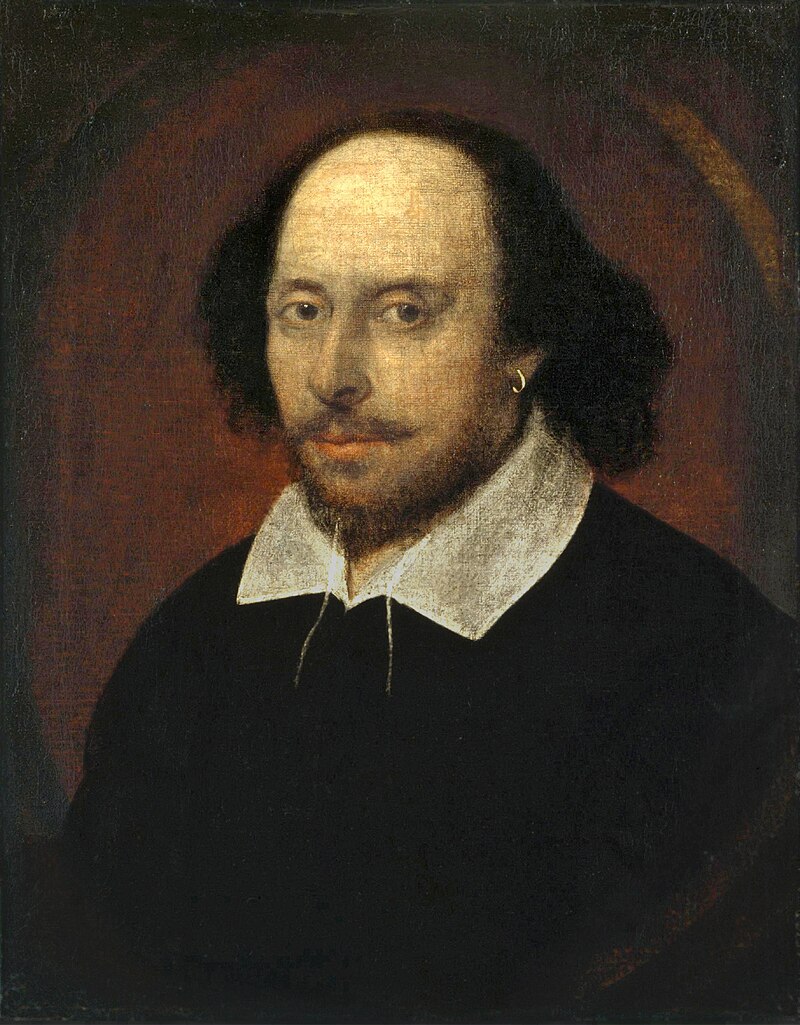
"Shakespeare" possibly by John Taylor
Source Wikipedia
National Portrait Gallery


To mark the 400th anniversary of Shakespeare's birth in 1964 Sir Frederick Ashton created The Dream.  Antoinette Sibley was Titania and Anthony Dowell  her Oberon, The Dream was one of the most beautiful ballets that Ashton ever created. Here is a snippet of the original production and another to a more recent performance by American Ballet Theatre with Alessandra Ferri and Ethan Stiefel. The ballet was part of a triple bill of works inspired by Shakespeare. The others were Kenneth MacMillan's Images of Love and Sir Robert Helpmann's Hamlet.  To commemorate the 400th anniversary of Shakespeare's death the Birmingham Royal Ballet will revive this iconic work at the Hippodrome between the 17 and 20 Feb 2016. If you see only one ballet this year this is the one you should not miss.

This is not the only contribution of the Birmingham Royal Ballet to the anniversary commemorations.  The company will dance its Romeo and Juliet the following week in Birmingham before taking it on tour to the Lowry, Sunderland, Nottingham and Plymouth.  The Northern touring section of the company will take pas de deux from Romeo and Juliet, The Dream and The Taming of the Shrew together with Wink, a new work by Jessica Lang and the Moor's Pavane to Durham, York and Shrewsbury on its Shakespeare Midscale Tour.

Regular readers of this blog will know that my favourite choreographer of all time was John Cranko (see Cranko's "Taming of the Shrew": Now's our chance to see one of the Ballets everyone should see before they die 21 Sept 2013). One of the works that he created for his Stuttgart Ballet is The Taming of the Shrew for which I waited 44 years to see (see Stuttgart Ballet's "Taming of the Shrew" - well worth the Wait 26 Nov 2013). Birmingham Royal Ballet, the successor to the company in which Cranko began his career, will perform his Taming of the Shrew in Birmingham between 16 and 18 June 2016.  Incidentally, the Stuttgart Ballet will dance their production of the ballet at the Stuttgart Opera House on the 21 July 2016. Whether you catch it in Brum or Stuttgart, Cranko's masterpiece is another must see show.

The Birmingham Royal Ballet's final contribution to the anniversary commemorations will be The Shakespeare Triple Bill consisting of Wink, The Moor's Pavane and David Bintley's The Shakespeare Suite at the Hippodrome between the 22 and 25 June 2016.

As Birmingham is just over 30 miles from Stratford on Avon and in the same historic country it is perhaps fitting that the Birmingham Royal Ballet should lead those commemorations but it is by no means the only company to dance works inspired by Shakespeare. The Royal Ballet will revive The Winter's Tale in Spring. The Bolshoi will bring their version of The Taming of the Shrew by Jean-Cristophe Maillot to music by Shostakovich to London in the Summer (see Bolshoi Ballet to return to the Royal Opera House in summer 2016 11 Nov 2015 on the Royal Opera House website:

Bolshoi Ballet's Taming of the Shrew, 
Standard YouTube Licence

British audiences will also get a chance to see that work streamed from Moscow on 24 Jan 2016 (see Live Performances streamed from the Bolshoi and Covent Garden 20 Sept 2015).  Phoenix Dance Theatre will launch Undivided Loves by Kate Flatt based on Shakespeare's Sonnets in their triple bill at the West Yorkshire Playhouse on 17 Feb 2016. I have already seen an extract of the work and I strongly recommend it (see Never attend a Ballet Class the Morning after the Night Before 21 Dec 2015).

Yesterday I chose Scottish Ballet as my company of the year (see Highlights of 2015 29 Dec 2015) and they will certainly be in contention for the 2016 title if David Dawson's Swan Lake is as good as I expect it to be. Dawson is Associate Artist to the Dutch National Ballet and was its resident choreographer between 2004 and 2012. I saw his Empire Noir in the Dutch National Ballet's Cool Britannia triple bill and was most impressed (see Going Dutch 29 June 2015 and David Dawson's Empire Noir 18 June 2015). Swan Lake will open in Glasgow on 19 April 2016 and will visit Newcastle between 11 and 14 May 2016 and Liverpool between 1 and 4 June 2016 as well as Aberdeen, Inverness and Edinburgh.

Another new work to which I look forward immensely is Akram Khan's Giselle for English National Ballet. This work will be premièred at the Palace on 27 Sept 2016 and will be the centre piece of the Manchester International Festival. Having seen Kaash at the Lowry (see Akram Khan's Kaash - contemporary meets Indian classical 7 Oct 2015) and Dust at the Palace (see Lest We Forget 25 Oct 2015) I am intrigued. After Manchester the company will take the work to Bristol, Southampton and London.

Looking across the North Sea I tip Ted Brandsen's Mata Hari  for the Dutch National Ballet (see Mata Hari 30 Nov 2015) and Ballet Bubbles the new season for the Durch National Ballet's Junior Company. The programme will include new works by Ernst Meisner and Charlotte Edmonds as well as pieces by Krzysztof Pastor, David Dawson and my favourite living choreographer Hans van Manen. Sadly the company will be unable to perform at the Linbury this year because it is closed for renovation. I have tried to persuade the company to consider other theatres in the UK but I am not confident that I have been successful. Other shows I should really like to see include Hans van Manen's Gold which will tour the Netherlands and Sasha Watts's Romeo and Juliet to Berlioz;s score. Incidentally, if like me you are a van Manen fan but can't make it to the Netherlands you can see Birmingham Royal Ballet dance his Five Tangos together with Solitaire, Four Scottish Dances and Monotones II in Cheltenham, Poole or Truro. I saw Scottish Ballet's performance of Five Tangos last April and enjoyed it very much (see No Mean City - Accessible Dance and Ballet 26 April 2016),

While it may not be possible to welcome the Junior Company to England this year we can at least look forward to visits by the Australian Ballet and the Bolshoi. The Australians are bringing Graeme Murphy's Swan Lake and Alexei Ratmansky's Cinderella to the Coliseum in July. The Bolshoi are bringing Maria Alexandrova, Ekaterina Krysanova, Olga Smirnova, Svetlana Zakharova, Semyon Chudin, David Hallberg, Denis Rodkin and others to delight us and will perform Don Quixote, Swan Lake, The Flames of Paris and Le Corsaire as well as Maillot's Taming of the Shrew which I mentioned earlier.

I am aware that I have barely scratched the surface and I apologize for any omissions. On the eve of what promises to be an outstanding year for dance I wish all my readers a happy and prosperous new year.

Wednesday, 16 December 2015

The Bolshoi's Encore


Last Sunday I took another butcher's at The Bolshoi's performance of The Nutcracker of 21 Dec 2014. I reviewed it last year in Clara grows up- Grigorovitch's Nutcracker transmitted directly from Moscow 21 Dec 2015 so this was literally a case of déjà vu. The company is actually dancing The Nutcracker on Sunday with Semyon Chudin in the title role. So why could we not see that performance in England? My guess is that the cinemas think they can make more money from showing the latest Star Wars and if that is the case they are almost certainly right. Love a duck! So much for popular taste. May the force be with us!

I enjoyed the show a bit more second time round as I knew what to watch for. Having seen Rodkin on the stage in St Petersburg Ballet Theatre's production of La Bayadere in September (see Blown Away - St Petersburg Ballet Theatre's La Bayadere 24 Aug 2015) I expected fireworks and that was what we got -  particularly in the final pas de deux with Nikulina, Russian ballerinas can be rather grand, remote if not slightly frosty ladies. Nikulina is sweet and sparkly. She is as exciting to watch as any other Russian principal dancer but she can also act. She looked genuinely frightened in the fight between the Nutcracker and King Mouse. She looked as though she needed a hug and a cuddle.

I saw the video at the Pictureville cinema at the Bradford Media Museum. It was quite full for a Sunday afternoon screening. On leaving the cinema I overheard one of the denizens of Bramhope or Huby remark to her companion "I'm seeing The Nutcracker again you know.  By the "Royal" Northern Ballet" (sic). Now there's a thought.

Monday, 7 December 2015

Lady of the Camellias Streamed from Moscow


Nigrum Sol BT    Standard YouTube Licence

Bolshoi Ballet, The Lady of the Camellias, HDTV transmission for Moscow, 6 Dec 2015

We don't see enough of John Neumeier's work in this country which is a shame because it is dramatic and beautiful. I saw a bit of it live on stage this year in two galas.  In March Alexandr Trusch and Lucia Solari danced the final pas de deux from his production of The Nutcracker in Leeds at Northern Ballet's Sapphire gala. In September I saw Marijn Rademaker and Igone de Jongh dance an excerpt from the Dutch National Ballet's production of La Dame aux Camelias (see A chance to see more of Neumeier's work: Dutch National Ballet's La Dame aux Camelias 18 March 2015) at the opening gala of the Amsterdam ballet season (see The best evening I have ever spent at the ballet 13 Sept 2015).

Yesterday afternoon I saw the whole of that ballet (albeit in two dimensions) streamed live from Moscow to the Huddersfield Odeon. I like other British ballet goers have been brought up on Ashton's Marguerite and Armand which he created for Fonteyn and Nureyev and is also based on the Dumas novel. Neumeier's ballet created 15 years later for the great Brazilian ballerina Marcia Haydée to Chopin's music is at least as beautiful and perhaps even more dramatic.

The synopsis for those who missed the transmission is here. Marguerite was danced magnificently by Svetlana Zakharova who was Giselle in October (see The Bolshoi does the Business - Giselle streamed from Moscow 12 Oct 2015) and Armand by Edvin Revazov. The production had been facilitated by Kevin Haigen of the Hamburg Ballet who represented Neumeier in Moscow. The excellent Katerina Novikova interviewed him during one of the intervals as well as Anna Tikhomirova who danced Manon Lescaut in the other. She was interviewed in costume which was gorgeous as Ms Novikova observed. The designs were Jürgen Rose's originals.

The ballet was beautiful but emotionally draining to watch as I tweeted at the end of the second interval

I long to see this whole ballet on stage. I could kick myself for missing it in Amsterdam earlier this year when I had the chance. Too much loyalty to Ashton I guess.

Monday, 12 October 2015

The Bolshoi does the Business - Giselle streamed from Moscow

The Bolshoi Theatre
Author Theeler
Creative Commons licence 
Source Wikipedia


Bolshhoi Ballet, Giselle, 11 Oct 2015

Just as the Americans excel in films and we in state pageantry the Russians excel in ballet. There are other countries that do very well including ourselves as World Ballet Day reminded us but the Bolshoi and the Mariinsky are masters of the art as yesterday's live transmission of Giselle from Moscow showed. I have seen a lot of performances of that ballet in my time and I am set to see at least two more before the end of the year but, despite a couple of hiccups that I barely noticed at the time and of which I had to be reminded, yesterday's performance from my perspective was about as good as they get.

The title role was danced  by Svetlana Zakharova who was as expressive in her acting as she was impressive in her dancing. I am not the most emotional person but I was close to tears several times in the show. The first time was when she plucked the petals and found the cad loved her not. The second was when she clutched her chest. The third time as she felt the material of Bathilde's garment and her girlish joy at receiving a gift from the grand lady. Tears actually formed in the sword scene. Even though I have serious problems with Act II of the ballet for the reasons I tried to explain in Reflections on Giselle 29 Jan 2014 I was enthralled by Zakharova's dancing from the moment she emerged from her grave to the second she handed a flower to Albrecht as she went down.

The perfect partner for Zakharova was Sergei Polunin. I have not seen much of him on stage since he left the Royal Ballet - I think the last time was at the Yorkshire Ballet Summer School Gala in September 2013 - but he has never failed to amaze me with his athleticism. Can that man jump! His turns and jumps as he danced for the wilis were breathtaking. However, he can also act and he almost persuaded me with his contrition in Act II.  I can see why Giselle begged Myrtha to spare his life even though I would not have bothered.

The other star ballerina was the magnificent Ekaterina Shipulina. A strikingly beautiful woman and a fine dancer she was a perfect queen of the wilis. In the interval she was asked about the coolness with which she despatched Hilarion (called "Hans" in this production for some reason and danced well by Denis Savin) and would have done the same to Albrecht had it not been for Giselle's intercession by Katerina Novikova. The answer was that she is a spirit and that is her character.

There were two other performances that deserve mention and that is the peasant pas de deux by Daria Khokhlova and Igor Tsvirko in Act I. I had admired Tsvirko in Swan Lake earlier this year, as the jester in Legend of Love and as Pepinelli in Marco Spada and it was great to see him again. Both dancers executed that piece magnificently.

One of the advantages of watching ballet in the cinema is that viewers get to see the Bolshoi stage which seems as cavernous as an aircraft hanger. The disadvantage is that you see the backcloth which looked a bit dowdy compared to Thurrock's scenery as did the costumed.  But overall the performance was excellent. I  am looking forward to seeing Jewels next month.

Sunday, 11 October 2015

Giselle in Moscow, Amsterdam, Edinburgh, High Wycombe and Manchester


Dutch National Ballet's Giselle


This afternoon at 16:00 the Bolshoi Ballet's Giselle will be transmitted to cinemas across the United Kingdom and many other countries (see Live Performances streamed from the Bolshoi and Covent Garden 20 Sept 2015). I shall watch it at the National Media Museum in Bradford but I believe it will be shown by the Odeon, Cineworld and most of the other nationwide chains. It should be a very good performance. Svetlana Zakharova dances Giselle, Sergei Polunin Alnrecht, Denis Savin Hans (aka Hilarion) and Yekaterina Shipulina as the queen of the wilis. I shall review the show tomorrow.

Much closer to home the Dutch National Ballet is staging Giselle in Amsterdan between 13 Oct and 15 Nov. Tsygankova, Makhateli, de Jongh, Wotmeyer and Shesterikovare in the cast together with many other of my favourite dancers. That will be good too.

Another Giselle will come to us from New Zealand.  Adult Beginner wrote a great review of that ballet when the Royal New Zealand Ballet visited Los Angeles last year (see Giselle 8 Feb 2015 Adult Beginner). The company will dance that ballet in Edinburgh between 27 and 31 Oct and High Wycombe between 6 and 7 Nov where I shall see it.

Finally, our very own Manchester City Ballet (the performing company of Northern Ballet School) will dance Giselle at the Dancehouse between 10 and 12 Dec 2015. Tickets are on sale on Ticketline.