Showing posts with label Theatre. Show all posts

Friday, 18 March 2022

Beatrix Potter comes to Life

Beatrix Potter and Peter Rabbit*


* Photo credits Rod Tinsley/Tony Cockrell Copyright 2022 Chelmsford Ballet Company, Reproduced with kind permission of the company

Chelmsford Ballet Company Beatrix Potter™ Tales in association with Frederick Warne & Co. Chelmsford Civic Theatre, 16 March 2022, 19:30

I have watched every annual show by the Chelmsford Ballet Company since 2013. I have enjoyed them all but none has delighted me more than Beatrix Potter™ Tales in association with Frederick Warne & Co. It was a show in which everyone shone from the tiniest hedgehog to guest artist Xholindi Muçi.  It was not just the cast that excelled.  I don't think I have seen so many scene changes. There was a different backcloth for each scene.  Those backcloths seemed to depict not the Cumbrian lakes and fells but the rolling hills, brooks and woods of rural Essex. Never have I seen more lavish costumes.  Each animal head painstakingly created.  There was entertainment even in the interval as the artists dashed through the bar and foyer in full costume. 

The ballet opened with Olivia Riley as Beatrix Potter at her desk.  She rose to her feet.  Gentle soutenus and développés represented her musings.  Characters from her Tales came to life one by one.  They included:
  • Mrs Tittlemouse (Sophie Odell)
  • Johnny Town Mouse (Orla Swann) 
  • Mice led by Anastasia Marks and Tessa Raita, 
  • Peter Rabbit (Alycia Potter)
  • Mrs Tiggy-Winkle (Anna Gellett)
  • Hedgehogs led by Isabella Stagg
  • Alexander Pig (Grace Emerson)
  • Pigling Bland (Xholindi Muçi)
  • Pig Wig (Darci Willsher)
  • Jemima Puddle-Duck (Samantha Ellis)
  • Mr Tod (Anna Gellett)
  • Jeremy Fisher (Kiera Cook)
  • Hunca Munca (Isabelle Fellows)
  • Tom Thumb (Abigail Wiltshire)
  • Squirrel Nutkin (Rachel Young)
  • Tabitha Twitchit (Echo Murrill)
  • Mrs Tiggy-Winkle in Act 2 (Grace Emerson) and 
  • Squirrel (Karisma Patel).
There were many artists - some very young - who danced in the ensemble.  Each and every one of them performed well. The only reason I have not listed them above or singled them out for special praise below is that this review would resemble a telephone directory had I mentioned everyone who impressed me.

Each of the scenes represented a different Tale. Some were solos and others were duets.  I particularly admired Muçi's dance with Willsher.  There was some difficult choreography in their duet including a fish dive. I enjoyed all the solos especially Peter Rabbit, Jemima Puddle-Duck who flew across the stage and Jeremy Fisher who read "Pond Life" while waiting for his catch.

This was the first time I had seen this ballet but I was told by Elizabeth Baker (the company's President) that it had been in the repertoire for some time.  She had danced in an earlier production.  She said that the ballet had been inspired by the filmFrederick Warne & Co. had licensed Chelmsford's version.  The score had been composed by John Lanchberry and Nigel Westlake.  The magnificent costumes were designed by Ann Starling. The sets were created by Annette Potter who also choreographed and produced the show. 

The Tales of Beatrix Potter shows what can be achieved by non-professional dancers.  Chelmsford Ballet was formed 73 years ago and has survived lockdown, austerity, inflation and umpteen recessions.  It inspired us at Powerhouse Ballet to set up a similar company in the North of England.  lt would be wonderful if we could stage something like the Tales of Beatrix Potter one day. 

There will be performances tonight and tomorrow.   If you can reach the Chelmsford Civic Theatre you can expect a treat.

Wednesday, 2 March 2022

Acosta Danza "100% Cuban"

Standard YouTube Licence

Acosta Danza 100% Cuban  New Theatre, Hull, 25 Feb 2022, 19:30

Cuba may be a small Caribbean island with a population of 11.2 million but it has world-class national ballet and contemporary dance companies.  Joanna Goodman reviewed one of the Cuban National Ballet's performances of Swan Lake in its own theatre in 2014 (see "We are the dancers, we create the dreams: Ballet Nacional de Cuba’s El Lago de los Cisnes in Havana8 July 2014). I reviewed the national contemporary dance company when it visited the Lowry (see Danza Contemporanea de Cuba at the Lowry 19 Feb 2017).

Artists from Cuba have contributed not only to their own national companies but also to leading companies of other nations.  Probably the best known of those is Carlos Acosta. He is now the artistic director of the Birmingham Royal Ballet.  Previously he was a principal dancer with the Royal Ballet.  A glimpse at his website shows that Acosta is more than a dancer and choreographer. He is an entrepreneur, novelist and indeed impresario.

In 2016 Acosta established Acosta Danza which he has described as "Some of the finest Cuban dancers I have ever had the pleasure of working with."  The company is touring the United Kingdom and my friend and I caught up with it at the Hull New Theatre on Friday.  We were treated to the following:
These were very different works that showed off the versatility of the company.

Liberto was a duet created by Raúl Reinoso to the music of Pepe Gavilondo.  The programme contains the following note:
"The story of a cimarron, invites us to reflect on the faces of slavery, from ancient times to the present day. The meeting of the fugitive with the woman, beyond the beginning of a love story, is a moment of reflection and retelling, the possible discovery of the path to the utopian kingdom of total freedom."

I think cimarron must be the Spanish word for "Maroon" who were fugitive slaves.  They formed colonies in the Caribbean and some found their way to Freetown in Sierra Leone where I first learnt their story.  The ballet featured a couple. I am not sure of the identity of the man because the company did not publish a cast list. I asked for one in a Q & A that followed the show but the company's interpreter did not seem to know what I was talking about or why I needed one.   I think Reinoso danced the male role and believe the woman was Zeleidy Crespo but I cannot be sure. I remember a giant net from which the man struggled to escape.  The designs were by Alisa Peláez. The lighting was by Yaron Abulafia.

Like a football match, Hybrid was a combination of two halves. Quite literally because there was a point when the cast lined up for a curtain call, accepted the applause and then slowly started dancing again.  The inspiration for the work appears to have been the legend of Sisyphus:

“O my soul, do not aspire to immortal life, but exhaust the limits of the possible.
(The Myth of Sisyphus).  According to the programme, the piece was about a "universe where the real and the unreal blur their limits to reach our chimaeras." It continued:

"An approach to sensitive realities and imaginaries of a nation and its people, told from the strength of its culture and dance.
An island that unveils its mysteries on a path that goes from darkness to light"
The whole company or at least a large part of it seemed to be in the work. The music was by Jenny Peña and Randy Araujo, the choreography by Norge Cedeño and Thais Suárez, the designs by Celia Ledón and the lighting by Yaron Abulafia.

This was not to everyone's taste because the audience thinned out a little after the interval.

As the music was entitled Cuban landscape with rumba by Leo Brouwer and Cuban Landscape by Stefan Levin and the ballet was danced against a backdrop of growing crops, I understood Paysage, Soudain, La Nuit to be an appreciation of the Cuban countryside and those who worked in it.  This was another work in which the whole company participated.  The choreographer was Pontus Lidberg. Costumes were by Karen Young.  The lighting was by Patrik Bogårdh.

The most spectacular work was Impronta.  It was a solo by Crespo which she performed to the music of José V. Gavilondo. The show started with a mass of blue.  It was not clear whether that was a prop or a group of dancers.  It turned out to be a long flowing dress worn by the dancer. A tall, elegant and exceptionally supple woman, Crespo had bent her body almost to the floor so that her face appeared through the dress.  In the Q&A, Crespo explained that the dress represented the sea.  In answer to a  question from my friend, she said that the dance had been influenced largely by African rhythms.  The programme added:
"Catalan choreographer María Rovira created this solo in wich contemporary dance merges with Afro-Cuban folk dances."

Several audience members stood to applaud Crespo's performance at the end.  Others whooped with delight.  The reaction was well merited because it was impressive.

My favourite ballet was De Punto a Cabo.  I surmise that the title must refer to a seaside walk that is opposite Havana.  The backdrop was of a busy city separated by a stretch of water and a sea wall. Alexis Fernández's choreography to José White and Omar Sosa's music reminded me of the view of Manhattan in the last scene of Liam Scarlett's Age of Anxiety (see Bernstein Centenary  18 March 2018). The piece generated much the same energy and awe.   The website states in Spanish that the choreographer sought to transpose into dance his impressions of contemporary Cuba, a land of diversity and contrasts. He made that point by combining ballet with contemporary dance.  There were some spectacular fouettés from Penélope Morejón as well as contemporary expressions to African and Cuban rhythms.

In the Q&A we learnt that the morning company class alternates between ballet and contemporary. Each of the dancers was asked which style they preferred.  None expressed a preference except Morejón who seemed to glow as she talked about ballet.  There were the usual easily anticipated questions from the floor about the creative process, influences and how they liked the British weather. The best intervention came from a lady from Bridlington who had to dash for a train. She probably spoke for all of us in expressing gratitude for the pleasure the company had brought after a 2-year pandemic.

This was the first time I had attended the Hull New Theatre and my first impressions are good.  It is located on Kingston Square where there was plenty of free street parking.  There is a restaurant and bar which offered inter alia burgers and scampi and chips. It was not exactly gourmet food and slightly over-priced for what it was but it was very convenient.  The auditorium seemed well ventilated.  The seats were comfortable with enough legroom at least for me.

Acosta Danza is nearing the end of its UK tour.  They are at the Marlowe Theatre in Canterbury tonight and at the Theatre Royal in Plymouth at the end of the week. 

Saturday, 24 June 2017

Northern Ballet says Goodbye to Takahashi, Solari and Curnier


Standard YouTube Licence


I am very sorry to say goodbye to Jeremy Curnier and Lucia Solari who are on their way to Germany's northern ballet at Kiel which is a few miles from the Danish border. I wish them well in their new company. Kiel is a very pleasant little town about the size of Hull. I went there once after driving all the way from Copenhagen to Esbjerg and finding that my hotel restaurant (and all the other restaurants in Esbjerg) were closed at not much later than afternoon teatime. Even though it was an extra hour's drive to Kiel everything was open. There is a history of the ballet company on the Kiel Theatre's website which starts off with the words: "Tanz hat in Kiel lange Tradition" ("There is a long tradition of dance in Kiel") though "long" in this context seems to be over 25 years. They seem to do Swan Lake and The Nutcracker regularly as well as a sprinkling of new work and there is a season for new choreographers.

I am also sorry that I will no longer be able to see Hironao Takahashi though he at least is remaining in the company with a new job as "Assistant Rehearsal Director & Assistant Artistic Director of Short Ballets for Small People". Now he really does have a lange Tradition in dance. I wish him every success in his new role too.

Also leaving are Naomi Bottomer, Isabelle Clough, Jenny Hackwell and Luke Francis. They will be missed too. I can't tell you where they are going or what they are doing but I am sure all my readers will join me in wishing them well in whatever they do and wherever they go.

Happily, Northern Ballet is recruiting new dancers.   They include
  • Ailen Ramos Betancourt who was a guest artist in Casanova and joins as a Soloist; 
  • Eneko Amorós Zaragoza (Estonian National Ballet); Thomas Holdsworth (English National Ballet School); Ommaira Kanga Perez (Escuela de Ballet Carmina Ocaña y Pablo Savoye); Heather Lehan (Canada’s National Ballet School) will join the corps; and 
  • Andrew Tomlinson, Archie James, Carlotta Pini and Mathilde Lambert (no relation) join as apprentices.
Welcome to each and every one of them.

Finally, I am delighted to see that Victoria Sibson is now a First Soloist, Mlindi Kulashe, Ayami Miyata, Kevin Poeung and Abigail Prudames are now Soloists, Sean Bates, Matthew Koon and Matthew Topliss Junior Soloists and Sarah Chun, Riku Ito and Jonathan Hanks are Coryphée.  Well done folks!

Friday, 28 April 2017

DEL Dance Theatre -


DEL Dance Theatre is a new dance company for young people in York. According to its Facebook page, DEL stands for "Dance", "Education" and "Learning" though it also appears to be the middle name of the company's founder, Hayley Del Harrison. The reason I know that is because the company is appealing for funds on Crowdfunder for a new production of Saint-Saëns’s Carnival of the Animals which will feature several styles of dance.

I cannot think of a better score for its repertoire. That music, and in particular The Swan, kindled my love for ballet. My mother was lucky enough to see Pavlova dance Fokine's interpretation of that movement (see In Leeds of all Places - Pavlova, Ashton and Magic 15 Sept 2013). I saw a great performance of that work by Elena Glurdjidze in the Gala for Ghana on 4 Feb 2014 and was able to tell that great ballerina how much I enjoyed her performance a few days later (see Elena Glurdjidze - So Lovely, So Gracious 11 Feb 2014). A year afterwards Javier Torres danced Michel Descombey's version in Northern Ballet's Sapphire gala on 15 March 2015. A week later I saw Christopher Marney's beautiful version for Chelmsford Ballet (see A Delight Indeed 22 March 2015).

The company had appealed for £1,500 and has already exceeded that target. The appeal, incidentally, ends at 15:05 today British time so there is still time to contribute if you would care to do so. The aim is to introduce musical theatre to the young people of York, both as patrons and performers.  Ms Harrison explains that:
"Dance theatre not only entertains; it sparks the imagination, provides tools for expression, and increases our ability to empathise."
She adds that though there is a lot of other artistic activity in York there is not much home-grown musical theatre in the city - especially not for children. The company plans to fill that gap offering opportunities not just for the young:
"We are also keen to draw on the talent and skills of so-called ‘mature’ dancers living in the area (these people should be cherished, not side-lined!), and provide opportunities for them to share their experience and knowledge."
And not just for dancers as local artists and musicians are also invited to participate in the project.

Ms Harrison spent her career in the West End and on stage. I plan to review the show when it appears and also to write a longer feature on the company for Terpsichore Yorkshire.

Friday, 17 March 2017

Ninette de Valois


Today is St Patrick's day. Ireland has given the world many great artists in every medium and genre over the centuries.  I can think of no better way of celebrating Ireland's national day than by remembering one of the finest of those artists, Dame Ninette de Valois.

Dame Ninette was born in Blessington on 6 June 1898. Although she is best known for establishing the Royal Ballet, the Birmingham Royal Ballet and the Royal Ballet School, she contributed much to the arts in Dublin. At the request of W B Yeats, she helped to establish the Abbey Theatre School of Ballet and choreographed several ballets for the Abbey theatre to scores by contemporary Irish composers. She was honoured for her services to the arts in Ireland by the Irish Catholic Stage Guild in 1949 and by an honorary doctorate from the University of Dublin in 1957.

Yet another country that honours Dame Ninette is Turkey for she founded the Turkish State Ballet and the Turkish State Ballet School and created the first full-length ballet for the national company.

I should like to wish all my readers whether Irish or not, and, in particular, Fiona Noonan who led me back to ballet, a very happy St Patrick's Day.

Saturday, 19 November 2016

DIBA @ RADA

Royal Academy of Dramatic Arts
Author Chemical Engineer
Source Wikipedia
Creative Commons Licence


DIBA stands for Danceworks International Ballet Academy. It is the facility through which Darnceworks trains dancers under the age of 18. I featured it in Danceworks Academy  on 21 March 2015. As readers know, dance education is one of my special interests whether for the young and gifted, those such as I who take up dancing for fun at any age and everyone in between.

Towards the end of the year, DIBA students put on a show. Last year it took place in one of Danceworks's studios in Balderton Street (see Danceworks International Ballet Academy Christmas Show 3 Dec 2015). Demand for tickets was so high that DIBA had to run three separate shows. The Academy will stage another show this year but this time it will take place in the theatre where RADA (the Royal Academy of Dramatic Arts) trains its own students (see Join us for DIBA's Christmas Nutcracker Suite on DIBA's website).

The performance will take place at 17:00 on Saturday, 10 Dec 2016 at RADA Studio Theatre, 16 Chenies Street, London WC1E 7EY. Tickets cost £20  for adults and £12 for children of 12 years or under.  There is also a £2 booking fee if you book online.

Ballet is not just a good way of improving deportment and keeping fit. It is intended to be performed in the theatre which is a place of magic and excitement.  If the link with the stage is ever lost or never there in the first place children will quickly tire of ronds de jambes and grands battements - and who can blame them? How many times have you heard well-rounded, well-educated adults say "I've never actually been to a ballet but I was made to take lessons as a kid and hated them." "Made to take ballet" indeed. It should be a treat!

One of the reasons why I write a lot about DIBA and (Danceworks in general) is that it keeps that link.  It is one of the features that distinguishes DIBA from so many other ballet schools up and down the country. The remarkable young dancer, Michaela DePrince, grand sujet with the Dutch National Ballet, taught some of the children on her last visit to Danceworks (see Michaela DePrince revisits Danceworks 7 Aug 2016). Most of those who attended Michaela's class will decide not to become dancers for one reason or another but they will all benefit from working with her. Their love of theatre will be enhanced for a start and many more will be inspired by her life story to jump their own hurdles which may lie in quite different fields.

However, Danceworks is not just for kids. I took one of its adult ballet classes earlier in the year and had a great time (see Hendrick's Class at Danceworks 19 Jan 2016).  I am delighted that the studio offers classes for my age group (see Over 50s Ballet Classes at Danceworks 30 May 2015). Tasha Bertram will teach a new over 50 class at Danceworks from 13 Jan 2017 between 18:00 and 19:15 (see New Over 50’s Ballet Class at Danceworks on Danceworks's website).

The following passage appears at the bottom of the web page:
"Benefits of balletThere is no age barrier to learn to dance and the long-term flexibility benefits of ballet are excellent. Ballet classes will help to:
Develop and maintain your flexibility. The combination of strength and flexibility is what keeps a body healthier and stronger for longer, and more resilient to injury.
  • Work both your body and your mind. The physical and mental challenges of ballet can improve vitality
  • Gain confidence in your body You will feel more supple and poised
  • Learn musicality Ballet is practiced in harmony with music. You will learn to draw energy from it, count it and live. 
  • Feel a new energy and forget your problems in a relaxed and quiet environment.
Come and experience our ballet class and enjoy this graceful and timeless form of dance."
I have been taking ballet classes now for several years first in Huddersfield and more recently with the Northern Ballet Academy in Leeds and KNT in Manchester as well as the occasional class in London and other cities. I can attest to all those benefits from my personal experience. There are adult ballet classes in every part of the country (even in towns and remote villages in the West of Scotland thanks to Ballet West (see the Outreach and Short Courses page on its website)). Everyone can have a go and I hope that a few of my readers will be promoted by this article to do just that.

Thursday, 29 September 2016

Ernst Meisner's New Recruits


Standard YouTube Licence


Every year the Dutch National Ballet scours the world for twelve of its most promising young dancers and invites them to Amsterdam for an intensive programme of training and performances. The artistic coordinator of that programme is Ernst Meisner who is well known to, and well liked by, British audiences (see Meet Ernst Meisner and his talented young dancers 6 Dec 2014). Many of his dancers have been recruited into the Dutch National Ballet and other leading companies and their careers have taken off like rockets. Michaela DePrince, for example, joined the Junior Company in 2013 and is already a grand sujet. Cristiano Principato joined the programme a year later and has contributed work to New Moves (see Palagio  4 June 2016).

Ernst has now recruited new dancers for the Junior Company which includes Hannah Williams who was born in Ashford. Hannah trained in the United States and the Netherlands which no doubt explains her transatlantic accent but that will not prevent ballet goers in the country from wishing her, and all the other members of the Junior Company, all the best.

Every year the company tours the Netherlands and occasionally one or two theatres abroad. Before the Linbury closed for renovation they danced two shows here each year.  I am desperately racking my brains trying to find the best way of tempting them back. The first opportunity to see the new dancers will be at the Meervaart Theatre in Amsterdam in Juniors Go Dutch on 18 and 19 Feb 2017. Tickets start at 15 euros and the theatre is only 23 minutes from Schiphol airport by the 69 bus. There are cheap and convenient flights from Southend, Manchester and just about every other corner of the UK. Despite the post-Brexit nose dive of sterling Amsterdam is still a lot cheaper than London and there is plenty to do apart from watching ballet when you get there (see Three Days in Amsterdam 12 Sept 2016).

Monday, 6 June 2016

Pinocchio


Standard YouTube Licence

Ballet Theatre UK, Pinocchio, Rotherham Civic Theatre, 4 June 2016

With perfect timing Ballet Theatre UK performed Pinocchio at the Rotherham Civic Theatre on the very afternoon that the English Defence League were demonstrating in the town centre thereby distracting 800 officers from all parts of South Yorkshire from their normal duties (see South Yorkshire Police and Rotherham Metropolitan Borough Council grateful for disorder free demonstrations 4 June 2016). Even though their demonstration is likely to have deterred many from venturing into Rotherham to see the show the company's excellent young artists still managed to attract a better audience than the demonstrators and counter-demonstrators combined which says a lot for BTUK and also a lot for Rotherham.

I have always had a lot of time for BTUK who regularly bring fresh, new full length ballets to small auditoriums the length and breadth of the United Kingdom.  The Birmingham Royal Ballet has its midscale tours of three theatres in the North and Midlands and three in the South and West Country every May in order to bring ballet to new audiences. Last year Northern Ballet started to do the same with Madame Butterfly and are doing the same right now with Jane Eyre.  BTUK however do that sort of thing all the time.  Between 25 March and 19 June 2016 they will have performed Pinocchio in 36 venues often covering enormous differences with a few hours. For instance, between 1 and 5 June they will have travelled between Peterborough, Solihull, Great Yarmouth, Rotherham and Buxton.  I have reviewed several of BTUK's shows (see Pure Delight - BTUK's Little Mermaid in Southport 27 April 2014, The Bedouin of Ballet 12 Dec 2014 and Ballet Theatre UK's Aladdin 5 April 2015) and I know from the buzz in the bars that their performances are very much appreciated.

The story of Pinocchio is about a puppet that comes to life which when you think about it is not all that different from Mary Shelley's Frankenstein which Liam Scarlett has recently turned into a ballet (see Rarely have I been so impressed by a new ballet 19 May 2016). However it is a lot less dark than Frankenstein though it is at least as complicated. Like Frankenstein the story focuses on what distinguishes a human from an intelligent machine which, of course, is also a theme of Coppelia.  It is remarkable how three 19th century stories all of which have been transposed into ballet have something to say about artificial intelligence now that our technology is on the point of delivering it.

Because the story is complicated it is difficult to follow the ballet without a synopsis and because I arrived at the theatre just seconds before the curtain rose I did not get mine until the end. The only part of the story I could remember was that Pinocchio was made of wood and that his nose would grow whenever he told a lie. Although I could recognize a fox and a cat I became hopelessly confused by the blue fairies, the circus, the schoolchildren and the signpost pointing to "School" in one direction and "Fun" in the other. Now that I have read the synopsis it all makes perfect sense.

The ballet starts off with a romantic scene that reminded me a little of Bournonville's Napoli. David Brewer is the craftsman Gepetto and Ines Ferreira is his bride.  I followed the bit where she died and came back to life as a blue fairy. I also followed the construction of the puppet and his awkwardly coming to life. Although I could recognize Emma Miller as a fox, Pedro Santos as a cat and Amy Keenan as some kind of insect (she turned out to be a cricket) and that they had been waylaid by Vincent Cabot and Charlotte Laura Eades in a circus it was not obvious to me what the school kids (especially the punchy little boy Lampwick danced by Sarah Mortimer) had to do with the story until after the performance.

If, as is likely, the company have children in mind, the choreographer might consider some sort of narration or voice over as Ballet Cymru did for Roald Dahl's Little Red Riding Hood and the Three Little Pigs or English National Ballet's My First Coppelia. A programme does help a lot but even if I had received it before the show I would have needed time to digest the complicated plot. Not all children's ballets need narration. Ballet Black's Dogs Don't Do Ballet gets by without one. But this one does.

Nevertheless, Pinocchio is a gorgeous show with great sets by Martyn Plant and costumes by Daniel Hope. The music is beautiful and Christopher Moore's choreography is delightful. The ballet is coming to the end of its travels but you can still  catch it at Horsham, Stourport, Middlesbrough, Chesterfield, Margate, Exmouth or Neath. Whether you are young or old, ballet newby or ballet snob, you should try to see this work. It is the best I have seen from BTUK to date and I am now a bigger fan of this great little company than ever.

Oh and just a word about Rotherham. It is a great place for fantasy. There is a "magical apothecary" in the town centre called Grimm & Co. from which humans are excluded. I kid you not. Rotherham is a great little town and that's just the sort of fantasy and fun its kids and grown ups need. Not the politics of fear and hate.

Friday, 25 March 2016

A Real Beauty: Chelmsford Ballet's The Sleeping Beauty

Marion Pettet as Carabosse
(c) 2016 Chelmsford Ballet Company, all rights reserved
Reproduction licensed by the company


Chelmsford Ballet Company, The Sleeping Beauty, Chelmsford Civic Theatre, 19 March 2016


Some would say that I am not the best person to write this review on the ground that I am far from unbiased. It is true that I am more than a Friend or well wisher of the Chelmsford Ballet Company as I am an associate member of the company and if I lived nearer I would audition for dancing membership. My membership of this remarkable company, which will celebrate the 70th anniversary of its origins next year, is a source of enormous pride. Never have I been more proud of my membership of the Chelmsford Ballet Company than I was on Saturday evening when I saw its performance of The Sleeping Beauty.

The Sleeping Ballet is not an easy ballet to stage because it is very long and has an enormous cast.  It is also associated in the minds of us Brits with the re-opening of the Royal Opera House on the 20 Feb 1946 with a cast that included Moira Shearer, Leslie Edwards. Gillian Lynne, Henry Danton, Beryl Gray, Michael Somes, Robert Halpmann, Jean Bedells, Harold Turner, Gerd Larsen, Stanley Holden, Pamela May and, of course, Margot Fonteyn. It is therefore a challenge to any company, particularly one that is composed largely of men and women with full time careers outside dance.

Our company responded to that challenge admirably.

First, our choreographer and artistic director, Annette Potter, pruned Petipa's choreography to manageable lengths adapting the work to the capabilities of her dancers who ranged widely in age and experience without sacrificing any of the important and often difficult bits such as the rose adagio or bluebird pas de deux.

Secondly, she had an excellent cast: Scarlett Mann as Aurora who had danced the title role in Pineapple Poll so enchantingly last year (see A Delight Indeed 22 March 2015), Lucy Abbott as the lilac fairy (quite a challenge as the company's co-patron dances Count Lilac in Sir Matthew Bourne's production of The Sleeping Beauty). guest artists Andrei Iliescu as Prince Florimund, Emily Starling as the fairy in the vision and Matthew Powell as one of the princes in the rose adagio, Morgan Wren who has advanced tremendously since I saw him as Fritz in The Nutcracker two years ago (see The Nutcracker as it really should be danced - No Gimmicks but with Love and Joy 20 March 2014) and of course the magnificent Marion Petter as Carabosse. Everybody in the show performed well and the only reason why I have not mentioned them all individually is that this review is long enough already.

The third ingredient of the show's success was its special effects. There were indoor fireworks as Carabosse made her entrances and exits. A menacing image projected onto the backdrop presaged her arrival at Aurora's christening and birthday party. An ingenious animation represented a century's growth of vegetation around Aurora and her family. The programme credited Phil Rhodes with special effects. Clearly he is a talented young man and I hope to see more of his work in future.

There is in fact a lot of talent in Chelmsford.  For me, Marion Pettett stole the show as she did last year as Mrs Dimple and Britannia in Pineapple Poll and the mother in Carnival of the Animals.  She positively exuded evil with her rodent like acolytes. Gita, the other member of Team Terpsichore, likes to choose a man or woman of the match when she attends the ballet as she is an accomplished sportswoman. Her choice for this show was Morgan Wren and I can quite see why. But there is also talent bubbling up from below. The smallest of Carabosse's acolytes had real stage presence as she took her leave of the audience before scurrying off with her evil mistress. I don't know that child's name but I do hope she carries on with her dance and theatre studies because she has great aptitude for the performing arts.  It is worth adding that that young girl was by no means the only young person to show promise.

It is rare for ballet companies to receive a standing ovation in this country but there were more than a few members of the audience who rose to their feet at the end of Saturday evening's show. The audience in the Chelmsford Civic was not unsophisticated. It knew when to clap - for instance the entrance of the principals and difficult bits of the choreography. I don't think that they would rise for anyone or anything without good reason and the fact that so many did on Saturday night speaks volumes for the show.

I do not know what Annette Potter and Marion Pettett are planning for next year's show but as it was in 1947 that Joan Weston organized a troupe of dancers at Broomfield YMCA which became Chelmsford Ballet I am sure that it will be good. Having achieved a lot over the years the company has a lot to celebrate. Though the March show is the highlight of the year the company holds other events such as Let's Make a Ballet for children in the Autumn and the Hutton and Shenfield Choral Society's Christmas show. Occasionally, they arrange coach trips to West End shows. I know we have the Choral but I wish we had a something like the Chelmsford Ballet in Huddersfield.

Sunday, 8 November 2015

"The Pride of Newport and the Pride of Wales"

Ballet Cymru and Guests, Riverfront Theatre, Newport 6 Nov 2015
Author Gita Mistry
(c) 2015 Gita Mistry: all rights reserved


Ballet Cymru, TIR, Riverfront Theatre, 6 Nov 2015

Towards the end of her performance Cerys Matthews described Ballet Cymru as "the pride of Newport" and a little bit later as "the pride of Wales". The auditorium exploded and rightly so for indeed they are at least that.  Friday night was one of those very rare times in the theatre when something special happens. Something like the moment when Igone de Jongh and Casey Herd stepped on stage to dance Voorbij Gegaan which Rudi van Dantzig had created for Alexandra Radius and Han Ebelaar immediately after the presentation of the Alexandra Radius prize (see The best evening I have ever spent at the ballet 13 Sept 2015.) Or when Hans van Manen took a bow at the Stadsshouwburg at the Junior Company's opening performance (see The Junior Company of the Dutch National Ballet - Stadsshouwburg Amsterdam 24 Nov 2013 25 Nov 2013). Or when Northern Ballet danced A Midsummer Night's Dream  at the West Yorkshire Playhouse on 14 Sept 2013 (see Realizing Another Dream 15 Sept 2013). Or indeed Sir Frederick Ashton's retirement gala on 24 July 1970.

There were many reasons why Friday's performance was special.  The company was at home. In the magnificent Riverfront Theatre in its home town. The company's artistic director, Darius James, is a Newport man and his pride in his city and company is palpable. I watched Darius in the intervals as he greeted well wishers. There is real affection for James and his company in Newport very much as I found in Birmingham for Bintley and his company, or in Glasgow for Scottish Ballet or in Amsterdam for the Dutch National Ballet. Another reason is that the company is like a family - a family still in shock and mourning one of its finest dancers (see Mandev Sokhi 10 Oct 2015). Mandev was never far from our thoughts but  in Marc Brew's Traces Implanted and Matthews's setting of the Rev Eli Jenkins's prayer from Under Milk Wood it was as though he was still centre stage. Yet another reason which Friday was special is that the dancers seemed to be inspired. I have never seen them dance so well. I have rarely seen any company dance as well.

The evening was a triple bill consisting of Catrin Finch's Celtic Concerto. Traces Implanted and Cerys Matthews's TIR. As I got hopelessly lost in the one way system after encountering the notoriously, stroppy taxi driver who charges £50 if you're sick in the back seat in Newport State of Mind  which we were assured by our hotel reception we needed for the "enormous distance" (for a snail) between the Newport Travelodge and the Riverfront Theatre, we missed Celtic Concerto.  But we were in time for Traces Implanted which impressed me even more than Brew's other works and, of course, Matthews's glorious TIR. We also have the perfect excuse to see the triple bill again in another venue.

On his website Brew explains that "Traces Implanted explores the imprints and memories made and the traces left behind".  Gita tells me that she discussed that theme with Brew when she met him after the show. Gita confirmed that the subject matter is death and bereavement, something that we don't wish to mention about every day even though we are confronted with that reality constantly. The dancers must have found it particularly difficult as they had recently been bereaved themselves. But as Brew added, he doesn't always want to create conventional balletic beauty. Although there was beauty in this piece - particularly in the final duet with almost ethereal figures in the soft and subtle lighting - it was a compelling but not a comfortable work to watch.

TIR was quite a different work. Matthews has a lovely voice which is admired everywhere in the UK but when she sings in Welsh to a Welsh audience she is adored. Darius James and Amy Doughty have created dances for some of her best known works. Works that I was relieved to find are almost as well known on this side of Offa's Dyke as on the other. I caught myself clapping to Sospan Fach and rooting for a tissue for Myfanwy. Half concert, half ballet it was a thrilling experience. The company were joined by Daisuke Miura and Emily Pimm-Edwards who had delighted us in Romeo a Juliet (see They're not from Chigwell - they're from a small Welsh Town called Newport 14 May 2013) and Suzy Birchwood who had amazed us in Llandudno (see An Explosion of Joy 21 Sept 2014).

After the show Gita and I were invited to meet the dancers and creative team over drinks and canapés. It was a privilege to shake their hands again - particularly Krystal Lowe's who never fails to move me. I got to meet Jack White the gifted young composer of Cinderella and Stuck in the Mud and many of the the creative and technical team who have worked with the company  though sadly not Matthews on this occasion. Still, I have seen her perform live for the first time and that was more than enough.

Thursday, 18 June 2015

Review: McQueen at St James Theatre, London


McQueen is a creative review of the life of tragic fashion designer Alexander (Lee) McQueen (Stephen Wight), as told to Dahlia (Dianna Agron), a fictional girl who apparently breaks into his house (or does she?) because she needs a dress. Like Lee, Dahlia is directionless and clinically depressed. He takes her on an adventure through his life story, in one night, during which time he makes her a dress which brings out her unique beauty – helps her see who she really is. There are various hints, but we are never actually told this.

The story is a vehicle, perhaps an allegory for McQueen’s artistic principle that fashion is the purest form of self-expression – how you dress (or in Lee’s case, the dresses he designs) expresses what you are. When Lee doesn’t have creative inspiration, he loses his way.
In a series of scenarios from his life, Lee effectively turns himself inside out to his mysterious intruder and they help each other through the night.
Why is this review appearing on Terpsichore, a blog about dance? Well, many of the scenes include dreamlike sequences where a group of dancers depict mannequins, wearing McQueen’s stylishly eccentric creations. The mannequins are his muses and Terpsichore is the muse of dance. David Farley’s production design and Christopher Marney’s choreography were striking from the first scene. I loved the opening sequence, where at some points it was hard to differentiate between dancers and mannequins. The dancers were all well cast, as they looked like living mannequins and they moved together beautifully as a group, with points of choreographic interest – posing and turning with lifts and exquisite silhouettes at different parts of the stage. Their skill belied the challenge of working with a relatively small space and a busy, changing set. In a later, party scene, the mannequins appear again, now representing beautiful party people – models perhaps – dancing and swaying around the stage in couples and formations, drawing Lee and Dahlia deeper in to the night.

The staging was perfect, and the lighting created and intensified the atmosphere, which was dark, but somehow optimistic. I found a balcony scene overlooking London particularly striking. Another fabulous creative device was when Lee fits a beautiful dress onto Dahlia on stage, transforming her from an obsessive fan to a late night muse who helps Lee find the inspiration that keeps him alive. This was so impressive – a nice detail was that he left one pin in the shoulder strap.
A lively, exquisitely designed production with fantastic set and production design, beautiful dancing and choreography and some excellent acting including a great Isabella Blow cameo from Tracy-Ann Oberman is let down by a plot full of holes. Here are just a few. Who is Dahlia? Is she real, or imaginary? Is she his alter ego? There are many references to her being already there, a doppelganger etc. Well if she is, it’s a bit bizarre that she’s an ‘I want, I want’ person, when Lee himself was obviously an ‘I get, I get’ person. Also if she is part of him, how come he has to tell her his life story? She’d already know all of that!

Dahlia makes a lot of suggestions that she is part of Lee, or his alter ego, but a lost American girl seems a strange alter ego for a talented, tortured designer at the height of his fame.
The reason the plot holes are so easy to spot is that the play is set between Isabella Blow’s suicide and Lee’s own. By this time his talent was globally recognised and he was at the pinnacle of his career. The programme included a useful timeline of his life, so when you read the programme, you wonder about the inaccuracies in the play. For example, Lee wasn’t ‘made’ by Isabella – he was a successful tailor before he was accepted to study on the MA course at St Martin’s and she bought everything in his graduate show. While in this play Isabella claims to be his Svengali, in reality she was a catalyst for his second career.

The play makes no reference to Lee's time at St Martin’s or his widespread recognition - including as British designer of the year – and only touches lightly on his serious issues with drugs.
The theme of self-harm and suicide – Dahlia gives no reason why she is so troubled – is treated lightly given Lee’s actual demise. The play ends on a possibly optimistic note, which is a plus point. Dahlia says she has had the best night of her life, which suggests that she is an individual in her own right. If she signifies part of Lee’s character, surely wandering around London reminiscing about his past to an imaginary friend is unlikely to be the best ever night for an internationally acclaimed fashion designer.

Even if you excuse the plot holes as artistic license, the wordy script made several scenes feel unnecessarily long. I would pick out in particular the scene in Lee’s dying mother’s house which could have been cut to less than half the length to get the message across. This was towards the end of the play and there was a distinct shuffling among audience members – the seats are not particularly comfortable.
Overall it was an entertaining show. The staging was beautiful and Stephen Wight was genuinely convincing as Lee McQueen. It helps that he really does look like him. He delivered his lines well – even the clunky ones – and he was on stage for the entire 1 hour and 40 minutes. Dianna Agron, however, was less impressive. At first I tended to agree with some critics who wrote that her acting seemed wooden, but her obvious professionalism throughout made me think that this is how she had been asked to portray the character Dahlia who would have fitted nicely into Twin Peaks.

And there was indeed a David Lynch quality about McQueen. The acting was generally pretty good, and I liked Tracy-Ann Oberman’s excellent take on Isabella Blow, though again half the number of words would have got the message across. I particularly liked her wafting around elegantly in the background of the dance sequences and other scenes.
I also have to declare a personal interest in McQueen, the play. My friend Amber Doyle is the dance captain, and I go to her ballet classes, so I was anticipating some excellent dancing. And I was certainly not disappointed. The perfect stylish dancing and choreography was one of the very best things about this show. I also felt that some reviewers were a bit harsh about the actors, particularly Stephen Wight, who I thought did a good job with an unwieldy script.

McQueen’s problem is that it is a hybrid – it’s not a musical, and a contingent in the audience who had come to see Agron based on her performance in Glee must have been disappointed that her only bit of singing is a few snatches of Billy Joel’s ‘Always a woman to me’, a song which I unfortunately associate with the John Lewis ad a few years ago.
McQueen is not a biography either, because it’s highly selective – it misses out important facts about McQueen’s life and influences and half the story is about an imaginary character, or doppleganger. Nor is it a ballet, either although much of the story is told in the dance sequences. All this means reviewers struggle to place it.

McQueen is an entertaining, beautifully staged tribute to a tortured and sadly missed talent and it successfully captures the strange and wonderful world of fashion – its creativity and its cruelty. It’s been described as self-indulgent, but what is fashion – and indeed much art too – if it is not self-indulgent? That’s the beauty of it! If you like fashion and dance, you’ll like McQueen.  I did.
NB, The image, by photographer Sam Mardon, shows the theatre’s special McQueen cocktails. This is because I had asked a contact at the theatre whether it was ok to take photos at any point and was told roundly that anyone with a camera would be escorted out. Having read some mainstream reviews I had considered putting a camera in my bag to facilitate an early exit! I’m glad I didn’t. The photo was taken on an iPhone before the show.

McQueen is at St James Theatre, London until 27 June. https://www.stjamestheatre.co.uk/theatre/mcqueen/


Sunday, 30 March 2014

The Guys of the Golden West

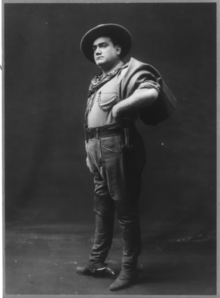
Enrico Caruso as Dick Johnson in The Girl of the Golden West  Source Wikipedia


We owe a lot to the West Country. Both Northern Ballet and Scottish Ballet trace their origins to Elizabeth West's Western Theatre Ballet in Bristol. Sadly there is no longer a resident professional ballet company in Bristol but that does not mean that there is no ballet in that city. One of the Golden Guys of the West is Dave Wilson who keeps the best ballet blog that I have come across so far (see "Fantastic New Blog: Dave Tries Ballet" 28 Sep5 2013).

Dave is a member of the the Bristol Russian Youth Ballet Company which danced Cinderella in Stockport last month (see "Good Show - Bristol Russians' Cinderella in Stockport" 19 Feb 2014). The company is dancing the same ballet again at The Playhouse in Weston Super Mare on 4 May 2014 at 16:00 with Elena Glurdjidze and Arionel Vargas as guest principals. I shall be in the audience again on that occasion and I shall review the performance for this blog. Glurdjidze is not only the company's guest artist she is also the Bristol Russian Ballet School's patron and she will take some of the school's master classes. The school is run, incidentally, by Chika Temma who trained with Glurdjidze at the Vaganova Academy in St Petersburg and Yury Denakov who trained at the Boshoi. All of those great dancers and teachers are Golden Guys.

Other Golden Guys are Duchy Ballet whose existence I discovered only yesterday. This evening and yesterday they were performing The Mousehole Cat & Other Ballets at The Hall for Cornwall in Truro. Roberta Marquez of the Royal Ballet appeared as a guest artist. According to the company's website Duchy Ballet was formed to celebrate the opening of The Hall for Cornwall with the aim was of establishing a youth ballet company for Cornwall providing the opportunity to train, rehearse and perform within a professional setting.  The company's choreographer is Terry Etheridge who was a guest choreographer of the Chelmsford Ballet Company some years ago and inspired and taught Andrew Potter who danced Drosselmeyer in that company's recent production of The Nutcracker (see "The Nutcracker as it really should be danced - No Gimmmicks but with Love and Joy" 20 March 2014). Potter acknowledged his debt to Etheridge on twetter this morning:
"Mr Etheridge, Found me, taught me and inspired me."
Having seen Potter's performance I congratulate Etheridge on a very good job. I really wish I could have been in Truro to support this production. I will be present at their next performance.

That brings me on to the last Golden Guy though of the North rather than the West. Chris Hinton-Lewis, who had the Herculean labour of trying to teach me last year, is running in the London Marathon on the 13 April 2014 to raise money for the Multiple Sclerosis Society. Please do sponsor him.

Thursday, 20 March 2014

The Nutcracker as it really should be danced - No Gimmicks but with Love and Joy

Chelmsford Ballet Company The Nutcracker Chelmsford Civic Theatre
19 March 2014


I had very high expectations of The Chelmsford Ballet Company's performance of The Nutcracker. As I noted in The Chelmsford Ballet 16 Dec 2013
"An amateur company with patrons like Christopher Marney, choreographer of the wonderful War Letters for Ballet Black, and the great ballerina, Doreen Wells, invites attention. On the home page of their website the Chelmsford Ballet Company describes itself as "an amateur company who set professional standards for all [its] work, involving professionals in [its] productions, courses, and other teaching and workshop opportunities." According to the history page it traces its history back to 1947 which makes it older than English National Ballet, Scottish Ballet and Northern Ballet."
I had fresh cause to admire the company when I learned that Cara O'Shea, the wonderful teacher I had seen at Northern Ballet's Open Day and who also taught me a few days later, had danced for the Company as Aurora in The Sleeping Beauty. None of that had quite prepared me for yesterday which was one of the happiest evenings that I have ever spent at the ballet.

There were so many reasons why I enjoyed this performance. First, it kept faithfully to the story that we all know and love.  No gimmicks like balloon trips or regal rodents clinging to the gondola into Act II. Set firmly in Mitteleuropa rather than the banks of the Thames, the Christmas party taking place at the Stahlbaums and not the Edwards and Clara remained a little girl throughout the show and did not morph into Sugar Plum. Secondly, this was a production in which every age group and both genders were well represented. I had expected to see only teenagers (mainly girls) and while there were certainly plenty of them the cast also included prominent members of Chelmsford society. Thirdly. they had a wonderful audience who knew when and where to clap. How they yelled when they saw something they liked. And how they roared at the end of the performance. Chelmsford knows that it has something special in its city and it supports the company magnificently. The theatre was packed. 

As I mentioned in "Chelmsford Ballet's Nutcracker - Not Long Now!" 24 Feb 2014 the company had engaged Richard Bermange to dance the Cavalier, Emma Lister Sugar Plum and Michael Budd, the Mouse King as guest artists.  They all danced well but I particularly admired Lister for her solo in the final pas de deux. With the possible exception of the overture the music for that dance is the best known part of the score and this ballet has more memorable tunes than just about any other. She executed it impressively. Bermange partnered Lister well and Budd was a Putin of a mouse king if not a Stalin. Really, really scary.

Amelia Wallis, who danced Clara, was delightful. Not only can she dance well but she can also act. Clara is on stage for almost the whole ballet which must require considerable stamina and concentration. Wallis did not flag or drop her smile for a second.  Clearly she has talent and I am sure we shall all see more of her. Also talented is Morgan Wren who danced Fritz, Clara's pesky brother, the Nutcracker and the Chinese divertissement. He has presence. Other dancers who caught my eye were Jessica Wilson who danced one of the Harlequins, the Spanish dance and the dance of the flowers, Jasmine Bailey, the other Harlequin, the principal snowflake and leader of the dance of the flowers and Megan MacKatchie, also in the Spanish dance.  Andrew Potter was a magnificent Drosselmeyer, Marion Pettet. Frau Stahlbaum, ever the gracious host - I loved the way she reprimanded a naughty boy tousling his hair - Stan Rose the sporting grandfather and Elizabeth Baker his wife.

But there was far more than just great dancing.  Ingenious sets and costumes, clever lighting and a last but not least a beautifully designed and printed illustrated programme. Altogether it was a triumph for the artistic director Annette Potter.

The show continues until the 22 March and there will be a video of Saturday's performance of which I shall certainly buy a copy. I came down from Yorkshire to see this show and I would say it was well worth the effort. We Yorkshire folk are quite sparing in our praise - particularly of Southerners. If we say something is good you can be sure it is bloody marvellous. If you live anywhere in East Anglia, Greater London or the home counties do yourselves a favour and see this show.

Tuesday, 11 March 2014

Elaine McDonald in her own Words

Spurred by this video from yesterday's New York Times  I have begun to de-clutter my library. Books are such beautiful things that I hate to throw them out even when they are hopelessly out of date. As I tweeted yesterday throwing out my Terrell on the Patents Act 1949, my Kerly on the Trade Marks Act 1938 and my Copinger on the Copyright Act 1956 feels like a betrayal. A bit like putting one's grandmother into a retirement home. But then the video from New York is a terrible reminder of the alternative. So I held my nose and got on with the job.

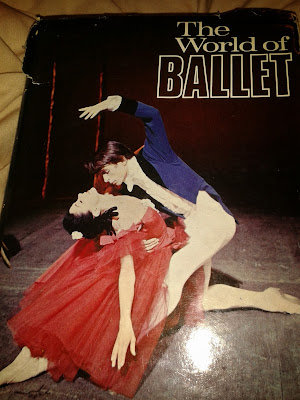
But then I came across this treasure: "The World of Ballet" edited by Anne Geraghty which was published by Collins in 1970. It is an anthology of articles with contributions from Arnold Heskell, Clement Crisp, Rudolf Nureyev and many others. I would have bought it from the Ballet Bookshop in Cecil Court which has sadly disappeared.

The reason I would have bought it is that it contains a chapter by Elaine McDonald entitled "A Dancer's Life". As I mentioned in my articles on Peter Darrell on 9 March 2014 and Scottish Ballet 20 Dec 2013 McDonald was Darrell's ballerina. Indeed, as Lord Brown acknowledged in McDonald, R (on the application of) v Royal Borough of Kensington and Chelsea [2011] PTSR 1266, (2011) 14 CCL Rep 341, [2011] UKSC 33, [2011] 4 All ER 881, (2011) 121 BMLR 164 she became the prima ballerina of Scottish Ballet. That was the first company that I got to know and McDonald was the first ballerina that I admired and in a way loved. And indeed still do.

McDonald came from Scarborough and had her first ballet lessons in the Queen of Watering Places. When she was 11 she won a competition organized by the Royal Academy of Dance (of which I became a Friend this morning) and Girl (a magazine for girls that was published between 1951 and 1964) for a ballet scholarship in Leeds. No doubt encouraged by this win she decided to make her career in ballet. She auditioned for and was accepted by the Royal Ballet School which would then have been in Baron's Court, just opposite the Cromwell Road from my old school. The Royal Ballet School's premises had enormous plate glass windows that stretched the full height of the front elevation. We tried so hard to hit a cricket ball through those windows - a feat that would have required the strength and prowess of Colin Cowdrey or Ken Barrington as the ball would have had to clear not only the boundary but a 9 foot terra cotta wall and a 6 lane dual carriageway to hit those windows.  It was never accomplished in the 5 years I was there and now both schools have moved - we to Barnes and the Royal Ballet School to Floral Street.

Returning to McDonald's story, her first appearance on the stage was in a pantomime produced by Cyril Fletcher where she and other girls danced puppets, children, flowers and princesses. Not long afterwards she auditioned for the London Ballet under Walter Gore, One of her first performances was as a member of the hunting party in Giselle and she tells how the long, heavy, velvet dress eased her into her role. She describes how she prepared for that first role, how she adjusted her hair and applied her make-up, how the performance seemed to go well - until she received a note from the ballet master on how her dancing could improve. After Giselle she danced the Prelude in Les Sylphides. Regrettably the company fell into difficulties and had to be disbanded.

After a spell at the Palladium she joined the Western Theatre Ballet. She wrote
"I did not know much about the company, but I had heard and read that it was young, vital and very forward -looking."
She added
"When I joined the Western Theatre Ballet it was considered one of the most modern companies in Britain, Not because the basic steps were different - we sill use the steps I have known since I was a child. But because the stories which some of our ballets tell are stories of everyday life. Our repertoire is very varied. It includes La Ventana, one of the very first classical ballets to be performed, Mods and Rockers '63 danced to the music of The Beatles, with such tunes as "She Loves You".
At the time she wrote that chapter Elaine McDonald was a soloist with the company. Her first principal role was in Beauty and the Beast which Darrell choreographed to a specially commissioned score by Thea Musgrave. She refers to that work in the last paragraph of that chapter. I saw that work shortly after it had been premièred in London at the King's Theatre in Edinburgh.

There are some lovely photos of McDonald as a little girl in one of her first stage appearances, another of her wearing a tutu in arabesque at age 9 and yet another with Kenn Wells and Peter Cazalet in Ephemeron. Cazalet, incidentally, was a talented cartoonist and the book contains lots of his drawings some of which are very funny indeed.

As I said in my article on Darrell it was good to see McDonald again and particularly good to see her smile. She has not been well and she and I are nearly 45 years older than we were when she wrote that chapter and I bought that book but when she smiled on television I saw only that powerful yet dainty young dancer who captivated audiences all those years ago.

Further Reading

Feb 2000  Elaine McDonald Feb 2000 Legend Ballet Magazine

Friday, 20 December 2013

Scottish Ballet

Tomorrow I go to Glasgow to see Scottish Ballet's Hansel and Gretel. I am looking forward to it tremendously, partly because a new work by Christopher Hampson is a delight in itself but also because Scottish Ballet has a special place in my affections.

Although I had an interest in ballet when I was at school in West London - maybe because of a wonderful exhibition of costumes and scenery from the Ballets Russes or perhaps because I had got to know some of the students of the Royal Ballet School as they were just across the Cromwell Road from us - it was at St Andrews that my interest developed into a passion.  The Professor of Art History was John Steer who had come to us from Bristol. There he had got to know Western Theatre Ballet and it was through him that I got to know that company.

Peter Darrell  1928 - 1987
The company had a wonderful choreographer in Peter Darrell as well as wonderful dancers like Bronwen Curry, Ashley Killar,  Kenn Wells and my favourite Elaine McDonald. I began to follow them even while they were still at Bristol.

A year after Steer came to St Andrews the company moved to Glasgow and changed its name to Scottish Theatre Ballet. I do not know whether Steer had anything to do with that move but he was very close to the company and eventually became its chair.  Once when Scottish Theatre Ballet visited Dundee Steer actually introduced me to the cast.  I even had the privilege of giving two of them a lift to their lodgings.  One was Kenn Wells. I cannot remember who was the other.  Steer actually brought them to our university. They performed in the Buchanan Theatre in Market Street, on 15 Feb 1971, the day we adopted decimal currency.

The first of Darrrell's full length works that I saw was Beauty and the Beast.  I reviewed it for Aien our student newspaper.  I saw the ballet at the King's Theatre in Edinburgh shortly after they had moved to Scotland.  I also remember chartering a bus for our ballet club of which I was a founder member.  The dancing was superb and I can remember Thea Musgrave's score which Darrell had commissioned.   I could not find the ballet in the company's current repertoire which is a pity.

Darrell and Steer are now dead and I was very sad to learn today that Elaine McDonald is not in good health.  I was even sadder to learn that my world had intruded into hers when she sought a judicial review of the richest borough in England's decision to withdraw her carer to save a few thousand pounds.  But I have seen a film clip of her taken shortly after the appeal.  Despite her infirmity she retains her elegance and bearing as a star.

A lot has happened to Scottish Ballet since I left St Andrews. Tarama Rojo has come and gone and it now has an excellent artistic director in Hampson.  It has won critical acclaim around the world.  It is one of the UK's strongest companies.  I now have other loves in ballet but it was Scottish Ballet that was my first love.

Sunday, 15 December 2013

The Chelmsford Ballet

Amelia Wallis         Courtesy The Chelmsford Ballet Company

An amateur company with patrons like Christopher Marney, choreographer of the wonderful War Letters for Ballet Black, and the great ballerina, Doreen Wells, invites attention. On the home page of their website the Chelmsford Ballet Company describes itself as "an amateur company who set professional standards for all [its] work, involving professionals in [its] productions, courses, and other teaching and workshop opportunities." According to the history page it traces its history back to 1947 which makes it older than English National Ballet, Scottish Ballet and Northern Ballet.

I heard about the company through twitter. English National Ballet had been tweeting about the work that goes into their costumes for The Nutcracker (see "Cracking" 14 Dec 2013). I commented:
"@ENBallet's tweets on the amount of work which goes into each dancer's costume for a classical ballet like The Nutcracker is an eye opener."
The Chelmsford Ballet's publicity officer Jessica Wilson replied:
"@nipclaw @ENBallet we are busy sewing ours too, mouse king head has arrived and soldiers are at the ready!"
I followed the links and found the company's website.

The dancers are staging The Nutcracker at the Chelmsford Civic Theatre between the 19 and 22 March 2014 and I shall be there to review it on the opening night. If you want to come too, the following link takes you straight to the box office.  Clara in that performance will be danced by Amelia Wallis whose photo appears above. She and the other dancers were auditioned at a Nutcracker workshop other pictures of which you can see here.

If you do see the show it is worth staying awhile to visit the city and county. It has a very pretty 15th century cathedral dedicated to St Cedd who was one of the earliest English saints. There's a fine Saxon church that is also dedicated to him by the nuclear power station on the coast. Chelmsford also has a fine Shire Hall near the cathedral where the Crown Court used to sit. I got to know the city well in my early years at the Bar because my clerk sent me regularly to cross-examine coppers and plead mitigation there.  Essex is very like the North. It also has factories, coast and even a few hills though none quite so high as ours. More importantly, it has gritty, generous hearted people with a thirst for education and a determination to get on - not la-di-da but just like us. In fact I regard them as honorary Northerners.

Returning to the company for a second, there are classes for the company and guests which I would love to take, a regular newsletter and lots of other events. You can join as a dancing or a non-dancing member for a very reasonable subscription. You can download the application form here.  If you live nearby and are into dance, what are you waiting for?