Showing posts with label Cristiano Principato. Show all posts

Monday, 21 October 2024

Principato's Cinderella: Having a Ball in Tallinn

Maria Chugai and Elizabetta Formento
Author Jack Devant © 2024 Jack Devant.  All rights reserved. Reproduced with the kind permission of the owner


Cristiano Principato and Sander Sellin Cinderella Estonian National Opera House, Tallinn, 14 Oct 2024 19:00

Cristiano Principato is a soloist with the Estonian National Ballet.  He first came to my attention 10 years ago when he was a member of the Dutch National Ballet Junior Company (see Meet Cristiano Principato of the Dutch National Ballet Junior Company 3 Dec 2014).  In his interview, he explained that he had loved choreography ever since he was a child. He said that his long-term dream was to direct a major company where he could create new ballets. My parting comment was: "Here is another young man who knows where he is going and I shall follow his career with interest."

I did not have to wait long for Principato's talent to emerge.  In June 2016 I flew to Italy to see some of Europe's most promising young dancers at the civic theatre of Trecate (a small town in Piedmont about the same distance from Milan as Huddersfield is from Manchester) perform at a benefit gala for an excellent local charity (see From Italy with Love 1 July 2016).  Not only did Principato raise money for the charity, he also danced before his father who had been prevented by illness from travelling to the opera houses in which Principato had performed.  It must have been a very proud moment for both men.

In the same year the Dutch National Ballet invited Principato to create a work for that company and the result was Palladio.   On the strength of that work, I nominated Principato as the outstanding young choreographer of 2016.  The following year Principato was placed in charge of New Moves 2017 which stages works by the Dutch National Ballet's dancers.   In my review, I wrote:

"As well as coordinating the whole event (see Principato moves to a Bigger Stage 30 May 2017), Cristiano Principato created, and danced in, my favourite work of the evening. He based his work on the music of Herny Purcell, our first great composer. This was a work for four dancers and his casting was impeccable."

I lost touch with Principato when he joined the Estonian National Ballet because Tallinn is much further from Manchester than Amsterdam.  

We reconnected when Maria Chugai, one of my favourite artists with the Dutch National Ballet, told me that she was dancing in a new production of Cinderella by Principato and suggested that I might like to fly out to Tallinn to see the show.  Although it was not easy for me to get away I jumped at the idea for several reasons.  First, Kenneth Tindall had told me in his interview on Casanova  that "the jump from one-act to full-length is an exponential and qualitative leap - not merely doubling or tripling of effort."  Not every choreographer can carry it off and I wanted to see what Principato would make of the challenge. Secondly, I have been a big fan of Chugai ever since I saw her dance Myrtha in Giselle at the Theater Heerlen on 9 Nov 2018 (see Mooie 10 Nov 2018).  I also owe her a special debt of gratitude for the online classes that she gave to Powerhouse Ballet during lockdown.  Finally, visiting Estonia was an adventure. It is a fascinating country with Russian, Finnish, Swedish and German influences, thriving tech and creative sectors and a concession called e-residency which confers some of the benefits of Estonian residence on non-resident foreigners.  The country also borders Russia and judging by the way international tensions are developing Tallinn may be the nearest I ever get to Theatre Street in my lifetime.

Although Cinderella was an independent production it took place in the Estonian National Opera House (Rahvusooper Estonia).  That building consists of two auditoriums side by side.  One is used for opera and ballet and the other for concerts.  For those who want to learn more about the opera house, the photographer Jack Devant has written an interesting article about the venue. The dominant feature of the auditorium in which the ballet took place is a gigantic painting on the ceiling encircling a chandelier.  It is not a big theatre compared to Covent Garden or the Music Theatre in Amsterdam but it gives an impression of opulence. The audience is seated on semi-upholstered wooden framed chairs allowing a reasonable amount of legroom.  There appeared to be space for an orchestra though the pit was boarded over for the performance. A heavy royal blue curtain hung across the stage.  The ushers were smartly turned out in black suits with golden trimmings around their neck and hemlines.

In an interview with Konstantin Litvichenko, Principato was asked to identify the three most successful factors of the performance.  He replied first the visual design, secondly, staging Cinderella in the style of Marius Petipa and thirdly the experience that he gained from staging the work.  I would agree with him about the design though I would not put it number one.  An obvious reason for the success of the show was that Principato's libretto stuck close to Charles Perrault's story and avoided gimmicks like gender alternation as in Scottish Ballet's Cinders or substitution of a male magician for the Fairy Godmother in David Nixon's.  But the main reason for the success of the show was the casting.  Principato chose dancers who were also accomplished actors.  They told the tale which was just as well as the programme notes were entirely in Estonian.

The casting of Elisabetta Formento from the Spanish National Dance Company in the title role was inspired. I had previously seen her with the Dutch National Ballet and the Birmingham Royal Ballet and it was a delight to see her again.  Formento is an excellent communicator of emotion.  Her despair and sense of burning injustice as her stepmother destroyed her dress and confiscated her invitation were palpable.  Later she shared her exhilaration with three soaring grands jetés as she approached her prince.

Perhaps because I am used to Sarah Kundi's portrayal of Hortensia (Cinderella's stepmother) in Christopher Wheeldon's version for the English National Ballet I had expected a comic performance from Francesca Loi. I was not disappointed.  There were some hilarious moments such as her panic over a mouse and her mounting frustration over her failure to distract the prince after she had recognized Cinderella. 

Loi was complemented by her two selfish and spiteful daughters Anastasia and Genevieve. These are difficult roles as they have to combine ridicule with nastiness which is the opposite of a dancer's training.  They were danced by Karina Laura Leškin and Phillipa McCann.

Much as the Lilac Fairy holds together The Sleeping Beauty and Drosselmeyer The Nutcracker the Fairy Godmother links the three crucial scenes of Cinderella.   She makes an appearance early in the first act noting Cinderella's misery.  She comes again with fairy helpers to create Cinderella's gown and carriage.  She returns to the stage just before midnight warning Cinderella to make her exit.  That role was performed by Maria Chugai with flair and virtuosity.

Formento was partnered gallantly by her prince Thomas Giugovaz.  Having graduated from La Scala ballet school less than 10 years ago his progress to soloist of the Spanish National Dance Company has been rapid.  He has danced in several American and continental companies and also in Hong Kong but not yet in the UK.  

Another dancer who has progressed rapidly is Diogo de Oliviera, a soloist with the Polish National Ballet.  He danced the role of the prince's advisor displaying humour when dealing with Cinderella's stepmother and sisters, carrying her discarded slipper and looking for a fit and considerable virtuosity at the ball.

Other artists I should mention are Akane Ichii, Kim Jana Hügi, Maarja Praks and Ashley Chiu who danced the seasons. Connor Willians and Hidetora Tabe were cavaliers.  Sacha Barber and Benjamin Pierce were guests at the ball.  All are members of the Estonian National Ballet whom I might not have seen had I not come to Tallinn.  All danced well and all deserve commendation.

I have already agreed that the designs contributed to the success of the show.  Credit for the lighting should go to Richard Boukine.  The visuals which consisted of CAD projections transported the audience through all the scenes of the ballet from Conderella's skullery to the ballroom of the royal palace. They were most impressive particularly the fireworks in the last scene. Aarto Hiiema and Principato share the credit for those projections.   Principato and Svetlana Leht collaborated on the costumes.  An original feature of the Fairy Godmother's headgear was the miniature golden stove pipe hat.  Last but by no means least of those who are to be congratulated is Sander Sellin of Grand Art MTÜ - Estonian Ballet Agency for he produced the show.   

Cinderella will be performed in Vilnius on 28 Oct and Tartu on 4 Nov 2024. The show returns to Tallinn on 25 Nov 2024.  It was a resounding success and for those who live within easy reach of any of those cities, it is strongly recommended.   Readers do not have to take my word for it as Principato has posted substantial portions of Act I  and Act II to YouTube.   

Tuesday, 16 October 2018

Ernst Meisner's "Embers" - One of the Highlights of the Dutch National Ballet's Opening Night Gala

Cristiano Principato and Jessica Xuan in Embers
Author Michel Schnater
© 2018 Dutch National Ballet, all rights reserved
 Reproduced with kind permission of the company


Cristiano Principato and Jessica Xuan  Embers (Opening night gala of the Dutch National Ballet) 8 Sep 2018, 19:30 Stopera

For me the highlight of the Dutch National Ballet's opening night gala on 8 Sept 2018 was the performance of Ernst Meisner's Embers by Cristiano Principato and Jessica Xuan.  I love Max Richter's music.  I love Ernst Meisner's choreography.  Most of all I love the interpretation by Cristiano and Jessica. 

This is what I wrote in my review:
"Another personal highlight was Cristiano Principato and Jessica Xuan in Ernst Meisner's Embers. I fell in love with that piece the first time I saw it at the Stadsshouwburg in 2015 (see The Dutch National Ballet Junior Company's best Performance yet 8 Feb 2015). In 2016 Principato brought his friends in the Dutch National Ballet and other leading companies to a tiny theatre in a small town half way between Milan and Turin to perform a Gala for Africa (see From Italy with Love 1 July 2016). I flew to Italy to support them. While I was there I had the honour of meeting Cristiano Principato's parents. It was a beautiful evening which ended with a performance of Embers by Principato and Priscylla Gallo. I wrote:
'Last year Meisner was my joint choreographer of the year for creating Embers. It moves me in a special way. I have now seen it four times and I love it a little more each time I see it. Thomas and Nancy Burer introduced me to the work and they dance it beautifully. I experienced it in a different way when Cristiano and Priscylla danced the piece on Tuesday night. Never has it seemed more beautiful.'
In July of this year, Principato and Xuan danced Embers at the Varna International Ballet Competition. For her performance in that piece, Xuan was awarded first prize. I am very fond of both of those dancers. When they took their bow on Saturday I felt compelled to rise to my feet. Wild horses would not have restrained me."
 I can't really add to that.

Tuesday, 11 September 2018

Dutch National Ballet's Gala 2018: A very special evening with a very special company

Author: Gebruiker:Iijjccoo  Licence CC BY-SA 4.0  Source Wikimedia Commons


Dutch National Ballet Gala 2018 National Opera and Ballet Auditorium, 8 Sept 2018, 19:30

I described the Dutch National Ballet'a gala in 2015 as "The Best Evening I have ever spent at the Ballet" 13 Sept 2015.  I meant it even though I had seen some very special performances.  "How could the 2015 gala possibly be equalled?" I asked myself rhetorically. In fact it was surpassed the very next year (see in Dutch National Ballet's Opening Night Gala - Improving on Excellence 8 Sept 2016).  Saturday night's gala was better still  It was a very special evening with a very special company.

It was special for all sorts of reasons.  Some of those were obvious such as the brilliance of the performances and the sense of occasion.  Others were personal reasons like the expression of pride on the face of my former ward (the nearest I have to a daughter) as she spotted Michaela DePrince in the grand defilé.   My ward also came from  Sierra Leone.  Having suffered  from civil war and ebola Sierra Leone has not had much to cheer about lately. DePrince's success is an exception. It is unadulterated good news and an enormous source of pride even to Sierra Leoneans who have never seen a ballet.  Recently DePrince sustained an injury that has kept her from her public far too long.  Seeing her dance again on Saturday in Peter Leung's Portrait  was a joy.  That alone justified the trip to Amsterdam as far as I am concerned.

Another personal highlight was Cristiano Principato and Jessica Xuan in Ernst Meisner's Embers. I fell in love with that piece the first time I saw it at the Stadsshouwburg in 2015 (see The Dutch National Ballet Junior Company's best Performance yet 8 Feb 2015). In 2016 Principato brought his friends in the Dutch National Ballet and other leading companies to a tiny theatre in a small town half way between Milan and Turin to perform a Gala for Africa (see From Italy with Love 1 July 2016).  I flew to Italy to support them. While I was there I had the honour of meeting Cristiano Principato's parents.  It was a beautiful evening which ended with a performance of Embers by Principato and Priscylla Gallo. I wrote:
"Last year Meisner was my joint choreographer of the year for creating Embers. It moves me in a special way. I have now seen it four times and I love it a little more each time I see it. Thomas and Nancy Burer introduced me to the work and they dance it beautifully. I experienced it in a different way when Cristiano and Priscylla danced the piece on Tuesday night. Never has it seemed more beautiful."
In July of this year, Principato and Xuan danced Embers  at the Varna International Ballet Competition. For her performance in that piece, Xuan was awarded first prize.  I am very fond of both of those dancers. When they took their bow on Saturday I felt compelled to rise to my feet.  Wild horses would not have restrained me.

One of the reasons I like Meisner's work so much is that he innovates.   In 2014 he collaborated with Marco Gerris of the ISH Dance Collective to create Narnia, The Lion, The Witch and The Wardrobe.  That work combined ballet with hip hop for the Junior Company and ISH.   Dancers from both companies performed extracts of that work at the 2016 gala and I was entranced.   Now Meisner and Gerris have collaborated again to produce a new work called Grimm which the Junior Company and ISH danced on Saturday night.  The combination of hip hop and classical dance succeeded brilliantly. The costumes were gorgeously outlandish and the music infectious.  I would love to see the whole work.   I hope it may be performed in the UK one day.

This year's gala was dedicated to Rudi van Dantzig who was one of two towering geniuses of Dutch ballet.  Three of his works were performed on Saturday: Voorbij Gegaan ("Beyond Goodbye")  by Josef Varga and Anna Tsygankova, Autumn Haze by Qian Liu and Constantine Allen and extracts from his Swan Lake.  The first extract was from act II where Siegfried meets Odette.   Artur Shesterikov was Siegfried and Anna Ol Odette.  The second was the seduction scene from act III with Legnani's 32 fouettés.  Maia Makhateli was Odile and Daniel Camargo Siegfried.   I have seen some great dancers in that role including Fonteyn and Nureyev but this was one of the most exciting performances  that I had ever seen.  Just before Christmas I joined the autograph queue following their performance in The Sleeping Beauty to ask Camargo and Makhateli to sign  two Christmas cards - one for two promising young ballet students at the Leeds Centre for Advanced Training whose mum is one of my ballet teachers and  another for Helen McDonough, who is the second biggest fan of Camargo and Makhateli from the UK.  Helen was in the audience on Saturday so they danced before their #1 and #2 British fans.

The other towering genius of Dutch ballet is, of course, Hans van Manen.  Three of his works were performed on Saturday.   The first was the Frank Bridge Variations, a pas de deux which was performed exquisitely by Remi Wörtmeyer and Suzanna Kaic.  It was followed immediately by In the Future  from the Junior Company which I had seen at the Stadsshouwburg in their fifth anniversary performance.  Visually Saturday's performance was as impressive as it had been the first time I had seen it but the words that are an integral part of the piece and essential for its appreciation were indistinct.  The last of Van Manen's works was his Symfonien der Nederlanden which was performed by the corps immediately after the first interval.  Van Manen is my favourite living choreographer and this symphony for the Dutch People is now my favourite of his works.  Set to Louis Andriessen's uplifting score, the dancers in costumes that resembled overalls saluted a great nation.  This was the first time that I had seen the Symfonien but I shall make sure that it is not the last.

Wörtmeyer is a talented choreographer.   I was impressed by his Passing Shadows at New Moves 2017:
"Passing Shadows by the company's principal, Remi Wörtmeyer, was another gripping work though more for the choreography than the staging. There was an explosion of applause before the curtain began to fall as Wörtmeyer spun his fellow Australian Juliet Burnett of the Flanders Ballet inches from the floor. This was a work for four dancers to Rachmaninov's Cello Somata in G Minor Op 19 Slow. This was a work for four dancers the other two being Jingjing Mao and Clemens Fröhlich. Wörtmeyer is credited with painting the sets and designing the costumes though they were sourced from the company's wardrobe and props departments."
He has created another beautiful work called You Before Me to Philip Glass's Etudes No 2 .  It was danced on Saturday by Anna Ol and Semyon Velichko.  Their interpretation was a joy to watch, as delicate as it was moving.

Ever since I saw her Streetcar Named Desire  for Scottish Ballet I have been a fan of Annabelle Lopez Ochoa.  Last year I was introduced to her by Cassa Pancho at Ballet Black's performance of her Little Red Riding Hood in Nottingham (see All Hail to the Lone Star Dancer 23 June 2017).  Her NUDE a delightful piece danced by Erica Horwood and Vito Mazzeo in flesh coloured body hugging costumes delighted the crowd.

Another choreographer who has created a major work for Scottish Ballet is David Dawson.  I loved his Swan Lake but I also enjoy his shorter ballets for the Junior Company and the Dutch National Ballet.  One of my all time favourite ballerinas is Sasha Mukhsmedov whose Nikiya delighted me (see Dutch National Ballet's La Bayadère 14 Nov 2016).  On Saturday I saw her in a very different role in Dawson's The Grey Area and she delighted me once more.  In The Grey Area she has partnered gallantly by James Stout who has recently been promoted to principal.

One of the most thrilling virtuosos of any company is Young Gyu Choi.  He excels in such roles as the Bluebird in The Sleeping Beauty and Shiva in Mata Hari.   He was superbly cast for the Soviet era ballet Flames of Paris which was danced for the first time in the Netherlands (and possibly the first time anywhere outside the former Soviet Union by a non-Russian company) on Saturday night. The bit that we saw was a rumbustious pas de deux with Aya Okumura to some catchy tunes by Boris Asafyev.  Okumura partnered Young enchantingly.  "Balletic Les Mis" flashed through my mind as I watched the piece.  I missed Ratmansky's revival of Flames of Paris on the Bolshoi's latest tour of London and in last year's cinema screening so I can't really say much about the work other than that the extract that we saw at the gala was very entertaining.

Another work that we see rarely in the UK is John Neumeier's Lady of the Camellias.   That is probably because we are brought up on Ashton's Marguerite and Armand which was created for Fonteyn and Nureyev some 15 years earlier.   Just as Fonteyn was Ashton's muse Marcia Haydée was Neumeier's.  The role of Marguerite requires a diva and there is probably nobody in the world who could have performed it more convincingly than Igone de Jongh.  Her Armand was Daniel Camargo who was magnificent.  Elegantly constructed and beautifully executed, it was the company at its best.

The show opened with the grand defilé or big parade - row upon row of dancers from the first year students at the National Ballet Academy to the principals presented themselves to the strains of Aurora's wedding from The Sleeping Beauty.   What presence and grace those children possessed.  The orchestra was conducted by our very own Koen Kessels.  That was yet another treat as Kessels is my favourite ballet conductor since John Lanchbery and I was able to tell him that in person as I was about to leave the theatre.  The show ended in a shower of gold confetti that brought the audience to their feet.

Every year the company awards a prize in honour of Alexandra Radius to the outstanding dancer of the year.  Usually it goes to a principal.   Young Gyu Choi won it last year and Artur Shesterikov the year before.  This year it was awarded to Timothy van Poucke, one of the company's youngest dancers who is still in the corps.  Van Poucke's career has been meteoric.  Only last year he and Salome Leverashvili were blogging about the Junior Company (see Missing Amsterdam 18 Feb 2017).

Readers will get some idea of the grandeur of the occasion from the video above. I am in the clip 8 minutes 35 seconds in.   Although it is grand it is not exclusive as it would be in some countries.  Anyone anywhere can buy a ticket through the company's website.  Tickets for the gala are more expensive than for other shows because there is a reception at which food and drink are served liberally.  Even so, our seats in row 9 of the stalls (zaal) were significantly less than the cost of equivalent seats at Covent Garden.

The New York Times ranks the Dutch National Ballet as one of the top 5 in the world and I would respectfully agree with that ranking.   I think the Junior Company has much to do with the Dutch National Ballet's success as recruits from the Juniors refresh and reinvigorate it every year.  According to Ted Brandsen, Junior Company alumni already make up a third of the company and that proportion is likely to rise over time.  I think that is why every year's gala has been better than the last.

Tuesday, 31 July 2018

Well Done Jessica!


Standard YouTube Licence

There is a beautiful photograph on Ted Brandsen's Facebook page of two of my favourite dancers: Jessica Xuan and Cristiano Principato.  They are wearing the most gorgeous costumes from a white act.   No gossamer sleeves so it can't be La Bayadḕre and I can't see any feathers so I don't think it is Odette.   Be that as it may the important words are at the base of the photo:
"Wow! 🤩 Jessica Xuan has won the gold medal at the prestigious VARNA - International Ballet Competition! Congratulations! 👏👏👏"
I first saw Jessica in 2013 when  she danced the first pas de deux  with Nathan Brahane in Rudi van Dantzig's Swan Lake (see The Junior Company of the Dutch National Ballet - Stadsshouwburg Amsterdam 24 Nov 2013 25 Nov 2013).  As I said then: "The audience loved them and so did I." I have been following Jessica's career and the careers of the other young dancers ever since.  I think the last time I saw her was as the Queen of the Dryads in Don Quixote earlier this year (see A Day of Superlatives - Dutch National Ballet's Don Quixote 1 March 2018.

I wrote about Varna on 23 Feb 2017 as it has its own opera house and ballet company in which Owen Morris danced for a while.  Its International Ballet Competition is one of the most prestigious in the world.  It has launched a lot of distinguished careers.  Jessica has done brilliantly.  I send her my heartiest congratulations and lots of love.

Friday, 6 April 2018

Junior Company - Five Tremendous Years


Standard YouTube Licence

In Ernst Meisner’s Work with the Dutch National Ballet 2 Dec 2014, Ernst Meisner. the Artistic Coordinator of the Dutch National Company Junior Company, told me how that company came to be formed:
“It has been a wish of Artistic Director Ted Brandsen for a long time to have a Junior Company to bridge the gap between school and company. While Christopher Powney was Director at the National Ballet Academy and placing the school on the international map, it seemed the right time to start such a young group. I was involved in setting the Junior Company up and it has been great to have the chance to develop the way we like this venture to go together with Ted and Christopher (now Jean-Yves Esquerre) during the years. We had a great start last year, with seven of the first group actually having joined the main company now."
I was lucky enough to attend the first performance of that company at the  Stadsschouwburg theatre in Amsterdam  which I reviewed in The Junior Company of the Dutch National Ballet - Stadsshouwburg Amsterdam 24 Nov 2013 25 Nov 2013.  On 15 April 2018 I am returning to the Stadsshouwburg to celebrate that company's fifth anniversary with a special performance of In the Future by the current members of the Junior Company.

According to the Dutch National Ballet's website, In the Future will be a triple bill consisting of the Napoli Suite (Pas de Six and Tarantella) by August Bournonville, Fingers in the Air, a new work by Juanjo Arques and In the Future by Hans van Manen.  it is described as "an attractive, yet daring programme for twelve dancers."  It differs from previous galas that I have seen where up to 8 new works were presented in a single evening.

Because I had been married for many years to a Sierra Leonean national who loved ballet as much as I do and knew a lot more about it, I was thrilled to learn about a young American dancer of Sierra Leonean origin.  She was already carving an enviable reputation for herself by winning the Youth America Grand Prix. her film First Position and early reviews of her performances in New York and her guest appearances in South Africa (see Michaela DePrince 4 April 2013).  When I learned that she had moved to Amsterdam my heart leapt (see No Holds Barred  4 Oct 2013).  I bought a ticket for the Junior Company's first show and booked a flight to Amsterdam.

When I eventually saw DePrince I described her as "quite simply the most exciting dancer I have seen for quite a while" but she was not the only dancer who impressed me that night. So, too, did Sho Yamada who partnered DePrince in Diana and Actaeon and all the other brilliant young people whom I saw on 24 Nov 2013 and subsequently.  On my last visit to Amsterdam just over a month ago I was overjoyed to see Yamada and Riho Sakamoto top the bill in Don Quixote (see A Day of Superlatives - Dutch National Ballet's Don Quixote 1 March 2018).

I have got to know several of those dancers.  When the outstanding young dancer and choreographer, Cristiano Principato, brought friends and colleagues from the Dutch National Ballet and other major companies to Trecate, a small town in Piedmont to raise funds for the charity Casa Alessia, I attended and reviewed their show (see From Italy with Love  1 July 2015).  The next year Principato arranged an even more ambitious programme of new choreography in Amsterdam called New Moves I was there for that too. One of the dancers who accompanied Principato to Italy was Thomas van Damme. Van Damme.  Van Damme also showed enormous talent as a choreographer in  New Moves 2017 but he also shows extraordinary talent as a film maker (see The Ballet Couple 8 Sept 2016). In that regard he reminds me so much of our own Kenneth Tindall.

If you can't make the Staddshouwburg next Sunday you get another chance to see it on 28 June 2018 at the Korzo Theatre in the Hague, The International Court, the International Criminal Court and a branch of the European Patent Office are also to be found there though only a lawyer would be interested in that kind of thing.  One of my ballet teachers danced there in The Lion King but he has now returned to Manchester.

If you miss In the Future  I recommend the opening night gala on the 8 Sept 2018 which is followed by a party a which you can meet the dancers and choreographers, Giselle, Christopher Wheeldon's Cinderella and Rudi van Dantzig;s Swan Lake.  There is now a direct train to Amsterdam from St Pancras and yesterday The Guardian published the Top 10 affordable hotels, hostels and B&Bs in Amsterdam.   

Tuesday, 27 June 2017

New Moves 2017


Standard YouTube Licence

Dutch National Ballet New Moves Music Theatre, Amsterdam, 26 June 2017 20:15

I have been following the Dutch National Ballet for several years now and have seen some great shows such as Ted Brandsen's Mata Hari and Coppelia (see Brandsen's Masterpiece 14 Feb 2016 and Brandsen's Coppelia  12 Dec 2016) and Natalia Makarova's La Bayadère (see Dutch National Ballet's La Bayadere 14 Nov 2016), but never have I admired that company more than I did last night. New Moves is a gala of work by some of the company's most talented young choreographers.  All of those pieces were good and several were outstanding.  I cannot think of any other company that stages galas like New Moves every year and I struggle to think of another that would be capable of doing so.

New Moves is intended to close the Amsterdam ballet season just as the gala in September, which I attended in 2015 and 2016, opens it (see The best evening I have ever spent at the ballet 13 Sept 2015 and Dutch National Ballet's Opening Night Gala - Improving on Excellence 6 Sept 2016). As on opening night, there was "a swinging afterparty in the foyers of the theatre" where it would have been possible to meet the choreographers and dancers.

The programme began with Clotilde Tran-Phat's In Limbo.  This was a work for 8 dancers choreographed to a score by Nicholas Robert Thayer. The title and programme notes suggest that the choreographer was inspired by the following words of Dante:
"Heaven, to keep its beauty, cast them out, but even Hell itself would not receive them for fear the damned might glory over them" (The Divine Comedy, Hell Canto 8).
All but one of the dancers appeared in what seemed to be surgical gowns. That other dancer was in a tight fitting skin coloured costume.  It ended with all the dancers in similar costumes and some words spoken in English which I believe to be those of John E Visitc. Having read the programme notes after seeing the piece and having once read Dante I guess the white gowns perhaps represented spirits trapped in a region from which they could not escape. It complemented the last work of the evening which was also about a sort of limbo.

Chanquito van Hoewe was the only choreographer with two works in the show.  He is a talented singer-songwriter as well as an accomplished dancer and choreographer and he took to the stage with a guitar in his second piece.  A woman just behind me in the auditorium whooped with a piercing ululation the moment he picked up the instrument.  The first of his works was a solo for Daniel Robert Silva whom readers will remember was my outstanding young male dancer for 2016 (see The Terpsichore Titles: Outstanding Young Dancers of 2016 28 Dec 2016). It was called Echoes Through Time and the programme notes indicate why:
"As we all take our journey on this planet of life
Life will always seem to change
Life will always die
Life will always be born
Life shall always seem to be cruel
Life shall always and forever be beautiful
As life travels through the echoes of time in our own minds."
It was danced beautifully by Silva. As he took his applause he appeared at one point quite overawed by the audience's response. He thrust his head no his hands as though he was about to burst into tears.

Bruno da Rocha-Pereira, who, like Silva, is from Brazil danced Pages without End (which he had created in collaboration with Robin van Zutphen) with yet another compatriot. Priscylla Gallo. This was a beautiful duet to the music of Max Richter When she came back. Gallo is one of several hugely talented artists who began their careers in the Junior Company and whom I follow closely. It was one of my favourite performances of the evening.

The only ballet to require a dramaturge was Bastiaan Stoop's Brighter than Gold.  It was also one of the few works for which the choreographer had commissioned costumes from a designer rather than relying on the company's wardrobe. Thr dramaturge, in this case, was Fabienne de Vegt and the designer Dieter de Cock. The work was a solo for Nathan Chaney dressed in a hoodie. Above him was a single light bulb which was explained as follows in the programme notes:
"In an abandoned window
Light vs darkness and vice versa a never ending battle.
Like the endless times she told me to leave, knowing I would stay. Left alone, the same own non-goodbye ...... Choosing between nothing and emptiness, either way, just me. My energy and my prode hoping that door will one day open once again."
The music, Jon Hopkins's atmospheric Abandon Window, seems to have been the inspiration for the work.

Van Hoeve's second work, Hopeless Romantics, was a solo for the talented Canadian dancer Theo Duff Grant whom I first saw in Ballet Bubbles last year.  Van Hoeve sang his own composition Shame on Me.  In the programme notes, van Hoeve stated that he had created a new wave ballet for the "hopeless romantics" such as the characters in Swan Lake and Tristan and Isolde and perhaps even members of the audience. It was a very popular piece and earned deafening applause.

The first half was rounded off with Christopher Pawlicki-Sinclair Voyagers which drew its inspiration from the NASA probes through interstellar space carrying images of life on earth. This was an upbeat piece for eight dancers to Peter Gregson's Held and Time.  The audience loved it and so did I.

During the interval, I met Remco van Grevenstein who had very kindly reviewed the company's Onegin for me earlier this year (see (see Onegin 2 April 2017) and another of my Dutch Facebook friends who teaches ballet in IJsselstein some 30 miles south of Amsterdam. My teacher friend was accompanied by two of her students.  I asked whether I could attend one of their adult ballet classes next time I am in the Netherlands and was told that I could.  I warned my friend that I was hopeless at pirouettes but I enjoy jumping to which one of the students offered to jump with me. One of my teachers refers to her teachers and students as a "family". I think that is right but I would go so far as to say that there is such a thing as a "worldwide adult ballet family".

Sebastian Galtier had created Step Addition to the music of René Aubry's Steppe for the Noverre workshop in Stuttgart some tears ago and had brought it back to Amsterdam to see how a Dutch audience would take to it. Danced beautifully by Daniel Carmargo, one of the company's principals, and  Nancy Burer, one of my favourite young dancers, it went down a treat with the crowd.  He said in the programme notes that he hoped that the audience reaction would give him inspiration to do some more.  He should now have all the inspiration that he needs so we can look forward to more work from him.

As well as coordinating the whole event (see Principato moves to a Bigger Stage 30 May 2017), Cristiano Principato created, and danced in, my favourite work of the evening.  He based his work on the music of Herny Purcell, our first great composer. This was a work for four dancers and his casting was impeccable.  He chose Silva to accompany him in the first and last movements and Khayla Fitzpatrick and Fabio Rinieri to dance the others.  Della Lo' Milano dressed Principato and Silva in 18th-century century wigs and jackets. They turned and travelled in complete unison.  Fitzpatrick appeared in a mask which Rinieri lifted. In his programme notes Principato remarked:
"this ballet wants to explore the essence of being an artist and performer. It shows how we 'wear' a different identity on stage and how demanding it is to completely become another character and forget whatever has been going on in our personal life, the moment we take out mask off."
I was reminded of the scene in Kenneth Tindall's Casanova where Casanova meets Bellino. The removal of the masks charts the development of trust as I described in Casanova Unmasked on 16 Feb 2017. Like Tindall, Principato shows what some critics call musicality. I prefer to use the term "sensitivity to music". Principato's teacher Ernst Meisner shows that quality in all his work as does Tindall.  It is odd that Purcell's work is not used more often as it works well in ballet. José Limón used Purcell's music in The Moor's Pavane which Birmingham Royal Ballet dance so well (see Birmingham Royal Ballet brings Shakespeare to York 18 May 2016).

The most dramatic work of the evening was Thomas van Damme's Convergence which he created for Skyler Martin and Clara Superfine to music by Gorecki. Superfine is yet another dancer whose career I follow closely (see Thank You Ernst 17 March 2016). Through superb use of lighting reminiscent of cinema, he seemed to force the dancers together. They seemed to approach each other but not as lovers, more like predator and prey. It seemed like a gripping narrative though the programme notes suggest something gentler:
"1. Independent development of similar characters often associate with similarity of habits or environment.
2. Moving toward union or uniformity."
As he has mastered the technique of building suspense, I look forward to seeing whether van Damme will use that technique in his future work.

Passing Shadows by the company's principal, Remi Wörtmeyer, was another gripping work though more for the choreography than the staging. There was an explosion of applause before the curtain began to fall as Wörtmeyer spun his fellow Australian Juliet Burnett of the Flanders Ballet inches from the floor. This was a work for four dancers to Rachmaninov's Cello Somata in G Minor Op 19 Slow. This was a work for four dancers the other two being Jingjing Mao and Clemens Fröhlich. Wörtmeyer is credited with painting the sets and designing the costumes though they were sourced from the company's wardrobe and props departments.

The finale was Milena Siderova's Withdrawn.  Siderova had created Full Moon for Bart Engelen who is now with the Norwegian Ballet. In that work, Engelen struggled with a pillow to the Dance of the Knights from Prokofiev's Romeo and Juliet which impressed me greatly when I first saw it (see The Dutch National Ballet Junior Company's best Performance yet 8 Feb 2015). I expected much from her next work and I think that we got it. Withdrawn was a work for 10 dancers to the music of Emilie Satt's Butterfly. It appears to have been inspired by a passage from Carol Becker's essay Thinking in Place, Art, Action and Cultural Protection of a dystopian future in which human social interaction is replaced by the interaction of electronic devices. Each of the dancers carried a torch which I guess was reminiscent of the screen of a mobile phone. They seemed to wander in a sort of limber rather like the lost souls in surgical gowns in Tran-Phat's In Limbo that launched the show.

The audience rose as one as soon as the curtain rose and we stayed on our feet through all the curtain calls. There were bouquets for all the dancers, the men as well as the women. And such original bouquets too. They seemed to be arranged around gladioli. We clapped until our palms were sore and cheered until we became hoarse and rightly so for we had seen something wonderful.

I would dearly have loved to have congratulated Principato and his team of dancers and choreographers in person at the party that followed the show. I know from the opening night galas of 2015 and 2016 that the company knows how to celebrate and the company had given me a voucher for the bar. But I had a plane to catch in the morning and it was already late. In order to be sure that I would make my flight, I had booked into an hotel near the airport.  I found to my cost after last September's opening night gala that the underground and suburban railway services in Amsterdam close down very much earlier than those in London and that taxis fleece their fares mercilessly at night. Even Uber is expensive after dark. I could not afford to be caught out a second time.

Throwing a party for the audience on special occasions is a lovely idea for it cements the relationship between the company and its patrons. The Dutch National Ballet seems to cherish its patrons and they, in turn, support the company.  Too often in England, I often get the feeling that the audience is almost an irrelevance.  I suspect that may be because companies here rely so much on Arts Council England for their funding. It is different in Wales, or at least in Newport, where I detect a similar bond between Ballet Cymru and its audience to the one that subsists between the Dutch public and their National Ballet. That may be one of the reasons why I warm so much to the national ballet companies west of Offa's Dyke and east of the North Sea.

Tuesday, 30 May 2017

Principato moves to a Bigger Stage

Standard YouTube Licence


Last year I nominated Cristiano Principato of the Dutch National Ballet as our outstanding young choreographer of the year (see The Terpsichore Titles: Outstanding Young Choreographer 28 Dec 2016). I chose Principato because of his enormous achievement in assembling some of the world's most promising young dancers for a benefit performance for the Italian charity, Casa Alessia, in Trecate, a small industrial town in North West Italy (see From Italy with Love 1 July 2016).

In that show, Principato performed some of his own work including Palladio which he contributed to the Dutch National Ballet's New Moves in 2016 (see Palladio 4 June 2016). I described that ballet as  "a very sophisticated work and quite a remarkable piece for one so young." I should add that Principato had only recently celebrated his 21st birthday. Equally impressive, however, was Principato's management of the gala. I exchanged a few words with him after the performance in which he told me that he had been responsible for everything.

I am glad to say that Principato's talents have been recognized by his company for he has been put in charge of New Moves 2017.  This is an "annual event where dancers of the company get the opportunity to develop their choreographic talents will be like a gala performance, with a party to follow." This year there will be contributions from Thomas van Damme who was also in Trecate last year as well as Bruno Da Rocha Pereira, Sebastien Galtier, Chanquito van Hoeve, Matthew Pawlicki-Sinclair, Milena Sidorova, Bastiaan Stoop, Clotilde Tran-Phat, Jozef Varga, Remi Wortmeyer and Jared Wright.  In previous years the show has taken place in a studio. This year it will be performed on the main stage of the Music Theatre or Stopera.

Last year, as a special treat that happened to coincide with my birthday, I was allowed to walk on the stage of that theatre as part of the New Friends Tour (see Double Dutch Delights  17 Feb 2017). I remarked that
"From the audience's perspective the theatre is massive but from the performer's it has quite an intimate feel."
To be put in charge of such an event at age 22 is a remarkable achievement. Did Kevin O'Hare do anything like that at the same age? I ask myself, or, indeed any of the artistic directors of the world's other great national companies? Could Principato be one of their successors?

Saturday, 31 December 2016

Terpsichore Titles: Company of the Year


Standard YouTube Licence


As Ted Brandsen, Ernst Meisner, David Dawson and Cristiano Principato were my choreographers of 2016 and Artur Shesterikov and Daniel Silva my outstanding male dancers it will come as no surprise that the Dutch National Ballet is my company of the year. How could it be otherwise?  I have seen three outstanding full-length ballets at the Music Theatre - Mata Hari in February, La Bayadere in November and Coppelia earlier this month - as well as a dazzling gala and the magnificent Junior Company at the Meervaart in February.  I congratulate everyone in the company and wish them all a happy and prosperous New Year.

Although the Dutch National Ballet is regarded as one of the world's top five ballet companies the above video shows that it is also a relatively new company.  It was founded in 1961 which was four years after the Royal Ballet received its royal charter, 20 years after the famous wartime tour of the Royal Ballet (then known as Sadler's Wells Ballet) to the Netherlands and 30 years after the formation of the company. It is also younger than English National Ballet, Scottish Ballet which started in Bristol as Western Theatre Ballet and, of course, the Birmingham Royal Ballet which is the Royal Ballet's sister company. Compared to the Paris Opera Ballet, the Royal Danish Ballet, the Bolshoi and the Mariinsky, the Dutch National Ballet is a mere stripling. To have achieved so much is so short a time is not far short of miraculous.

The complete list of Terpsichore Titles is as follows:

Company of the Year      Dutch National Ballet

Contemporary Company of the Year  Phoenix Dance Theatre

Choreographers of the Year   

- Full Length Works  Ted Brandsen
- Short Works Ernst Meisner
- Best New Work in the UK  David Dawson
- Young Choreographer  Cristiano Principato 

Ballet of the Year     Bolshoi's The Taming of the Shrew

Ballerina of the Year   Lauren Cuthbertson, Royal Ballet

Premier Danseur Noble of the Year    Artur Shesterivov, Dutch National Ballet

Outstanding Male Dancer (Smaller companies) Damien Johnson, Ballet Black

Outstanding Young Dancers

- Male   Daniel Silva, Dutch National Ballet

- Female  Gwenllian Davies, Ballet Cymru

This has been a tremendous year for Terpsichore, particularly this last month.  We have already received 25,369 page hits in December which is almost double the number of page hits we received in November which was itself a record month, and there is still the rest of the day to run. Our growth reflects a growing interest in adult dance (and particularly adult ballet) throughout the UK and indeed the rest of the world, We plan to do more to help those who want to dance to access classes, workshops and performances next year.

As this is my last post for 2016 I wish all my readers a happy New Year.

Wednesday, 28 December 2016

The Terpsichore Titles: Outstanding Young Choreographer

Cristiano Principato
Photo Robin dePuy
(c) 2914 Dutch National Ballet: all rights reserved
Reproduced with kind permission of the company


There is a lot of great, young choreographic talent here and overseas. For the last two years Northern Ballet has been showcasing some of it at its Tell Tale Steps choreographic workshops in Leeds (see My Thoughts on Saturday Afternoon's Panel Discussion at Northern Ballet 21 June 2015 and Tell Tale Steps 2 17 June 2016). One of the participants in last year's lab was Charlotte Edmonds who had created Fuse for Ballet Bubbles at the Meervvart.

I described Edmonds's work as the most polished and dramatic which was not surprising given her talent and experience. Having also been impressed with Fuse, I thought she would be a shoe-in for my outstanding young choreographer title.

But then I went to Italy and saw Palladio.

Palladio was one of several works created for the Gala for Alessia at Trecate by Cristiano Principato who is one of the Dutch National Ballet's most talented young dancers.  This is what I wrote about his ballet in From Italy with Love on 1 July 2016:
"In the video about the ballet Cristiano explains that it is about a young girl who breaks her heart but recovers and moves on. It explores her sadness but then her strength as she creates new relationships. Cristiano cast all the Amsterdam dancers in this piece including himself. This is a very sophisticated work and quite a remarkable piece for one so young. Though completely original I could see the influence of Meisner - but not just Meisner for I was also reminded of Jerome Robbins. Balanchine and Jose Limon's The Moor's Pavane. Most choreographers' early works are quickly forgotten but I don't think this will be one of them. I think it will be performed time and again, I might add that I think it will be popular in England as Cristiano's choreography is well suited for dancers trained in the English style."
Cristiano created that work before his 21st birthday which makes it all the more impressive.

Given a fair wind this talented young gentleman can look forward to great things. He is, of course, a fine dancer but he can also direct and manage. At Trecate he acted as artistic director, choreographer, principal dancer, lighting engineer - you name it he did it. Don't be surprised if he ends up running one of the world's great ballet companies or opera houses one of these days.

There was one other new work that I saw just before I went to Italy which I really should mention. That was Small Steps created by Cara O'Shea who is one of my teachers at the Northern Ballet Academy. Small Steps is about the Kindertransport which rescued large numbers of Jewish children from Nazi Germany.  I saw it at the Leeds CAT end of term show and wrote in Small Steps and other Pieces - Leeds CAT End of Term Show 2 July 2016:
"Small Steps was a very beautiful work and I was profoundly moved by it for two reasons. The first is that the dancers were about the same age as the children who were sent abroad. They looked so bonny but also so lost and vulnerable. The second is that Cara chose very appropriate music - Arvo Pärt's Für Alina and Spiegel im Spiegel, Lee Holdridge's Into the Arms of Strangers, the intermezzo from Pietro Mascagni's Cavalleria Rusticana and Paul de Senneville's Marriage d'Amour. The ballet explored the conflict in the parents' minds and the pain of separation. Although she challenged her dancers her choreography was restrained and sombre - and as I have said before profoundly beautiful."
Cara is a fine teacher who is loved and respected by each and every one of her pupils - none more than me - but she is also a talented dance maker. I hope we shall see more from her.

Monday, 12 December 2016

Brandsen's Coppelia


Standard YouTube Licence

Dutch National Ballet Coppelia, Music Theatre, Amsterdam 11 Dec 2016, 14:00

With Mata Hari Ted Brandsen showed he was a master of tragedy (see Brandsen's Masterpiece 14 Feb 2016). With Coppelia he shows his mastery of comedy. I can't remember when I last laughed so much in a ballet or left a theatre more elated.  It is without question the best dance show around this Christmas. While I recommend the three Nutcrackers or Hansel and Gretel from our four leading companies, Sir Matthew Bourne's The Red Shoes and Northern Ballet's Beauty and the Beast, if there is only time or money for one ballet this Christmas, this is the one to see.  Though I had a horrendous journey from Amsterdam last night thanks to a lorry running into an aeroplane, easyJet's appalling customer service, immigration officers forcing us to use their useless and annoying e-passport machines when we eventually landed at Ringway and a 2 hour wait for a train home, the pleasure I got from that show more than made up for it.

I am usually pretty scathing about updates of well-loved ballets as readers of this blog well know. I don't like bikes on stage in Swan Lake.  I bristle at shillelagh-wielding wilis. As I said in Manchester City Ballet's Coppelia 10 Dec 2016, Coppelia already addresses contemporary themes like coming to terms with artificial intelligence, low-level youth crime and elder abuse so why update it? With all these thoughts in mind, I was a little apprehensive as I entered the Music Theatre auditorium yesterday afternoon.  I need not have been. Brandsen had made some changes to the story and he had set the scene int the present, but those changes were changes for a reason rather than change for change sake.

Brandsen has changed the names of the lead characters from Franz and Swanhilde to Frans and Zwaantje. He has given them jobs in a gym and a juice bar respectively.  He has turned Dr Coppelius into a businessman with a chain of beauty clinics. He has introduced a lot of new characters including a demonic PA to Dr Coppelius called Anna Marx, a girl geek friend for Zwaantje called Emma, lots of relations, celebrities and two adorable dogs danced by children. On the other hand, he has retired Dawn, Prayer and Work as well as the duke and Burgermeister, He has given the last act a new sub-plot with Coppelia turning up in a wedding dress forcing Frans to choose between her and Zwaantje.  Probably the best way to appreciate those changes is to watch the animation even though it is in Dutch. In all other respects, Brandsen has left the story unchanged and he has kept the score in its entirety.

Yesterday, the role of Zwaantje was danced by Anna Ol and Frans by Artur Shesterikov. Both are consummate virtuosos. Ol thrilled us with her fouettés, posés and chaînés. Shesterikov with his soaring and seemingly effortless leaps.  They are also accomplished actors. Shesterikov held his head in his hands when he knew that Zwaantje had caught him making advances to Coppelia, a gesture known to every single woman in the audience who has caught her man doing something that he ought not to be doing and eliciting a ripple of knowing female laughter. More laughter from the audience as she dodged his embraces until she forgave him. Clearly too quickly because Frans allowed himself to be enticed into the clinic by Dr Coppelius and his assistant.

In Brandsen's version, Dr Coppelius was a major role which was danced yesterday by the soloist, Edo Wijnen. He was no eccentric old alchemist pottering about in his workshop but a powerful and unscrupulous businessman. He was energetic and guileful and very sinister. His assistant in his scheming was Weng Ting Guan who was as scary as her boss. It was she who produced a bottle laced with a drug that knocked Frans out cold. She wired him up to a machine which was to extract whatever it was that made him human and inject it into Coppelia.

Coppelia was danced by Nancy Burer whom I had first noticed when she danced Embers with Thomas van Damme on the opening night of the Junior Company's 2015 tour (see The Dutch National Ballet Junior Company's best Performance yet 8 Feb 2015). She had rather more to do in Brandsen's Coppelia than in most other productions who simply require their doll to sit and look beautiful and, occasionally, make short, jerky arm and leg movements. Brandsen made her into a seductress and a rather dangerous one. I think I saw more than a little of Mata Hari in Burer's depiction of Coppelia, resplendent in her strawberry blonde bouffant wig. There is, incidentally, a very amusing little video of Coppelia playing hide and seek with the security guard on the company's YouTube channel called Coppelia v The Night Watch with some lovely views of the Stopera or Music Theatre.

Van Damme, incidentally, also had a character role as a "glam rock star" or one of the dolls in the numbered boxes in the clinic. It was good to see him and other young dancers I follow such as Cristiano Principato, Emilie Tassinari, Giovanni Princic, Melissa Chapski and many others. There were opportunities for lots of fine young dancers such as Ahmad Joudah who danced the clergymen and indeed the students from the National Ballet Academy two of whom, Aafka Wolles and Wisse Scheele, danced the poodle and dalmatian. The final scene of the ballet with each of the characters taking a farewell bow the corps turning and the children doing balances brought each and every member audience (me included) to their feet. Standing ovations, which used to be rare when I first started watching ballet in the 1960s, have become increasingly common. More and more frequently I have to ask myself: "why?"  I didn't yesterday.  It was obvious. The audience's accolade  was well and truly earned by everyone in the cast.

I should say a word for the creatives. Sieb Posthuma's set designs were exquisite. In addition to theatre design he had been an illustrator of children's books and the intention was to create the illusion of walking into a story book.  Copies of that book were on sale in the foyer for just over 15 euros. I thought long and hard about buying a copy for Vlad the Lad but there was a lot of text in Dutch. The poor little boy is already expected to master his mother's Krio and his dad's Ga as well as major modern European languages and possibly the classics. François-Noël Cherpin did a magnificent job with the costumes. And who should be conducting the orchestra but our own dear Koen Kessels.

Anna Ol and Artur Shesterikov
(c) 2016 Jane Lambert
All rights reserved
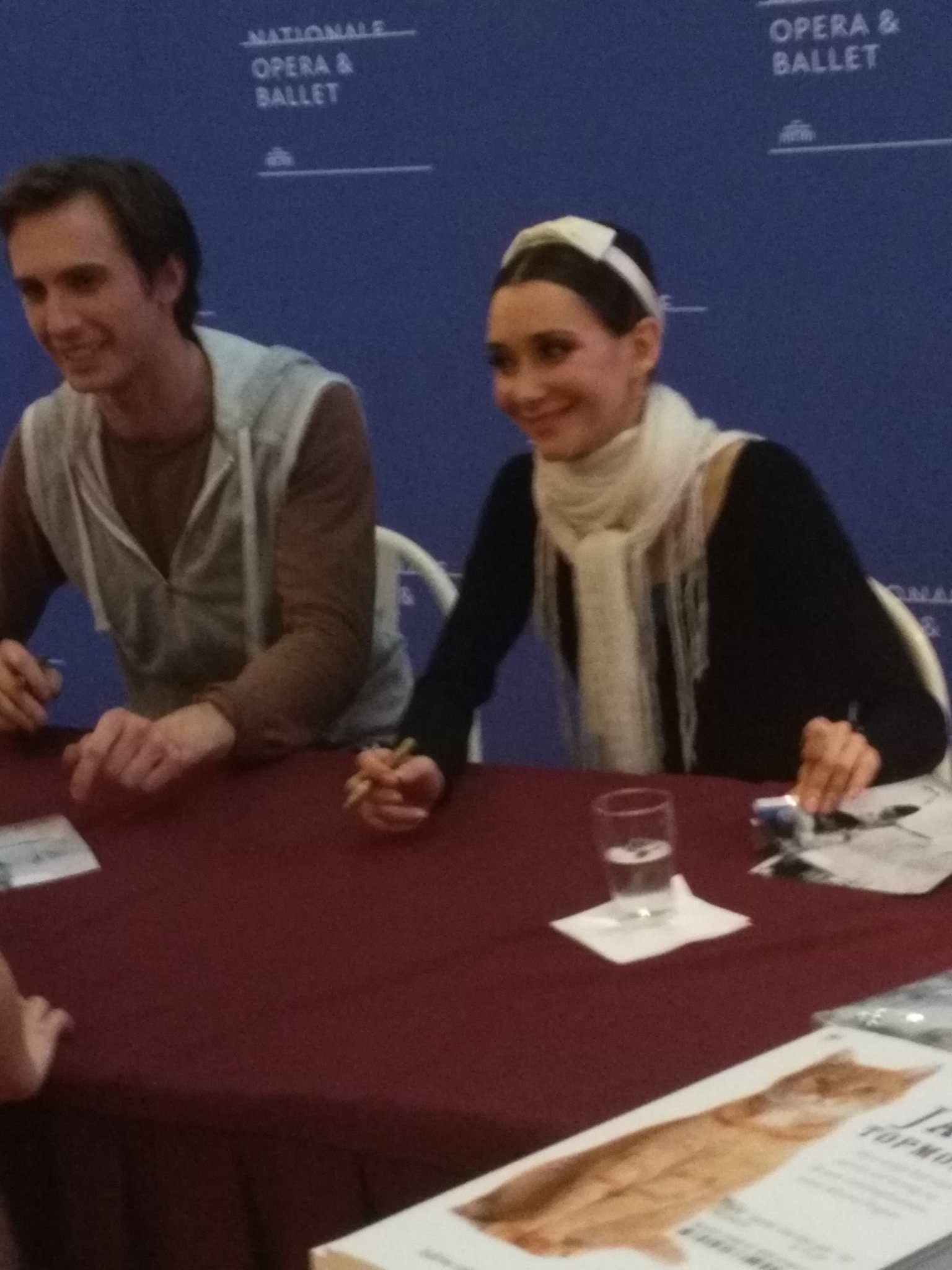
After the show, Ol and Shesterikov sat at a desk at the top of the stairs and signed programmes and merchandise for a lot of excited little boys and girls and their equally excited Mums and Dads. Signing after a matinee is a charming practice of the Dutch National Ballet which I wish dance companies in this country would follow. It would do more to bounce kids into regular exercise than anything else I know.

Like most of my compatriots who follow ballet, my home is Covent Garden. There is nothing quite like the House on a ballet night. But, increasingly, I am finding a welcoming second home in the Dutch National Ballet's Music Theatre and I am beginning to know and love the Dutch National Ballet as I do the Royal Ballet.

Friday, 18 November 2016

Dutch National Ballet Junior Company Auditions


Standard YouTube Licence


If I were a talented young dancer (or the mother, father, aunt, uncle, brother, sister, cousin, friend or teacher of such a dancer) I would be thrilled by the opportunity of joining the Dutch National Ballet Junior Company.  This is a half way house between ballet school and the professional stage which I discussed in an interview with Ernst Meisner in The Junior Company on 3 Dec 2014.

The Junior Company has already been the springboard for some brilliant careers.  I saw Michaela DePrince in Nov 2013 just after she had joined the Junior Company (see The Junior Company of the Dutch National Ballet - Stadsshouwburg Amsterdam 24 Nov 2013 25 Nov 2013) and she is already a grand subjet with the National Ballet. DePrince has been particularly successful but there are others who have done very well too. The outstanding young Italian dancer, Cristiano Principato, for instance, has already had a chance to show his talent for choreography by staging his own ballet (see Palagio 4 June 2016). Many of them have been recruited to the main company or been offered contracts with other fine companies such as the Stuttgart Ballet, the Norwegian National Ballet and the Hungarian National Ballet.

Such an opportunity has arisen because the Dutch National Ballet is holding auditions for next year's Junior Company at Amsterdam on 21 Jan 2017 (see Audition Junior Company on the Dutch National Ballet's website). Candidates can apply online so long as they meet the following requirements:
  • strong classical ballet technique;
  • minimums height of 5 feet 5 inches (1.65 metres) for ladies and 5 feet 11 inches (1.8 metres) for gents; and
  • graduating this year or next.
I hope that there will be at least a few applications from the UK and that some may actually be good enough to get in but I wish all candidates from all countries all the very best. Whether or not he or she is accepted I wish each and every candidate who is good enough to try every success in his or her training and subsequent career.