Sunday, 15 November 2020

World Ballet Day Highlights #2 - The Royal New Zealand Ballet

Standard YouTube Licence

The Royal New Zealand Ballet had a very successful tour of the UK five years ago.  I attended and reviewed their performances of A Passing Cloud in Leeds on 4 Nov 2015 and Giselle in High Wycombe on 7 Nov 2015.   Their contribution to World Ballet Day on 29 Oct 2020 was one of my highlights of that day.  

Since their visit to this country, the company has appointed Patricia Barker as Artistic Director and it was she who welcomed the audience to the company's studios.  For the first 17 minutes, we saw the company's class taken by one of its ballet masters, Nicholas Schutz.  Schutz, like Barker, comes from the United States. So, too, does his wife Laura, who is one of the company's ballet mistresses.  It will be interesting to see whether they influence the company's repertoire and choreography.

World Ballet Day coincided with the opening night of The Sleeping Beauty which is touring New Zealand.  Barker led us to the rehearsal studio where she directed Kate Kadow and suitors in the rose adagio.  Schutz reappeared with Clytie Campbell, the other ballet mistress, to demonstrate how they create the scene where the lilac fairy leads Florimund to the sleeping Aurora.

The last scene was the technical rehearsal at the Wellington Opera House.  Kadow, already in costume for Aurora's 16th birthday, greeted her internet audience in her dressing room. The camera followed her down to the stage pursued by beaming students waving excitedly.  The very last scene showed Aurora's entry, a bit of the rose adagio and one of the scariest Carabosse entries I have ever seen. Judging by the volume of applause I think the last scene must have been the first night in Wellington.

Though New Zealand has been much more successful than most countries at controlling coronavirus the company has not been unaffected by the pandemic.   According to the News page, it has had to endure theatre closures and cancel a visit to London. On World Ballet Day, sunlight streamed through the windows of the rehearsal studios. The dancers trained without face coverings.  The applause in the theatre was thunderous.  While the main reason the RNZB's slot was one of my highlights of World Ballet 2020 is that the company is good it was also because it projected light and hope. Those of us about to enter the Northern Winter were shown an image of ballet in a post-pandemic world, Just as the prince was shown an image of the sleeping Aurora by the lilac fairy.

Friday, 6 November 2020

Bethany Kingsley-Garner - A Ballerina with a Brand

Standard YouTube Licence


 In Ballet as a Brand? How to bring More Money into Dance for Companies and Dancers 13 March 2020 I quoted Alina Cojocaru:
"Ballet careers are relatively short and require years of training that pose the risk of injury, yet the world’s top dancers earn far less money than their counterparts elsewhere in show business."

"What to do about it?" I asked.  I concluded that companies and theatres were already pretty stretched and that the public whether as theatregoer or taxpayer cannot afford much more. Since then we have had the pandemic that has closed theatres around the world for months.

"So is there anything else that can be done?" I asked.    "Well perhaps" I answered." As the Bailey's Nutcracker commercial showed some years ago, ballet can sell. Maybe advertising, merchandising and endorsement.  Many companies were already taking advantage of that revenue stream but what about dancers?  Compared to sports stars, rock musicians and even opera singers, dancers have been slow to tap into it.   When I wrote my article 6 years ago, the only two that came to mind were Carlos Acosta and Darcey Bussell.

They have been joined by several others and the latest happens to be one of my favourite artists, Bethany Kingsley-Garner.   I wrote in my review of her performance as Odile in David Dawson's Swan Lake:
"Bethany Kingsley-Garner, who has recently been elevated to principal, was perfect in both. She first came to my notice as Cinderella in Edinburgh (see Scottish Ballet's Cinderella 20 Dec 2015) and she has already entered my canon of all time greatest ballerinas. The only other Scottish dancer in that rare company is Elaine McDonand (see Elaine McDonald in her own Words 11 March 2014)." (see Empire Blanc: Dawson's Swan Lake 4 June 2016)

Kingsley-Garner has two spin-off activities: online ballet classes and coaching and, more recently, her own dancewear collection which she distributes through Manchester-based online retailer Move Dance.

The dancewear includes leotards, shrug, skirts, top and leg warmers.  Each of those garments has a name and a story.   For instance, one of the leotards is called "The Rachel Leotard".  This is the story:

"Every step of the way

​Here's to good women everywhere. May we know them. May we be them. May we raise them."

​Creation - Emergence - Life Force - Love - Nurture - Protect - Support - Confidence

​Rachel is my mother, she gave me the greatest gift of life itself; nurtured, protected and loved unconditionally.

She helped me take my first steps, raised me to become confident, individual and independent and was there to watch me step on stage emerged as a principal ballerina leading the ballet company.

A mother is not a person to lean on, but a person who makes leaning unnecessary. I am a strong woman because a strong woman raised me.

​Feel the support and protection when you're dancing in The Rachel Leotard.

Be Inspired Be Unstoppable Be You . . BKG"

That is a delightful sentiment and it says something that we might have guessed but would not otherwise have known why Kingsley-Garner is such a remarkable dancer.  

Launching a dancewear collection when dance studios in most parts of the UK are in lockdown might seem to some to be a bold thing to do. But it is also a promise of better things to come.  This venture deserves to succeed and it has every chance of doing so.

Wednesday, 4 November 2020

World Ballet Day Highlights #1: The Royal Academy of Dance

World Ballet Day Trailer  -  Standard YouTube Licence

World Ballet Day came just as theatres and studios across the UK were emerging from a 7-month hibernation.  It was a day of optimism.  Sadly that optimism has been dampened by the announcement on Saturday of another lockdown in England.  The sudden closure of studios and theatres is devastating; It is therefore all the more vital to hang on to that optimism. One way to do that is to remember the highlights of World Ballet Day. Over the next few days, I shall recall some of my most memorable moments.  

I begin with the Royal Academy of Dance.  The RAD is an institution that educates students at all levels, of all ages in all parts of the world.  Its contribution to World Ballet Day summarized its work exactly.  The Academy's Artistic Director, Gerard Charles, and its President, Darcey Bussell, opened the clip. The first half featured the work of three RAD teachers in Peru, Kenya and Australia while in the second Dame Darcy coached Anya Mercer, a student at the English National Ballet School and a finalist in last year's Genée in the second female solo of the pas de trois in Act 1 of Swan Lake.

When I first started blogging about dance I mentioned the work of Mike Wamaya who teaches ballet in Kibera, one of the most impoverished neighbourhoods of Nairobi (see What can be achieved by a good teacher 3 March 2013). In Recognition for the Kibera Ballet Class  9 Jan 2017 I noted that some of those students had been accepted for training at the Dance Centre Kenya with Ms Cooper Rust.  In the video, Ms Rust taught a class of boys who showed considerable enthusiasm as well as aptitude for their art.

Nairobi is a conurbation of over 9 million people where there is the possibility of exposure to the performing arts through the press and broadcasting.  Such a possibility is much less in the upper reaches of the Amazon where the Nevada Building Hope Foundation operates.  One of its teachers is Barbara Land.  In the video, Ms Land explains how she introduced ballet to local children. They were enchanted and wanted to learn. 

As an RAD teacher, Ms Land was able to train the Peruvian kids to the same exacting standards as the young  Sydneysiders in Hilary Kaplan's class at the Alegria Dance Studios in Australia.  Australia has given the world some of its greatest dancers from Sir Robert Helpmann and Elaine Fifield to Alexander Campbell who was my male dancer of the year for 2019.  After watching Ms Kappan's class for a few minutes, I think we can understand why.  Excellence is baked into ballet at the very earliest opportunity.

Dame Darcey's session with Anya Mercer was a masterclass for her audience as well as for that promising young dancer.   It is a thrilling solo particularly the turns at the end.   Dame Darcey discerned details that I had never noticed before. Her pupil has shown considerable promise to reach this point.  I wish her well with her studies and subsequent career.

My next article will feature the Royal New Zealand Ballet's company class and preparation for the opening performance of The Sleeping Beauty in an apparently coronavirus fee Wellington.

Sunday, 1 November 2020

"Live" - Van Manen's Narrative Ballet?

© 2020 Dutch National Ballet Licence Standard YouTube

inplayer Dutch National Ballet Live  10 Oct to 7 Nov 2020

Hans van Manen made it very clear that he does not do story ballets in a discussion that followed the first screening of the latest filming of Live.   To emphasize the point he added that that was why he had never created a full-length ballet.  It is true that there is no synopsis or libretto but you don't need a plot for a narrative ballet.  That was about the only point upon which a panel of experts on narrative dance was agreed when I asked that question at the "State of the Art Panel Discussion: Narrative Dance in Ballet" in Leeds some years ago.   For me, Live tells the story of a relationship at least as eloquently as any ballet.

It is also much more real and immediate.  Unlike the storybook ballets, Live is not confined to the stage.  It starts there bit spills into the audience's world.   It proceeds into the lobby of the Music Theatre and finally the streets.  The last scene shows the woman in red walking slowly along the banks of the Amstel towards the Waterlooplein underground station.  

Van Manen's Live is therefore just as much a work of cinema as it is of ballet.  On his foundation's website, van Manen lists Live as a "video ballet" rather than simply as a ballet.  He gives the cameraman equal billing with the dancers. That is likely to be because the cameraman is very much part of the action.  The interplay between dancer and cameraman is best appreciated in Altin Kaftira's film Diana Vishneva in 'LIVE' of Hans van Manen.  The cameraman is in the dancers' faces, particularly the woman's. At one point, she repels him by pressing her palm against the camera lens.  The other important element of the film is the music. Van Manen chose the following pieces by Liszt:  Sospiri, Bagatelle sans tonalité, Wiegenlied,  Vier kleine Klavierstücke and Abschied.

Live was filmed for the first time in 1979  Colleen Davis and Henny Jurriëns were the original dancers and Henk van was the cameraman.  It was filmed in the Carré because the Music Theatre had not been constructed at that time. The video has been remade several times with different dancers including, of course, Vishneva.  The film that has been released between the 10 Oct and 7 Nov 2020 casts  Maia Makhateli as the woman in red and Artur Shesterikov as her partner. 

I have long admired Shesterikov and Makhateli for their virtuosity but in the film I also saw superb acting.  There were moments when sparks seemed to fly.  The drama was heightened by the accompaniment of Olga Khoziainova.  After the screening, there was a short conversation about the film between van Manen, Rachel Beaujean and Davis.  Clips from the 1979 film were shown.  I was amazed to learn that Davis was only 19 when she danced the lady in red. Particularly as her successors in the role have included Vishneva and Makhateli.

Though he was much younger than the other choreographers and his work was very different, van Manen was one of the recurring names in the 1960s when I first started to follow ballet.  His works were reviewed in almost every issue of Dance and Dancers and The Dancing Times which I devoured when I was at university. His name was mentioned as frequently as those of Ashton, Balanchine, Cranko, Darrell, MacMillan and van Dantzig.  All those great choreographers have gone.  Only van Manen is left.  He must be well into his 80s but he still knows how to excite, surprise and delight.

The film may be viewed on the Dutch National Ballet's website until 7 Nov 2020.  The access charge is €2.95. 

Saturday, 31 October 2020

The Finale - Dutch National Ballet;s "Dancing Apart Together"

Standard YouTube Licence


Dutch National Ballet Dancing Apart Together Music Theatre, Amsterdam, 20 Sep 2020 14:00


Ib her review, Dutch National Ballet - "Dancing Apart Together", Yvonne Charlton described the show's finale:
"Extending the stage by moving the side curtains and the backcloth, Anna Tsygankova appeared in the centre. Slowly all the other dancers joined her coming from between the stage lightings filling the whole stage with social distance. A sublime grand finale with the whole ensemble of the National Ballet and the Junior Company."

It must have been a wonderful moment.

Happily, I have just found a video of that scene and it seems to have been every bit as impressive as the scene that Yvonne described.   Listen to that applause.   It's deafening.  Yet the auditorium was only a quarter full.  It represents the affection in which Amsterdam - indeed the whole world - holds that magnificent company.

Friday, 23 October 2020

KNT's Day of Dance Tomorrow

The Dear Old Dancehouse


One of the highlights of my year is KNT's Day of Dance.  It offers a chance to train with some of the best teachers and performers in the business.  Last year, for example, I took classes with   Alex Hallas of Bale Cymru and  Jane Tucker of Northern Ballet Academy.

Another Day of Dance will take place tomorrow and I regret to say that I only learned of it a few minutes ago when I tried to check in your some online classes for the coming week. According to KNT's Class Manager app, the following are available:

  • 11:00 - 12:30 Beginner/Pre-Intermediate Ballet 
  • 11:00 - 12:30 Intermediate/Advanced Contemporary 
  • 13:00 - 14:30 Intermediate/Advanced Ballet
  • 13:00 - 14:30 Pre-Intermediate Contemporary 
  • 19:00 - 20:30 Beginner/Pre-Intermediate Ballet 
  • 19:00 - 20:30 Beginner/Pre-Intermediate Contemporary
  • 20:30 - 22:00 Intermediate/Advanced Ballet  
  • 20:30 - 22:00 Intermediate/Advanced Contemporary 
All the classes for tomorrow's Day of Dance are priced at £10.

Sadly it won't be quite the same as last year because we are exiled from the Dear Old Dancehouse as a result of the public health emergency but we shall still have excellent teaching.  Above all, we can still wave at each other over Zoom even if we can no longer embrace.

Plagues don't last forever.  There is every chance that medicine will eradicate or at least contain this virus as it has done with so many other infections.   One day this horrible scourge will be nothing more than a horrible memory.  I wish everyone a great weekend.

Thursday, 22 October 2020

Dutch National Ballet - "Dancing Apart Together"

Anna Ol
(c) 2020 Hans Gerritsen


Dutch National Ballet Dancing Apart Together Music Theatre, Amsterdam, 20 Sep 2020 14:00

Happiness!

I visited the Dutch National Ballet on the afternoon of Sunday 20 Sept 2020 for a very special programme.  It was my first visit since the coronavirus lockdown in March.

It was not quite the same as before. Instead of having a full audience of about 1,600, only 400 were allowed for each performance. But at least we were back as an audience.  That gave us a very special feeling. We were quite emotional.  It felt very safe. The front of house staff made sure we kept our distance from each other.

The programme was called Dancing Apart Together.   It consisted of 12 different pieces by 9 different choreographers.   Each of those pieces was, in the words of Ted Brandsen, “connected by a number of central questions." Those questions were:  How do we experience togetherness? How do we do it from a distance? And how important is physical contact for us individually? Each of those choreographers gave his or her take on those themes thereby showing how he or she dealt with lockdown.

The programme was as follows:

1. The Dying Swan by Mikhail Fokine;
2. Romanian Folk Dances a new work by Ted Brandsen;
3. Kaddish another new work by Ted Brandsen;
4. Manoeuvre a new work by Juanjo Arqués;
5. L’Autre Côté a new work by Sedrig Verwoert;
6. Reset a new work by Milena Sidorova;
7. On the Nature of Daylight by David Dawson;
8. Largo a new work by Ernst Meisner;
9. Quasicystal a new work by Annabelle Lopez Ochoa;
10. Solo by Hans van Manen;
11. Slot one more new work by Ted Brandsen, and
12  Frolicsome Finale yet another new work by new Ted Brandsen.

The Dying Swan
(c) 2020 Hans Gerritsen


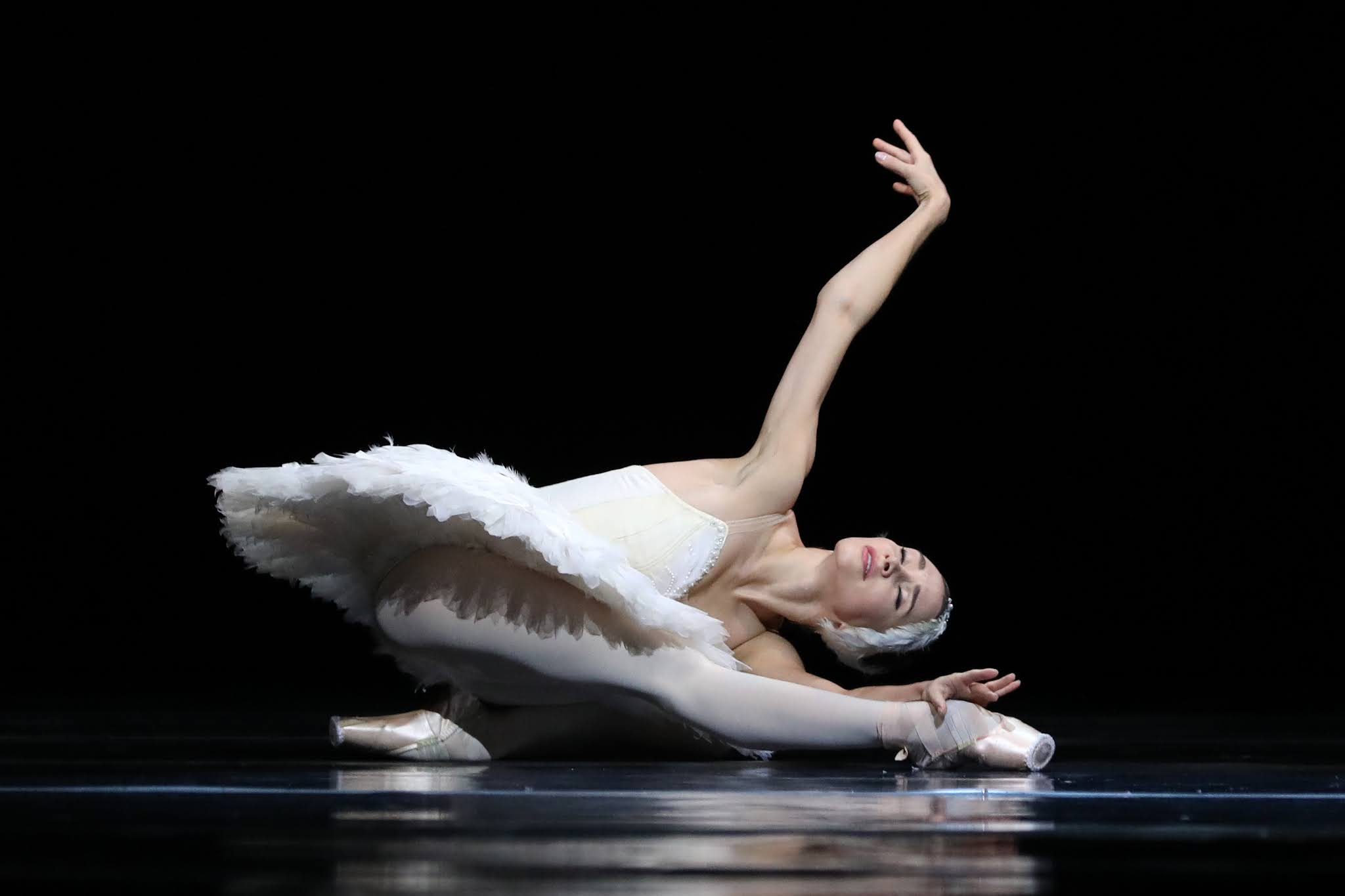
The show began with the Dying Swan beautifully performed by Anna Ol.  Her movements represented not only dying but also the resurrection of the phoenix.  An analogy which was drawn byTed Brandsen. A solo full of loneliness and sadness would be followed by a new beginning symbolized by eight new pieces created by present-day choreographers.

Romanuan Folk Dances
(c) 2020 Michel Schnater


Brandsen's Romanian Folk Dances was a lively and joyful ballet for 16 dancers (8 men and 8 women).  They formed a lot the forms of circles. Circles can be a symbol of emptiness, the infinity and of the absolute freedom, bound by nothing but the are also a symbol of safety and connected with love, energy and power. 


Romanian Folk Dances
(c) 2020 Michel Schnater


All those aspects were represented in the piece.


Kaddish
(c) 2020 Hans Gerritsen 


There then followed a duet, Kaddish, danced by Jessica Xuan and Semyon Velichko based on a prayer from the Jewish liturgy. For me, it was about believing in yourself and believing in each other.  Intense and soft. A beautiful contrast with the Romanian folk dances.


Manoeuvre
(c) 2020 Hans Gerritsen 


For me, the next piece, Manoeuvre, stayed in this intense and soft feeling. However, this was danced by 8 men.  Through their masculinity, they showed their intensive and sensitive feelings. Now and then you got the feeling of being in a slow-motion movie.


L'Autre Côté
(x) 2020 Hans Gerritsen


The next work was L'Autre Côté by Sedrig Verwoert.  To be honest, I had never seen a piece from this choreographer before.   Here he challenged the cast of 10 to come out of their current comfort zone into the new “future” without losing mutual trust.   This was well chosen and I hope to see more from this choreographer in the future.


Reset
(c) 2020 Hans Gerritsen


In Milena Sidorova's Reset, we were thrown back to the time before lockdown.  The artists were dancing as they did in the “old days” close together, albeit briefly, and then suddenly realizing the need to keep their distance.  They made you think:  What is freedom?  What are restrictions?  What are obstacles?


On the Nature of Daylight
(c) 2020 Hans Gerritsen


The duet On the Nature of Daylight made me feel how very precious and delicate is true love between two persons.   It was performed beautifully by Anna Tsygankova and Constantine Allen.


Largo
(c) 2020 Hans Gerritsen


The introduction of this season’s new Junior Company has had to be put “on hold” for the duration.  This was the first opportunity for the public to see them.  Ernst Meisner's Largo showed them off to best advantage as individuals and as an ensemble.  The dancers formed a single line from which they emerged in ones or twos to display their virtuosity.  A promising new generation.


Quasicrystal
(c) Hans Gerritsen


Quasicrystal consisted of intense duets by 4 couples showing extreme sorrow and pain that people inflict upon themselves.


Solo
(c) 2020 Michel Scgnater


Solo is one of van Maanen’s great works.  It was danced by 3 totally different strong male dancers: Remi Wortmeyer, Edo Wijnen and Young Gyu Choi.  What a joy to watch this at a time of holding back. Each of their solos was full of spirit and fire. Finishing all 3 together on stage by challenging each other in a good way. It was like watching a play battle between them.


Frolicsome Finale 
(c) 2020 Hans Gerritsen


With Frolicsome, we came to the end of the show. 

And as the name stated and using the words of Ted Brandsen: Dancing Apart Together concluded with a subdued and contemplative ending, signalling the return to the core of the dancer’s existence.

Extending the stage by moving the side curtains and the backcloth, Anna Tsygankova appeared in the centre. Slowly all the other dancers joined her coming from between the stage lightings filling the whole stage with social distance.  A sublime grand finale with the whole ensemble of the National Ballet and 
the Junior Company.

Throughout the performance, you saw the emotions in all the dancers.  They all excelled.  I couldn't say that any of them eclipsed the others.   However, all the individual and different pieces in a way came together to create one ballet. 

The costumes, the music from an orchestra consisting entirely of strings and of course the choreography came together to create an excellent and emotionally charged programme.

I am already looking forward to my next visit to see Back to Ballet.