Showing posts with label Carlos Acosta. Show all posts

Saturday, 29 April 2023

BRB2 in Nottingham

Standard YouTube Licence

BRB2 Carlos Acosta's Classical Selection Theatre Royal, Nottingham, 28 April 1930

Nearly 10 years ago I was in Amsterdam for the first performance of the Dutch National Ballet's Junior Company (see The Junior Company of the Dutch National Ballet - Stadsshouwburg Amsterdam 24 Nov 2013  25 Nov 2013).  I had come to see Michaela De Prince about whom I had heard a lot.  She did not disappoint me, but she was not the only artist who impressed me.  The other members of the cast were super talented too. Several are now principals in the Dutch National Ballet and other companies.

The Junior Company has greatly strengthened the Dutch National Company by attracting some of the world's best young dancers,   Because of its success I urged British companies to set up their own junior companies.   The Central School of Ballet set up Ballet Central to tour the South, Ballet West had a company that toured Scotland and Northern Ballet had Manchester City Ballet which gave several excellent performances in the Dancehouse.  But that was not quite the same as the Dutch National Ballet's Junior Company as none of those student companies was associated with an established company.

I first learned about BRB2 when I attended An Evening with Ashton at Elmhurst.  That was a master class on Ashton's Rhapsody given by Lesley Collier.   Ashton had created that piece for Collier and  Mikhail Baryshnikov and the dancers Collier taught were Frieda Kaden and Oscar Kempsey-Fagg,  Carlos Acosta introduced them as members of BRB2, Birmingham Royal Ballet's junior company (see An "Evening with Ashton" and the Launch of an English Junior Company 30 Jan 2023).

The company is now on tour.   According to the programme, their debut was in Northampton on Tuesday 25 April 2023.  Nottingham is their second stop.  Their next will be Peterborough on 3 and 4 May, London on 13 and 14 June and finally Wolverhampton on 24 June.  When I visited Elmhurst someone told me that Northampton would be the best place to see them because they would have a live orchestra.  Had it been possible I would have been there.  Sadly, barristers tour at least as much as ballet dancers and I had a breakfast meeting in Colwyn Bay at 09:00 the day after their Northampton show.  Even without an orchestra, BRB2 were impressive.  I would have trekked down the M1 to see them again tonight had Powerhouse Ballet's company class not been scheduled for this afternoon in Salford.   I will try to catch them again at the Linbury or elsewhere on the tour. 

The format of last night's show was very similar to the Dutch National Ballet Junior Company's.  Except for Majisimo which was the finale the show consisted of solos, duets and pas de deux. The first part consisted of four very well-known works plus Carlos Acosta's bolt-on of  Descombey's Dying Swan to Fokine's which he called Dying Swans.  The second part of the show consisted of seven less familiar works.  Two of the works that I saw yesterday were also in the Dutch National Ballet's opening performance, namely the pas de deux from Act II of Swan Lake and Diana and Actaeon.

The show opened with an empty stage except for a travelling barre and other touring paraphernalia.  One by one the artists walked on stage.   They limbered up as if preparing for class.   Two of them, Kaden and Kempsey-Fagg, peeled away and approached that front.   A backdrop fell to hide the other dancers and they performed Rhapsody just as Collier had taught them at Elmhurst.  They had impressed me even in the master class.  Yesterday they were polished and confident and executed the piece with flair. There could not have been a better start to the show.

The backdrop was lifted to reveal the company again.  This time Olivia Chang Clarke appeared in a romantic tutu and Eric Pinto-Cata in a kilt to dance the pas de deux from La Sylphide. Their piece turned out to be the high point of my evening.  That may have been partly because I love Bournonville's ballet very much and know it well but credit must also go to the dancers.  Pinto-Cata was the perfect James with his powerful tours en l'air and Chang Clarke was a delightful sylph, playful and flirtatious.  I almost wept at the thought of what Madge's shawl would do to her.

Maɨlȅne Katoch and Mason King followed with the pas de deux from Act II of Swan Lake. Interestingly, Katoch had written on her web page that her dream would be Odette-Odile because she finds it interesting to be able to interpret an ethereal and delicate swan and then a mischievous swan.   It must have pleased her to have been given a taste of her dream role so early in her career.  I am sure it will not be long before she performs the whole role.  King partnered her gallantly.  Not hard to envisage him as a principal in the not-too-distant future.   

I had seen Javier Torres perform Descombey's Dying Swan at Northern Ballet's 45th anniversary in 2015 and had admired the work greatly (see Sapphire  15 March 2015).   I would have enjoyed watching it again in its original form and I am sure that Jack Easton would have danced it magnificently.  I would have enjoyed Fokine's Dying Swan even more for the reason I gave in to Sapphire.  I am sure that Regan Hutsell would have danced it exquisitely.  Combining the two works and their music to create a solo did not work for me.   I had to switch between the two alternately as though I was watching two separate ballets at the same time. That way I appreciated Easton and Hutsell's considerable virtuosity.

Diana and Actaeon had been the highlight of my evening in Amsterdam because De Prince and Sho Yamada displayed exceptional virtuosity.   The ballerina enters the stage to Pugni's punchy music practically jumping on pointe.   I had described De Prince as "quite simply the most exciting dancer I have seen for quite a while" and she will always be my Diana just as Antoinette Sibley will always be my Titania.   Beatrice Parma's interpretation was softer, more delicate, more Ashtonesque perhaps? Enrique Bejarano Vidal was spectacular.

Part 2 opened to a blue background with several dancers seated around tables.    There is a suburb of Buenos Aires near the cemetery where Eva Peron is buried called La Recoleta which is famous for its cafes.   As the second piece was Gustavo Mollajoli's A Buenos Aires to Astor Piazzolla's music I was transported there.   

However, the second part began with Ben Stevenson's apocalyptic End of Time danced hauntingly by Lucy Waine and Kempsey-Fagg to Rachmaninov's Cello Sonata in G Minor.   Stevenson started his career with the precursor of the Birmingham Royal Ballet and he did great things in Houston including sheltering Li Cunxin according to Mao's Last Dancer. 

Kaden and Easton were the first couple to leave the table to dance A Buenos Aires.   They were followed by Hutsell's spirited Je ne regret rien tIt io Ben van Cauwenbergh's interpretation of Edith Piaf's famous song.  She was followed by Vidal's Les Bourgeois also by van Cauwenbergh.   He tottered around the stage clutching a bottle executing unusual jumps and turns to Jacques Brel's music prompting loads of laughs from the audience.   As bouré is another word for "drunk" in French I quipped on Twitter that he gave a whole new meaning to pas de bourrée.  It is however very difficult to clown successfully in ballet and those who can carry it off are abundantly talented.

I enjoyed Acosta's Carmen much more than his Dying Swans.   Chang Clarke reminded me a little of Zizi Jeanmaire who will always be my Carmen though I had seen her only on film.  Wearing her hair loose she danced the pas de deux with Cata passionately.  it was one of my favourite pieces from Part 2. My other favourite from Part 2 was Will Tuckett's Nisi Dominus danced by Lucy Waine to Montiverdi's Vespers.  Sacred music does not often fit well with ballet for many reasons but Tuckett's choreography seemed to work well with the score.

The evening finished with Kaden, Vidal, Katoch and King together with Rachele Pizzillo, Ryan Felix and Ava May Llewellyn in Jorge Garcia's Majissimo to Massenet's music.  The piece focused on each of the artists to demonstrate his or her skills and strengths.   It was a good way to round off a very successful evening.

Carlos Acosta and Kit Holder, BRB2's artistic coordinator, are to be congratulated.  The company could not have made a better start.   One of the strengths of the Dutch Junior Company is that they draw heavily on their heritage as well as their talented up-and-coming choreographers.   There is always a van Manen and van Dantzig in their repertoire as well as new works by Ernst Meisner and  Milena Siderova.  The Birmingham Royal Ballet also has a rich heritage. In future, I would like to see a little more Ashton and maybe some MacMillan, Peter Wright and Bintley as well as perhaps pieces by Holder himself and other young choreographers.   

Now that two of Europe's leading ballet companies have junior companies it is likely that a friendly rivalry between the two will spur them both to even greater achievements.   But I also hope there will be more than rivalry.  I would love to see what BRB2's artists would make of In the Future or No Time Before Time. The Dutch National Ballet's Junior Company remains my first love.  I will continue to support it in any way I can.   But I can now take pride in an excellent English junior company.  I shall follow, encourage and support it too. 

Saturday, 5 March 2022

Birmingham Royal Ballet's Don Quixote at the Lowry

Standard YouTube Licence

Birmingham Royal Ballet Don Quixote The Lowry 4 March 2022 19:30

I have seen a lot of shows in Greater Manchester in my time from pantomimes to grand opera. I cannot recall one with greater flair than last night's Don Quixote at the Lowry. Never have I been part of a more appreciative audience.  Standing ovations are rare in this country, particularly outside London. Yesterday, a large part of the audience (including yours truly) rose to our feet at the end of the show.

I have followed the Birmingham Royal Ballet for many years.  Indeed long before it moved to Birmingham. Never have I seen it dance as well as it did last night.  Yesterday was the first time that I had seen the company since Carlos Acosta became its director.  He seems to have galvanized it.

When I saw the Royal Ballet's Don Quixote at Covent Garden I wrote:
"Seldom have I enjoyed a performance at the Royal Opera House more than last Saturday's matinee of Don Quixote" (see Campbell and Magri in Royal Ballet's Don Quixote 2 April 2019).

I think I enjoyed last night's show even more.

For those who do not know the ballet, there is a brief synopsis in Wikipedia. The work is known for its spectacular jumps and fouettés requiring considerable virtuosity not only of those who dance Basilio and Kitri but also Espada, the matador, Mercedes, the street dancer, the Queen of the Dryads and the gipsy and fandango dancers. There are also great character roles for Sancho Panza, Gamache and, of course, Don Quixote himself.

I had been looking forward to seeing Lachlan Monaghan as Don Basilio as advertised on the company's website.   He had been my guest at The Stage Door. As I said in my interview, I admire his choreography and photography as well as his dancing.  Yesterday he was cast as Espada which he danced with panache.  Basilio was danced by Mathias Dingman another of my favourite artists.  He impressed us with his virtuosity and amused us with his touches of humour.  Miki Mizutani was a perfect Kitri. Coquettish when interacting with Gamache and her father.  Spectacular in her solos and pas de deux.  I was impressed by Eilis Small as Mercedes and Lucy Waine as Queen of the Dryads.  It is always a delight to see Tzu-Chao Chou who danced Amour.  Casting Laura Day as Don Quixote's hapless squire was inspirational. I have never seen or even imagined the role being performed by a woman. She carried it off brilliantly. I must also commend Rory Mackay for his performance of Gamache and Jonathan Payn for the title role.   Everyone in the cast delighted and impressed us and I congratulate them all.

One of the strengths of yesterday's performance was the designs and special effects.  I was particularly impressed with the sails of the windmills which morphed into limbs and claws before our eyes. I am not sure whether credit for that scene belongs to Tim Hatley who designed the sets and costumes or Nina Dunn the video designer.  It was spectacular.

The Symphonia conducted by Peter Murphy excelled themselves as much as the dancers.  Before the performance, they played the Ukrainian national anthem.  There has always been a large Ukrainian community in the North as is evidenced by the many Ukrainian clubs and churches to be seen.  Playing that anthem was an apposite reminder of those links.

The first two performances of this short season had to be cancelled because of injuries and illness.  There will be more performances at the Lowry this afternoon and evening.  The tour continues to Sunderland, Plymouth and at Sadler's Wells. If you can reach any of those theatres you should see this show.

Friday, 6 November 2020

Bethany Kingsley-Garner - A Ballerina with a Brand

Standard YouTube Licence


 In Ballet as a Brand? How to bring More Money into Dance for Companies and Dancers 13 March 2020 I quoted Alina Cojocaru:
"Ballet careers are relatively short and require years of training that pose the risk of injury, yet the world’s top dancers earn far less money than their counterparts elsewhere in show business."

"What to do about it?" I asked.  I concluded that companies and theatres were already pretty stretched and that the public whether as theatregoer or taxpayer cannot afford much more. Since then we have had the pandemic that has closed theatres around the world for months.

"So is there anything else that can be done?" I asked.    "Well perhaps" I answered." As the Bailey's Nutcracker commercial showed some years ago, ballet can sell. Maybe advertising, merchandising and endorsement.  Many companies were already taking advantage of that revenue stream but what about dancers?  Compared to sports stars, rock musicians and even opera singers, dancers have been slow to tap into it.   When I wrote my article 6 years ago, the only two that came to mind were Carlos Acosta and Darcey Bussell.

They have been joined by several others and the latest happens to be one of my favourite artists, Bethany Kingsley-Garner.   I wrote in my review of her performance as Odile in David Dawson's Swan Lake:
"Bethany Kingsley-Garner, who has recently been elevated to principal, was perfect in both. She first came to my notice as Cinderella in Edinburgh (see Scottish Ballet's Cinderella 20 Dec 2015) and she has already entered my canon of all time greatest ballerinas. The only other Scottish dancer in that rare company is Elaine McDonand (see Elaine McDonald in her own Words 11 March 2014)." (see Empire Blanc: Dawson's Swan Lake 4 June 2016)

Kingsley-Garner has two spin-off activities: online ballet classes and coaching and, more recently, her own dancewear collection which she distributes through Manchester-based online retailer Move Dance.

The dancewear includes leotards, shrug, skirts, top and leg warmers.  Each of those garments has a name and a story.   For instance, one of the leotards is called "The Rachel Leotard".  This is the story:

"Every step of the way

​Here's to good women everywhere. May we know them. May we be them. May we raise them."

​Creation - Emergence - Life Force - Love - Nurture - Protect - Support - Confidence

​Rachel is my mother, she gave me the greatest gift of life itself; nurtured, protected and loved unconditionally.

She helped me take my first steps, raised me to become confident, individual and independent and was there to watch me step on stage emerged as a principal ballerina leading the ballet company.

A mother is not a person to lean on, but a person who makes leaning unnecessary. I am a strong woman because a strong woman raised me.

​Feel the support and protection when you're dancing in The Rachel Leotard.

Be Inspired Be Unstoppable Be You . . BKG"

That is a delightful sentiment and it says something that we might have guessed but would not otherwise have known why Kingsley-Garner is such a remarkable dancer.  

Launching a dancewear collection when dance studios in most parts of the UK are in lockdown might seem to some to be a bold thing to do. But it is also a promise of better things to come.  This venture deserves to succeed and it has every chance of doing so.

Tuesday, 2 April 2019

Campbell and Magri in Royal Ballet's Don Quixote


Standard YouTube Licence


Royal Ballet Don Quixote 30 March 2019, 13:30, Royal Opera House, Covent Garden

Except when I was a graduate student in Los Angeles, I have visited Covent Garden several times a year, every year, since 1969.   Seldom have I enjoyed a performance at the Royal Opera House more than last Saturday's matinee of Don Quixote. I had already seen that production several times in the cinema and once on television and had been somewhat underwhelmed by those transmissions (see ¡Por favor! Don Quixote streamed to Huddersfield 17 Oct 2013). I think that must be because no screening comes close to communicating the colour, movement and energy of the live show.

Although Gerard Davis referred to this production by Carlos Acosta as a remake in the programme notes, it seems to be pretty much the same as other companies' versions of the ballet.  The prologue begins with the dotty Don Quixote sheltering the shoplifting Sancho Panza.  The rogue kits the old man out with a bedpost for a lance and a shaving bowl for a helmet.  He is dubbed a knight by an imagined dulcinea and is confronted immediately by equally imaginary hooded demons.  As in other versions, he meets Kitri and Don Basilio in the town square and helps them elope.  On their travels, they meet gipsies.  He falls ill fighting ambulatory windmills.  In his delirium dreams of dryads or tree spirits.  They return to the town where Kitri's suitor is partnered up, KitrI marries Don Basilio and Don Quixote and his squire slip away for more adventures.   I  understand that the score had been rearranged and reorchestrated by Martin Yates but I did not detect any variations even though I know the music well. Aspects of the show that impressed me particularly were the lavishness of Tim Hatley's sets and costumes and the slickness and energy of the dancing.

My enjoyment of the show was facilitated greatly by the casting of Alexander Campbell as Don Basilio.  A year or so ago I read about his taking part in a scheme by the RAD and MCC to encourage kids to take up ballet and cricket.  Perfectly natural in my view as I have always had a passion for the two.  I think it was Arnold Haskell who observed that cricket had predisposed the British to ballet pointing out many parallels between the two.  Like another of my favourites, Xander Parish, Campbell had been a promising cricketer as a boy. I had long surmised that that might be the case before I had read that article for Campbell commands the stage like a batsman at the crease.  There is something about his manner - perhaps his grin - that makes it impossible not to like him.  He wielded his guitar while wooing the coquettish Kitri as an extension of himself just as a batsman holds his bat.  As he seized her fan in the same scene I imagined his diving for a catch. In his jumps and lifts, he is much an athlete as an artist.  It may be a figment of my imagination as it may be have been years since he last played the game, but I think that his youthful cricketing prowess has contributed more than a little to his appeal as a dancer.

Campbell's Kitri was the Brazilian first soloist, Mayara Magri,  She excelled in that role.  I was told by a well-informed acquaintance whom I met in the interval that last Saturday's matinee had been her debut.  If that was the case, her performance was all the more impressive.  I mentioned her coquetry in the previous paragraph but the role also requires virtuosity and prodigious stamina.  She displayed those qualities in abundance, particularly in the last act where she dances in the pub and in the final pas de deux where she performs lots of fouettés.    She dazzled me with those displays.

Other artists who particularly delighted me included  Itziar Mendizabal as Mercedes, Claire Calvert as the queen of the dryads. Lara Turk as the Dulcinea and, of course, Gary Avis as Don Quixote.  It was also good to see Jonathan Howells as Sancho Panza.  I had been looking forward to seeing Thomas Whitehead as Gamache. I am one of his fans and that is not just because he comes from Bradford.  That role was danced by Benet Gartside whom I also follow. I hope that Whitehead's absence was not the result of injury or illness but, if it was, I wish him a full and speedy recovery.  Valentino Zucchetti had been advertised to dance the matador and he was also indisposed through illness or injury. I wish him a full and speedy recovery too.  He was replaced if my memory is correct, by Reece Clark but sadly he was also hurt and had to be replaced (I think) by Thomas Mock. Like the rest of the cast, Mock and Clark danced well.  I wish Clark too a full and complete recovery. I congratulate everyone who took part in that performance.

I have been lucky enough to see two other fine performances of Don Quixote.   On Christmas day of 2017, I saw Mathieu Ganio and Isabella Boylston in the ballet company of the Paris Opera (see
Paris Opera Ballet's Don Quixote 28 Dec 2017).  I wrote:
"Spectacular choreography needs virtuoso dancers and Isabella Boylston is a virtuoso par excellence. She launches into grands jetes almost as soon as she appears on stage and hers seemed as graceful and effortless as any I have seen before. She danced Kitri who ends the show with spectacular fouettés. I have seen plenty of those from lots of Odiles but the excitement that Boylston generated with hers at the Bastille last night could not have been exceeded by Legnani herself."
A few weeks later, on 28 Feb 2019, I was delighted again by Sho Yamada and Riho Sakamoto in the lead roles in the Dutch National Ballet's performance of that work (see A Day of Superlatives - Dutch National Ballet's Don Quixote  1 March 2018).  I enjoyed that show a lot:
"I don't think I have ever seen a better Don Quixote even though I have seen artists like Isabella Boylston and Marianela Nuñez dance Kitri and Carlos Acosta dance Don Basilio. Above all, I don't think I have ever seen the Dutch National Ballet dance better."
Comparisons between three great performances by three great national companies would be odious.  They all had strengths.  For me, the Royal Ballet's were Hatley's designs and the casting of Campbell, Magri and Avis.  It is enough for me to say that the Royal Ballet's  Don Quixote is right up there in my esteem with the Paris Opera's and HNB's.

Without wishing to be too political I had booked my ticket to Don Quixote to cheer me up for what had been scheduled to be the day after brexit.   As it happened it wasn't but that has prompted me to think of parallels. Don Quixote lived in the past and looked back to a mythical golden age.  In that regard, he reminds me very much of our brexiteer MPs living in the past with their notions of English exceptionalism being the modern equivalent of courtly love and chivalry.  The battle with the windmills raises obvious analogies with our noble ministers battling against an intransigent commission.  Cervantes intended his novel to be a satire.  He would have had a field day had he been alive now.

Monday, 28 November 2016

Castro and Cuban Ballet

Fidel Castro 1926-2916
Author Antônio Milena
Source Wikipedia


Whether your opinion of him is closer to that of Mr Jeremy Corbyn or that of President Elect Trump, it would appear that the late Fidel Castro was personally responsible for the phenomenal development of ballet in Cuba. Acknowledging that achievement is not to endorse or excuse the former leader any more than admiration for the German motorway system can be a justification of Adolf Hitler, but the construction of those highways in the 1930s like the success of Cuban dancers are historical facts that cannot be denied.

In her article in The Guardian We owe it all to Castro 3 Aug 2015,  Judith Mackrell quoted Alicia Alonso:
"before Castro, "professional ballet just didn't exist in Cuba, not at all". She had tried to do what she could, returning from a stellar career abroad to run a small company in Havana, which she subsidised with her earnings and cast with imported dancers."
After he came to power, Castro offered Alonso US$250,000 to set up a state ballet company in Cuba. Mackrell continues:
"When Castro came to her with his remarkable appeal Alonso was ready. Her first imperative was to begin training local dancers and her second was to train local audiences. "In the beginning the people knew nothing, so we went into the factories and into the military centres to teach the ballet to them."
As a result of those efforts Cuba established regional ballet schools around the island as well as the National Ballet School that trained artists like Javier Torres and Carlos Acosta and developed "one of the most devoted dance audiences in the world,"

Joanna noted that devotion  in her review of the National Ballet of Cuba's Swan Lake when Alicia Alonso herself came on stage to take a curtain call (see We are the dancers, we create the dreams: Ballet Nacional de Cuba’s El Lago de los Cisnes in Havana 8 July 2014). I have never visited Havana but I have seen the National Ballet when it has danced in London and I know the talent and enthusiasm of the dancers. The Cuban people may well have paid a terrible price in terms of political oppression and economic stagnation but it is hard to see how that success could have been achieved without Castro.

I am no fan of Fidel Castro or the political and economic system that he created but I am a fan of Javier Torres, Carlos Acosta, all the other dancers from Cuba in the companies of the world and, above all, Alicia Alonso.

Saturday, 11 June 2016

The Dubai Opera House


Standard YouTube Licence


In Dance in the Gulf 10 June 2016 I noted that "a lot of money is going into the arts as states in the Gulf seek to diversify their economies and that has resulted in the construction of new auditoriums for the performing arts. " I mentioned the Royal Opera House in Muscat which has already hosted the English National Ballet and is about to stage performances by the Eifman Ballet and American Ballet Theatre.

Next door to Oman is the United Arab Emirates. The capital of the Emirates, Abu Dhabi, already has an annual arts festival which included a performance by Carlos Acosta at the Emirates Palace auditorium on 25 April 2016. In 2008 and 2009 the Bolshoi Ballet performed Swan Lake and Giselle in Abu Dhabi.

The other metropolis of the UAE is Dubai which is just about to open a new opera house in an area to be known as "the opera district".   Two ballet companies will perform in its first season: The Russian State Ballet and Orchestra of Siberia which will dance Coppelia on the 15 and 17 Sept 2016 and Giselle on the 16 and
Béjart Ballet which will dance Ballet for Life on 21 Oct 2016 and a gala that includes Seven Greek Dances, Piaf and Bolero on the 22.

Further up the Gulf, Bahrain has a National Theatre which staged the Eifman Ballet's Anna Karenina and Giselle with Anna Nikulina in the title role last year. Qatar has an opera house which has hosted a number of dance companies. Kuwait is constructing an opera house which should open soon.

Saturday, 28 May 2016

Cuba

Alicia Alonso
Source Wikipedia


Javier Torres's appearance at the London Ballet Circle last Monday reminded me of the extraordinary contribution of Cuban dancers to British ballet. Torrres is for the moment one of two male premier dancers at Northern Ballet  the other of whom has just announced that he is about to take leave of absence (see Batley and Leebolt 10 May 2016). Carlos Acosta may have retired as principal dancer with the Royal Ballet (see Au Revoir but not Adieu 19 Nov 2015) but he is still very busy. Yonah Acosta and Alejandro Virelles are principals of English National Ballet.

I could go on and I could also find Cubans as principal dancers in many other countries around the world. That is impressive for a country with a population of just over 11 million whose gross national income is US$7,301 per head which ranks 67 in the UN's human development index (see UN Development Programme Human Development Indicators).

Clearly one reason for such success is that it has directed considerable resources to the development of the the art which is only possible in a command economy (see Michael Voss Passion fuelling Cuban Ballet Boom 7 Nov 2008 BBC).  According to Wikipedia the Cuban National Ballet School is the biggest in the world with over 3,000 students and there are several other schools and classes throughout the island. Another reason, however, is the genius, drive and vision of Alicia Alonso, the founder of the National Ballet of Cuba. Alonso, who had a glittering career in the USA, established the National Ballet in the name of the Alicia Alonso Ballet Company some 11 years before the present government came to power.

This blog has acknowledged Alonso's genius in two articles. The first is the review by Joanna Goodman of the National Ballet's Swan Lake in Havana on 27 June 2014 (see "We are the dancers, we create the dreams": Ballet Nacional de Cuba’s El Lago de los Cisnes in Havana 8 July 2016). Alonso took the curtain call and Joanna managed to snap that great dancer together with Viengsay Valdés who danced Odette-Odile that night. The second was my tribute to Alonso on her 95th birthday last December (see Alicia Alonso 22 Dec 2015).

For many years Cuba was isolated from its neighbours by diplomatic and economic sanctions imposed by the USA and other members of the Organization of American States. During that period Cuba depended heavily on aid from the former Soviet Union and its allies which would have increased Soviet influence in all areas of Cuban life including the performing arts. Happily there has been rapprochement between Cuba and the USA which means that Cuba will be open to other influences. Will ballet continue to flourish in ballet n changing times? I hope so and think there is every chance that it will if only because ballet is flourishing in Brazil, Mexico, Argentina and elsewhere in Latin America.

Tuesday, 12 April 2016

Bolshoi's Don Quixote

Honoré Daumier's Don Quixote
Source Wikipedia


Bolshoi Ballet, Don Quixote, streamed live from Moscow, 10 April 2016

It is very easy to enjoy a performance of a ballet one loves. It is very much harder to enjoy a performance of a ballet to which one is indifferent. A good test of a company is whether such indifference can be overcome by the quality of its performance, Yesterday, by its performance of Alexei Fadeyechev's Don Quixote, the Bolshoi Ballet passed that test.

The reasons why Don Quixote has never appealed to me despite such choreographic pyrotechnics as Kitri's fouettés, Basilio's one handed lifts and fish dives are that the story is weak and except for the final pas de deux the score is undistinguished.  The libretto, which owes very little to Cervantes, is not very different from La Fille mal gardéea much shorter, tighter and generally more entertaining work with its clogs and dancing poultry and Alain swept into the storm by his umbrella. Instead we have some dryads who, despite their prettiness, are something of an irrelevance as they interrupt the flow of the story.

What saved the ballet for me were primarily the performances of Ekaterina Krysanova and Semyon Chudin as Kitri and Basilio which were outstanding. There were also strong performances by Denis MedvedevAnna Tikhomirova and Kristina Karasyova as Gamache, the street dancer and Mercedes.  There was some great character dancing by Alexei Loparevich as the Don, Roman Simachev as his squire and Andrei Sitnikov as Lorenzo.  If we must have dryads in this ballet, there could be no more delightful dryad queen than Olga Smirnova.  Other aspects of the show that I liked were the sets by Valery Leventhal, particularly the townscape in the first act and the windmills in the second. I also admired Elena Zaitseva's costumes.

The Royal Ballet now has its own version of Don Quixote which was staged by Carlos Acosta. I have not yet seen it on stage but I reviewed the HDTV transmission from Covent Garden in ¡Por favor! Don Quixote streamed to Huddersfield 17 Oct 2013.  I was somewhat underwhelmed by that production too and tried to work out why in More Thoughts on Don Quixote 29 Oct 2013. I can't decide whether I prefer the Fadeyechev version or Acosta's. On the whole I incline towards Fadeyechev who has simplified the work and improved its flow by cutting the tavern scene though he has included elements like the guitar dance and bull fighters without a bull that add nothing to the story.

Fadeyechev was interviewed in the first interval by Katerina Novikova who presents all the Bolshoi's transmissions.  Elegant and fluent in English and French she is a great asset to the company and one of the reasons why I have generally preferred the Bolshoi's transmissions to the Royal Opera House's. Fadeyechev spoke about those inclusions and the music of other composers that has been added to the score which are said to be unique to the Bolshoi.

Novikova also interviewed Makhar Vaziev who is described on the Bolshoi's website as "Ballet Director." He has recently taken over that job title from Sergei Filin who remains with the company as the "Director of Young Artists Ballet Program" though it is not clear from the articles by Ismene Brown Bolshoi abolishes Filin’s job 30 July 2015 Arts Blog and Makhar Vaziev appointed Bolshoi ballet head 26 Oct 2015 Arts Blog what either man's job description will be. Tactfully Novikova avoided that question and asked Vaziev about the differences between the Mariinsky where Vaziev started his career and the Bolshoi which he joined three weeks ago. Vaziev, who seems to be quite a jovial chap, replied that they both had their pluses and both had produced great artists. Galina Ulanova had started in St Petersburg and Maya Plisetskaya in Moscow. For those who are interested in that question, a more detailed answer is given in The Bolshoi Ballet (12 Aug 2010) by The Ballet Bag.

As the Bolshoi are coming to London between 25 July and 13 Aug 2016 (see Bolshoi Ballet Diamond Jubilee) I have found this season's HDTV season particularly useful for selecting what to see (see Live Performances streamed from the Bolshoi and Covent Garden 20 Sept 2015). If I lived in London and had all the time in the world I would have chosen to see all five shows. As I live 200 miles away and have a demanding albeit rewarding full time job I have to confine myself to two. I have chosen to see Swan Lake on 30 July 2016 and The Taming of the Shrew on the 3 Aug 2016. Even though booking has been restricted to Friends of Covent Garden many of the best seats for both shows seem to have been taken. I am not sure how many tickets will be left for the public when the tickets go on general sale later today.

Thursday, 19 November 2015

Au Revoir but not Adieu


Embedded pursuant to YouTube's standard licence


I was very tempted to attend the Royal Ballet's mixed programme to see Carlos Acosta's last performance on the main stage of Covent Garden on Thursday night for I was offered a ticket for the grand circle for only £100. The reason I was tempted was that I knew that I would see a little piece of balletic history. But then I would have missed Phoenix Dance Theatre at the Royal Opera House and I knew that that would be good too. Torn though I was I opted for Phoenix (see The Phoenix Soars over London 13 Nov 2015) as they are from Leeds. I see them nearly every time I attend an adult ballet class. Some of these classes even take place in their studios.

One of the reasons why I chose to watch Phoenix in the Linbury was that I knew the mixed bill would be filmed and that I would get a chance to see that film at the Huddersfield Odeon on Sunday, That is what I did. The Royal Opera House HDTV transmissions have just about got it right now. The show was introduced by Fiona Bruce who is an experienced TV presenter. Darcey Bussell interviewed Carlos Acosta and Kevin O'Hare and contributed anecdotes from her experience as a principal dancer. The programme consisted of four ballets: Liam Scarlett's Viscera. Jerome Robbins's Afternoon of a Faun, Tchaikowsky Pas de Deux by Balanchine and Carlos Acosta's Carmen. It was a thrilling programme showing the Royal Ballet at its best.

Ever since I heard Laura Morera's talk to the London Ballet Circle I have wanted to see Viscera (see Laura Morera 25 Aug 2015). Although the work was commissioned by Miami City Ballet it is associated with Morera in this country.  In the cinema transmission Morera was accompanied by Ryoichi Hirano and Marianela NuñezViscera is a spectacular ballet in three movements. It reminds me very much of David Dawson's Empire Noir which I saw in Amsterdam as part of the Dutch National Ballet's Cool Britannia programme earlier in the year  (see Going Dutch 29 June 2015) in that everything except the second movement is done on the double. There were spectacular turns and jumps by in the first and last movements and a delicious duet in the middle with the most delicate lifts and holds. The ballet was set to Lowell Liebermann's First Piano Concerto. You can get a taste of Liebermann's work from this concert performance of the third movement on this YouTube video.

Viscera was followed by an interval which showed an interview of Carlos Acosta by Darcey Bussell over tea. Acosta spoke about his career in England: how he entered ballet largely on his father's insistence, his short time with the English National Ballet where he actually contemplated giving up dance, his audition with the Royal Ballet, his career with the company and the two works that he created for it. Bussell shone as Acosta's interviewer. She coaxed the story from Acosta adding her own reminiscences here and there. This is what she does well.

The next act consisted of Afternoon of a Faun and the Tchaikovsky Pas de Deux.  These are two short works by two of America's best known choreographers.  Robbins's Afternoon  shares the music and title of Nijinsky's L'Après-midi but, as can be seen from archive film of the Nijinsky's work and a video of the Ballett am Rhein's performance of Robbin's, the narratives are quite different.  I am not sure which work I prefer. The Robbins probably makes more sense as it is set in a dance studio with the audience acting as a mirror on the fourth wall. Nobody is dressed in an animal costume or moves like a faun. However, Nijinksky's work for Diaghilev has the rich backcloth by Leon Bakst. Afternoon was danced by Vadim Muntagirov and Sarah Lamb. This was the first time I had seen them together and they teamed up well. Balanchine created the Pas de Deux from music that Tchaikovsky wrote originally for Swan Lake. It is a gorgeous work with male and female solos and a thrilling coda. It was danced magnificently by Steven McRae and Iana Salenko.

There followed quite a long interval when I went in search of a hot dog to avoid the tweets and trailers which is the one part of the Royal Opera House's transmission that I wish the House would drop. Towards the end there was a short interview of O'Hare by Bussell in which they discussed World Ballet Day, the career of Carlos Acosta and his latest work Carmen.  Then the curtain rose on the last Act which was Carlos Acosta's Carmen.

Acosta is not the first choreographer to transpose Prosper Mérimée's novella and Bizet's score into ballet. Roland Petit created a version for himself and Zizi Jeanmaire in 1949. So, too, did Alberto Alonso for the Bolshoi and the National Ballet of Cuba with Maya Plisetskaya in the lead  (see Wikipedia's Carmen Suite (Ballet)). Neither of those works has stuck and I am not sure why.  It seems that a full length opera does not translate easily into a one act ballet. Whether Acosta's work fares any better than his compatriot's or Roland Petit's remains to be seen. If it does not, it will not be for want of trying. Acosta threw just about everything bar the kitchen sink into the mix - voice, flamenco, contemporary and a new character called Fate danced by Matthew Golding. Surprisingly, Acosta found no role for Michaela which might have been an interesting one for a ballerina. I have mixed feelings about the work but it was certainly exciting. Acosta danced Don José, Nuñez was Carmen and Federico Bonelli Escamillo. Fiona Kimm sang the fortune teller's role.

Whatever the strengths of the work the audience loved it. As you can see from the above video there was a flower throw. O'Hare made a speech. The whole cast appeared on stage, It must have been one of those memorable evenings that the Royal Opera House does so well. I stayed in the auditorium for as long as the video of the applause continued long after everyone else had left with the ushers glancing pointedly at their watches. I felt that was the least I could do for Acosta who has given me and many others so much pleasure over his long career.

Wednesday, 2 September 2015

The New Season at Covent Garden

Royal Opera House
Author Russ London
Source Wikipedia
Creative Commons Licence


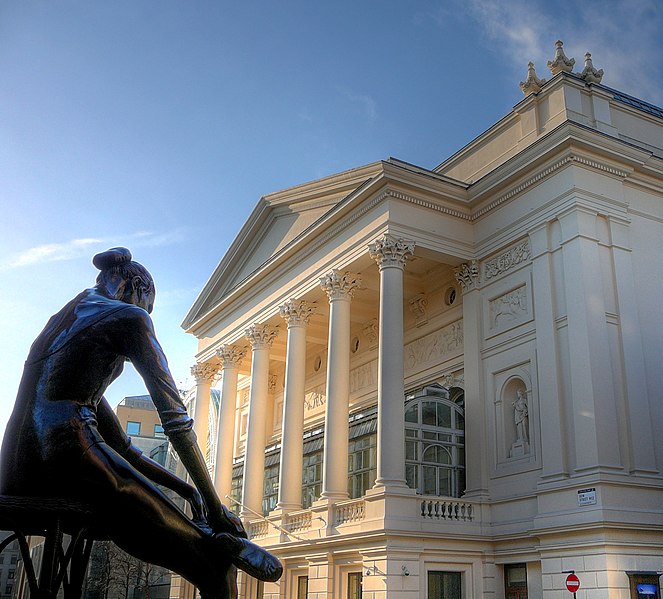
The Royal Opera House's new dance season has been on the House's website since 15 April and it has already attracted some 71 comments, not all of them positive though I can't see why. The Royal Ballet is special and I wish I had the time and resources to see everything though if I did I would never be able to see anything else.  There are some who would ask "Why would you want to see anything else when the Royal Ballet is the gold standard, at least in Britain?" My view is that one needs a bit of variety in life. Fish and chips and chicken tikka masala as well as haute cuisine. In ballet terms, that means small regional as well as national flagship companies. So I have to be selective and here are my choices.

This Autumn I am tempted by Viscera, Afternoon of a Faun, Tchaikovsky pas de deux and Carmen particularly Viscera after hearing Laura Morera at the London Ballet Circle last week (see Laura Morera 25 Aug 2015). Of course, I am also looking forward to Carlos Acosta's Carmen. There have been lots of attempts to translate Bizet into ballet but they have not generally stuck with the public. Maybe  this production will be different.

One ballet that I really love is Ashton's Monotones and that is to be performed with Two Pigeons in November and early December. The Nutcracker returns at Christmas and the Royal Ballet's production is particularly good. There are so many Nutcrackers at that time of the year that it is easy to get Nutcracker fatigue. However this one is magical not least because the House with its Christmas decorations offers such n enchanting setting. It is the show to which I shall take my grandson manqué for his first experience of Covent Garden.

I did not do justice to The Winter's Tale first time round because I was shattered by the drive (see Royal Ballet "The Winter's Tale" 14 April 2014) and I only got to appreciate it in the cinema (see The Winter's Tale - Time to eat my Hat 29 April 2014) and on telly last Christmas. I think I shall appreciate it far more when I see it on stage again.

The last show on my "must go" list is the new Wayne McGregor, The Invitation  and Within the Golden Hour in Spring.  Another Wheeldon and one, of course, MacMillan.

Most of the productions are contributed by the Royal Ballet but there will be visits to the Linbury by our own Phoenix Dance Theatre which I would not miss for the world, the Royal New Zealand Ballet and a number of other interesting companies. This year the Linbury will close for a while which will mean that Ballet Black will have to find somewhere else to launch their new season which is a shame because they always shine in that auditorium. The Dutch National Ballet Junior Company will also have to find another venue if they come to this country this year. I am trying to persuade them to perform at the Stanley and Audrey Burton Theatre and if they came to Leeds Gita and I would spoil them to bits. But I guess there are many other factors that they have to consider.

Wednesday, 28 January 2015

The National Dance Awards

The National Dance Awards were announced yesterday and I congratulate all the winners and indeed all the nominees.

I had been rooting quietly for Xander Parish and English National Ballet and am delighted that they had won in their respective categories.

I first saw Xander Parish dance at the Yorkshire Ballet Summer School and I have been following his career ever since. I saw him dance the leading role in Romeo and Juliet when his company visited London in the summer.  I also had the pleasure of shaking his hand when he spoke to the London Ballet Circle a few days later.  Not only is he a magnificent dancer he is also a thoroughly nice chap. He signed a birthday card that I bought from Northern Ballet for my ballet teacher's younger daughter. She and her hum (and of course her mum's student) were over the moon. He also made a lot of other people in the audience very happy.

English National Ballet was the first company I ever saw. For kids growing up in London and the Home Counties in the 1960s a trip to the Festival Hall to see The Nutcracker was always a great treat. The company had lovely dancers then such as Peter Schaufuss and Dagmar Kessler and of course it has lovely dancers now. I was lucky enough to see all my favourites in class when they visited Oxford in November. Last year I saw their Coppelia, Swan Lake, Romeo and Juliet in the Round and Le Corsaire and enjoyed them all.  On a personal note I was delighted that Sarah Kundi, one of the dancers who makes my spirits soar, joined the company.

I had my fingers crossed for Ballet Black, Arthur Pita and Kevin Poeung and am delighted they came so far.

Finally, the Royal Ballet's Giselle with Carlos Acosta and Natalia Osipova in the leading roles was one of my highlights of 2014.  Acosta's outstanding achievement award and Osipova's two awards were richly deserved.

Tuesday, 28 January 2014

Good Quality Hamburger at the Very Least - Giselle streamed from Covent Garden 27 Jan 2014

Hamburger      Source Wikipedia


In "For those who may be interested ........"  25 Jan 2014 I warned that "an HDTV transmission bears about as much resemblance to the theatrical experience as hamburger does to fillet steak".  The Royal Ballet's Giselle was the third transmission that I have seen this year and it was by far the best. I left the Huddersfield Odeon in a much better humour than I did in October when I watched Don Quixote (see "¡Por favor! Don Quixote streamed to Huddersfield" 17 Oct 2013). I think that is because I learned quite a lot about the ballet yesterday.

The reason I learned so much was that I had already seen this production with almost the same cast on 18 Jan 2014 (see "Giselle - Royal Ballet 18 Jan 2014" 20 Jan 2014). Seeing the same work on a big screen is a bit like watching an action replay in sport.  You see the catch or try on the field but not quite how it happened.  The action replay enables spectators to see how the fielder positioned himself or how the ball passed to the forward who edged over the line.   In very much the same way the broadcast enabled me to appreciate some of the subtleties of the ballet such as the disappointment on Myrtha's face and the relief on Giselle's as the bell tolls 4 and Albrecht escapes.

In my review of the performance of the 18 Jan 2014 I commented on Acosta's presence and Ospiova's virtuosity as an actor as well as a dancer.  Those qualities shone through yesterday too. However, I had not realized just how strikingly beautiful Ospiova is until I saw the footage of her interview and rehearsals before the broadcast.  My admiration for her has soared even higher. I also paid more attention to the other dancers such as Thomas Whitehead who danced Hilarion with grace. Before the show I tweeted
"Heads up for fellow Yorkshire person Thomas Whitehead who dances Hilarion in #ROHgiselle tonight. You lost the lass and died. Not fair!"
To my great surprise the House twitter feed "favorited" (sic) that tweet.

Now for the criticism. Although yesterday's was the best broadcast from Covent Garden so far it still fell short of the Bolshoi's. Their works are presented by Katerina Novikova, an accomplished presenter who is at home in three languages. Last night's ballet was introduced by Darcey Bussell who is a ballerina and not a presenter. While it was lovely to see her and hear her experience of dancing Giselle there were lots of missed opportunities. For instance, interviews with Sir Peter Wright and Kevin O'Hare were compressed into one question each from members of the public. One of those questions from Dave of the Dave Tries Ballet was very interesting. If only there had been time for Sir Peter to develop his answer.

Instead the focus was on the story of the second act and the wicked wilis who have it in for all men.  I really don't think it is necessary to tell the story because the choreography is sufficient in itself. The best way to appreciate the second act of Giselle is the same way as one enjoys Balanchine as pure abstract dance without a story.

A big difference between the Royal Ballet's transmissions and the Bolshoi's is the former's use of twitter. The Royal Ballet suggests a hash-tag and invites the public to tweet where they are from and what they think of the ballet. I am not sure why they do that. You can't say much about a ballet in 140 characters especially after you have identified your cinema so the result is gush.  Superlatives upon the superficial.  Too much attention is given to those voces populorum. That is probably why we did not hear from the conductor or designer at all and why so little time was given to Sir Peter.  Maybe a chance to explore the topic raised by Dave will arise when Sir Peter speaks to the London Ballet Circle on the 14 April.

But the main reason for coming to the cinema yesterday was to see the dancing and hear the music and they were as exquisite on camera as they were on stage.  I think I now know how to use HDTV  to best advantage: see the same production on the stage and in the cinema.  Having seen how well that worked for Giselle I will do the same for Christopher Wheeldon's Winter's Tale. As I said before, HDTV is to a live performance what hamburger is to fillet steak but yesterday's was like a very good hamburger, the sort we used to get at The Great American Disaster.  If you are too young to remember the GAD read Will Self's "A burger with a side order of smugness" 27 Jan 2011 The New Statesman,

Monday, 20 January 2014

Giselle - Royal Ballet 18 Jan 2014


Why do we still watch Giselle?  Except for the occasional performance of La Sylphide and La Péri we don't see much of the romantic ballets of the 1830s and 1840s probably because we no longer believe in ghoulies, ghosties and lang-legged beasties and things that go bump in the night. So why is it that Giselle with its wilis has remained so popular and is in the repertoire of just about every major ballet company in the world?

I think it is because the ballet still has a lot to to say to us not about wilis or prince charming in reverse but about human relationships, shock and the imaginings of a deluded mind. Arguably it has a feminist message though  I doubt that was ever in the minds of Perrot, Grisi or the audiences around the world who have filled the theatres night after night ever since it was first performed. Modern theatre goers do know what it is like to build up one's hopes unreasonably, to see them dashed suddenly, to suffer public humiliation crushingly and in a few cases extreme cases illnesses that can lead to self harm,

Everything is hunky dory for Giselle.  She's the prettiest girl in her village.  She attracts the hunky new kid with style who is so much more fun than nerdy old Hilarion who is in with her mum for slipping her the occasional rabbit or partridge. There she is - queen of some kind of harvest pageant the envy of all her friends - and then Hilarion spoils it all by exposing Albrecht as a two timer.  Suddenly from queen of the pageant she is a laughing stock. No wonder she goes out of her mind. And her mum yapping on about the spirits of girls who die before their wedding day can't have helped.

Giselle's mad scene is the key to the ballet which forms the link between the merry making and flirting of the first part of the first act and the world of the wilis of the second.  It takes a ballerina with extraordinary dramatic powers as well as great virtuosity to do it well. And she needs a credible partner with similar powers to accompany her. I have seen many versions of Giselle by many companies but I can only recall a couple of performances when I have been entirely satisfied. One of those performances was by Fonteyn with Nureyev and another by Sibley with Dowell. A third was last last Saturday night. Natalia Osipova who danced Giselle in the evening performance at the Royal Opera House on 18 Jan 2013 with Carlos Acosta has those powers. As for her partner, I would go so far as to say that Acosta, who dominates a stage like no other dancer, was the best Albrecht that I have ever seen, and that includes Nureyev.

Also impressive were Thomas Whitehead who danced Hilarion, Deidre Chapman Giselle's mum, Christina Arestis Albrecht's girlfriend, Hikaru Kobayashi queen of the wilis and Elizabeth Harrod one of her attendants. I have been following Harrod ever since I first saw her at a Yorkshire Ballet Summer School Gala and it is great to see how well she is coming on.  I loved everything about Peter Wright's production and also John Macfarlane's designs.

I used to go to the Royal Opera House frequently until it was refurbished.  I got out of the habit when it was closed for those works and I have only been back since though I kept up my membership of the Friends of Covent Garden for most of that time.  It must be over 30 years since I was last in the amphitheatre and how that has changed with its swanky bars and restaurants.  On the whole I welcome those changes but I do miss the old House with its stench of veg, the cut flowers tossed by the audience from the boxes, the liveried footmen and the ritual of the ballerina choosing her choicest bloom for her partner.

Sunday, 20 October 2013

More Thoughts on Don Quixote

Natalia Osipova and Ivan Vasiliev of the Bolshoi   Source Wikipedia

The performance of Don Quixote which was streamed to my local Odeon last Wednesday has prompted me to think about the ballet generally and to ponder why it is not staged more often (see ¡Por favor! Don Quixote streamed to Huddersfield 17 Oct 2013). Lots of companies dance Swan Lake, Sleeping Beauty, Nutcracker and Giselle but not so may include Don Quixote in their repertoire.  It is one of those ballets like La Sylphide that everyone has heard of but not actually seen. I have only seen one version of Don Quixote on stage and that was London Festival's at the Coliseum in the late 1960s or early 1970s.  Dame Ninette de Valois tried to stage the ballet for what is now the Royal Ballet in 1950 but it does not seem to have been very popular. 

Although the ballet takes its title from Miguel Cervantes's well known novel it is very much a Russian work (or perhaps, more accurately Eastern European as the score was contributed by an expatriate Austrian).  It is one of Petipa's earliest works having been staged for the first time in 1869 and that may be one of the reasons.  It provides scope for some brilliant dancing by the principals and soloists but it does take liberties with the novel. The ballet really ought to be renamed Basilio and Kitri for that is what the story is all about - a Hispanic Fille mal gardée with a touch of Carmen.  

Save for the coda in the last Act, the music is not very well known.  I had (and possibly still have) a vinyl LP somewhere which I bought from the old Ballet Bookshop in Cecil Court. Does anyone else remember that wonderful source of ballet memorabilia? I played that disc often when I was a student - particularly when I had an essay to write.  The composer Ludwig Minkus wrote a lot of music for the ballet. After many years service at St Petersburg, Minkus returned to his native Vienna where he subsisted on a pension from Russia.  That remittance ended with the First World War as the Austro-Hungarian empire and Russia were on opposite sides.  He died in 1917, the year of the Bolshevik revolution, in very straightened circumstances. Having to cope with such circumstances poor old Minkus had more than a little in common with with Cervantes's creation. 

From what I could see from the images that were streamed from Covent Garden, Carlos Acosta has reworked substantially the Petipa ballet.  By dancing Basilio himself and casting another Marianela Nunez, another Latin American dancer, as Kitri he has reclaimed the work for the Spanish speaking world. As I said in my review, the screening left me dissatisfied. All the remaining performances of the ballet this season are fully booked.  I hope Acosta's version stays in the Royal Ballet's repertoire rather longer than de Valois's because I should really ought to see it.