I wanted to like Akram Khan's Giselle for English National Ballet so much. I love that company having followed it for ever since I was first taken to the Festival Hall to see The Nutcracker as a child some 60 years ago. As I said in Manchester's Favourite Ballet Company 29 Nov 2015 the company danced its first ballet in Manchester on 5 Feb 1951 and I am mindful of the compliment that ENB has paid my native city by premiering an important new work there. I am glad that virtually the entire audience (or so it seemed from my position in the centre stalls) was able to give it a standing ovation - though I was not one of those who stood.
Now I have to choose my words very carefully for I don't want to condemn a work that has much merit with faint praise. There was some exciting, energetic and in the final duet between Giselle and Albrecht, quite beautiful dancing. Vicenzo Lamagna wrote, and Gavin Sutherland orchestrated, an interesting score with frequent allusions to Adolphe Adam's. Equally interesting were Tim Yip's designs. Two of my favourite dancers, Alina Cojocaru and Isaac Hernández, danced Giselle and Albtrcht and there were other favourites in other roles. The dancers worked hard contorting their bodies in unusual shapes and positions. The courou on pointe by Stina Quagebeur, who danced Myrtha, and the corps at the beginning of Act II must have been exhausting and for some excruciating.
I am glad I saw the work. I hope to see it again and perhaps pick up some of the nuances that my companion (who is of Gujarati heritage) appreciated but which passed me by. I recommend it. It was a good show - though not a great one - and it certainly was not one that swept me to my feet in the way that Brandsen did with Mata Hari (see Brandsen's Masterpirce 14 Feb 2016), Maillot with his Shrew (see Bolshoi's Triumph - The Taming of the Shrew 4 Aug 2016), Dawson with his Swan Lake (see Dawson's Swan Lake comes to Liverpool 29 May 2016) or Meisner with his No Time Before Time (see Dutch National Ballet's Opening Night Gala - Improving on Excellence 8 Sept 2016) earlier this year.
To understand my critique of this work it is worth looking at The Story on the special website that ENB has created for this ballet. At first sight it is Gautier's libretto with a modern twist - perhaps closer to that version than the Dance Theatre of Harlem's Creole Giselle and certainly Mats Ek's for the Paris Opera - but it does not unfold that way. In Gauthier's libretto, which is explained so beautifully in the following Dutch language
Standard YouTube Licence
animation, the story builds. The audience can understand Hilarion's hostility towards Albrecht which is the only reason why he has to die. In Ruth Little's version that hostility is taken as read. The scene opens in the factory with Albrecht seeking out Giselle. Hardly any of the cues - the hiding of the sword, the picking of the petals, Giselle's heart tremor and so on - remain. Surprisingly there is still the dance of the vignerons where Giselle playfully runs from Albrecht as the dancers wheel round stage but it seems to serve no obvious purpose in Little's version. It is the absence of those cues that prompts my companion's question "Why does Hilarion have to die in act II?" As she said, he has done nothing wrong. Or at least he was not half as bad as Albrecht who seduced Giselle and then abandoned her for Bathilde. In Gautier's libretto there is a logic. In Little's it seems so unfair.
As I wrote in Reflections on Giselle 29 Jan 2014 I have problems with the second act. I have to treat it as though it were an abstract work by Balanchine in order to sit through it. In reworking Giselle the creative team had a golden opportunity to ditch the superstition as Ek did by settling act II in a psychiatric hospital. Had they done something like that it might have strengthened the show but they kept it spooky. However. Khan's choreography for act II was quite different. Instead of those mesmerizing arabesques as the corps crosses the stage the girls couroured on pointe for what for them must have seemed ages. Instead of forcing their victims to dance themselves to death through exhaustion the wilis dispatched them with sticks to the accompaniment of grinding and crackly noises. Instead of facing the whole company of wilis Giselle had only to fend off Myrtha who stood scowling with her stick as Giselle danced with Albrecht for the last time.
That final duet was for me the most beautiful part of the ballet and also the most impressive. At one point Hernandez held Cojocaru by the legs and she seemed to revolve in the hold in a most amazing fashion. That last dance is what I most want to see again. With some ballets it is only a single pas de deux that survives in a company's repertoire and perhaps that will be the case with this duet.
My companion and I discussed the sticks on the drive home. "Were they supposed to be tasers?" I asked myself. Whether intended or not they were the only allusion to the Sub-Continent that registered with me for they reminded me of the sticks carried in a Punjabi folk dance that I had seen at a Bhangra festival in Huddersfield Town Hall some years ago. My companion, who is fortunate enough to have grown up in two cultures, told me that there was so much more in the rhythms of the music and the dancers' steps.
My all abiding impression of the work was unremitting darkness. Dark in two senses. Every scene was very dimly lit. So dark that I could not recognize the faces of the dancers until the reverence. I had been looking out for Sarah Kundi who is one of my favourites - but I never saw her until that curtain call. However, my companion recognized Sarah from her movements that were quite different from those of the other dancers - perhaps because of her heritage, my companion suggested. Even darker than the lighting, however. was the story for it was one of constant grind. At least in the traditional Giselle there are some happy bits such as the crowning of Giselle as harvest queen. There was nothing like than in Khan's. Just a morose folk dance for the landlords who were heralded by blasts that sounded like factory sirens or perhaps fog horns. Very intense and just a little depressing.
How does Giselle compare to Khan's other work? I regret that I have not seen much of it but of the works that I have seen I much prefer Ka'ash (see Akram Khan's Kaash - contemporary meets Indian classical 7 Oct 2015) and indeed Dust which was the highlight of last year's triple bill (see Lest we forget 25 Nov 2015). However, as my friend said "Giselle is a work in progress that can only improve." She did get up to applaud at the end of the show and shouted "Go on Akram!" Maybe in time I shall be able to do the same.

Dance News from around the UK and the Rest of the World
Showing posts with label Palace. Show all posts
Showing posts with label Palace. Show all posts
Wednesday, 28 September 2016

Wednesday, 15 June 2016
Akram Khan's Giselle
Standard YouTube Licence
All being well I shall be in the audience for the premiere of Akram Khan's Giselle on 27 Sept 2016. This is billed as "a new interpretation" of Giselle which is one of my favourite ballets and the one of the world's most popular. I have not taken too kindly to most "new interpretations" of Swan Lake which is my other favourite and the other classical ballet that is at least as popular as Giselle so why am I so excited about Akram Khan's Giselle?
One reason for my excitement is that I don't really like the story of Giselle as it stands. In my Reflections on Giselle 28 Jan 2014 I wrote that the reason I have a problem with Giselle is the story. Not so much Act I which, as I said in my note, could have come from The Archers but Act II , I continued:
"because Giselle is buried in unconsecrated ground where her spirit joins those of other women who have been seduced and die before their wedding day. They have it in for men and if any man is unfortunate enough to stray across their path as the gamekeeper did they kill him (though having said that I have seen one performance, though I cannot remember which company, where the gamekeeper survives and the curtain falls on his shaking hands with the playboy). That is a pretty unpleasant as well as fantastic story and offends my sensibilities ....."My strategy for coping with Act II is to put the narrative out of my mind and to treat that part of the work as a purely abstract work like Act II of Balanchine's Jewels.
English National Ballet are not giving anything away about Akram Khan's creation. They have posted a synopsis page on their website but all it contains are a series of quotations. There is a film and some photos but they could have come from lots of rehearsals. We know that Adam's score is to be used but we are told that the score has been adapted and that there will be some additional music by Ben Frost. We also know that Akram Khan is working with Ruth Little, the dramaturg who collaborated with Jonathan Watkins on 1984.
One clue that I do have comes from Simon Garner who dances with me at KNT. Simon recently exhibited a mixed media work which included some sound effects at London Scottish House in Manchester (see Images of Giselle 20 May 2016). Someone from ENB visited the exhibition and saw the work and sent a message that he had parts of the ballet were not unlike his work.
Akram Khan's Giselle will start in Manchester and will tour Bristol and Southampton before ending in Sadler's Wells in November. I should add that the company will also dance Mary Skeeping's Giselle at the Coliseum in January.
Sunday, 29 November 2015
Manchester's Favourite Ballet Company
 |
| Manchester Town Hall
Source Wikipedia
Creative Commons Licence
|
English National Ballet, Romeo and Juliet, Palace Theatre, 28 Nov 2015
Last night was the 46th anniversary of the first performance by Northern Dance Theatre (later known as Northern Ballet) at the University Theatre in Manchester. Northern Ballet crossed the Pennines many years ago leaving our city without our own major ballet company. Or did it? I think Manchester has a special relationship with English National Ballet which goes back a very long way. The company gave its first performance at the Opera House on 5 Feb 1951 (see Our History) and it has chosen Manchester for the première of Akram Khan's Giselle on 27 Sept 2016. Last night and on Tuesday English National Ballet pulled out all the stops for us. I don't think I have ever seen English National Ballet dance better since I started following it in 1955.
On Tuesday the company performed Lest we forget (see Lest we Forget 25 Nov 2015). For the rest of the week it has been dancing Nureyev's production of Romeo and Juliet. Yesterday was the first time I had seen that version and I liked it a lot. It has a lot of imaginative and original features some of which, such as the unfolding of Friar Lawrence's cunning plan, seem to have been borrowed from the cinema. It is tense and tight and packed with action. There are lots of colourful touches from the dropping of the black and red cloth in the prologue to the Montagues' flag dance in Act II. There are whole new scenes such as Mercutio's death scene when Romeo and his mates think he is play acting or Juliet's solo with the dagger after Romeo has gone into exile and her parents are trying to force her to marry Paris. The shock when Romeo realizes that Mercutio is dead explains the rush of blood that goaded him to pick up a sword even better than the play. Having said that it is much closer to its source material than either Jean-Christophe Maillot's for Northern Ballet with its focus on Friar Lawrence or Krzysztof Pastor's for Scottish Ballet with its potted history of Italy even though I must add that I liked both versions well enough at the time (see Northern Ballet's Romeo and Juliet - different but in a good way 8 March 2015 and Scottish Ballet's Timeless Romeo and Juliet 18 May 2015).
Though I admired Nureyev's choreography, the orchestration of Prokofiev's magnificent score and Ezio Frigerio's designs it was the dancing that made the evening for me. The casting of Max Westwell and. in particular, Lauretta Summerscales in the title roles was inspired. On her web page she mentions Juliet as the role she would love to dance. The company gave her the chance to dance that role and she grabbed that chance with both hands. I don't think I have ever seen a better Juliet although I have seen some of the world's greatest ballerinas in that role. The quality that she brought to that role was her youth. When playing with her nurse and girl friends in Act I she looked as though she might actually be 13. She grew into a mature woman before our eyes. Westwell was an excellent partner for her. I can quite see how he became a finalist of the emerging dancer contest. His web page says that Romeo and Juliet is his favourite production too and he also made the most of his opportunity to dance the leading role.
All the cast did well and it is perhaps unfair to single any of them for special praise but Fernando Bufalá was a great Mercutio. He was the life and soul of every party (even the one he gate crashed) and clowning even as he died. Fabian Reimair was a seething Tybalt, Jeanette Kakareka a delightful Rosaline and Daniele Silingardi a decent Paris. He seems to have loved Juliet and would have been quite a catch for almost every other young woman. I felt really sorry that he had to die in the tomb.
But the casting that delighted me most was to see Sarah Kundi as Lady Capulet. I have followed that dancer ever since she danced in Leeds. It was she who led me to Ballet Black and through MurleyDance to Richard Chappell. She is tall and elegant with the most expressive face. An actor as much as a dancer, yesterday's role was perfect for her. It is an important one in Nureyev's production for it is Lady Capulet who forces her daughter to take desperate measurers. How I clapped at the curtain call. I fear my "brava" roared from the middle of the stalls would have been drowned out by everyone else's applause by the time it reached the stage. Had this show been in London I could have tossed flowers at her. She and everyone on stage would have deserved them.
So farewell to English National Ballet until its next season in our city. Heartfelt thanks for two magnificent shows. Now that we are to build our fine new £78 million arts centre (see The Factory begins to take Shape 26 Nov 2015) maybe we can tempt it back more often and to stay with us a little longer each time it returns.
Wednesday, 25 November 2015
Lest We Forget
 |
| Commemorating World War 1
Photo Andrew Davidson
Source Wikipedia
Creative Commons Licence
|
English National Ballet, Lest we Forget Palace Theatre, Manchester, 24 Nov 2015
Yesterday's performance of Lest we Forget in Manchester was superb. It was not an easy watch and for that reason I can't say that I enjoyed it but I was moved by it in a very special way. This was ballet at its best. It showed the unique power of dance to comprehend and find beauty in one of the greatest tragedies of human history. The end of the performance brought some members of the audience to their feet. I guess the only reason why more did not join in was that the audience was emotionally drained by the end.
The performance consisted of Liam Scarlett's No Man's Land, Russell Maliphant's Second Breath and Akram Khan's Dust. That was a shorter programme than the one premièred at the Barbican last year in that it omitted George Williamson's Firebird which I hope to see one day. All three were impressive works but the one that stood out for me was Scarlett's No Man's Land.
I had already seen a recording of Scarlett's Viscera earlier in the month (see Au Revoir but not Adieu 19 Nov 2015) and was keen to compare it to No Man's Land. The two works could not have been more different. Set to excerpts from Franz Liszt's Harmonies Poétiques et Religieuses that had been arranged by Gavin Sutherland No Man's Land was haunting and lyrical. The work remembered not only the men who served in the forces but the women who stayed behind to make the munitions in appalling and sometimes dangerous conditions. The setting for this work was a damaged but still operational building - possibly a factory or maybe a ruin on the front. The women were in simple flowing dresses. The men in green or brownish tunics with steel helmets at one point in the ballet. There was enchanting dancing by Begoña Cao, Junor Souza, Alison McWhinney, Fabian Reimair, Shiori Kase and Fernando Bufalá.
Maliphant's Second Breath was an opportunity for Tamarin Stott and Joshua McSherry-Gray to shine and they were incandescent in their duet though the supporting dancers were important too. The work was set to a score by Andy Cowton but not easy to absorb. There were pulses of sound that I found quite alarming though that was possibly the composer's idea. There were snatches of barely audible and even less comprehensible speech in the piece followed by a pretty clear rendering of Dylan Thomas's Do Not Go Gentle into That Good Night which seemed to be delivered by the author himself. Dark and disturbing this was the work that required most work on the part of the audience.
The most dramatic work of the evening was Khan's Dust. It began with an execution - or possibly the nightmare of an execution for the victim continued to writhe on the ground. There was some impressive human sculpture where the dancers' limbs became waves or possibly a production line. It was Khan's Kaash at the Lowry that prompted me to book for Lest we Froget but this work was very different in that any South Asian influences were much less noticeable to me at an rate. The music for this work was by Jocelyn Pook who also wove speech into her score. There was what seemed to be a phrase of Auld Lang Syne repeating itself on a scratched record. The lead dancers were Erina Takahashi with Reinar and Bufala, This piece won Khan a number of awards last year and its success seems to have led to his commission to create a Giselle. I look forward to it immensely.
The centenary of the First World War inspired the Royal New Zealand Ballet to create Salute, another mixed bill focusing in war. They two of their ballets from that production to Leeds which I reviewed in Kia Ora! The Royal New Zealand Ballet in Leeds 5 Nov 2015 earlier this month. The Netherlands which was neutral in the conflict is commemorating the war in a different way with Ted Brandsen's Mata Hari who was also a victim of that conflict.
Anyone who thinks that dance is a frivolous, frothy superficial art form incapable of dealing with difficult matters should think again. It is the synthesis of many arts and the whole is almost always greater than the constituent parts.
Saturday, 24 October 2015
1984 Second Time Round
Embedded pursuant to a standard YouTube licence
Northern Ballet, 1984, Palace Theatre, Manchester, 17 Oct 2015, 19:30
As I had expected, I liked Northern Ballet's 1984 very much more the second time around. There are two reasons for that. The first is that I knew what to look out for having seen the show in Leeds on 11 Sept 2015 (see My First Impressions of 1984 12 Sept 2915). The second is that Isaac Lee-Baker and Dreda Blow came very close to my picture of Winston Smith and Julia.
There is only so much that the senses can absorb when one attends the theatre. The first time I saw the show I concentrated on the plot in order to understand the ballet rather than the sound and movement through which the story was expressed. There was a lot of movement in this ballet - the choreography, of course, but also spectacular electronic displays on a massive "telescreen". Knowing the sequence of the ballet I was better able to appreciate Jonathan Watkins's choreography, Andrzej Goulding's telescreen, Simon Daw's sets and costumes, Alex Baranowski's score and some exquisite dancing.
Lee-Baker as Smith and Blow as Julia were perfect casting in my recollection of Orwell's novel. Smith is a young chap, very impressionable and somewhat naive - the sort who might have been turned by Stalin had he worked in the Foreign Office in the late 1940s rather than the Ministry of Truth in 1984. Such a role requires a young dancer but one with considerable ability. A role tailor made for Lee-Baker who had triumphed as Friar Lawrence in Maillot's Romeo and Juliet earlier in the year (see Northern Ballet's Romeo and Juliet - different but in a good way 8 March 2015) and as Wilson in Gatsby last year (see Northern Ballet at its best: The Great Gatsby in Bradford 16 Nov 2014).
As I recall the novel, Julia is a temptress and I intend it as a compliment when I say that Blow was a very sexy lady. She is another dancer that I began to appreciate for the first time in Romeo and Juliet. When I saw her as Juliet I wrote:
"Casting Blow for the role was an inspiration. She was a perfect Juliet. Playful and feisty. Loving but conflicted. Brave but fearful. Blow is elevated to my pantheon of favourites."Julia is a very different role from Juliet but Blow was an excellent choice. She is perhaps Northern's best actor. She was sultry. She was seductive. She was my idea of Julia.
The third leading character in Watkins's ballet is O'Brien, the senior apparatchik who tricks Smith and Julia into dropping their guard and then betrays them. Javier Torres danced that role in September and he was excellent. He saved that show for me on that occasion. Last Saturday it was Ashley Dixon who was a very different O'Brien but no less convincing. He projected menace and oiliness even in the privacy of his apartment when entertaining his young quaries with a silent telescreen.
It was good to see some of my favourites in the company - Hiranao Takehashi as Charrington, Jeremy Curnier as O'Brien's assistant, Victoria Sibson as the lead female prole and Rachael Gillespie, Abigail Prudames and Mlindi Kulashe who danced in the crowd scenes as party faithful and proles but still shone - as did all in the cast last Saturday night.
Orwell's satire is not an obvious choice for a ballet. In the Q & A that followed the show in Leeds on 11 Sept 2015 Watkins was asked why he had chosen that work as the subject of a ballet. He replied that
"he had read the book as a teenager and had been affected by it. He had contemplated how it could be translated into dance for some time. The same had happened with the Ken Loach film Kes which he first saw about the same time. That film resonated with him because it was set in the area in which he had spent his childhood. Last year he had the chance of stage it for The Crucible in Sheffield. By staging Kes and 1984 he had achieved two longstanding ambitions."As you can see from the synopsis Watkins followed Orwell pretty faithfully. The sets, costumes, music, choreography, dancing came together beautifully. I don't think that this will ever be one of my favourite ballets but it it one that I now understand, appreciate and recommend.
The company will perform 1984 today in Sheffield for one last time in the North before they take it to the rest of the country. I had hoped to see it in Sheffield with Giuliano Contadini and Antoinette Brooks-Daw in the leading roles but they were dancing on the nights when Jane Tucker teaches the improvers and I was due to see Rambert at The Alhambra. Perhaps I can catch that cast at Sadler's Wells in May. Londoners tend to like Northern Ballet perhaps even more than we Mancunians and I am sure they will enjoy this show.
Saturday, 28 March 2015
More Ballet in Essex
 |
| Photo Jane Lambert All rights reserves |
Sheila Beelam who keeps the wonderful Just Ballet shop in Thorpe Bay just outside Southend has just posted the following announcement on Facebook:
"We have just managed to book in a photo shoot for next Wednesday 1st April 10.30am - 1.30 pm at the Palace Theatre in Southend. We are looking for the following to help model our beautiful collection of leotards:
Each dancer will receive a Just Ballet gift voucher, goody bag and a complimentary image from their photo shoot.:-)
- 3 x adult dancers (UK 6-8, UK 8-10 & UK 10-12)
- 3 x 8 - 11 year old dancers
- 1 x 4 - 5 year old dancer
Casting closes this Sunday 29th March at 10 pm".I visited Sheila in her shop last month on the way back from Amsterdam and was very impressed.It was just like Aladdin's cave and she was running a recording of Giselle on her monitor. I had previously bought two leotards from her (she stocks all sizes even for hippos like me) and I bought another really pretty one for me plus something for a friend in Sheffield.
The shop is just round the corner from the sea front and you can park outside. There are no restrictions.
If I were an Essex girl I would love to take part in this shoot. As I have written quite a lot about ballet in Chelmsford and Harlow this week I thought that some of them might like to apply to take part.
Thursday, 11 December 2014
Let's bring the Royal Ballet to The Factory Manchester
 |
| Palace Theatre
Photo Wikipedia
|
With 2.9 million inhabitants the Greater Manchester metropolitan area is the second largest conurbation in the British Isles. It is also the largest conurbation without a resident world class ballet company. London has lots of good companies - the Royal Ballet, English National Ballet, Rambert, Ballet Black to name just a few. Birmingham has the Birmingham Royal Ballet, Glasgow Scottish Ballet, Leeds Northern Ballet and Newport Ballet Cymru.
It has not always been so. Northern Ballet began life in Manchester but moved across the Pennines first to Halifax and then to Leeds. It now has a magnificent home at Quarry Hill in Leeds with its own theatre in the same neighbourhood as the West Yorkshire Playhouse, Leeds College of Music, Yorkshire Dance, the BBC and the Grand. There is no reason why it should move anywhere else. Of course, we still see Northern Ballet in Manchester from time to time just as we see the Birmingham Royal Ballet, English National Ballet, Rambert and many other companies. We also have the Northern Ballet School which performs a classical ballet every year at the Danceworks Theatre in Oxford Road. All very good but not the same as having our own world class company.
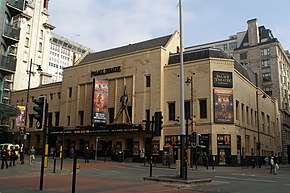
A few years ago there were plans for the Royal Opera House to establish a Northern base at The Palace with regular seasons for the Royal Ballet and Royal Opera in Manchester. That would have been wonderful but austerity put paid to that (see Rob Sharp Royal Opera House shelves move north 28 Oct 2010 The Independent). Although the news report says that the plans have been put on hold nobody has tried to revive them in the intervening time.
But maybe we can do so now. In his Autumn Statement 2014 the Chancellor of the Exchequer announced a £78 million investment in a massive theatre and arts centre on the site of the Granada Studios to be known as "The Factory Manchester". It is part of a £7 billion programme of investment in transport, science and technology and the arts to transform the cities of the North into a "Northern Powerhouse" to serve as an economic counterweight to London.
An economic counterweight needs culture. As Manchester City Council recognizes in its press release "£78m for The Factory Manchester - a new large scale, ultra-flexible arts space" 3 Dec 2013
"The Factory Manchester will play an integral part in helping Manchester and the North of England provide a genuine cultural counterbalance to London, supporting the city and region's growth."Now Manchester already has The Hallé, The Royal Exchange and The Lowry which go a good way towards providing that cultural counterweight but it needs first class opera and ballet to be complete.
We could try to persuade an established company in another city to move to Manchester as Birmingham, Glasgow and Leeds did but that would be resented by the city such company would leave behind and we Mancunians are too big hearted for that. We could also grow our own company but that would take years. Dusting off the plans that were put on hold only five years ago now seems a viable option. If the BBC can move to Media City why not the Royal Ballet and Royal Opera for at least part of the year? The second city of the nation needs and deserves nothing less.
Post Script
The following paragraph appears in the Wikipedia article on the Royal Ballet:
"The Royal Opera House and Manchester City Council are currently in the planning stages of a new development known as Royal Opera House, Manchester. The proposal is for the Palace Theatre in Manchester to receive an £80m refurbishment, creating a first-class theatre capable of staging productions by both the Royal Ballet and Royal Opera. The Royal Opera House would take residence of the theatre for an annual 18 week season, staging 16 performances by the Royal Opera, 28 performances by the Royal Ballet and other small-scale productions. The proposals would establish the Palace Theatre as a designated base for the Royal Opera House companies in the North of England, as a producing house for new ballet and opera, and as a training centre for all aspects of theatre production. The proposals could potentially lead to the creation of 700 jobs for local people.More on Ballet in Manchester
The proposals have been approved by Andy Burnham MP the Secretary of State for Culture, Olympics, Media and Sport, and accepted by a number of public bodies. However the plans are currently being revised to address the concerns put forward by those who are opposed to the plans. Issues that have been raised include:
- How will the refurbishment of the Palace Theatre be funded?
- Will the proposals impact negatively on The Lowry, a theatre and arts complex in nearby Salford?
- Will the Manchester season present the same standard of performance as the Royal Opera House in London?"
13 Dec 2014 Alchemy
9 Nov 2014 A Mancunian Nutcracker
10 Oct 2014 What Manchester does today
29 Aug 2014 So proud of Manchester
More on the "Northern Powerhouse"
10 Dec 2014 Jane Lambert "Let's take this opportunity with both hands" IP North West
8 Nov 2014 Jane Lambert "Northern Futures Summit" IP Yorkshire (see the links to other articles)
Sunday, 16 February 2014
English National Ballet's Le Corsaire - a Valentine's Day Treat
Standard YouTube Licence
In the programme, Tamara Rojo noted that Le Corsaire is such an important work that it is strange that no British company has ever owned a production. She added
"The great thing about having a work that no one else has is that you can really make it your own. This is going to be Le Corsaire for the United Kingdom."
The ballet was not entirely unknown to British audiences. The Bolshoi's version was broadcast live in 2012 and I watched it at the National Media Museum in Bradford.
Based on Lord Byron's The Corsair the ballet tells how Conrad, a corsair or privateer in love with Medora, a beautiful Greek woman in Turkish captivity, rescues her from a fate worse than death and takes her back to his den with other beauty including other captives. Conrad's lieutenant, Birbnanto, becomes dissatisfied with the distribution of the booty especially after Conrad promises to give it all to Medora especially after Medora persuades Conrad to liberate the other captives. He makes two attempts to mutiny the second od which results in the recapture of Medora. Conrad comes looking for Medora and rescues her a second time. Sailing away the corsair's barque is caught in the sort of storm that has been battering our coasts for the last few months and sinks. Conrad and Medora (or at least their spirits) survive and they fade away in each other's arms.
This story provides juicy roles not only for the principals who dance Conrad and Medora but also for Birbanto, Ali (Conrad's sidekick), Lankendem (the governor of the city) and Gulnare, a young slave girl who is left behind in captivity. There is also a great character role for the fat old pasha who can't wait to get his hands on a pretty slave girl.
The production that I saw yesterday was commissioned from Anna-Marie Holmes who had staged the work for the wonderful Boston Ballet which visited us briefly this summer (see "Boston Ballet: 'High as a flag on the Fourth of July!'" 7 July 2013). Homes's production was itself based on a revival of the work by Konstantin Sergeyev, the artistic director of what was then called the Kirov Ballet and is now once more the Mariinsky. The work that Sergeyev revived was choreographed by Marius Petipa to a score by Adam though with contributions from a number of other composers including Delibes and Minkus.
The work had its première in Milton Keynes on 17 Oct 2013 since when it has been staged in Southampton, Oxford, Bristol and London. Manchester is the last stop of its tour although it is going to Spain for a few days in April. The advantage of seeing a show at the end of a tour is that the company will have accumulated a lot of experience so the performance should be very polished. Le Corsaire had had a very good run in London both from the critics and audiences. I therefore had very high expectations when I braved the elements on Valentine's day.
I was not disappointed. Conrad was danced by Zdenek Konvalina who danced with enormous energy and grace. He was partnered by Fernanda Oliveira as Medora. She was delightful. Sweet and imploring when begging for the slave girls' freedom in Act II, fierce when cornered by Birbanto indignant when denouncing him to Conrad and very exciting to watch, particularly in the spectacular dances with Conrad and Ali in Act II. Fabian Reimair projected slyness and malice as Birbanto. Ken Saruhashi, who danced Lankendem, is an impressive young man with ambitions to dance Siegfried, Albrecht and Basilio, I am sure we shall see a lot of him. Michael Coleman, the fat old pasha (the archetypical dirty old man) had the audience chuckling as he vibrated after acquiring Medora. But the loudest applause on Friday went to Shiori Kase who danced Gulnare and Yonah Acosta who danced Ali.
When I mentioned that the crowd had gone wild for Acosta on BalletcoForum one of the ballet buffs replied:
"Not to take anything away from Yonah Acosta, of course, but ENB's Corsaire audiences have all gone wild for Ali, whoever has been dancing the role!"
I can understand why that would be the case. Ali has some spectacular jumps that would raise a cheer whoever danced that character. But I was impressed by this young man and I am sure we shall all see a lot more of him.
The same is true of Gulnare's role which is danced by an up and coming young dancer. Michaela dePrince (a Sierra Leonean dancer currently with Ernst Meisner's Junior Company whom I just can't see enough of) performed it for the Joburg Ballet when she was just 16 or 17. As with Ali's role the choreography certainly helps for there is a delightful flower dance in the pasha's garden. Shiori Kase danced it beautifully. All the audience could do after that scene was purr.
But there was yet another star and that was Bob Ringwood's designs. Though overlooked by some, the sets, costumes and lighting can be as important to the success of a ballet as the dancing and the score. The opening scene of old Istanbul wowed us before a step was danced. The view of the sea from the pirates' cave took our breath away. The storm (so reminiscent of the news reels last week) made us shiver. The costumes were sumptuous, particularly the pasha's outfit complete with paunch. The multicoloured skirts in the opening scene were delicious. They must have been such fun to wear.
I do not know why this ballet has not been performed more often but now that it is the repertoire I am sure it will become one of English National Ballet staples. Valentine's day happens to be my birthday and I cannot think of a better way of celebrating it.
Subscribe to:
Posts (Atom)