Showing posts with label Royal Opera House. Show all posts

Monday, 5 December 2022

The Royal Ballet's Mayerling on Stage and Screen

Crown Prince Rudolf


The Royal Ballet Mayerling Royal Opera House, 29 Nov 2022 19:30

Schloß Mayerling is now a Carmelite convent. In 1889 it was a royal hunting lodge where Rudolf, the 30-year-old Crown Prince of the Austro-Hungarian empire, and Mary Vetsera, an impressionable 17-year-old, killed themselves. Details of their deaths were suppressed for many years but the truth eventually emerged.  In 1978 Sir Kenneth MacMillan created a ballet on the story to the music of Franz Liszt with designs by Nicholas Georgiadis. I saw the work in the cinema in October and on stage at the Royal Opera House on 29 Nov 2022. 

While not exactly a barrel of laughs it is one of MacMillan's most frequently performed ballets.  It is not hard to see why.  It has exciting choreography, enchanting music, elaborate sets and lavish costumes. For many years the Royal Ballet was the only company to stage Mayerling.  There are now several others in the United States, Germany and Scotland.  Scottish Ballet's was based on Sir Kenneth's choreography and staged with his widow's cooperation.  I missed it because I was recovering from a hip injury when it was on tour. 

The performance that I saw last Tuesday evening was one of my best nights at the ballet in a lifetime of theatre-going. That was despite last-minute cast changes resulting from an injury to Steven McRae.  Having seen Ryoichi Hirano on screen I had been looking forward to a very different interpretation from McRea.  I also wanted to see Kristin McNally as Sissi, Anne Rose O'Sullivan as  Rudolf's long-suffering wife and Bradfordian Thomas Whitehead as Colonel Bay Middleton.  Having said that I was not in the least disappointed by those who took their place.

The role that MacMillan created for Prince Rudolf is pretty close to the historical character.  An exceptionally privileged individual who could literally get away with murder (or at least manslaughter) but also a very trapped one.  A figure readily deserving contempt but also sympathy and compassion. Hirano stimulated all those emotions in me.  Contempt as he humiliated his bride in a brothel or threatened women with his pistol but compassion as he drank himself crazy minutes before he blew his brains out.  The role requires outstanding virtuosity.  It requires a rare talent to carry all that off but that is exactly what Hirano did.

There are four important female roles in Mayerling:  

  • Mary, Baroness Vetsora who agreed to die with him
  • Mitzi who most certainly would not
  • Rudolf's wife, Princess Stephanie of Belgium, and 
  • his mother, Empress Sissi.
Akane Takada brought Mary to life with her sweetness and delicacy. Perhaps more than brought her to life because the real Mary was little more than a child when she met Rudolf.  Leticia Dias was a streetwise Mitzi, picking herself up and carrying on even after a police raid.  Yuhui Choe danced Stephanie. Her indignation was palpable as she was dragged to a brothel.  Itziar Mendizabal danced the Empress exactly as I would have imagined her,

The Hapsburgs who had ruled Austria since the 13th century were approaching their end by the late 19th century. Like contemporary Britain, they faced challenges from nationalists represented in the ballet by the 4 Hungarian officers, Luca Acri, Benjamin Ella, Joseph Sissons and David Yudes.    There was more than a little sleaze as represented by the sex workers.   A flawed royal family had their extra-marital support in such characters as Sisi's lover Colonel Middleton danced by Nicol Edmonds.

Sunday, 4 November 2018

Nothing Wrong with this La Bayadère


Standard YouTube Licence


Royal Ballet La Bayadère Royal Opera House 3 Nov 2018 13:30

It is often said that only the Russians can do La Bayadère.  In one online forum to which I subscribe, I have read the suggestion that the Royal Ballet should not even bother to stage that ballet "because the Russians do it so much better." While it is true that only the Russians did  La Bayadère until very recently I find it a very curious argument.   Nobody says anything like that in respect of Swan Lake, The Sleeping Beauty, The Nutcracker or any of the other 19th century Russian classics.  As it is set in Golkonda in India by a French-born choreographer to an Austrian composer's score, the ballet is not actually all that Russian.

Yesterday's matinee performance of La Bayadère by the Royal Ballet is the fourth that I have seen. The others were by the St Petersburg Ballet Theatre in August 2015, the Dutch National Ballet in November 2016 and the Mariinsky last year.  Each of those productions including yesterday's had its good points.   The Royal Ballet's lay in the set and projection designs except for the appearance of a Buddha in what was supposed to be a Hindu temple.  I watched the show with one friend who is a Hindu and another who comes from Japan which is a predominately Buddhist country and I don't think either was impressed by that solecism.  Notwithstanding that niggle, it was a very slick and polished production with a well-rehearsed corps and particularly good performances by the shades (Yuhui Choe, Fumi Kaneko and Beatriz Stix-Brunell) and the bronze idol (Valentino Zuchetti).

I could not fault the lead dancers, Sarah Lamb, Ryoichi Hirano or Claire Calvert who were Nikiya, Solor and Gamzatti respectively.  At the curtain call, Lamb was presented with a very respectable bouquet from which she selected one rose for Hirano and another for the conductor, Boris Gruzin but Calvert received even bigger bouquets (presumably from a well-wisher in the audience) which is something I have never seen before in over half a century of ballet going.  The lead dancers were well supported by Yorkshireman Thomas Whitehead as the brahmin (earning an especially loud cheer at the reverence from our little section of the stalls on account of his Borealian provenance), Bennet Gartside as the rajah and Liverpudlian Kristen McNally as the aya.

Although I liked yesterday's show I preferred the Dutch National Ballet's two years ago.   I think that is because of the superb performance by Sasha Mukhamedov who will always be my Nikiya.  The Royal Ballet's production like the Dutch National Ballet's was created by Natalia Makarova. There is another version of the ballet by Stanton Welch for the Houston Ballet with designs by Peter Farmer and an arrangement of the score by John Lanchberry that I would love to see.   Birmingham Royal Ballet appealed for funding to bring it to the UK to which I actually contributed (see A Birmingham Bayadère 26 Nov 2016) but that idea was abandoned when the local authority cut its funding to the company (see How Nikiya must have felt when she saw a snake  21 Jan 2017).

Yesterday was my first opportunity to see the result of the building works that have been carried out around the Royal Opera House over the last few years. We snuck downstairs to the Linbury bar and lobby which now looks very smart and we had a cup of tea at the new cafeteria at the entrance to the lobby which also doubled as a cloakroom.   All very new and shiny but a little confusing.  One obvious inconvenience was the ladies' loo has been moved and there was inadequate signage to its new location.   Another is that there is nothing like enough space in the cafeteria. As free wifi is provided, I suspect that some of those spaces were occupied by folks with laptops with no particular interest in opera and ballet, but that may not be a bad thing.

On the whole, we three musketeers from the North had a good day in London and it was good to meet in the interval a worthy D'Artganan, namely Marion Pettet who was until recently the chair of the Chelmsford Ballet upon which Powerhouse Ballet is modelled.   Marion has given us a lot of tips and encouragement over the last few months and it was good to see her again.

The ballet will be screened to cinemas in the UK on 13 Nov 2018 and I recommend it strongly. It may not be the very best (but then there is only one Mukhamedov) but it is still a very good production.  Lots of drama, some beautiful solos, the mesmerizing descent into the kingdom of the shades, some great projection technology.   There is nothing wrong with our Bayadère and if the Russians, Dutch or Texans do better ones, never let the best be the enemy of the good.

Monday, 18 June 2018

Plato's Cave - the Live Transmission of the Royal Ballet's Swan Lake

Plato's Cave
Author Jan Sanraedam according to Cornelos van Harlaam
Source Wikipedia


Royal Ballet Swan Lake 12 June 2018 Live streaming to cinemas worldwide from Covent Garden

I was lucky enough to see the Royal Ballet's Swan Lake from the stalls of the Royal Opera House on 22 May 2018 and reviewed the performance in Scarlett's Swan Lake 23 May 2018. I saw it again last Tuesday at the Leeds Showcase against my better judgment and really wish I hadn't.

In Flowers for Dreda 9 June 2018 I wrote that ballet should never be a passive experience and that is the difference between watching ballet in the cinema and watching it live. You can marvel at Legnani's 32 fouettés from your local flicks just as much as you can in the theatre. Arguably you can even get a better view.  Certainly more than you would in rows L to Q of the amphitheatre. But however loudly you clap or cheer Nuñez or Nikulina can't hear you.  They are 200 or in the case of the Bolshoi 1,500 miles away and their dialogue is with the living, breathing, thinking audience a few feet away.  Not the hot dog munchers or cola quaffers of Birstall, Bergen or Brescia.

There are some advantages to ballet in the cinema.

You can see details that you might want to see such as the dancer's facial expressions, Rothbart's picking up the crown at the end of act III or Odette's mime in act IV when she breaks the news that they have to spend the rest of their lives floating around a slimy pond because Siegfried has blown it. On the other hand you also see some details that you don't like the brush strokes or bricks on the backdrop or loose threads on the costumes.

The other big advantage of cinema is that audiences can gain insight into the production or performance that they would never get in the theatre by interviewing the choreographers, composers or designers who created the work or the conductors and dancers who are about to perform it.  Generally, that is something that Pathé  Live and the Bolshoi do so much better than Covent Garden. One of the reasons the Bolshoi get it right is that they employ a multilingual journalist with good dress sense and an excellent knowledge of the ballet.

One feature of the Royal Ballet's transmissions that I wish they would drop are the gushing tweets.  Most seem to state the obvious - namely that ballet is a remarkable spectacle (it wouldn't be worth watching otherwise) plus their locations. Social media could have a role.  For example, it could be used to put questions to the creatives. I would love to have quizzed Liam Scarlett on why and how he developed  von Rothbart's role.  Covent Garden just seem to use it as a marketing tool or perhaps just simple vanity.

In watching the cinema transmission I was reminded of the story of Plato's cave.

Standard YouTube Licence

I first heard of it from my father long before I started to learn Greek.  Live transmissions of ballet are rather like the shadows of reality from the fire in the cave.  They may be better than nothing and they have their place but don't let anyone tell you that they are ballet because they are not. The analogy works quite well with live transmissions because some things that look good in the theatre just so not show up well on screen. John Macfarlane's designs are a case in point.  The screen images did not do justice to them.

I expressed these views on a ballet goers' website some years ago and got roasted. I was accused of elitism by a lady who makes her living from translating foreign  language patent specifications and was excoriated a man of the cloth.  I was reminded of the fate of the man who broke free of the cave and tried to warn the remaining troglodytes and gave that website a miss for many years. I am now very careful about what I post to that website confining myself to reviews of performances that most subscribers would not have seen lest I be offered a pint of hemlock.

Sunday, 18 March 2018

Bernstein Centenary

Leonard Bernstein 1918-1990
Photo Jack Mitchell
Source Wikipedia


Royal Ballet Bernstein Centenary (Yugen, The Age of Anxiety and Corybantic Games 17 March 2018, 19:30 Royal Opera House Covent Garden

This year is the 100th anniversary of the birth of Leonard Bernstein, one of the most popular classical composers ever. One of the reasons for his popularity is that he did not work entirely in the classical idiom.  Consequently, many of his tunes appeal to an audience who have never entered a concert hall.  They are simple and memorable - easy to sing, hum or whistle. To celebrate the anniversary the Royal Ballet revived Liam Scarlett's The Age of Anxiety and commissioned new works form Wayne McGregor and Christopher Wheeldon, namely Yugen and the Corybantic Games.

I liked all the ballets in the programme. Yugen and The Age of Anxiety appealed immediately.  Corybantic Games was different. I admired the choreography, the geometric sets and, of course, Bernstein's music and I am an enormous fan of Lauren Cuthbertson but I think I will have to see it again and probably more than once to appreciate it properly.  Happily I will get that opportunity when the programme is streamed to cinemas on 28 March 2018.

Recently Gary Avis, the work's ballet master, tweeted that Yugen was breathtakingly beautiful. On seeing the tweet my first reaction was that he would say that - but he was right. I literally gasped for breath from the moment the stage revealed the geometric set with the dancers clad in red at first glance almost exactly alike. McGregoor had interpreted Bernstein's Chichester Psalms (extracts from the psalms including the 23rd sung in the original Hebrew) in movement and the result can only be described as sublime. I was enchanted by the whole performance.

The Age of Anxiety could not have been more of a contrast.  According to the programme notes it is based on W H Auden's poem which I have yet to read.  Wikipedia states:
"The poem deals, in eclogue form, with man's quest to find substance and identity in a shifting and increasingly industrialized world. Set in a wartime bar in New York City, Auden uses four characters – Quant, Malin, Rosetta, and Emble – to explore and develop his themes."
Well everybody must have got the New York bar bit but the coming to terms with industrialized world bit bypassed me. The ballet seemed to be about 4 people getting progressively drunk until the barman throws them out. They repair to Rosetta's flat with a magnificent view of the New York skyline. One of them passes out.  The last scene reveals Manhattan at dawn and the dancer's wonder at the sight.

Well Rosetta was  obviously Sarah Lamb and she was splendid in that role as she always is.  Luca Acri was Emble, Yorkshireman Thomas Whitehead was Qant and James Hay was Malin. I always give Whitehead an extra loud clap or cheer whenever I see him on stage because ........ well, we Northerners have to stick together, don't we.

For some reason or other the Corybantic Games reminded me of Ashton's Symphonic Variations even though Bernstein's music is so different from Cesar Franck's as is Wheeldon's choreography from Ashton's. I think it may have been because of the classical allusions. I seem to remember my old classics master telling me that the Olympic games were only one of a number of games in which the Greek city states competed. I surmised that the Corybantic Games must have been another. The dancers were clad simply as athletes and their movements were pretty extraordinary too. The work was divided into five movements with Matthew Ball, William Bracewell, Yasmine Naghdi accompanying Cuthbertson in the first. Beatrix Stix-Brunnell on her own in the second, Navarra Magri and Marcelino Sambé in the third, Cuthbertson, Naghdi, Ball, Ryoichi Hirano, Stix-Brunnell and Bracewell in the fourth and Tierney Heap leading the ensemble in the fifth.

The crowd applauded politely at the end of Corybantic Games - especially when the leading ladies received bouquets - but the applause ended before the lights came on again. Nothing like the sustained clapping and cheering for the other two works.  I think the Wheeldom will become a well loved staple of the repertoire in time but audiences need to get to know it better.  Perhaps a different title would have helped.

Sunday, 13 August 2017

The Mariinsky's Bayadère

Bolshoi Theatre, St Petersburg


Mariinsky Ballet, La Bayadère, Royal Opera House, 12 Aug 2017, 14:00

Yesterday afternoon's performance of La Bayadère by the Mariinsky Ballet met all my hopes and expectations. As I have had to cut out ballet for the last few weeks I had promised to treat myself to something nice once I had done all that I was supposed to do. And what a treat La Bayadere turned out to be.  It was an enchanting performance. A dramatic story. Awesome choreography. Thrilling dancing. Lavish sets and costumes. And, of course, Minkus's magnificent score.

I have often wondered why La Bayadère is not performed more often, particularly by companies outside Russia.  I think that at least part of the answer must be that it cannot be easy to stage or at least to stage well.  It requires considerable dramatic skills on the part of the lead dancers as well as technical virtuosity because they have to communicate powerful emotions to the audience. These include love as it subsists between Solor and Nikiya in the first and last acts, jealousy on the part of the brahmin and Gamzatti (a jealousy in the case of the latter that is so strong that it induces her to commit murder), the conflict between love and duty on the part of Solor when forced to choose between his ruler's daughter and his lover and despair and perhaps a sense of betrayal on the part of Nikiya when she refuses the brahmin's antidote to the serpent's venom because she can't see the point of living if she can't have Solor. The success of a performance of this ballet depends to a large extent on the ability of the dancers to communicate those emotions and especially the conflicts inside the heads of Solor and Nikiya.

I think Yekaterina Chebykina who danced Nikiya, Timur Askerov who was her Solor, Nadezhda Batoeva who danced Gamzatti and Soslan Kulaev, the brahmin, did pretty well. Chebykina impressed me particularly because of her expressive countenance and especially her doe like eyes. At times she seemed to dance with her eyes much in the way that Antoinette Sibley used to do. It was in that regard and for that reason that I admired Sibley even more than Margot Fonteyn though I loved Fonteyn too. Askerov is a fine dance-actor too though I was thrilled most by his mighty leaps. Batoeva also impressed me with her virtuosity. As for the brahmin, Kulaev communicated his jealousy, his cunning, his malevolence to the entire house.

In the Mariinsky's version of La Bayadère the golden idol is just one of several divertissements at Solor and Gamzatti's wedding celebrations whereas in other versions the idol seems to central to the story. So great is the offence of Nikiya's betrayal in the eyes of the gods that they cause a statue to come to life rather like the Commendatore in Don Giovanni. It was my favourite dance when I was learning the choreography last year (see La Bayadere Intensive Day 2: Idols and Disembodied Shades 17 Aug 2016).  Nothing like that yesterday but it was still a very popular dance which earned Vasily Tkachencko some loud cheers as well as sustained clapping. Tamara Gimadieva, one of the members of the corps who performed another of the divertissements with a jug, also received a resounding cheer.

Although I have not heard anybody mention it, this year marks the 140th anniversary of the first performance of La Bayadère.  According to our cast sheet, it was first danced at the Bolshoi Theatre in St Petersburg on 23 Jan 1877.  "The Bolshoi Theatre where?" I hear you say.  "I have heard of a Bolshoi in Moscow but not St Petersburg. Well, apparently there was a "bolshoi" in St Petersburg too but the authorities closed it down for health and safety reasons and the company moved to the Mariinsky Theatre where it has remained to this day. There is an engraving of the St Petersburg bolshoi at the top of this blog. I have never got round to studying Russian (though it is on my "to do" list to stop me losing my marbles should I ever retire) but I think "bolshoi" just means "big" hence "bolshevik" which has somehow become "bolshie" (troublemaker) in our language.

I should just say a few words about the sets and costumes.  The sets were gorgeous.  I particularly liked the stuffed elephant and the palanquins for the wedding ceremony.  The costumes were also lavish, particularly the rajah and the brahmin's outfits. Evgeny Ponomarev has to be congratulated. Also, there was some ingenious lighting particularly of Nikiya and the shades in the last act.  In every regard, it was a very polished production.

There was just one disappointment about yesterday's show and that was the lukewarm response from the audience. There's usually a ripple of applause to welcome the principals. Not yesterday. There should have been flowers all round for all the leading ladies. Not a single petal.  And the curtain calls should have lasted and lasted. Those dancers gave us their all yesterday and we should have thanked them properly. I know London sees a lot of ballet and it takes a lot to impress a Cockney but yesterday's matinee was a great deal better than a lot of shows that have earned more rapturous applause. I watched the ballet with a fellow Mancunian and we agreed that the Lowry or Palace would have risen as one. I think so too would New Yorkers who also see a lot of ballet or even maungy old Yorkers in the Alhambra or Grand. Londoners are spoilt. Too damn snooty for their own good. 

So it is up to me to do justice to the artists.  Well, here are some digital roses for Chebykina, Batoeva and each of the other super talented women dancers:
Author Jebulon
Licence Creative Commons Attribution share alike 3.0 unported


And a very special single malt for each of the men:

Authr Sansvase
Licence Creative Commons Attribution share alive 3.0 unproted


Xander Parish will tell you all about malt whisky if you don't already know.

Have a good trip back to Russia, folks, and come back soon.

Monday, 12 June 2017

Saying goodbye to Zenaida


Standard YouTube Licence


The Royal Ballet  The Dream, Symphonic Variations and Marguerite and Armand encore, Leeds Showcase, 11 June 2017

Yesterday, I found a movie theatre that showed last Wednesday's performance of The Dream, Symphonic Variations and Marguerite and Armand. I had missed the live transmission because I was in Preston that day watching Ballet Cymru dance Darius James's A Midsummer Night's Dream (see "A Most Rare Vision ...... A Dream" 8 June 2017).  I had intended to see Ballet Cymru on Saturday in Sale but that was the only day I could get to London to see Scottish Ballet's Emergence and MC 14/22. I had already dashed down to London to hear Christopher Hampson's interview with Gerald Dowler at the London Ballet Circle. There was also the little matter of a general election at which I like many other voters did my best to make sure that the blighters who had failed to stand up to their Eurosceptics last year and who had opportunistically sought to take advantage of a commanding lead in the opinion polls this year got their comeuppance.

Sir Frederick Ashton had created The Dream in 1964 to mark the 400th anniversary of Shakespeare's birth.  I remember that year well because it was the year I took my "O" levels one of which was English literature which included a compulsory Shakespeare play, Birmingham Royal Ballet revived The Dream last year to commemorate the 400th anniversary of his death. When I think of all the plays and sonnets that he crammed into that short life I admire that genius all the more. I love that ballet particularly because it was created for Dame Antoinette Sibley, my favourite ballerina of all time, and Sir Anthony Dowell, my favourite male dancer. I cannot hear Mendelssohn's music without memories of those two flooding back. It was wonderful to see footage of Sir Anthony coaching Steven McRae and Akane Takada. I nearly blubbed like a baby when I saw him again embracing Zenaida Yanowsky.

The other ballet with special memories was Marguerite and Armand. Ashton had created it for Fonteyn and Nureyev and they danced it at the gala for Sir Fred's retirement as director of the Royal Ballet on 24 July 1970. I know because I was there. You can see a picture of Sir Fred on stage with the company in the Royal Ballet's album on Flickr. Fonteyn's role was danced on Wednesday by Yanowsky and Nureyev's by Roberto Bolle. They are very different from Fonteyn and Nureyev but they seem to have conquered that ballet and made it their own. "Regal" was the adjective that sprang to mind several times as I watched Yanowsky trace the familiar steps. She is tall. She is graceful. She is grand. Bolle is much more believable as Armand than Nureyev ever was. He danced the role. Bolle lived it. Two other greats danced solo roles - Cristopher Saunders as Armand's father and Gary Avis as the duke.

I first saw Symphonic Variations 20 years after it was first performed and it already had a period feel. Perhaps the swirling isobars backdrop and the tennis dress tutus.  But many of the original cast - Pamela May, Moira Shearer, Margot Fonteyn, Brian Shaw and Michael Somes were still dancing. Only Henry Danton had retired. Ironically they were all survived by Danton who appeared in the recording still handsome and, seemingly, with all his faculties intact.  It was a joy to see this grand old man. He had retired before I started following ballet so I never saw him dance but I have seen his photos and what a dish he must have been.

However, the most memorable part of the performance was not the dancing but Zenaida Yanowsky;s curtain call. Flowers were everywhere. First from the House's flunkies (whatever happened to the powdered wings and knee breeches of my youth), then from the premiers danseurs nobles  (tears welled up when I saw Carlos Acosta), he was followed by Ed Watson (more tears) and they flowed like a New York fire hydrant when Anthony Dowell embraced her as a daughter and finally a floral blizzard from the balcony. Goodbyes are something the House does particularly well. I am sure there are goodbyes at The Stopera, the Palais Garnier, the Met but they can't be as they are at Covent Garden.

Friday, 14 April 2017

MacMillan - A National Celebration


Tulsa Ballet, Elite Syncopations, Standard YouTube Licence


Sir Kenneth MacMillan died on 29 Oct 1992 (see the biographical notes on the Kenneth Macmillan website). To commemorate the 25th anniversary of his death, dancers from the Royal Ballet, Birmingham Royal Ballet, English National Ballet, Scottish Ballet, Northern Ballet and the Yorke Dance Project will come together on the stages of the Royal Opera House to celebrate MacMillan’s extraordinary legacy (see Kenneth MacMillan: a National Celebration on the  Royal Opera House website.

On 18 and 19 Oct 2017, dancers from the Royal Ballet, Birmingham Royal Ballet, English National Ballet, Scottish Ballet and Northern Ballet will dance Elite Syncopations which the Kenneth MacMillan website describes as MacMillan at his most playful (see Elite Syncopations on the Kenneth MacMillan website). Extracts from the ballet performed by the Tulsa Ballet appear in the video above. Birmingham Royal Ballet will dance Concerto and Scottish Ballet Le Baiser de la Fée  (see Concerto, Le Baiser de la fée and Elite Syncopations on the Royal Opera House's website and Scottish Ballet dances Stravinsky on Scottish Ballet's). Readers may remember my article on the reconstruction of an extract from Le Baiser de la Fée in Pavlova's drawing room (see A Minor Miracle - Bringing Le Baiser de la fée back to Life 2 June 2014),

On 24 Oct and 1 Nov 2017 dancers from the Royal Ballet and English National Ballet will dance The Judas Tree and Das Lied von der Erde (see The Judas Tree and The Song of the Earth on the Royal Opera House website).  The Royal Ballet will dance The Judas Tree again on 26 and 27 Oct 2017 while Northern Ballet will dance Gloria and dancers from the Royal Ballet, Birmingham Royal Ballet, English National Ballet, Scottish Ballet and Northern Ballet will perform Elite Syncopations (see Gloria, The Judas Tree and Elite Syncopations on the Royal Opera House website).

The Royal Ballet will dance Jeux. a short ballet by Wayne Eagling inspired by MacMillan's recreation of Nijinsky's work at the Clore Studio Upstairs on the 18, 18 and 24 Oct 2017 (see Jeux on the Royal Opera House website).

Also in the Clore Studio Upstairs, dancers from the Yorke Dance Project will dance A Sea of Troubles on 26 and 27 Oct and 1 Nov 2017 (see Sea of Troubles on the Royal Opera House website).

As I noted in What can possibly follow Tindall? Nothing less than MacMillan 13 March 2017, Northern Ballet plans its own tribute to MacMillan by dancing Concerto, Las Hermanas and Gloria in Bradford between 5 and 7 Ocr 2017. The company will also dance that programme in Leeds on 16 and 17 March 2018 (see A Celebration of Sir Kenneth MacMillan, Master Choreographer  on the Northern Ballet website),

Saturday, 8 April 2017

Gems

Lauren CuthbertsobRoyal Ballet Jewels Royal Opera House
Photo Helen McDonough
© 2017 Helen McDonough, all rights reserved
Reproduced with kind permission of the author


Helen McDonough

The Royal Ballet, Jewels, Royal Opera House, 1 April 2017, 14:00

Last Saturday I went to ROH to see the matinee of Jewels. It was wonderful I really enjoyed it and I came away ever grateful to Mr B for looking in that window at Van Cleef & Arpels in New York 50 years ago and being inspired to create this ballet - one of my all time favourites!

Emeralds
Photo Helen McDonough
© 2017 Helen McDonough, all rights reserved
Reproduced with kind permission of the author

Emeralds was beautiful I really love that piece for its elegant dancing and the gorgeous Faure score which I find so calming. Yasmine Naghdi and Matthew Ball were the main couple and danced like it was second nature to them and not their debut! I thought Yasmine was really beautiful. Itizar Mendizabal did the other lead with the clock-work like arm and leg moves - she was nice but Leanne Benjamin, whom I saw years ago, is the one to get those moves spot on. I really enjoyed watching the corps with all the patterns and intricate weaving in and out that Balanchine so loves.
Rubies
Photo Helen McDonough
© 2017 Helen McDonough, all rights reservedReproduced with kind permission of the author

In Rubies we had Tierney Heap as the "Tall Girl" - she was very good. The couple was danced by Alexander Campbell and Akane Takada. They were all great. It is such a fun piece and at one point though Tierney ran out of music! She was still dancing but the orchestra had finished the music - Pavel Sorokin conducting perhaps did not have his eye quite on the dancers?! Alexander Campbell had a lot of fun especially where he danced with the male corps being chased by them - he was not quite as fast as Steven McRae with the spins but that is Steven's speciality I think! Akane Takada was a surprise choice for me in Rubies as I thought Emeralds might be more "her". However, she danced beautifully as she always does.

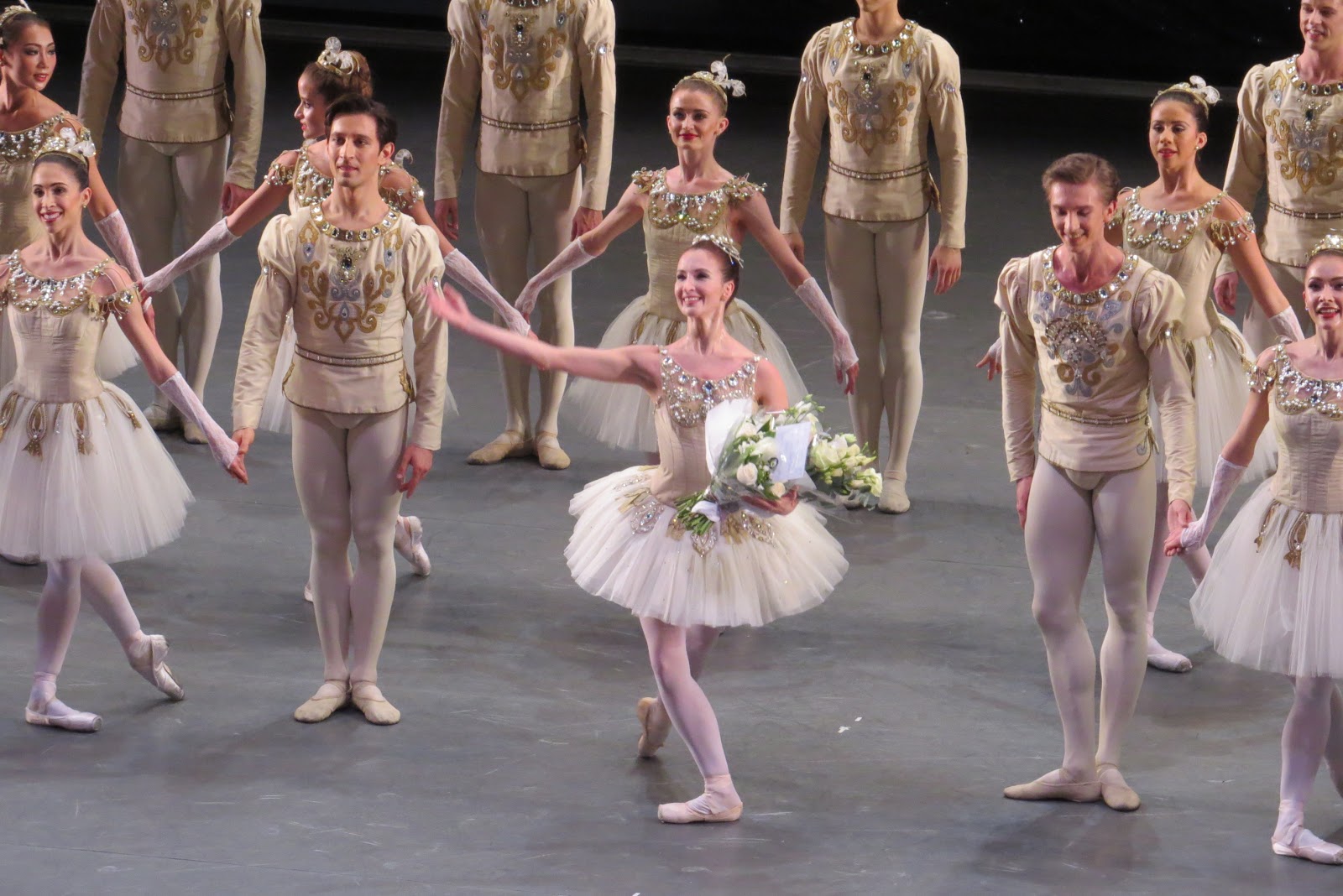
Diamonds on this occasion was my favourite piece it was just stunning. I was mesmerised by it. Lauren Cuthbertson and Vadim Muntagirov danced the lead couple and their grand PDD was just fabulous. The brush of hands, very light touches and regal elegance of their dance was just gorgeous to watch. Vadim has really matured since I last saw him in a major performance and his command of the stage has grown. He did some amazing tours en l'air in a large circle and landed so softly from all his jumps. His partnering of Lauren was always very considerate - a real "danseur noble" as they say! It was such a refreshing change for me to see these 2 dance Diamonds as previously I always seem to have seen Marianela Nunez and Thiago Soares who are good, but I needed a change and yesterday I got it in spades. The corps de ballet were great in Diamonds and the choreography was so wonderful to watch with its complex patterns - all best seen from above as per my seat. It is a credit to all the dancers and repetiteurs that the patterns worked so well - squares, lines, crisscrossing over, circles you name it it is in there - what a genius Mr B was! Then the finale with the crescendo of music was just spine tingling and really left me wanting more. 

For some reason, there was no "red run" at the end of any piece which was a pity, but the applause was enthusiastic for all three pieces. I shall be going to the cinema relay next week to see the main cast, but I would really love to see this cast again, I was so impressed. If you can get a ticket I would highly recommend seeing this run of Jewels as The Royal Ballet seem to be on really good form with lots of the younger dancers coming up and doing really well. The future looks very bright at ROH at the moment!

Friday, 18 November 2016

McGregor Triple Bill

Wayne McGegor
Author Deborah Hustic
Source Wikipedia/Random Dance Company
Creative Commons Licence


Royal Ballet Chroma, Multiverse and Carbon Life Royal Opera House 17 Nov 2016. 19:30


To celebrate the 10th anniversary of his appointment as resident choreographer at Covent Garden, the Royal Ballet has staged a short season of Wayne McGegor's works. These include two of his most popular creations, Chroma and Carbon Life, and a new work, Multiverse, which was performed for the first time just over a week ago. McGregor is remarkable for the volume of work that he has created, for the awards and distinctions that he has achieved for such work and for being the first contemporary choreographer to become a resident choreographer at Covent Garden.

Chroma is a work that I already know quite well having seen it several times, most recently by the Dutch National Ballet as part of their Cool Britannia programme (see Going Dutch 29 June 2015). The Dutch National Ballet is not the only company to perform that work. According to McGregor's website it has been danced by many other leading companies including the Australian Ballet, the San Francisco Ballet and the Bolshoi. One company that dances it particularly well is Alvin Ailey's American Dance Theatre as can be seen from the YouTube video below.

Standard YouTube Licence

No doubt that was why Luca Acri, Federico Bonelli, Lauren Cuthbertson, Sarah Lamb and Calvin Richardson of the Royal Ballet were joined on stage by Jeroboam BozemanJacqueline GreenYannick LebrunRachael McLaren and Jamar Roberts of Alvin Ailey. The latter company has just completed a tour of the UK visiting the Bradford Alhambra and the Lowry where I caught them (see Alvin Ailey in Bradford  29 Sept 2016 and Alvin Ailey in Salford 8 Oct 2016).  It was good to see them again, particularly Roberts who earned an especially loud applause at the end. He is tall, strong and commands the stage in the way few other dancers can.

In all three works that we saw last night, McGregor offered not just choreography (thrilling though it was) but total theatre particularly in the set designs and lighting. In Chroma, for instance, John Pawson's simple geometric shapes were bathed in subtly changing lights beautifully engineered by Lucy Carter. The importance of lighting - another principal in the show - is obvious from the title. The programme notes began with the dictionary definition:
  1. "The purity of a colour or its freedom from white or grey
  2. Intensity of distinctive hue, saturation of a colour"
When combined with Moritz Junge's costumes and Joby Talbot and Jack White III's score, this work excites all the senses. Clearly, that explains why the work is loved so much by audiences as well as admired.

Multiverse was more challenging, at least for me, even though similar techniques were used and Junge and Carter contributed the costume designs and lighting. The performance began quite unexpectedly with the curtain rising on a set with two figures against a plain geometric set of two high walls while the house lights were still on. The hubbub from the audience continued for a few seconds after the curtain rose until the realization that the show had started sank in. The house lights dimmed gradually and the words of a street preacher in San Francisco from over 50 years ago began to fill the auditorium:
"After a while - it's gonna rain after a while! For forty days and for forty nights! And the people didn't believe him. And they began to laugh at him! And they began to mock him! And the began to say 'It aint gonna rain.'"
In his famous work from 1965, It's Gonna Rain, which was written at the height of the cold war when the risk of thermonuclear war threatened to wipe out life on earth in the way that environmental catastrophe had threatened the world at the time of Noah, Steve Reich chops up that recording until it becomes percussive and repetitive. Not easy listening as anyone who plays the YouTube Steve Reich - It's gonna rain  will probably agree. But although the movements against the stark towering walls seem angular in the beginning the piece begins to soften. The walls break down into slabs of colour like the sides of a Rubik cube and eventually elements of a painting. It's Gonna Rain ends and the more soothing Runner takes its place. Reich is said to be America's greatest living composer. I have not heard enough of his work to judge but I have heard his Drumming several times which was used by Arthur Pita in Ballet Black's Cristaux (see Ballet Black in Doncaster 3 Nov 2016) and that work has definitely grown on me.

My favourite work of the evening was Carbon Life which began almost magically with the artists behind a gauze screen lit only by what appeared to be fairy lights. Music was provided by a live band on stage including a rapper called Dave who earned an enormous titter from the audience with his dig at President-elect Trump. Each scene presented something exciting and something new. The dancing was vigorous and exuberant. Carter provided the lighting once again and Gareth Pugh's costumes bordered on the fantastic. I particularly liked the colour combination such as the green stripes against the black.  Sadly, it came to an end all too soon. I felt compelled to rise to my feet as first the dancers and then the musicians appeared on stage to take their bow. Standing ovations do not happen every day at Covent Garden but these folks deserved it and I am glad to say one or two people in the stalls and more in the slips and circles seemed to follow my example.

I floated out of the Opera House on a cloud which carried me off to Holborn tube, followed me down the escalator onto the Piccadilly line and even on to the 23:30 train back to Doncaster.  Not even the exorbitant £20.90 parking charge (£5 more than my train fare from London) which the Frenchgate Centre extracted because all the spaces in the section reserved for rail passengers had bee full spoilt my evening. On the train back I read in the programme that McGregor came from Stockport which is just across the Mersey from Didsbury where I was born. Yet another reason to like him, I'd say.

Friday, 5 August 2016

Jean-Christophe Maillot

Probably completely illogically I felt a surge of regional pride when Jean-Christophe Maillot strode on stage to acknowledge the applause of a London audience for the British premiere of his version of The Taming of the Shrew (see Bolshoi's Triumph - The Taming of the Shrew 4 Aug 2016). Maillot is not of course a Northerner. He is not even English. But he has created what in my very humble, provincial and totally untutored opinion is the best existing work in the 2016 and 2017 season for Northern Ballet. When he came on stage I recognized him from his photo on his web page on the Northern Ballet website.

But even though Maillot is not English he will know all about regions because France has the same cultural, economic, political and social divide between capital and country as we do and he like me is definitely from the country. I suspect a little bit of metropolitan snootiness in some of the comments on his The Taming of the Shrew that were less than ecstatic. Maillot trained in Tours not Paris and he made his name in Hamburg in a country whose capital for many years was Bonn (a city with a population that is not much larger than that of Barnsley). The company of which he is artistic director is in Monte Carlo which is a stiff 9 hour drive from Paris.

Those who want to learn more about Maillot the man can glean some useful info from the Northern Ballet web page that I mentioned above, his web page on Les Ballets de Monte Carlo website and in articles by Judith Mackrell (The Monte-Carlo method: a ballet company's fairytale story 7 April 2014 The Guardian) and Mark Monahan (Jean-Christophe Maillot: 'What about people who don't know about dance?' 19 Apr 2015 Daily Telegraph). There is also the above YouTube interview that I have dug up for those who can still remember their GCSE (or in my case O Level) French.

Those of my readers who missed the Bolshoi's performances or the cinema transmission of The Taming of the Shrew earlier this year (see Competition for Cranko: The Bolshoi's Taming of the Shrew streamed from Moscow 25 Jan 2016) missed a treat. You'll have to fly to Moscow if you want to see it and I am not sure when it will next be performed there. However, you can see his Romeo and Juliet in Canterbury, Woking or Belfast as well as Sheffield and Bradford this autumn (see Northern Ballet's website). And it is worth seeing.  Here's what I wrote about it in Northern Ballet's Romeo and Juliet - different but in a good way 8 March 2015 and Leebolt's Juliet 13 March 2015.

Finally, in case you hadn't guessed, Maillot's Shrew  is currently leading the field by a length in my ballet of the year stakes despite strong entries from Ted Brandsen, David Dawson and Cathy Marston this year.

Sunday, 31 July 2016

Grigorovich's Swan Lake in Covent Garden

Swan Lake, Bolshoi Ballet 2016 by Victor Hochauser, Standard YouTube Licence

Bolshoi Ballet, Swan Lake, Royal Opera House, 30 July 2016, 14:00

After seeing the live streaming of the Bolshoi's Swan Lake in January 2015 I wrote the following in Grigorovich's Swan Lake in Bradford 26 Jan 2016:
"Grigorovich's version of Swan Lake is different. As I have noted von Rothbart becomes "the evil genius". The show is compressed into two acts instead of three or four. There is no prologue explaining how Odette became a swan, no gift of a bow, no trip by the lads to the lake to try it out, the lovely divertissements in the royal palace in what is normally Act III are turned into a pitch by the various princesses and the whole episode takes place in Siegfried's imagination so that nobody has to jump into the lake in the last scene. Looking on the positive side there are expanded roles for the jester (danced by Igor Tsvirko) and also for von Rothbart danced by Belyakov.
Now I was brought on Ashton's version for the Royal Ballet which has been lovingly preserved by English National Ballet (see What Manchester does today 10 Oct 2014) and I have to say that I do prefer that version. I don't take kindly to change for change's sake when it comes to my favourite ballets such as The Nutcracker and Swan Lake but that's not to say that I am against innovation. Grigorovich's versions of Swan Lake and The Nutcracker do work though not perhaps as fairy tales as much of the magic of those stories is removed from them.
Overall I enjoyed the performance very much indeed. Tchaikovsky's magnificent score remains which was conducted well by Pavel Sorokin. Above all there was some glorious dancing. Particularly the pas de deux in the seduction scene in the palace. Rodkin and Zakharova are fine artists. His jumps and her fouettés were thrilling. They were both supported well by Tvirko and Belyakov and a splendid corps. Simon Virsaladze's designs did not show up well in the cinema but they may well have been more impressive on the Bolshoi's historic stage."
Yesterday I saw that production live on stage in Covent Garden. It was perhaps not quite the same as seeing it in the company's home in Moscow where I believe the stage is enormous but it was certainly the next best thing. My first impressions which I jotted down in BalletcoForum as soon as I returned from London were, however, very similar:
"I enjoyed it very much with two tiny reservations. I wasn't entirely happy with Grigorovich's libretto and I found the sets and costumes a little dowdy. However the important things were the choreography and dancing and I couldn't fault them at all. I was very impressed with all the cast - Nikulina and Skvortsov, of course, but also Georgy Gusev who danced the jester. His energy and virtuosity reminded me of Wayne Sleep in the 1970s."
The cast that I saw yesterday was different from the one I saw in the live streaming.  Anna Nikulina danced Odette-Odile, Ruslan Skvortsov Siegfried, Mikhail Kryuchkov the "evil genius" (or von Rothbart as I still prefer to think of him) and Georgy Gusev the fool (in the sense of court jester). Each and every member of the cast danced well.  I should say a special word about Gusev who impressed me particularly. with his energy and virtuosity. He reminded me of Wayne Sleep when I first took an interest in ballet in the early 1970s.

There was one anxious millisecond when Nikulina appeared to lose her footing that caused the person next to me to draw in breath sharply but it was barely perceptible from where I was sitting and she recovered immediately.

Notwithstanding the same niggles about the synopsis and the sets which I had mentioned in 2015, I enjoyed the show very much and I congratulate and thank everybody involved for a very good performance. It was well worth the 500 mile (800 km) trek to and from London.

I have to say that I found the audience a little grudging. The Bolshoi seem to come to London every three years or so (see the Bolshoi's Tours page on the company's website) and perhaps the Southerners are used to them but the applause was pretty sparing. At one point I think I was the only one clapping while the house lights were still dimmed and the spotlight was on the break in the curtains for the first curtain call by the principals. When Kryuchkov appeared at half time there was actually a bit of booing not because he wasn't good (he was fine) but because he was dancing the villain. I don't think they have many pantos in Russia so the poor bloke must have wondered what on earth he had done wrong. Nothing at all, mate! You were great. Finally, only Nikulina got flowers even though several other women artists deserved them too and even her bouquet looked like it had come from Tesco even though she had done her company and audience proud. Relations between our governments are a bit strained at the moment with lurid reports in The Times about propaganda units in Edinburgh, but that's no excuse for lukewarm treatment of the dancers. These fine artists are guests in our country and I for one am very glad that they are here.

The Bolshoi have brought a varied and interesting programme to London (see Bolshoi Ballet on the Royal Opera House's website). I have a ticket for The Taming of The Shrew which I liked a lot when I saw the live streaming (see Competition for Cranko: The Bolshoi's Taming of the Shrew streamed from Moscow 25 Jan 2016) and if it wasn't for the small matter of having to advise clients and prepare cases for court I would have seen The Flames of Paris and Le Corsaire too. 

Finally a word on the programmes. They cost a whopping £12. "You can see a whole ballet for that where I come from" I protested to the usher together with a whole lot of other North Country expletives. She replied with a sweet smile: "Well, ours cost £7 and the Bolshoi's covers the whole season so it's not bad value really." Put like that, perhaps she's right.

Friday, 10 June 2016

Dance in the Gulf


Along with lots of interesting news of its participation in the Patron's Lunch, a parade of its dancers and teachers in London, a pop up event in Birmingham and other activities in Leeds and Ormskirk to celebrate the Queen's 90th birthday, the latest email newsletter from the Royal Academy of Dance links to an article in the Kuwait Times about Teni Matian, an RAD teacher who "helps girls in Kuwait learn to soar".

The reason I take an interest in the region is that I also blog about intellectual property and other legal issues in the Gulf. I am on the lookout for news about dance in the region because dance notations, musical scores, stage backdrops and even some props and costumes can be copyright works and dancers and musicians have the right in countries that are party to the Rome Convention for the Protection of Performers, Producers of Phonograms and Broadcasting Organisations to object to the filming, taping or broadcasting of their performances.

A lot of money is going into the arts as states in the Gulf seek to diversify their economies and that has resulted in the construction of new auditoriums for the performing arts. One of the most impressive is the Royal Opera House in Muscat where the English National Ballet performed Le Corsaire between 10 and 12 March 2016. Other companies that are scheduled to visit that venue include the Eifman Ballet and American Ballet Theatre. The Eifman Ballet will dance Anna Karenina (which Mel saw in Budapest last Monday) between 15 and 17 Dec 2016 while ABT will dance Giselle on 6 and 7 April 2017.

While there is a very well established national ballet in Egypt at the splendid Cairo Opera House where I once saw a performance of Act I of The Nutcracker I have not been able to find any professional ballet companies in the Gulf itself. I believe there was once a very good Iranian ballet but that has been forced underground and overseas (see Wikipedia Iranian National Ballet Company). I have not been able to discern a consensus among my Muslim friends as to whether ballet is compatible with Islam (any more than I have been able to detect a similar consensus among my Quaker friends whether it is compatible even with that faith), but ballet certainly seems to be taught to children in many Islamic countries and not just wealthy ones like Kuwait (see Gaza Ballet School 3 Jan 2016). It would be nice to think of some of Teni Martian's pupils making a career in dance.

Friday, 3 June 2016

Richmond

The Thames at Richmond
Author Diliff 
Source Wikipedia
Creative Commons Licence


I arrived home in the early hours of this morning after a diversion via Leeds because I missed my connection from Wakefield owing to a late departure from London. Leeds has much to commend it not least its adoption of Northern Ballet but its attractions are far from obvious at 23:15 in the evening.

My visit to London had not been entirely a pleasure trip.  I had to give a course on Intellectual Property Law and Fashion in the City between 09:30 and 17:00 yesterday which was followed immediately afterwards by a VoIP con with lawyers in London and the United States.  I shuffled into King's Cross trundling heavy equipment and papers as well as a lady's typical accoutrements for a night at the theatre and a day's business with minutes to spare before the advertised departure only to find that my service was not even in the station.

Nevertheless I had a great time in the Smoke and that was largely thanks to the performance of Cathy Marston's Jane Eyre which, as you will note from my review, was the best new work I had seen from Northern Ballet for yonks. The fact that it was so good should surprise no-one  for Marston is an important choreographer. She was Associate Artist at the Royal Opera House between 2002 and 2006 Artistic Director of the Berne Ballet between 2007 and 2013 and the footage on her YouTube channel is amazing. The only surprise to me is that Jane Eyre, which ought to be a flagship work as it towers over 1984 and just about everything else that the company has done since the days of Christopher Gable, was launched in Donny and is being traipsed round Richmond (which is at the end of the tube and awkward to reach from most parts of London) and places like Leicester and Stoke on Trent. A work like Jane Eyre could easily have filled The Grand (if not the Wells) not to mention The Palace in Manchester, the Festival in Edinburgh and The Mayflower in Southampton.

Doubtless there is an explanation and I am not complaining as I know Richmond very well having grown up in Molesey and attended school in West Kensington. My school was just across the Talgarth Road from the Royal Ballet School and one of its students used to catch our train to Barons Court. I can't remember her name and have often wondered what became of her. It was good to return to the theatre on the Green where I have seen many pantomimes.

I didn't buy a programme on Wednesday as I found it was exactly the same as the one I had bought last March for the Simon and Anthony show. I have since had a chance to read the interview with Marston, which confirmed my surmise that the "D-Men" were demons. It also has a lovely photo Gavin McCaig and Abigail Prudames with Marston in rehearsal.

After the show I reflected on its success with a bife de lomo and a glass of Malbec at the Buenos Aires restaurant in The Square. I also found Barreworks not far away and took a peak at one of the classes upstairs. The studio where the class took place was spacious, light and well equipped studio and the students seemed to be having fun but I did not stay long as there was nobody on reception and I did not want to distract the instructor. However, I would love to sample one of the classes on another visit and I shall try out its on-line workouts in the meantime.

The only shadow over my visit to Richmond was that a child or young woman in the seat next but one to me was taken ill during the curtain call. She grasped the lady next to me shouting "Mum", "Mum", "Mum". Her companion asked  for an ambulance and I passed that request onto an usher who acted with commendable alacrity and efficiency. The patient left her foot behind in her haste and I handed that to the usher after the reverence. I feel so sad for the patient and her party. They had just seen something splendid and this attack must have marred their evening. I wish them all the very best.

Monday, 30 May 2016

Should we stay or should we go?

European Union
Source Wikipedia


A very interesting debate has taken place on BalletcoForum on "how is leaving or staying with the EU going to affect the arts?" The thread has now been locked by one of the moderators but before the discussion was closed down one of the subscribers referred to an article by the arts writer Jessica Duchen entitled I'm IN, and here's why you should be too 25 March 2016 Jessica Duchen's Classical Music Blog.

Duchen gave a number of compelling reasons for remaining in the EU:
  • British musicians will lose their treaty right to perform in other parts of the EU and EU musicians will lose their right to perform here with the result that "quality levels will most likely drop and career prospects for UK musicians will be unnecessarily hobbled";
  • If British artists had to obtain work permits or visas to perform in the Schengen area logistics will be more complicated and costs will rise;
  • many of our employment rights derive from EU legislation:  "Take those away and the pro-Brexiters left in charge will get rid of your rights faster than you can say Emmeline Pankhurst";
  • British students will lose their right to study in countries like Germany where there are no tuition fees; and
  • it will be harder and more expensive to travel to concerts and other performances in the EU if sterling falls and the advantages that have been achieved by the Commission's intervention such as cheap fares cease to be available to us.
And the advantages of leaving? 

"In the interests of 'balance'," writes Duchen "I've been trying to think of one advantage for the music industry of leaving.
"I've come up with....
um...??
Nothing. Null. Nix. Nada. Nul points. (Oh, right - perhaps if we exit Europe we would have to leave the Eurovision Song Contest. That would be an advantage because the British entries are usually so embarrassing.)"
Duchen's views are shared by 96% of the members of the Creative Industries Federation including Deborah Bull and Andrea Stark, chief executive of High House Production Park in Thurrock where the Royal Opera House's Bob and Tamar Manoukian Production Workshop is located (see David Cameron Meets the Fed as Members Vote Remain May 2016). Andrea Stark writes:
“Our new costume centre would not have been possible without support from the European Regional Development Fund - crucially it unlocked the other funds necessary to make this development happen. The Bob and Tamar Manoukian Costume Centre will house costumes for Royal Opera House productions, and a new BA (Hons.) degree course in costume construction will be delivered from the centre’s bespoke workrooms.”
Duchen mentioned a letter to The Guardian signed by 300 historians (see Lessons from history for the Brexiters 24 May 2016) although I have to say that I am more impressed by the views of 600 British economists:
"Poll shows 88% of 600 experts fear long-term fall in GDP if UK leaves single market, and 82% are alarmed over impact on household income" (see Economists overwhelmingly reject Brexit in boost for Cameron 28 May 2016).
Or, indeed, the view of The Economist itself (see The Brexit Delusion 27 Feb 2016).

There is a contrary argument (other than xenophobia) based on the contention that the EU is too inward looking, too bureaucratic and decreasingly important in a world in which trade will gravitate increasingly towards East Asia and that we can run our economy better and secure better access to the markets of China, India and other countries outside Europe through our own efforts than in concert with our continental neighbours.  I see some force in that argument but at the end of the day it is a matter of judgment and on the balance of probabilities I think it is wrong. Though I have formed my view independently, I draw comfort from the fact that it coincides with that of the Prime Minister, the Leader of the Opposition, the Chancellor of the Exchequer, the Governor of the Bank of England, the Managing Director of the World Bank, the President of the United States and all the other luminaries from around the world who have weighed into the referendum debate on the side of Remain.

Nevertheless, I would vote Remain even if the economic arguments were stacked the other way. I have been inspired by the European ideal ever since I was a child. One of the sources of that inspiration is a common European culture. That culture is expressed through literature, music, painting and, of course, the performing arts. In particular the art of Terpsichore, which evolved in the courts of renaissance Italy, was codified in 17th century France, refined in Paris, Copenhagen and St Petersburg, conveyed to England by the Ballets Russes and now flourishes in theatres, opera houses, studios and even draughty gyms and church halls the length and breadth of the United Kingdom.