Showing posts with label Vienna State Ballet. Show all posts

Sunday, 31 July 2022

The van Manen Festival, Programme IV

Standard YouTube Licence

Dutch National Ballet and Guests Hans van Manen Festival IV National Opera and Ballet auditorium 29 June 2022 20:15

I would argue that Hans van Manen is the greatest living choreographer and one of the greatest of all time.  I have been a fan ever since I first saw his work some 50 years or so ago.   In that time he has made over 150 ballets and I have seen a fair number of them.  His works are performed regularly by the world's leading ballet companies including those of the United Kingdom.

Earlier this month van Manen celebrated his 90th birthday.   To mark the occasion, the Dutch National Ballet ended its 2021-2022 season with a special Hans van Manen Festival.  Between 8 and 29 June 2022, the Dutch National Ballet and companies from Austria and Germany performed 19 of van Manen's works arranged in four separate programmes.  

I attended the fourth of those programmes on 29 June 2022 which consisted of Four Schumann Pieces, In the Future, Variations for Two Couples, Solo and Concertante.  I chose that programme for three reasons.  It was an opportunity to see the latest recruits to the Junior Company which I had followed closely since 2013.  They were to perform In the Future which I had previously seen at their 5th-anniversary celebration at the  Stadsschouwburg on 15 April 2018, the 2018 gala and in London on 5 July 2019.  Secondly, one of the works was to be performed by the Vienna State Ballet and another by the Stuttgart Ballet which had been Cranko's company.  These are companies that rarely visit this country and it was a chance to see them. Finally, the fourth programme included Concertante which is the work by van Manen that I know best.

Van Manen had created Four Schumann Pieces for the Royal Ballet.  It was first performed at Covent Garden on 31 Jan 1975 with Sir Anthony Dowell in the leading role.  The music is Robert Schumann's String quartet in A opus 41 no. 3.   The ballet revolves around the leading male and there is some YouTube footage of Dowell in that role.  It was part of a mixed bill which I attended.  I can't remember much about it but it would have been one of the reasons why I began to admire van Manen.   According to the programme notes, the male lead was later performed by Rudolf Nureyev, Hans Ebelaar, Wayne Eagling and Matthew Golding each of whom interpreted it in a different way.  The company that performed the piece on 29 June was the Vienna State Ballet.   Davide Dato was the lead male  He was supported by Hyo-Jung Kang and Arne VanderveldeLiudmila Konovalova and  Francesco CostaElena Bottaro and Igor MilosSonia Dvořák and  Géraud Wielick and Aleksandra Liashenko and Andrey Teterin.  The company danced Four Schumann Pieces for the first time in the Vienna Volksoper on 4 June 2022. For them, it was a brand new piece which they danced with appealing energy and freshness.

In the Future was created for the Scarpino Ballet Rotterdam in 1986,  a company that is even older than the Dutch National Ballet.  The piece was inspired by music that the Scottish composer David Byrne had written as a soundtrack for Fritz Lang's film Metropolis the previous year.  As striking as the music are the set, costume and lighting designs of Keso Dekker  Each dancer wears a garment that is green at the front and red at the back. The dancers pulsate to the music as if they were beams of light.  It is a perfect piece for the Junior Company which is now a completely different cohort from the one I saw in Amsterdam in 2018 and London in 2019.  The members who danced on 29 June were Luca Abdel-NourKoko Bamford, Lily CarboneMila Caviglia, Sven de Wilde, Lauren Hunter, Nicola Jones, Gabriel Rajah, Guillermo Torrijos, Louisella Vogt and Koyo Yamamoto.  They were as impressive as their predecessors and I look forward to watching them develop as a troupe and blossom as artists of the Dutch National Ballet and other leading companies.

Variations for Two Couples is one of van Manen's latest works.  It was created for Anna Tsygankova,  Matthew Golding, Igone de Jongh and Jozef Varga and first performed on 15 Feb 2012.  It is a very short piece that packs in music by Benjamin Britten, Einojuhani Rautavaara, Stefan Kovács Tickmayer and Astor Piazzolla.   The programme states that for van Manen it was all about the personalities of the dancers that he wished to draw out.  Varga danced the role that van Manen had created for him on 29 June. but instead of Tsygankova, Golding and de Jongh he was joined by Riho Sakamoto, Young Gyu Choi and Jessica Xuan.   Van Manen intended this to be a very understated ballet.   He said, "everything is 'low down' – even the dancers’ lifts."  That is echoed by Dekker's costumes and backdrop.  The result is a work of refinement and elegance.

There was an interval after Variations for Two Couples.   On returning to my seat I noticed that van Manen was sitting in my row.  Several of his fans were talking to him and one gave him a hug.   He stood up to allow me to pass and for a moment I felt impelled to introduce myself and shake his hand.  However, the curtain was about to rise and I let the moment slip.  The very next day my friend Gita Mistry button-holed him in the lobby of the National Opera and Ballet auditorium as we gathered for the Gala.  She introduced me to him and  I had the opportunity to tell him how much I had enjoyed his work over the last 50 years.  However, Gita went one better and actually took a selfie of herself with the great man. In her interview with Judith Mackrell, Laura Esquivel compared the art of the chef with that of the choreographer (see Like Water for Chocolate  23 July 2022). Gita offered to cook for van  Manen and as she is an artist in spice he would enjoy one of the best meals of his life were he ever to take her up on the offer.

Solo danced by Henrik Erikson, Alessandro Giaquinto and Matteo Miccini of the Stuttgart Ballet won the loudest and most sustained applause of the evening.  It is a very short piece set to Bach's Violin Partita. Keeping up with the music requires great virtuosity and equal stamina.  It was danced with energy, flair and fluidity. - an altogether brilliant display.

The first time I saw Concertante it was performed by Northern Ballet.   I wrote in Terpsichore:
"What can one say about a masterpiece? Especially when there is a YouTube video of the great man himself discussing his ballet. According to the clip van Manen staged the work for the Nederlands Dans Theater junior company (Dans Theater 2). He spoke very highly of the Leeds dancers (Bateman, Batley, Leebolt, Contadini, Lori Gilchrist, Nicola Gervasi, Prudames and Isaac Lee-Baker) as well he might for they were good."

The video to which I referred was an interview with van Manen in Leeds on 6 June 2013.   I have seen performances of the work by other companies since then and it never ceases to impress me. Floor Eimers said that Concedrtante brings out the best in her and that seems also to be the case with other dancers.  There is something compelling in Frank Martin's music, Kekko's designs and of course the choreography,   This was the last work of the van Manen season and it was danced with verve by Nina Tonoli, Timothy van Poucke, Jingjing Mao, Martin ten Kortenaar, Lore Zonderman, Jan Spunda, Khayla Fitzpatrick and Conor Walmsley.

The evening had begun under the baton of Matthew Rowe, a compatriot and (I believe) an old boy of St Paul's School.  It ended under that baton of Northern Ballet's Director of Music, Jonathan Lo.  As he was led onto the stage the applause was deafening.   I felt very proud of him as well as Matthew Rowe.   But the loudest cheers and most vigorous clapping were reserved for van Manen himself.  They were in appreciation of the works that we had seen that night but also for his lifetime's achievement.

Monday, 4 July 2016

A Room for Dancing


I was not the only blogger in the Silvio Pellico Theatre at Trecate last week. Monica Bragagnoli who describes herself as "a simple but passionate ballet viewer" has a splendid blog called A Room for Dancing. Her latest article features the Gala for Alessia and contains some lovely pictures of the performance (see Gala per Alessia - Cristiano Principati e Giovanni Danzatori - Teatro Silvio Pellico Trecate 28 June 2016).

Other recent posts include the end of year show of La Scala's ballet and music students (see Accademia del Teatro alla Scala - Scuola de Ballo e Orchestra - Milano 13 June 2016), David Dawson's Swan Lake for Scottish Ballet in Inverness 6 May 2016 and the Vienna State Ballet in Vicenza 10 April 2016.

Monica started the review of Gala Les Etoiles which included the Royal Ballet's Thiago Soares and
Marianela Nuñez on 10 Jan 2010. She is an excellent photographer and her photos are exquisite. I have included the publication in my blog roll.

Sunday, 26 June 2016

Reacting to Brexit


Like a lot of my compatriots I am very disappointed by last Thursday's vote. The referendum was quite unnecessary. It was a Machiavellian tactic on the part of the Prime Minister that went disastrously wrong. A lot of people have already been hurt by Brexit and a very great many more will suffer in future including some of those who voted "Leave". It is a massive self-inflicted wound which will take years if not decades to heal.

But we are where we are. Our fellow citizens have voted to leave the EU and we have to live with that vote. Some have already said that they regret it. Very many more may do so very soon.  The petition for another referendum stands at over 3 million and the number of signatories is increasing like the meter of a taxicab. Nevertheless, even though the referendum may not be binding in law any attempt by Parliament to ignore or reverse the result in the short term may make a very bad situation even worse.

However, that does not mean that we have to take the defeat lying down. Nothing is irreversible in politics and I think a new European consensus can be built up in time.  It may take many years - possibly decades - but I am confident that we will rejoin the European project one day and when we do we shall be far more committed to it than ever we were between 1973 and the present.

Until that happens we do not have to abandon our internationalist or European ideals. Thursday's vote did not alter geography, repeal the laws of economics, blot out our history, change our language or rewrite our literature. We are and have been since the days of Julius Caesar if not earlier part of a common European culture. We may live on a small island but England is as much part of Europe as any of our continental neighbours.

Even though political and economic links may loosen for a season there is no reason why our cultural and personal links with our fellow European should weaken too. On the contrary we should strengthen them. Tomorrow I fly to Italy to watch some of the most talented young dancers from the Dutch National Ballet, La Scala Ballet, Vienna State Ballet and JAS Arts Ballet perform works by Marius Petipa, Ted Brandsen, Ernst Meisner and the talented young Italian dancer and choreographer Cristiano Principato.  I am  already a Friend of the Dutch National Ballet and an occasional visitor to Amsterdam. I shall be a frequent visitor to that city and also to the other cities in the remaining EU member where I have made friends and connections such as Budapest which I visited two months ago.

This is a very bad time but it is not the end of the world. We must stop moaning about it and start rebuilding now.

Thursday, 28 April 2016

Update on the Trecate Gala


Earlier this month I wrote about a gala that Cristiano Primcipato is organizing in Trecate near Novara at 9 pm on 28 June 2016 to raise funds for Casa Alessia to carry out relief work in Burundi (see Principato's Project 7 April 2016).

I have now spotted this splendid poster for the Gala for Alessia which states that Cristiano will be the Artistic Director and that his dancers come not only from the Dutch National Ballet but also La Scala Theatre of Milan, the Jas Art Ballet and the Vienna State Ballet.

I would very much like to see the show and I had sent several emails to the box office to try to get a ticket but I have not yet received an answer.  Now I know why.  Admission is free (Ingresso libero) but you have to call the number at the base of the poster before 24 June to let them know you are coming.  As the object f the exercise is to raise funds for the relief work I am sure that someone will be passing a hat round.

The address of the theatre appears to be 24 Piazza Riccardo Cattaneo which is not far from the railway station. Milan seems to be the nearest airport but it does not seem to be easy to get a train to Trecate.  If I can get some folks from England to join me we could hire a car.

Saturday, 2 January 2016

Prosit Neues Jahr

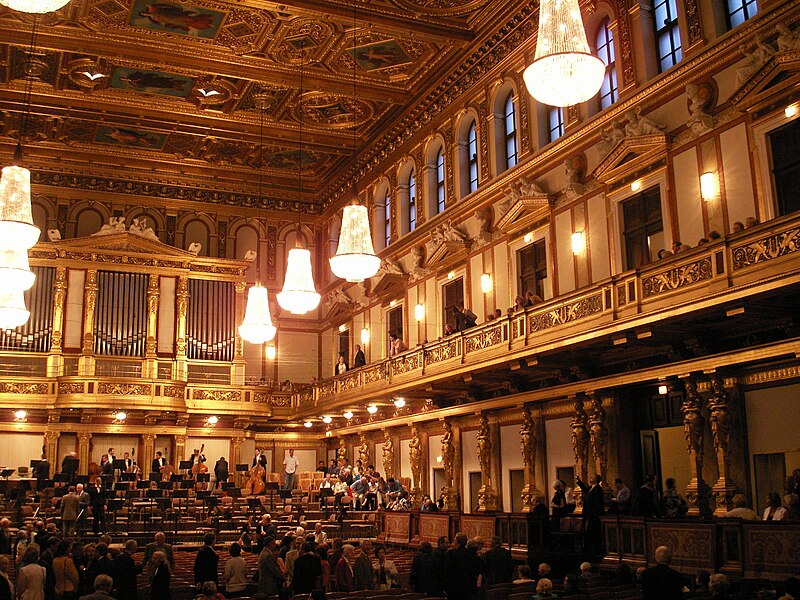
Musikverein Vienna, Golden Hall
Source Wikipedia


Television over the New Year used to be decked out with tartan, accordions, Scottish country dancing and Glaswegian comics. That tradition seems to have waned even in Scotland with a new emphasis on fireworks and fun fairs. Probably a good thing as Hogmanay was often accompanied by excessive drinking which must have placed an enormous strain on traffic patrols and the National Health Service. Nowadays the world wakes up for the annual New Year's Day concert from Vienna.

Not everyone enjoys that concert. Writing in The Spectator Norman Lebrecht described the concert as "an annual jellybox of waltzes, polkas, galops, marches and any old tritsch-trash" in "The Nazi origins of the Vienna Phil’s New Year’s Day concert". He described the music as "strictly bar-room, written by members of the Strauss family as social foreplay for the soldiery and serving classes in low taverns."

I am afraid that I do not agree with him.

Great orchestras are allowed to let their hair down once in a while. On Thursday I attended The Hallé's Abba concert where the orchestra including the conductor appeared in big hair wigs and 1970s costumes to act as a backing group for largely inaudible singers attempting to belt out Dancing Queen and Fernando to an audience of swaying sexuagenarians. If I were unkind I could have described the experience as akin to listening to a tribute band in a retirement home, but I won't because it was still good fun and everyone including yours truly had a great time.  The Strauss family are at least the artistic equals to Abba and for my part I greatly prefer them.

Mr Labrecht's main concern lies in the origins of the concert:
"The tradition, however, is decidedly pernicious. This concert came into being as a gift to Nazi criminals, a cover for genocide. The Vienna Philharmonic was quick to sack Jewish and leftist musicians when Hitler came to town. More than a dozen were sent to concentration camps; seven of them perished. The orchestra unanimously endorsed the Anschluss with Germany, exhorted by the conductor Karl Böhm to declare ‘a 100 per cent “yes”’, and proved a willing executioner of cultural cleansing, removing Mahler and other giants from its walls and histories."
He complains of the exclusion and under representation of women and non-white musicians in the orchestra:
"The orchestra has, until recently, excluded women. One of the perverse pleasures of watching the New Year’s Day broadcast is to count how few females are permitted to take part. The orchestra has just seven women members out of a roll call of 130, the lowest in any 21st-century symphony orchestra."
True but that was also a criticism that could be levelled at many British institutions including a well known watering hole in Fleet Street frequented by journalists and out of work barristers for many years. He concludes:
"So long as appearance defeats substance — so long as the world oohs and ahhs at the musical sweetmeats and ignores the dirt in the kitchen, New Year’s Day from Vienna will remain a family favourite, a testament to our human ability to look the other way."
With all respect to Mr Lebrecht, I rather hope it does.

Anschluss was reversed over 70 years ago. There was pretty thorough de-Nazification by the allies who partitioned Austria for a while immediately after the end of the war. Very few if any of the players could have been born during the second world war. Modern Austria is our democratic partner in major international and European institutions including the United Nations which was celebrated by Robert Stolz's UNO March, the first piece in yesterday's programme.

The Vienna Philharmonic is raising money for asylum seekers. Next year's concert is to be conducted by Gustavo Dudamel of the Simon Bolivar Orchestra. Sorry but I want to hear that concert. Indeed, if I could spare the time and money I would rather like to be in Vienna this time next year.

Before reading Mr Lebrecht's article I had intended to write about the ballet sequences which were performed by dancers of the Vienna State Ballet (Wiener Staatsballett). There were only two of them this year - one danced at the Prater race track and the other at the Schönbrunn Palace. Not surprisingly, these are the bits of the TV transmission that I like most. I enjoyed both pieces very much and I wish I could find out the names of the dancers and choreographer in order to congratulate them. I can, however, report that the company is directed by Manuel Legris who was one of the stars of the Paris Opera Ballet, that the company is dancing Ashton's La Fille mal gardée until 20 Jan 2016 and that it has some lovely works in its current repertoire and that some of those performances are streamed live over the internet.

Vienna's connection with the ballet is often overlooked but it was the birthplace of Ludwig Minkus who gave us La Bayadère and Don Quixote (see More Thoughts on Don Quixote 20 Oct 2013). It is also the setting for Lichine's charming Graduation Ball which I really wish someone would revive.