Showing posts with label trade marks. Show all posts

Tuesday, 26 April 2016

Happy World Intellectual Property Day


Today is World Intellectual Property Day and I wish everybody in the dance world a happy World Intellectual Property Day, "Thank you very much" I hear you say "but what's that got to do with me or dance?"

Well everything actually. If you are a dancer you are a performer and performers have the exclusive right to object to the filming, taping or broadcasting of their performances. That's why someone tells the audience to switch off their mobiles and that filming and recording is not allowed just before the curtain rises.

The same goes for the orchestra in the pit or the maestro with his baton.

If you are a choreographer your work is protected against unlicensed performance or copying for the rest of your life plus 70 years. The same for your libretto if you are the dramaturge, your score if you are the composer, your backdrop if you are the artist who painted it and so on.

The sets and costumes may be protected from unlicensed reproduction by unregistered design right or even unregistered Community design.

If you are the Artistic Director or in charge of the company's business you should think about registering the company's name and logo as trade marks if you want to sell branded goods like T-shrts and ballet bags. You make a lot of money from doing that sort of thing.

I've written a lot of stuff about IP and ballet over the years.  Here are some of them:

Saturday, 16 May 2015

The Sleeping Beauty

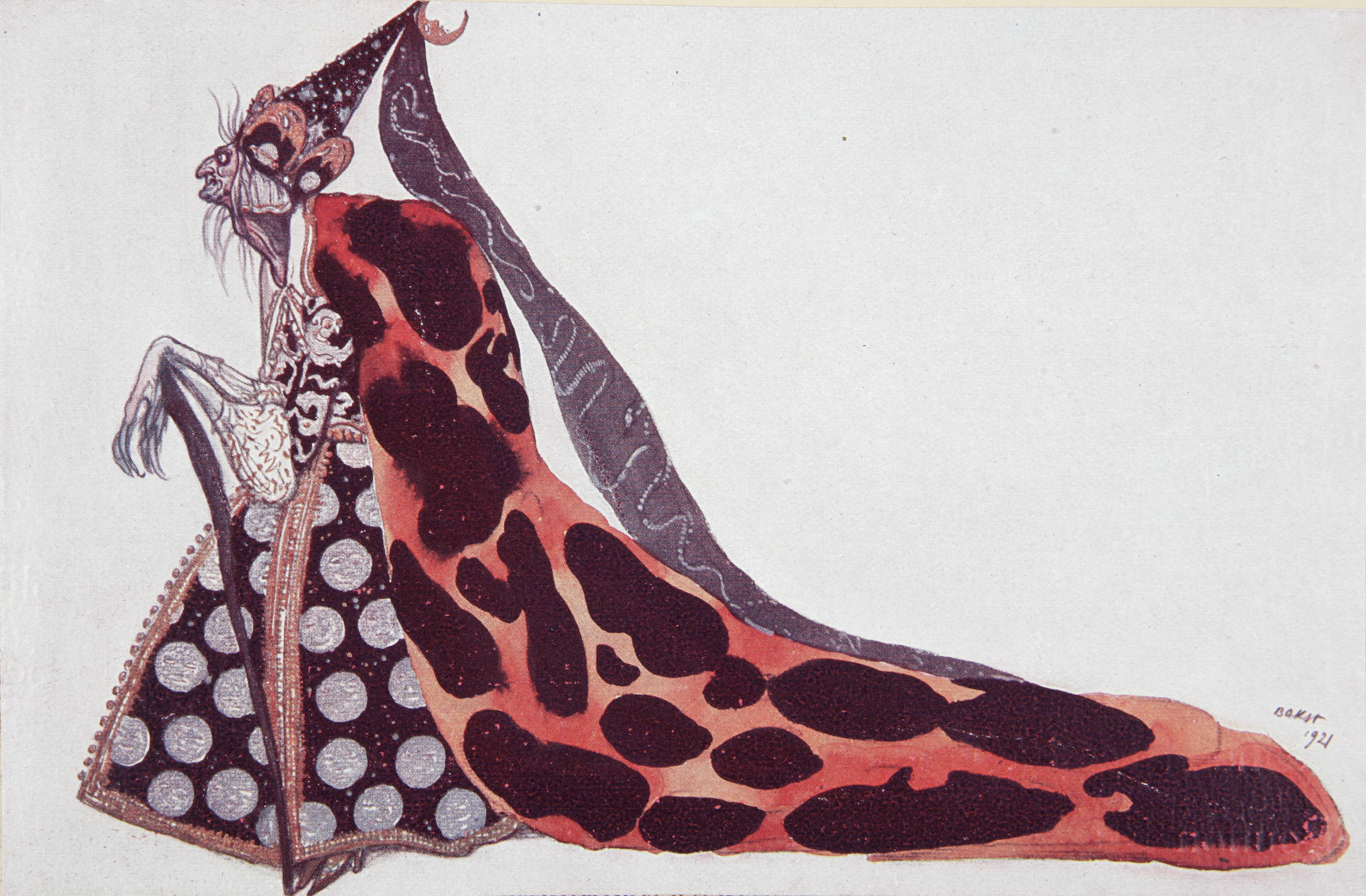
Leon Bakst's costume design for  Carabossse
Source Wikipedia


In my review of Birmingham Royal Ballet's performance of The Sleeping Beauty in The Lowry on 27 Sept 2013 I wrote:
"Even though The Sleeping Beauty was premièred at St. Petersburg, its score was composed by Tchaikovsky and it was choreographed was by Petipa to Perrault's story, it is also a very English ballet. It was the work that reopened the Royal Opera House on the 20 Feb 1946 after the House had been used as a dance hall and furniture store (see "The History of the Royal Opera House" on the Royal Opera House website).
To understand the importance of The Sleeping Beauty in our social as well as our cultural history you have to know that it entered the repertoire of the Vic-Wells Ballet just before the Second World War. By all accounts the 1946 revival was a glittering occasion. It must have been one of the rare great nights of ballet to which I referred "In Leeds of all Places - Pavlova, Ashton and Magic" 18 Sept 2013. It was produced by Ninette de Valois, designed by Oliver Messel, Princess Aurora was danced by Margot Fonteyn and Petipa's choreography was supplemented by Frederick Ashton. There must have been a whiff of mothballs in the theatre as the audience had dusted off their pre-war dinner jackets, retrieved their best frocks and put on their jewellery for the first time after the Second World War. The analogy of that evening after years of war and rationing with Aurora's wedding after a century of hibernation must have been obvious and compelling."
It is a very special ballet which is why I am delighted to report that the Chelmsford Ballet Company (of which I am a proud non-dancing associate) will perform it at the Chelmsford Civic Theatre between 16 to 19 March 2016.

Although this company is made up largely of dancers who do not make their living from dance there is nothing amateurish about its performances (see The Nutcracker as it really should be danced - No Gimmicks but with Love and Joy 20 March 2014 and A Delight Indeed 22 March 2015). They have a resourceful and imaginative artistic director in Annette Potter, talented dancers several of whom are at first rate ballet schools, accomplished costume and set designers and makers, able technicians and an inspiring Chair in Marion Pettet who showed her flair as a character dancer in Pineapple Poll and Carnival of The Animals. Small wonder that their patrons are Christopher Marney, my favourite living British choreographer, and the great ballerina Doreen Wells.

I don't yet have any details of the performance. In particular, I don't know whether they have begun casting but I know who could dance the lilac role very well indeed. In my review of Matthew Bourne's Sleeping Beauty in Bradford on 28 March 2013 I wrote:
"No Lilac Fairy though there was a Count Lilac powerfully danced by Christopher Marney"
Marney's dancing in that show was spectacular. I also seem to remember that Cara O'Shea, one of Northern Ballet Academy's most adored teachers (see Northern Ballet Open Day 18 Feb 2014 and A Treat For Us Old Ladies 27 Feb 2014), once danced Princess Aurora for the company. When I do get some information about Chelmsford's show I shall pass it in to you.

There's just one other thing about The Sleeping Beauty and that is the following passage from Wikipedia:
"Trademark controversy
The Walt Disney Company has registered a trademark with the US Patent and Trademark Office, filed March 13, 2007, for the name "Princess Aurora" that covers production and distribution of motion picture films; production of television programs; production of sound and video recordings. Some suggest that this may limit the ability to perform this ballet, from which Disney acquired some of the music for its animated 1959 film Sleeping Beauty."
At first I thought it was a joke but I followed the link and found that the words PRINCESS AURORA have indeed been registered by Disney Enterprises Inc. with the US Patent and Trade Mark Office as a service mark for
"Production and distribution of motion picture films; production of television programs; production of sound and video recordings"
in class 41 on 17 Jan 2012 under registration number 4,088,154.

The scare seems to have originated in an article by Nikki Finke in Deadline Hollywood dayed 1 May 2009 entitled An Attempt To Stop The Disney Machine which began with the alarming words:
"I’m told that the Walt Disney Co is currently attempting to trademark the character name “Princess Aurora” for all media: stage, sound, film, TV, video, Internet, photographs, news. In short, everything except literature."
The article continued:
"The problem is that, if the Disney Company is successful, it will effectively control the legal right to all future performances of the ballet. The move also could sink any movie about the ballet or that uses a scene of the ballet in another movie."
There is, incidentally, a parallel registration for the words PRINCESS AURORA in relation to a wide range of goods and services here.

Disney's trade mark cannot be infringed by performing Petipa's ballet The Sleeping Ballet for all sorts of reasons. The intellectual assets that the Disney Corporation seeks to wish to protect is a range of goods and services about a number of princesses one of whom is called Aurora.  She seems to be a spin-off from the studio's well known 1959 animation. The other princesses, incidentally, include Cinderella, Pocahontas and Rapunzel. A ballet that is based exclusively on any of those characters might perhaps infringe some of Disney's IP rights (though not necessarily the trade mark) but that would be an altogether different matter.

If anybody is, however, troubled by the intellectual property issues relating to The Sleeping Beauty, do give me a shout. I will advise and represent you and keep you on the straight and narrow for free. I know of at least one patent and trade mark agent as well as a specialist solicitor who love ballet as much as I do who would probably do the same.

Post Script

I do have some more information about Chelmsford Ballet's production. The following notice appeared on its Facebook page:
The Company will present
  "The Sleeping Beauty "
March 2016

Do you or someone you know want to dance in this enchanting tale?

Company Auditions 
21st June 2015
Only auditioned dancing members can dance in our annual productions.
Company auditions for new members and for upgrades for existing members are scheduled for Sunday 21st
 June.  Male applicants are especially welcome. Application forms are available to download from the website, or you can contact the membership secretary directly for more information. cbcenquiries@hotmail.com 
The closing date for applications to audition is the 7th June.

(Auditions for The Sleeping Beauty, open only to members, will take place in October 2015)

Sunday, 13 July 2014

Branding and Ballet - Ten Top Tips

Whenever possible I try to get the company's T-shirt when I watch them performing in a ballet. So far I have T-shirts from
  • Ballet Black
  • Ballet Cymru
  • Rambert
  • The Dutch National Ballet
  • The Royal Ballet, and
  • The Stuttgart Ballet.
I also have a ballet bag from the Bristol Russian Ballet School and I'be bought English National Ballet's My First Coppelia t-shirts for Vlad the Lad and my Huddersfield ballet teacher's younger daughter. It is a way of supporting those companies and one that I much prefer to the doling out of public money by the Arts Council of England

The reason I feel uncomfortable about it is that I can't really think of an answer to my fellow citizens who see opera and ballet as all right for those who like that sort of thing but it shouldn't be their brass that pays for it. Now don't get me wrong. I love opera, ballet and all the other performing arts. I am delighted that my beloved Northern Ballet was favoured in the Arts Council's latest round of investment in opera and ballet. But I am not sure that Arts Council funding is particularly fair to those who prefer their money to be spent in other ways and when I look across the Atlantic where just about every town of any size has its own company that is supported strongly by its local community (some of which such as the Sarasota Ballet seem to be rather good) I have to ask whether this form of subsidy is even good for the performing arts. The Arts Council was promoted by one of its first chairmen Lord Keynes (see "John Maynard Keynes and English Ballet" 3 March 2013). Like a lot of Lord Keynes's ideas that wilted under the scrutiny of Thatcherism in the 1980s direct funding for the performing arts may have to be reconsidered.

Even if the Arts Council can be justified the funds available to it for investment are unlikely to grow by much and there is also a limit to the amount of money that the hard pressed public can afford to pay for tickets or donations.  As I said in "Ballet as a Brand? How to bring More Money into Dance for Companies and Dancers" 13 March 2014 companies, theatres, dancers (at least principals) and possibly even schools and dancers will have to exploit their goodwill a little more in the way that sports stars and artists in the other performing arts have done. To that end I wrote three further articles to show how that could be done:
This is a summary of the advice that I gave in those articles. It applies to everyone in dance - individual artists and teachers as well as institutions.
  1. Register your business name and any logo as trade marks: You can do it yourself on-line for the UK from as little as £170 though I would advise you to last out a few hundred pounds more and get a trade mark or patent agent to do it for you. He or she will make a search to make sure there are no conflicting registrations, prepare a specification that covers all your needs, file it and correspond with the Intellectual Property Office or other registry until you have your grant. There are two advantages of registration, First it is easier to protect and license branded merchandise. Secondly, it trumps anything a cyber-squatter can say in a domain name dispute. If you do it yourself make sure you cover all the countries in which you want to perform or sell your merchandise and that your registration covers clothing, printed matter and anything else you can see yourself selling in the next five years.
  2. Subscribe to a good watch service. A watch service scours the IPO and other patent office websites for applications that could conflict with your registrations and reports back to you if it finds any.  Most patent and trade mark agents can set up such a subscription for you though they tend to be on the pricey side. Leeds Business and IP Centre runs a good service. Call Ged or Stef on 0113 247 8266 for more info.
  3. Keep an audit trail of all your artistic, choreographic, literary and musical works. As I said in "Branding and Ballet - Copyright and Rights in Performances" copyright and rights in performances are not registered rights. They come to being when a qualified person creates an original artistic, dramatic, literary or musical work or, in the case of dancers and musicians, takes part in live performances.  The best way of proving your title is by means of contemporaneous notes and logs with references back to the stave on which the choreology or music is recorded.
  4. Review and keep under review all your licences and other agreements. This applies both to people who serve you such as your choreographers, dancers and musicians and also to those who want to take licences from you. Make sure these are drawn up professionally and that you enforce them.
  5. Take out adequate insurance to cover claims by you and against you.   IP litigation is expensive and is usually excluded from most legal risk indemnity programs. There are some specialist companies that provide such a service and it is worth looking out for them (see my article "IP Insurance Five Years on" 23 Oct 2010 Inventors Club blog).
  6. Be sure to talk to a lawyer first if you think someone has infringed your IPR. That is because some statutes such as the Copyright, Designs and Patents Act 1988 and the Trade Marks Act 1994 provide a cause of action against those who threaten litigation without justification (see "If you think someone has infringed your patent talk to a lawyer first" 11 July 2014 Inventors Club biog).
  7. Carry out periodic IP audits. You are creating new works all the time and also licensing in and out other peoples' work. Make sure that everything is covered.
  8. If someone infringes your rights don't ignore it. There's an expression in the law that delay defeats equity. At the very least delay in enforcing your rights could prevent your getting an interim injunction. At the worst it could be seen as acquiescence.
  9. Make others aware of your IP rights.  Use the copyright symbol (c) and the registered trade mark symbol to make the public aware of your rights. That way they can't use the defence of ignorance.
  10. Get your audiences on your side. Folk who have paid a lot of money for their tickets are understandably annoyed when the first thing they hear is an order not to use cameras or mobile phones. But if you explain why they will co-operate with you even to the point of stopping their neighbours from surreptitiously photographing or taping your show.
This is the last of my articles on ballet and branding. It is my gift back to the artists and impresarios who have given me so much pleasure over the years. I hope that at least some of you will find my tips useful.

Monday, 31 March 2014

Protecting the Brand

The United Kingdom Intellectual Property Office


In "Ballet as a Brand? How to bring More Money into Dance for Companies and Dancers" 13 March 2014 I argued that if dancers are adequately to be paid and companies and theatres properly to be funded they should learn from sport and indeed the other performing arts and tap the potentially enormous sums that could be released from harnessing their goodwill. In order to do that they need to protect that goodwill. The best way of doing that is by registering the names, logos and other signs under which they are recognized by their audiences as trade marks. As I said in my previous article I made a search of the UK Intellectual Property Office trade mark database and was surprised to find how few dancers or even ballet companies and theatres had taken that step.

What is a Trade Mark?
The UK Intellectual Property Office defines a trade mark as
"a sign which can distinguish your goods and services from those of your competitors ........... It can be for example words, logos or a combination of both."
It can be an actual name like "W H Smith", an invented name like "Microsoft" or indeed a logo such as the three red arrows against a black background in the shape of a triangle of the National Westminster Bank.  It can be just about anything that can be the recorded on paper or other medium. In ballet English National Ballet's white stripe against a red background and the words ENGLISH NATIONAL BALLET are good examples.

Protection of a Mark without Registration
You can have a trade mark whether you register it or not and there is a limited degree of legal protection for trade marks in the UK and many other countries under a doctrine that we call "passing off" and other countries "unfair competition" ("concurrence déloyale"). In England and Wales (and similarly in Scotland, Northern Ireland and most other English speaking countries) this doctrine has been developed by the judges in a series of decisions over many years. Essentially, it means that you cannot offer your goods or services under a name, logo or other sign that is the same as or similar to that of another trader. If you do, even inadvertently, that trader can sue you for an injunction (order by a judge to do or refrain from doing something upon threat of punishment if you disobey), damages (compensation) and other remedies. To win such an action the complainant must show that he or she is recognized in the market by his name or other sign, that you have misled his or her customers or potential customers by using a similar sign and that he or she has suffered as a result.

Trade Mark Registration
The trouble with passing off is that it takes a lot of time and costs a lot of money to prove those three things. Moreover the doctrine will not help a new or very small business that has not yet established itself in the market. To avoid those difficulties the UK and most other countries provide a service by which businesses can register their names, logos or other signs and the goods or services for which they use or intend to use those signs with a national or supra-national registry. The registry for the United Kingdom is part of the Intellectual Property Office in Newport (also the home town of Ballet Cymru) but businesses can if they so wish register their mark for the whole of the European Union at the Office for Harmonization in the Internal Market ("OHIM") in Spain. By registering a mark the registered you can prevent anyone else from using the same mark in relation to the same goods or services, the same or similar mark in relation to the same or similar goods or services where by reason of the similarity there is a likelihood of confusion including association with yourself. Registration avoids the need to prove reputation, misrepresentation and damage as is required for an action for passing off.

Why bother to register?
If you have a trade mark you have something to license. A registered trade mark is much more manageable, tangible and substantial than a right merely to sue for passing off. Registration makes it much easier to negotiate deals with major clothing, stationery, toys and games, food and drink and other manufacturers and distributors of those products and thus gain royalties on sales of branded products as a result of such deals. Registration also makes it easier to control the quality of such products because you can insert conditions on materials and workmanship into the contract. A trade mark registration will make it easier to prevent cyber-squatters from registering domain names that incorporate your mark under the Uniform Domain Name Dispute Resolution Policy or Nominet Dispute Resolution Service. If you do have to go to court to prevent others from supplying goods or services that incorporates your mark it is considerably easier and cheaper to do that if you have registered your mark.

What Sort of Sign can I register?
The first thing you need is a trade mark that is capable of registration. S.1 (1) of the Trade Marks Act 1994 defines a "trade mark" as
"any sign capable of being represented graphically which is capable of distinguishing goods or services of one undertaking from those of other undertakings."
Although this is a British statute it implements an EU directive which has to comply with a number of international agreements so there are broadly similar requirements at OHIM and in most other countries. The sign has to be capable of distinguishing your goods or services from those of others. Clearly you can't register "ballet" or "dance" simpliciter because those are activities that everyone in the dance world perform but you can usually register the name of a nation, town or other region for a ballet company associated with that town. Similarly there are some national emblems that you need permission to use. Her Majesty allows the Royal Ballet and Birmingham Royal Ballet to use the royal coat of arms but nobody else has that right.

Secondly, you can't register a trade mark that someone else already uses or is about to use for the same or similar goods or services. As there are many registered marks some of which you are unlikely to have heard of it is always a good idea to carry out a search of prior registrations and applications. You can do some of that work yourself but it is always better to commission a search by a specialist librarian or other professional.

As unregistered marks do not show up on a search it is also sensible to scour the internet and specialist magazines and publications to see whether anyone else is using the same or similar sign as an unregistered mark.

How to register your Mark
As there is a lot of help on the "Applying for a trade mark page" on the Intellectual Property Office website I won't go into too much detail here. You will find all the information you need on the articles linked to that page. There are a few extra points that I would stress. The first is that although there is nothing to prevent you from applying for a mark yourself and plenty of people do it is probably more cost effective and certainly safer to instruct a trade mark agent (also known as "trade mark attorneys"). They will carry out the necessary searches, draft the application in the correct way, deal with queries from the examiners and generally shepherd your application through to grant. They will charge only a few hundred pound extra for their services. Trade Mark agents (like patent agents) and regulated by the Intellectual Property Regulation Board ("IPReg") so if you have a problem with your agent IPReg will investigate it and if necessary correct it. If you do not know any agents you can find one through IPReg's "Find an attorney" page. Secondly, you must be sure that you will use the mark in respect of the goods or services for which you register it within 5 years or you could lose it. Thirdly, there are a lot of sharks who prey on unrepresented applicants demanding money for listing and other services that you don't need and often never get. Be on your guard. The Intellectual Property Office gives loads of warnings about those practices but it is amazing how many businesses fall for this trick.

How much does it cost?
It depends on how many goods or service you want to register, whether you use an agent, what extras you need and whether your application is opposed. Goods and services are grouped in classes and you can register your mark in any number of them. The basic cost for a UK mark is £170 which includes one class and £50 for each additional class. Agents usually charge a few hundred pounds for preparing and filing the application.  They would probably advise you to commission a search which will be another £100. If your application is opposed you will have to spend a lot of money on legal representation if you want to fight though you may get some of that back. Once you get your mark I would recommend your subscribing to a watch service which looks our for applications that are similar to your registration so you can challenge it in good time. Unless you have plenty of money I would also advise you to take out IP litigation insurance so that you can afford to take an infringer to court.

Further Information
I am making this information available to the ballet world pro bono as a thank you for all the pleasure dancers, companies, theatres and schools have given me throughout my life. I have offered to give a free half day seminar on IP relating to dance to Middlesex University which has a very successful dance programme in its performing arts department. I have already lectured on IP in the law school and I hold an IP clinic there once a month. If my offer is accepted I will ask for the University to admit dancers, administrators and others to the seminar free of charge. In the meantime I will answer any questions that anyone has by phone or email. My number is 020 7404 5252 and you can contact me through my contact form, twitter, Linkedin, G+. Facebook or Xing.

Thursday, 13 March 2014

Ballet as a Brand? How to bring More Money into Dance for Companies and Dancers

Degas, Class                                                           Source Wikipedia


On 20 Nov 2013 The New York Times published an article by Michael Cooper and Roslyn Sulcas entitled "Ballet Dancers as Brands". The opening sentence was as follows
"A wave of international ballet stars are increasingly leaping from company to company, creating their own brands and becoming more like world-traveling conductors and opera stars."
Alina Cojocaru was quoted as saying:
"Ballet careers are relatively short and require years of training that pose the risk of injury, yet the world’s top dancers earn far less money than their counterparts elsewhere in show business."
Less money? Well according to Cooper and Sulcas only three dancers at American Ballet Theatre earned more than US$190,000 and  the étoiles at the Paris Opera earn on average, around US$125,000 a year. Now bearing in mind how long it takes to become a principal and how few dancers actually reach the top that is not a lot of money. It may allow a reasonably comfortable standard of living for a few years while the dancer is at the peak of his or her career but it does not allow him or her to plan, save and invest for a comfortable retirement or other priorities like private education for his or her children.

What to do about it? Well I don't think dancers can expect very much more from  their companies. The arts in the United Kingdom at any rate rely on grants, ticket receipts and corporate and individual sponsorship for their income. Can that be increased? A bit perhaps but not by much.  There is a limit to what the public will pay whether as taxpayer or theatre goer. Especially in hard times.

So is there anything else that can be done? Well perhaps. As the Bailey's Nutcracker commercial showed last Christmas ballet can sell. Maybe advertising, merchandising and endorsement. A few companies are already making a little extra money from advertising. The Royal Opera House shop offers a wide range of merchandise bearing the Royal Ballet name and crest such as books, calendars, greeting cards, t-shirts and videos. Other companies sell t-shirts. A website called Balletgifts, which appears to be based in New Cross. markets various items of clothing and other merchandise for the Birmingham Royal Ballet, the Bolshoi and the Mariinsky. Many companies hire out rooms in their studios or their orchestras. Most also have schemes by which businesses and individuals can become friends or patrons of a company or sponsor individual productions or dancers.

What about individual dancers? A few superstars like Carlos Acosta and Darcey Bussell have websites through which they market branded merchandise. Acosta offers clothing and posters and advertises his book with links to Amazon and Waterstones. Bussell markets a range of children's dancewear, books and games and DVDs from her site. But not every principal of the Royal Ballet does that and a few do not even have websites or social media accounts. I think more could be done in that regard by other dancers because many ballet goers are loyal almost to the point of obsession referring to artists whom they hardly know and in most cases have never met or are ever likely to meet by their first names. Ballet tickets are not cheap yet some fans see the same work albeit with different casts in the same season. Moreover the audience for ballet and thus the fan base will expand massively with HDTV broadcasts to cinemas around the world.

If companies or dancers want to exploit such goodwill they have to protect and manage it in the way that sports stars and indeed other entertainers do. Company names and indeed the names of individual dancers are valuable assets and should be protected by trade mark registration. Last night I made a number of searches on the Intellectual Property Office databases and was surprised to find that not every major company in the United Kingdom let alone every dancer had registered their names and logos as trade marks. They really do need good advice on IP and licensing strategy and no doubt tax planning and pension advice as well.  If there is sufficient interest from dancers and their companies to discuss these issues I would be very happy to organize one and speak for free as my gift to those who have given me so much pleasure in the past.