Showing posts with label copyright. Show all posts

Monday, 15 May 2017

Music Copyright

By User:Milantex (File:DVD-4.5-scan.png) 
[Public domain], via Wikimedia Commons


Yesterday someone asked a very interesting question about music copyright on BalletcoForum. I shall not address the specific question but I shall say a few words about music copyright generally.

What is Copyright?
In the United Kingdom, copyright is defined by s.1 (1) of the Copyright, Designs and Patents Act 1988 as
"a property right which subsists in accordance with this Part in the following descriptions of work--

(a) original literary, dramatic, musical or artistic works,

(b) sound recordings, films or broadcasts, and

(c) the typographical arrangement of published editions."
Although this Act applies only to the United Kingdom, the definition will be very similar in most other countries as most of the world has agreed to bring their copyright laws into line with certain international agreements.

What is a Copyright Work?
The above definition says that copyright can subsist in musical works and sound recordings.  A musical work is essentially a score.  A sound recording is a recording of a performance of a score. Thus there at least two separate copyrights in every DVD or other sound recording.  One copyright will subsist in the work of the composer who wrote out the notes. The other will lie in the work of the recording studio which captured the playing of the work and reproduced it on DVDs or other media. If the music is a song then a separate literary copyright will subsist in the words of the song.  If there is more than one tune on the DVD there will be a separate copyright for each tune. On a typical DVD, there will be lots of different types of copyright works.

What does Copyrught do?
Copyright confers on the copyright owner the exclusive right to do various acts in respect of a copyright work.  These include copying the work and performing and playing the work in public. Unless you are the copyright owner (which is usually the person who created the work or his or her employer) you need the copyright owner's permission to do any of those things. If for instance, you want to play a DVD in public, you will need permission from the owner of the copyright in the score - that is to say the composer or music publisher - and the owner of the copyright in the sound recording.

Where do you get Permission?
Most copyright owners belong to collecting societies which grant permission to play, perform or make available copyright music on behalf of their members and members of collecting societies overseas in return for a fee. For instance, The Performing Rights Society represents songwriters, composers and music publishers and has formed an alliance with the Mechanical Copyright Protection Society.  You can find out whether you need a licence and, if so,  how much you will have to pay, from the Music Users section of the PRS website.

What if you don't get Permission?
Unless you fall within one of a number of exceptions you will infringe the copyright in the work which will entitle the collecting society to sue you for an injunction (an order by a judge to do or not to do a specified act), damages (compensation for your wrongdoing) or an account and surrender of the profits you made from your wrongdoing and an order that you contribute to the other side's legal fees and other expenses in bringing you to court.  Some copyright infringements are also offences which are punishable by long terms of imprisonment and unlimited fines.

Are there any Exceptions?
There is actually one for dance schools and a more limited one for teachers outside dance schools who provide teaching for recognized exams.

Further Advice
Copyright law is complex and if you are in any doubt you should seek specialist professional advice.

Saturday, 6 May 2017

Jack White


The brilliant young composer, Jack White, who wrote the score for Ballet Cymru's Cinderella which was our ballet of the year for 2015 against some incredibly strong competition (see Highlights of 2015 29 Dec 2015) and Stuck in the Mud for the same company (see An Explosion of Joy 21 Sept 2014) has just published his soundtrack for Cinderella on his website (see Cinderella soundtrack now available 2 May 2017).

Very fairly, Jack has invited his licensees to name their price for permission to download and replay his music. But please remember that "name your price" does not mean "pay nowt" even if you come from Yorkshire like these monkeys.

Hear nowt, see nowt, say nowt
Eat owt, drink owt and pay nowt
And if thou ever does owt for nowt
do it for th''sen
Author Tumi
Unrestricted Licence

Copyright subsists in Jack's work and will continue to subsist in it at least in Wales and England for the rest of Jack's life plus 70 years and in some places even longer.  So as he has played fair with you, you play fair with him.

Jack tells me that he has recently been commissioned to write a score for the National Dance Company of Wales which will be premiered later in the year.

He likes writing for ballet and contemporary dance companies. I invite every artistic director and choreographer from Alaska to Australia to give Jack's music a listen.

Tuesday, 26 April 2016

Happy World Intellectual Property Day


Today is World Intellectual Property Day and I wish everybody in the dance world a happy World Intellectual Property Day, "Thank you very much" I hear you say "but what's that got to do with me or dance?"

Well everything actually. If you are a dancer you are a performer and performers have the exclusive right to object to the filming, taping or broadcasting of their performances. That's why someone tells the audience to switch off their mobiles and that filming and recording is not allowed just before the curtain rises.

The same goes for the orchestra in the pit or the maestro with his baton.

If you are a choreographer your work is protected against unlicensed performance or copying for the rest of your life plus 70 years. The same for your libretto if you are the dramaturge, your score if you are the composer, your backdrop if you are the artist who painted it and so on.

The sets and costumes may be protected from unlicensed reproduction by unregistered design right or even unregistered Community design.

If you are the Artistic Director or in charge of the company's business you should think about registering the company's name and logo as trade marks if you want to sell branded goods like T-shrts and ballet bags. You make a lot of money from doing that sort of thing.

I've written a lot of stuff about IP and ballet over the years.  Here are some of them:

Wednesday, 20 January 2016

Dance Law #1: PRS for Music Charging Policies

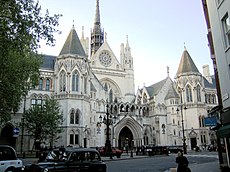
Royal Courts of Justice
Author Anthony M
Creative Commons Licence
Source Wikipedia


Copyright is a property right which subsists in original literary, dramatic, musical or artistic works, sound recordings, films or broadcasts, and typographical arrangement of published editions. It is the exclusive right to do or authorize the following acts in respect of the work:
(a) to copy the work
(b) to issue copies of the work to the public
(ba) to rent or lend the work to the public
(c) to perform, show or play the work in public
(d) to communicate the work to the public
(e) to make an adaptation of the work or do any of the above in relation to an adaptation.
Anyone who does or authorizes any of those acts in the UK without the licence of the owner infringes that right, Such an infringer may be sued in the civil courts or in some circumstances prosecuted in the criminal courts. If found guilty the penalties for copyright infringement are approximately the same as for theft.

As civil litigation can be expensive owners of certain types of copyright works have established organizations known as "collecting societies" to enforce their copyrights. One of those collecting societies is PRS for Music which describes itself as "the home of PRS and MCPS, representing the rights of over 115,000 members in the UK," The PRS and the MCPS are two separate collecting societies representing respectively the rights of the owners of the copyrights in words and music and those of the owners of the copyrights in the sound recordings. PRS for Music offers to license the performance of their  members' works on terms that are regulated by statute. They have reciprocal agreements with collecting societies in other countries to enforce the rights of foreign collecting societies' members' rights here, The foreign collecting societies enforce the rights of British copyright owners elsewhere.

The statute that protects the rights of copyright owners in the United Kingdom is The Copyright, Designs and Patents Act 1988 ("the CDPA"). Section 2 of that Act confers the exclusive tight mentioned above subject to a number of exceptions. One of those exceptions is provided by s,34:
"34 Performing, playing or showing work in course of activities of educational establishment
(1) The performance of a literary, dramatic or musical work before an audience consisting of teachers and pupils at an educational establishment and other persons directly connected with the activities of the establishment--
(a) by a teacher or pupil in the course of the activities of the establishment, or
(b) at the establishment by any person for the purposes of instruction, is not a public performance for the purposes of infringement of copyright. 
(2) The playing or showing of a sound recording, film or broadcast before such an audience at an educational establishment for the purposes of instruction is not a playing or showing of the work in public for the purposes of infringement of copyright.
(3) A person is not for this purpose directly connected with the activities of the educational establishment simply because he is the parent of a pupil at the establishment."
Doubts have arisen over the years as to whether a dance school falls within that exception.  Until the beginning of this year it was the opinion of PRS for Music that it did not. Following representations from the Royal Academy for Dance (see PRS for Music - Educational Exemptions 4 Jan 2016) the collecting society appears to have changed its position. In its PRS for Music Charging Policies the collecting society writes that it has a number of non-charging policies that define circumstances in which it chooses not to make a charge for its licence and one of these is dance schools:
"Section A - Dance Schools that are educational establishments
Where a dance school qualifies as an educational establishment, section 34 of the 1988 Act provides that a public performance licence will not be required from PRS (or any other copyright owner) for performances before an audience of teachers and pupils/students at the school (and other persons directly connected with it) provided that the performance is given
  • by a teacher or pupil in the course of the activities of the dance school; or
  • at the dance school by any person for the purposes of instruction.
Section B - Dance tuition provided by persons other than educational establishments
Where copyright music is used for the purpose of dance tuition, a licence will ordinarily be required by the course provider. However, if the music is performed within the context of and for the purposes of a lesson and/or examination leading to a qualification aligned with Regulated Qualifications Framework (RQF) Level 1 or above, [for the purposes of calculating charges under the dance tuition session of the current DS tariff and proposed new Fitness and Dance Tariff], PRS is willing to treat such performance as if it were given in circumstances to which section 34 of the Copyright, Designs and Patent Act 1988 applies and accordingly will not make any charge respect of that session."
First, it has to be stressed that that is only a position statement from a collecting society - albeit a powerful one - and not a statute, judgment or other authoritative statement of the law. Having said that, I stress that I do not necessarily disagree with it. If anyone wants to challenge that position in respect of charges made in previous years they can still do so though I am not encouraging (or indeed discouraging) them to do so. Secondly, this statement does not bind copyright owners who are not represented directly or indirectly by PRS for Music. Thirdly, this position statement applies only to the United Kingdom and those other territories to which the CDPA applies.

If anyone wants to learn more about copyright in music or relating to dance, exemptions and licences, collecting societies and enforcement he or she should call me on 020 7404 5252 during office hours or use my contact form.

Wednesday, 8 April 2015

Oh dear I am beginning to sound like a lawyer


A week ago I had lunch with a friend who is also into ballet.  We met just before 14:00 but stayed for the whole afternoon. We had a lovely time talking about ballet, ballet, ballet and yet more ballet. We would have stayed longer had a waitress not thrown us out. Although we talked almost exclusively about ballet there were 5 minutes when we discussed law. The reason we talked about law was that my friend had read Branding and Ballet - Copyright and Rights in Performances 3 May 2014, Branding and Ballet - Licensing the Brand 18 April 2014 and Branding and Ballet - Ten Top Tips 13 July 2014 and wanted some clarification on a few points. As other people are likely to have similar questions I thought I would mention them here.

Who owns copyright in a ballet?
A ballet is a composite work consisting of a story, choreography, music, sets, costumes, lighting and much more. Anybody has contributed any of those things is likely to have created a copyright or other intellectual property right. Thus there will be separate copyrights in the story, choreography, score and so on. It is unlikely for the same person to own all of those rights unless it is a very big company that has taken extensive legal advice from specialist lawyers.

As the author of the work that person is likely to be the first owner of the copyright unless he or she has created it in the course of his or her employment in which case the employer will be the first owner. If the author or his or her employer has been commissioned to create the work the contract under which the work was commissioned may state that the commissioner shall own the work. If not, copyright will belong to the author but the commissioner will almost certainly have a licence to perform that work.

How can copyright subsist in choreography?
S.1 (1) (a) of the Copyright, Designs and Patents Act 1988 provides that copyright subsists in original literary, dramatic, musical or artistic works. S.3 (1) includes works of dance and mime within the definition of dramatic work. It is important to have regard to  s.3 (2) which provides:
"Copyright does not subsist in a literary, dramatic or musical work unless and until it is recorded, in writing or otherwise..."
Notation by a Benesh choreologist would meet that requirement but so probably would a video recording of a ballet or enchainement.

How long does copyright subsist in a choreographic work?
In this country and the rest of the EU it is the life of the author plus 70 years. In other countries the term may be longer or shorter.  As Marius Petipa died in 1910 any copyright that may have subsisted in his work has long expired. Ashton, however, died only in 1988 so his works are still in copyright.

Don't forget that some works have been modified extensively by modern choreographers. La fille mal gardée, for instance, was first performed in Bordeaux in 1789 less than a fortnight before the storming of the Bastille but the version that everyone in this country knows and loves is Sir Fred's and as I have said above all his works are in copyright.

So what does copyright restrict?
Most importantly performing the work in public (see s.16 (1) but also copying the work, issuing copies to the public, renting or lending the work to the public, communicating the work to the public or making an adaptation of the work. Don't forget that those restrictions are subject to a large number of exceptions which are set out in Chapter III of Part I of the Act and that many of the things that you may wish to do may be expressly or impliedly licensed. It is important to get specialist advice on all of that.

What about other intellectual property rights?
Dancers and musicians are performers for the purposes of Part II of the Copyright, Designs and Patents Act 1988 and they have the right to object to broadcasting, filming or taping of their performances under s.180 (1) (a). So, too, do broadcasters, film or sound recording companies with the exclusive right to record such performances pursuant to s.180 (1) (b).

Costume designers may have unregistered Community design and unregistered design rights in any costume designs that they may create in addition to any copyrights that may subsist in the fabric designs or indeed the costumes themselves as works of artistic copyright. Similar rights may also subsist in props and three dimensional scenery.

Finally, be careful about titles or names of ballets. Copyright can't subsist in a single word or even a phrase as such but if a ballet (or for that matter film or play) is associated with a particular company, choreographer or performer there may be circumstances in which the company, choreographer or performer could complain that you are representing a connection with his even if you use completely difference choreography or music.

OK. So what do I do if I want to stage a ballet?
Find out who the rights holders are of every work that comprises the ballet and ask for a licence or permission from each of them. It has become considerably easier to obtain such permission since 25 Oct 2014 when an orphan works licensing scheme came into force. I have written quite a lot about this in my IP blog (see Orphan Works Licensing 3 Nov 2014 NIPC Law).  It could be made even easier if Professor Hargreaves's proposal for a copyright clearing house ever sees the light of day (see Digital Copyright Exchange: Hooper's Final Report 31 July 2012 NIPC Law) but that idea seems to have been put on the back burner for the time being.

In the meantime I am thinking of setting up and running a cost-effective web based copyright rights clearance and licensing service and will be glad to talk about it if you want to get in touch.

Further Reading

Irving David and Ben Challis  Dancing a Fine Line - Choreography and Copyright Dance UK News Issue 70 Autumn 2008

Irving David and Ben Challis   Copyright and Copying  Dance UK's website

Sunday, 13 July 2014

Branding and Ballet - Ten Top Tips

Whenever possible I try to get the company's T-shirt when I watch them performing in a ballet. So far I have T-shirts from
  • Ballet Black
  • Ballet Cymru
  • Rambert
  • The Dutch National Ballet
  • The Royal Ballet, and
  • The Stuttgart Ballet.
I also have a ballet bag from the Bristol Russian Ballet School and I'be bought English National Ballet's My First Coppelia t-shirts for Vlad the Lad and my Huddersfield ballet teacher's younger daughter. It is a way of supporting those companies and one that I much prefer to the doling out of public money by the Arts Council of England

The reason I feel uncomfortable about it is that I can't really think of an answer to my fellow citizens who see opera and ballet as all right for those who like that sort of thing but it shouldn't be their brass that pays for it. Now don't get me wrong. I love opera, ballet and all the other performing arts. I am delighted that my beloved Northern Ballet was favoured in the Arts Council's latest round of investment in opera and ballet. But I am not sure that Arts Council funding is particularly fair to those who prefer their money to be spent in other ways and when I look across the Atlantic where just about every town of any size has its own company that is supported strongly by its local community (some of which such as the Sarasota Ballet seem to be rather good) I have to ask whether this form of subsidy is even good for the performing arts. The Arts Council was promoted by one of its first chairmen Lord Keynes (see "John Maynard Keynes and English Ballet" 3 March 2013). Like a lot of Lord Keynes's ideas that wilted under the scrutiny of Thatcherism in the 1980s direct funding for the performing arts may have to be reconsidered.

Even if the Arts Council can be justified the funds available to it for investment are unlikely to grow by much and there is also a limit to the amount of money that the hard pressed public can afford to pay for tickets or donations.  As I said in "Ballet as a Brand? How to bring More Money into Dance for Companies and Dancers" 13 March 2014 companies, theatres, dancers (at least principals) and possibly even schools and dancers will have to exploit their goodwill a little more in the way that sports stars and artists in the other performing arts have done. To that end I wrote three further articles to show how that could be done:
This is a summary of the advice that I gave in those articles. It applies to everyone in dance - individual artists and teachers as well as institutions.
  1. Register your business name and any logo as trade marks: You can do it yourself on-line for the UK from as little as £170 though I would advise you to last out a few hundred pounds more and get a trade mark or patent agent to do it for you. He or she will make a search to make sure there are no conflicting registrations, prepare a specification that covers all your needs, file it and correspond with the Intellectual Property Office or other registry until you have your grant. There are two advantages of registration, First it is easier to protect and license branded merchandise. Secondly, it trumps anything a cyber-squatter can say in a domain name dispute. If you do it yourself make sure you cover all the countries in which you want to perform or sell your merchandise and that your registration covers clothing, printed matter and anything else you can see yourself selling in the next five years.
  2. Subscribe to a good watch service. A watch service scours the IPO and other patent office websites for applications that could conflict with your registrations and reports back to you if it finds any.  Most patent and trade mark agents can set up such a subscription for you though they tend to be on the pricey side. Leeds Business and IP Centre runs a good service. Call Ged or Stef on 0113 247 8266 for more info.
  3. Keep an audit trail of all your artistic, choreographic, literary and musical works. As I said in "Branding and Ballet - Copyright and Rights in Performances" copyright and rights in performances are not registered rights. They come to being when a qualified person creates an original artistic, dramatic, literary or musical work or, in the case of dancers and musicians, takes part in live performances.  The best way of proving your title is by means of contemporaneous notes and logs with references back to the stave on which the choreology or music is recorded.
  4. Review and keep under review all your licences and other agreements. This applies both to people who serve you such as your choreographers, dancers and musicians and also to those who want to take licences from you. Make sure these are drawn up professionally and that you enforce them.
  5. Take out adequate insurance to cover claims by you and against you.   IP litigation is expensive and is usually excluded from most legal risk indemnity programs. There are some specialist companies that provide such a service and it is worth looking out for them (see my article "IP Insurance Five Years on" 23 Oct 2010 Inventors Club blog).
  6. Be sure to talk to a lawyer first if you think someone has infringed your IPR. That is because some statutes such as the Copyright, Designs and Patents Act 1988 and the Trade Marks Act 1994 provide a cause of action against those who threaten litigation without justification (see "If you think someone has infringed your patent talk to a lawyer first" 11 July 2014 Inventors Club biog).
  7. Carry out periodic IP audits. You are creating new works all the time and also licensing in and out other peoples' work. Make sure that everything is covered.
  8. If someone infringes your rights don't ignore it. There's an expression in the law that delay defeats equity. At the very least delay in enforcing your rights could prevent your getting an interim injunction. At the worst it could be seen as acquiescence.
  9. Make others aware of your IP rights.  Use the copyright symbol (c) and the registered trade mark symbol to make the public aware of your rights. That way they can't use the defence of ignorance.
  10. Get your audiences on your side. Folk who have paid a lot of money for their tickets are understandably annoyed when the first thing they hear is an order not to use cameras or mobile phones. But if you explain why they will co-operate with you even to the point of stopping their neighbours from surreptitiously photographing or taping your show.
This is the last of my articles on ballet and branding. It is my gift back to the artists and impresarios who have given me so much pleasure over the years. I hope that at least some of you will find my tips useful.

Saturday, 3 May 2014

Branding and Ballet - Copyright and Rights in Performances

Theatre Royal Drury Lane 1821                                           Source Wikipedia


This is the fourth in my series of articles on ballet and branding which is my thank you to companies, theatres and dancers for a lifetime of pleasure watching their performances. The others are "Ballet as a Brand? How to bring More Money into Dance for Companies and Dancers" 13 March 2014, "Protecting the Brand" 31 March 2014 and "Branding and Ballet - Licensing the Brand" 18 April 2014. In this article I shall discuss two important intellectual property rights ("IPR") for companies, theatres and dancers: copyrights and rights in performances.

What is IP?
Intellectual property ("IP") is a portmanteau terms for the bundle of laws that protect investment in intellectual assets.  Intellectual assets are creations of the mind that give one business a competitive advantage over all others. Such assets can be a new invention, a blockbuster film or novel, the cachet that is given to luxury product and so on.  

Intellectual assets fall into four categories:
  • Brands
  • Design
  • Technology, and
  • Works of art and literature.
The laws that protect the investment in creating those assets in the UK include the Patents Act 1977, the Copyright, Designs and Patents Act 1988 ("CDPA") and the Trade Marks Act 1994. The rights that those laws confer, such as patents for inventions, copyrights in original works of art and literature and registered trade marks for signs that distinguish one business's goods or services from those of all others are types of IPR (intellectual property rights). 

The exercise of those rights can be very valuable for a business which is why we regard them as property.  As they protect creations of the mind or intellect we call them intellectual property.

Copyrights and Rights in Performances
The intellectual assets that copyrights and rights in performances protect are works of art and literature. 

Copyrights have existed in one form or another since the days of Queen Anne. The first copyright statute for this country is still referred to as The Statute of Anne. Copyrights prevent the unauthorized copyright, distribution, performance and other exploitation of works that are written, drawn or otherwise created in some permanent medium such as film or optical or magnetic memory. 

Rights in performances are much more recent. These protect the performances of actors, musicians, dancers and other performers from unauthorized broadcasting, filming or taping and other exploitation of their performances. The existence of those rights has only been possible since the development of sound and motion picture recording and transmission technologies. 

The CDPA
In the UK copyright and rights in performances are conferred by different parts of the CPDA.  Copyright is conferred by Part I of the Act and rights in performances by Part 2.  The CPDA came into force on the 1 Aug 1989 and has been amended many times since then. The Intellectual Property Office has helpfully compiled an up to date version of Parts 1 and 2 of the Act together with other relevant legislation.

International Agreements
The UK is party to a number of international agreements that require foreign governments to protect the intellectual assets of British businesses and individuals in their territories and the British government to protect the intellectual assets of foreigners here.  The agreement that provides reciprocal protection of works or art and literature is the Berne Convention for the Protection of Literary and Artistic Works ("Berne").  The agreement that provides reciprocal protection for performances is the Rome Convention for the Protection of Performers, Producers of Phonograms and Broadcasting Organizations ("Rome"). Berne and Rome have been supplemented by a number of other international agreements of which the most important are the WIPO Copyright Treaty and the WIPO Performances and Phonograms Treaty. One of the reasons why Parliament enacted and has revised the CPDA was to enable the UK to comply with those conventions and treaties.

Copyright Works
The CDPA protects the following types of work from unauthorized copying, publishing, performance and other distribution in the UK:
  • Original artistic, dramatic, literary and musical works
  • Broadcasts, films and sound recordings, and
  • Typographical arrangements of publications.
That covers such works as the story, score, the choreology, broadcasts and HDTV transmissions and some of the art work such as scenery and fabric designs.  One of the many things that the Court of Appeal decided in Massine v De Basil[1936 - 1945] MCC 233, one of the few copyright cases relating to ballet, was that there is no such thing as copyright in a ballet. There are instead a bundle of copyrights in the works that make up a ballet such as an outline of the plot, the music, notation, artwork for the scenery, costumes and other works. Secondary copyrights are created in any videos that are made during class and rehearsals as well as in any sound recordings that may be made. Yet more copyrights are made in the notes, photos, compilation, editing and typographical arrangement of the programmes. 

Rights in Performances
Performers including dancers and those who have contracted with a dancer or other performer to broadcast, film or tape a performance such as the BBC, a film studio or a record company have the right to object to the broadcasting, filming or taping of a performance regardless of whether the performance takes place in a theatre, TV studio or film set.

Creating a Copyright?
There is no system of copyright registration in the UK though there is in some other countries. Copyrights come into being the moment a work in which copyright can subsist is created by a British citizen or resident or a citizen or resident of any other state that confers confers protection on the works of British citizens and residents within its territories pursuant to the Berne Convention or some other agreement with the UK government. Most countries of the world are party to Berne and the few that are not have entered other multi or bilateral agreements with the UK.

Copyright can subsist in any of the works listed above provided that it is not copied wholly from another work. Essentially copyright rewards the labour, skill and taste that has been expended on a work. Thus, a poet may write a poem which creates a literary copyright; an artist a drawing that creates an artistic copyright; and an editor may choose the poem and the drawing and combine them with other poems and drawings in an anthology which creates yet another literary copyright in the compilation.

Creating a Right in a Performance
Consent is required for broadcasting, filming or taping of a performance from the moment the dancer or other performer walks on stage to the final curtain call so long as the performance takes place in the UK or by a national of a country that is party to the Rome Convention or some agreement with the UK.

Who owns Copyright?
Usually the author (that is to say the person who makes the work) is the first owner of the copyright subsisting in the work but there are a number of exceptions. If the author is employed to create the work under a contract of employment or apprenticeship the author's employer becomes the first owner unless the employer and employee have agreed otherwise. Merely commissioning a work, however, does not usually confer copyright on the commissioner unless the circumstances suggest that that is what the parties had intended as happened in Massine v de Basil.  When commissioning a score, choreography or other work it is important for the parties to think about who is to own the work and what rights (if any) each of the parties has or should have in its exploitation.

Who owns a Right in a Performance?
In the first instance it is up to the dancer or other performer to consent to the broadcasting, filming, taping or other exploitation of his or performance.  In practice the terms upon which such consent is given have been negotiated by Equity on behalf of its members. Such terms are incorporated into individual performers' contracts of employment. Broadcasters, film and recording studios that have negotiated exclusive contracts to record a performance can also object to broadcasting, filming and taping of performances.

How to make Money from Copyrights and Rights in Performances
Copyrights and rights to make, distribute and otherwise exploit copies of recordings may be assigned or licensed for money or moneysworth.   How much will be paid by way of a royalty, licence fee or other payment will depend on supply and demand. The work of a well known artist, choreographer or composer will generally command a greater payment than that of a lesser known one.  Some copyright owners assign their rights to organizations known as "collecting societies" which collect payments on behalf of all their members and distribute them after deducting their expenses as individual dividends. BECS (British Equity Collecting Society) collects royalties for licensing performers' rights on behalf of their members.

Moral Rights
In addition to the rights mentioned above which are generally referred to as "economic rights" performers and some copyright owners have rights to be identified as performer or author and the right to object to derogatory treatment of their works that are known as "moral rights".  These subsist quite independently of the economic rights and cannot be assigned.

Enforcement
Violation of an IPR is known as "infringement".

Large scale deliberate infringement of copyright (known as "piracy") and rights in performances ("bootlegging") are offences that can be punished by up to 10 years imprisonment and an unlimited fine. Local authority trading standards officers have a statutory duty to investigate and prosecute such offences.

IPR owners can also sue infringers in the civil courts for injunctions (orders of the court to refrain from or stop infringements on pain of fine or imprisonment for disobedience), damages (compensation for past infringements) or an account of profits (disgorging any profits that have been made from infringements), surrender of infringing copies and their costs (legal expenses for bringing the action). In England and Wales most claims for IPR infringement (including small claims) are brought in the Intellectual Property Enterprise Court ("IPEC") or the Intellectual Property list of the Chancery Division of the High Court of Justice.

Collecting societies also bring proceedings in the civil courts on behalf of their members.

Further Reading
The Intellectual Property Office has published a very useful guide entitled "Copyright, Essential Reading" which can be downloaded in pdf from its website. Equity also has a considerable volume of materials on performers' rights which is accessible to its members.

Should anyone require additional information he or she can call me during office hours on 020 7404 5252 or send me a message through my contact form, twitter, Facebook, G+, Linkedin or Xing.

Happy May bank holiday everybody.