Showing posts with label Petipa. Show all posts

Saturday, 14 June 2025

Ballet Cymru's Giselle 3.0

Scene from Act Two of the Original Performance of Fisekke


Ballet Cymru Giselle  Pontio Arts and Innovation Centre, Bangor 13 Jun 2025 19:30

Yesterday I saw Ballet Cymru's third production of Giselle.  Their first production was in 2006 when they were known as Independent Ballet Wales (see Ballet at the Bridport Arts Centre, BBC website, Oct 2006).  Their second was livestreamed from Lichfield Cathedral on 5 Jul 2021 (see Giselle Reimagined, 9 Jul 2021).  I later saw it in Leeds and Newport and even danced a bit of Darius James and Amy Doughty's choreography for a workshop that Ballet Cymru held for Powerhouse Ballet when they visited Leeds (see Ballet Cymru's Giselle, 10 Nov 2021).  Their latest version was premiered in Newport on 16 May 2025 and is now touring the United Kingdom (see Ballet Cymru's New Giselle, 8 Jun 2025).  I was not in Bridport to see Giselle 1.0, but I did see and liked Giselle 2.0.  In Giselle 3.0, Darius James and Amy Doughty reverted to Adolphe Adam's original score and much of Petipa's choreography, albeit with a simplified libretto.   I thought it worked very well.

The versions of Giselle that big national companies perform, such as Peter Wright's, Rachel Beaujean's or Mary Skeaping's, require a lot of dancers for such roles as the vignerons and hunters in Act 1 and the wilis in Act 2.  Ballet Cymru is still not a big company so the story has to be tweaked if it is to be told successfully.  That is probably why James and Doughty dropped such characters as Giselle's mother who warns her daughter of the likes of Albrecht and the consequences of too much dancing for a girl with a dicky heart, Bathilde (Albrecht's betroathed) who presents Giselle with a necklace just before Hilarion exposes Albrecht or Moyna and Zulma in Act 2 aptly described by Susan Dalgetty-Ezra as "Myrtha's sidekicks".  But they did keep a lot of the essentials, including the peasant pas de deux and the mesmerizing arabesques from Act 2.  They set Act 1 in a Welsh village and Act 2 in a forest, and they dressed their wilis, including the men, in romantic tutus.

Isobel Holland, who had danced Myrtha powerfully in Giselle 2.0, was equally impressive in the equivalent role in Giselle 3.0.  If I am not mistaken, her makeup and costume in Giselle 3.0 were similar to her costume and makeup in  Giselle 2.0.   I gave her my loudest clap at the reverence.  Also impressive were Mika George Evans in the title role and Jakob Myers as Albrecht.  They are both athletic dancers, and they came into their own in Act 2.  I once saw Carlos Acosta and Natalia Osipova in Giselle, and Evans and Myers reminded me strongly of their performance.  Jacob Hornsey elevated Hilarion's role into a major part of the drama, which cannot have been easy, as he is portrayed as a bit of a churlish chump in most productions.   The same is true of Wilfred, Albrecht's squire. James Knott, who danced the equivalent role as Albrecht's friend, made that a much bigger role.  It is not clear from the cast list whom I should congratulate for the peasant pas de deux bit they delivered one of the highlights of my evening.

Before the show, the audience was treated to a performance by local ballet students called Duets.  It is part of a programme that offers dance training to children in rural or former mining, steel-making or heavy industrial communities who would otherwise be unable to receive it.  Immediately after their performances, the children are led to any vacant seats in the auditorium where they watch the company.  Until Wales gets its own national ballet school with connected associates schemes, it is the best way to identify and promote talent and ambition in that nation.  It is good not only for Ballet Cymru and Wales but also for all the other ballet, contemporary dance and theatre companies in the rest of the UK and beyond.  It is a project that deserves the widest possible support.  


Tuesday, 8 February 2022

The Dutch National Ballet's "Raymonda"

Copyright 2021 Dutch National Ballet Standard YouTube Licence

As I said in my review of the live-streaming of the Bolshoi's performance on 27 Oct 2019, Raymonda is not performed in this country very often.  Indeed, as English National Ballet noted on its website, no local company had performed the work in its entirety until its production opened at the Coliseum last month.  As ENB's version is set in the 19th-century Crimean war rather than the medieval crusades, it could be argued that we still have to wait for a British company to dance the whole work.

But if we want to see a full-length performance of the traditional ballet, we do not have to go very far or wait very long to see one.  That is because the Dutch National Ballet will premiere a new production of Raymonda at the company's auditorium in Amsterdam on 3 April 2022.   It has been created by the company's assistant artistic director, Rachel Beaujean, in collaboration with the artistic director, Ted Brandsen, and Grigori Tchitcherine of the National Academy.  Beaujean produced Giselle which impressed me greatly when I saw it at Heerlen on 9 Nov 2018 (see Mooie! 10 Nov 2018). Tchitcherine gained a thorough knowledge of Raymonda first as a student at the Vaganova, later as a dancer with the Mariinsky and most recently from his research into the original and subsequent productions of the ballet.   As the sets have been created by Jérôme Kaplan who also designed the sets for David Nixon's The Great Gatsby and as the orchestra will be conducted by Boris Gruzin I have very high hopes for this production.  

Although Beaujean will depart from Countess Pashkova's libretto in one regard in order to "devise a crown and setting that are relevant to today" HNB's website emphasizes that the "choreographic splendours" will be retained. Further reassurance in that regard is provided in an interview with Beaujean and Tchitcherine. They describe how they delved into the history of the ballet over the last two years. They examined the records of the original choreography that had been made by Vladimir Stepanov. He devised one of the earliest systems of ballet notation which he explained in Alphabet des mouvements du corps human, essai d'enregistrement des mouvements du corps humain au moyen des signes musicaux published in Paris in 1892.  They also examined Konstantin Sergeyev's choreography for the Kirov's revival in 1948 and concluded that it was probably closest to Petipa's. A member of HNB's cast who also knows the Mariinsky's version well tells me that it follows tradition.    

Beaujean's modification to the story is to characterize Raymonda as "a young woman who makes her own choices on the path of love" rather than tamely accepting her marriage to Jean de Brienne as inevitable.  She justifies the change on the ground that Petipa and Glazunov were not happy with the original libretto and made changes to it.  That is altogether different from writing a story about a different war, in a different country in a different century.

In making these observations I do not disparage Tamara Rojo's version in the least.   I missed the season at the Coliseum only because of pressing professional commitments and soaring omicron infections in London.   I am a Friend of English National Ballet and have attended its performances regularly ever since I was enchanted by one of its performances of The Nutcracker in the Festival Hall.  New versions of familiar ballets can work as David Dawson has shown with his Swan Lake for Scottish Ballet.  I look forward to watching Rojo's version when English National Ballet brings its Raymonda to Manchester or Liverpool.

I will see ENB's Raymonda after HNB's.  I have my ticket for the centre of the stalls 6 rows from the stage, a return rail ticket to Amsterdam via St Pancras and a reservation at my favourite hotel in Amsterdam.   I shall publish my review in early April.

Tuesday, 29 October 2019

"Raymonda" from Moscow


Standard YouTube Licence


Bolshoi Ballet Raymoda  Streamed from Moscow to cinemas worldwide 27 Oct 2019 15:00

Although Act III of Nureyev's production is in the current repertoire of the Royal Ballet, Raymonda is not a ballet that we see very often in this country. That is a pity because it has a pretty score by Alexander Glazunov and plenty of exciting choreography. It was after all created for Pierina Legnani who pioneered the 32 fouettés in the seduction scene in Swan Lake. Also, Sergei and Nicolai Legat, Olga Preobrajenska and Giuseppina Cecchetti were all in the first show. It was one of Petipa's last ballets and it has a fin de siȅcle feel to it. By that, I mean that it is close to the border in artistic as well as chronological terms between the age of the Imperial Ballet and that of Diaghilev's Ballets Russes.

The action is set in medieval Europe at the time of the Crusades. The male lead is Jean de Brienne who was a real historical character. He was king of Jerusalem for a while and even took over Constantinople but none of that features in the ballet except in so far as he follows Andrew II of Hungary on crusade. I can find no reference to a historical Raymonda, Abderakhman or even Castle Doris where the ballet is set.  But then I suppose Lidiya Pashkova, who wrote the libretto, would have claimed to be writing historical fiction rather than history.

As ballets go, it is quite a good story. Raymonda is betrothed to Jean de Brienne who visits her in Castle Doris just before he is due to go on crusade. After he has left she falls asleep and dreams of an eastern prince called Abderakhman who declares his love for her.  She wakes up in a cold sweat and finds that it was all a nightmare.  In the second Act, however, the real Abderakhman appears and offers to carry her away.  She politely turns him down but Abderakhman will not take "no" for an answer. He and his followers try to adduct her but are interrupted by de Brienne. They fight each other with swords and de Brienne kills his rival. In the last Act, Raymonda weds de Brienne and they all enjoy a long Hungarian divertissement.

On Sunday's transmission, Olga Smirnova was Raymonda, Artemy Belyakov was de Brienne and Igor Tsvirko was Abderakhman.  All performed well as did the rest of the cast.  I particularly liked Tsvirko who was the most realistic of the leading characters. I have seen him several times in London as well as on screen. Ekaterina Novikova who is an excellent interlocutor switching effortlessly between her own language and English and French interviewed him while he was still in costume in the second interval. Tsvirko showed real emotion when Raymonda rejected him.  It seemed he was tearing out his heart - a gesture that his followers echoed by waggling their shields. There was some great jumping for Belyakov and some moves that must have required considerable stamina as well as skill from Smirnbiva.

The costumes were gorgeous but I was not taken with the set design.   The orchestra played well under Pavel Klinichev, their conductor.  Apart from a couple of seconds when the sound was lost temporarily the transmission was good.  Altogether it was a successful start to the Bioshoi and Pathé Live's new cinema season which is about to celebrate its 10th anniversary. 

Saturday, 25 March 2017

A New Interactive Resource: Royal Ballet School's Ballet History Timeline

Bridge of Aspiration between the Royal Ballet School and the Royal Opera House
Photo Edward
Source Wikipedia
Copyright released by the author


The Royal Ballet School has recently compiled a magnificent resource for anyone who is interested in the history of dance in the United Kingdom called the Ballet History Timeline. It consists of nearly 750 images of items held in The Royal Ballet School Special Collections together with commentary written by the School’s Manager of Special Collections, Anna Meadmore. There is a useful introductory video on YouTube which states what is in the collection and how to use it.

At present. the Timeline covers the period between 1862 (the year in which Marius Petipa was appointed chief ballet master of the Maryinsky Ballet) and 1956 (the year in which the Royal Ballet received its royal charter and, also incidentally, the year in which the Bolshoi made its first appearance in the United Kingdom). However, the intention is to go back much further and also to advance to the present time.

Readers can access this resource at http://timeline.royalballetschool.org.uk/. There are at present 6 introductory chapters:
  • "Prologue: Marius Petipa and the Imperial Russian Ballet 1860–1897
  • The Birth of Modern Ballet: the Diaghilev Ballets Russes 1898–1919
  • Early British Ballet: foundations and pioneers 1920–30
  • Early British Ballet: building a repertoire 1931–38
  • World War Two: a national ballet for Britain 1939–46
  • Formative Years: The Royal Ballet 1947–56".
Users can either click on those or use the search facility.  

I have already had a lot of fun with this resource. I started by searching for "Petipa" and found references to him recurring in just about every chapter. The last of those references was:
"1862 – Marius PetipaBallet Master of Imperial Russia"
I clicked on the hypertext link and came across a page headed with that title bearing a splendid photo of Petipa in a costume from the ballet The Pharaoh's Daughter.  The introductory text states:
"Marius Petipa (1818–1910) was a French dancer and choreographer; he was chief Ballet Master of the Mariinsky Theatre in St Petersburg for more than 40 years (1862–1903). The repertoire and style of Imperial Russian Classicism is exemplified by the enduring ‘ballet classics’ that Marius Petipa and his assistant, Lev Ivanov, created to the glorious ballet scores of Pyotr Tchaikovsky."
More information can be obtained by clicking "Read More". There is also a short biography and a page of drawings, photos and an interesting lithograph of Arthur Saint-Leon's dance notation on a page headed "Gallery".

One of the pleasures of taking up ballet again very late in life is the awareness that one is participating albeit in a very small way in a glorious artistic tradition. It keeps me going when my legs ache and right foot screams out in agony. It motivates me to drive to Truro and back to see a youth ballet and, above all. to keep this publication going.

Sunday, 17 July 2016

The Australian Ballet's Swan Lake - Murphy won me over


Standard YouTube Licence

The Australian Ballet, Swan Lake, Coliseum, 16 July 2016, 14:00

The synopsis in the programme notes were ominous as were some of the reviews in the papers and on BalletcoForum. A lot of parallels had been drawn between the plot of Graeme Murphy's Swan Lake and Prince Charles and Lady Di though Judith Mackrell thought the story saw closer parallels to Giselle (see Australian Ballet: Swan Lake review – a royal tragedy lifted by its leads 14 July 2016 The Guardian). It all sounded very like change for change's sake which I don't like very much at all (see Up the Swannee 17 March 2016). To my great surprise and delight I enjoyed Murphy's version despite the liberties that he took with the story and the score.

I think the reason why I liked Murphy's Swan Lake  so much more than say David Nixon's is that it was a genuine variation upon a theme with some real innovation and not a completely different story with different characters albeit with some bits of Petipa and Ivannov's choreography such as the cygnets' dance bolted on. That was also true of David Dawson's Swan Lake for Scottish Ballet which I saw in Liverpool last month (see Empire Blanche: Dawson's Swan Lake 4 June 2016). I hesitate to use the expression "traditional Swan Lake" because ballets evolve over time and Geraldine Morris reminded us in Tell Tale Steps 2 that there wasn't much Petipa or Ivanov in the Swan Lake that she danced in the 1960s but if we take Anthony Dowell's production for the Royal Ballet as the meme Murphy did not stray all that far from it.

The plot of Dowell's Swan Lake and of every similar version is Siegfried's betrayal of Odette. Murphy explored that theme as did Dawson though their Odettes were very different. I have to say that I prefer Dawson's as his Odette is nobody's victim but Murphy's is interesting all the same.  She is head over heals in love with her husband but he still hankers after another (hence the parallels with Lady Di). When she realizes that her marriage is somewhat crowded she flirts with just about everything in trousers and creates a terrible scene which ends in her committal to a psychiatric hospital beside a lake staffed by nurses who appear to be members of a religious order with a scary swan like headgear (a bit like the Ursuline sisters though I had always thought they were a teaching order). I think it must be the mad scene that reminded Mackrell of Giselle though Siegfried's philandering reminded me more of James's two timing of Effie and the sylph in La Sylphide. During her stay in the hospital Odette imagines herself swimming on the waters of the lake with its swans and Siegfried coming to look for her.

Odette recovers her sanity. She gatecrashes a party given by Odile where Siegried sees Odette in a new light and falls in love with her. This time it is Odile who loses herself in a frenzy of jealousy. She summonses the psychiatrist and scary nurses but Odette scarpers with Siegfried and the whole court scouring the countryside for her.  I should point out that Odile is never referred to as such in the programme. She is called "Baroness von Rothbart" but that is not such a big departure as it sounds for Odile is Rothbart's daughter in the Dowell version. There is no Rothbart as such but his function is served by a lugubrious psychiatrist in charge of the psychiatric hospital.

There are some interesting transpositions.  It is Odette and not Odile who dances fouettés in the mad scene. The music that announces Rothbart and Odile's arrival in the black act of Dowell announces Odette's presence at the Baroness's party. Odile prowls outside the hospital looking pointedly at her watch as Siegfried visits his wife just as Odette flutters outside the palace as Siegfried declares his love for Odile in Dowell's version. Both Dowell and Murphy end with Odette jumping in the lake. There is a dramatic epaulement in Murphy when Odette and Siegfried spot each other for one last time before Odette is dragged down into the deep taking the draperies representing the water with her.

Several commentators talked about Murphy's use of contemporary dance. I didn't see all that much contemporary as opposed to classical vocabulary and what I did see seemed to work very well.  For instance, I liked some of the more unconventional lifts very much indeed as well as steps that gave the impression of skating.  Having nearly killed myself as a 66 year old Rumpole trying to learn the cygnets' and Hungarian dances and swans' entry at the KNT Swan Lake intensive last year I was pleased to find that they were all there and not too different from the versions that Jane Tucker had taught us unlike Dawson's where the cygnets became a pas de quatre.

For all its cleverness Murphy's Swan Lake would have been nothing without some excellent dancers. Robyn Hendricks was a perfect fit for Murphy's Odette. Tall and commanding but also delicate and vulnerable she was as great an actor as she was a dancer.  The expression "dance-actors" is often used by critics but except for Ed Watson I could think of very few people who merited the description. Ms. Hendricks is certainly one who does.  She was matched by Amy Harris as Baroness Rothbart who was captivating in the jealousy scene.  Earlier this year I saw Ted Brandsen's Mata Hari in Amsterdam (see Brandsen's Masterpiece 14 Feb 2016). That dance is how I imagine Mata Hari in real life. Partnering both Odette and Odile magnificently. Rudy Hawkes was a great Siegfried.  Murphy's Siegfried is a complex character. Not a complete bastard despite the way he treated Odette though someone who needed chastisement. Hawke understood his character well.  Every Swan Lake needs what the Bolshoi call an "evil genius" and that lot fell to Tristram Message as the psychiatrist. Not as big a role as Dowell's Rothbart but just as important to the story.

Looking through the dancers' bios I notice that nearly all of them come from Australia and many of them were trained at the Australian Ballet School. Given its relatively small population, the existence of two other fine companies in Brisbane and Perth and the fact that it continues to export fine dancers like Steven McRae and Jenna Roberts to us, Australia's contribution to dance is massive. I shall return to London for Cinderella next week and I am looking forward to it tremendously.

Saturday, 16 May 2015

The Sleeping Beauty

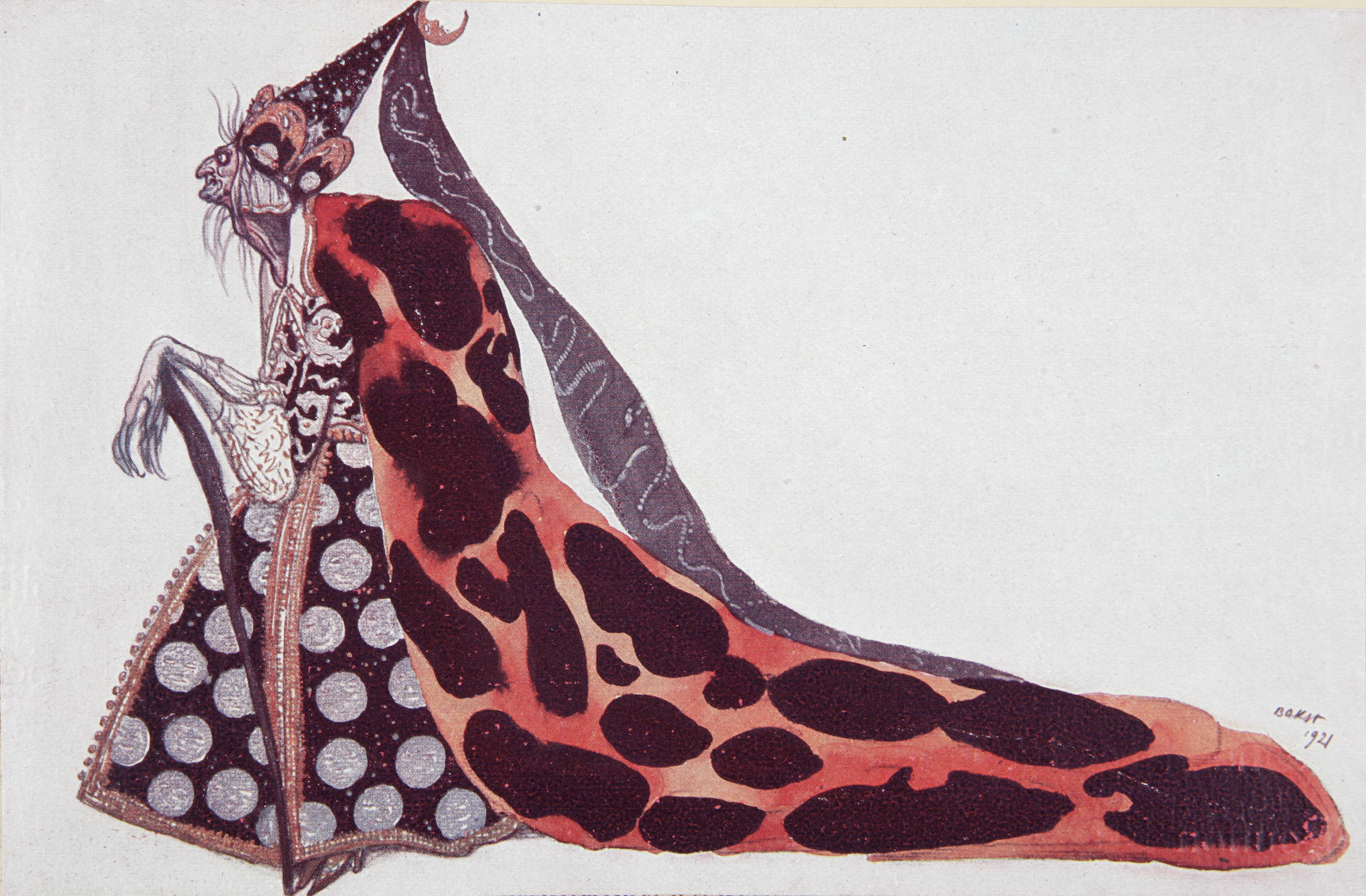
Leon Bakst's costume design for  Carabossse
Source Wikipedia


In my review of Birmingham Royal Ballet's performance of The Sleeping Beauty in The Lowry on 27 Sept 2013 I wrote:
"Even though The Sleeping Beauty was premièred at St. Petersburg, its score was composed by Tchaikovsky and it was choreographed was by Petipa to Perrault's story, it is also a very English ballet. It was the work that reopened the Royal Opera House on the 20 Feb 1946 after the House had been used as a dance hall and furniture store (see "The History of the Royal Opera House" on the Royal Opera House website).
To understand the importance of The Sleeping Beauty in our social as well as our cultural history you have to know that it entered the repertoire of the Vic-Wells Ballet just before the Second World War. By all accounts the 1946 revival was a glittering occasion. It must have been one of the rare great nights of ballet to which I referred "In Leeds of all Places - Pavlova, Ashton and Magic" 18 Sept 2013. It was produced by Ninette de Valois, designed by Oliver Messel, Princess Aurora was danced by Margot Fonteyn and Petipa's choreography was supplemented by Frederick Ashton. There must have been a whiff of mothballs in the theatre as the audience had dusted off their pre-war dinner jackets, retrieved their best frocks and put on their jewellery for the first time after the Second World War. The analogy of that evening after years of war and rationing with Aurora's wedding after a century of hibernation must have been obvious and compelling."
It is a very special ballet which is why I am delighted to report that the Chelmsford Ballet Company (of which I am a proud non-dancing associate) will perform it at the Chelmsford Civic Theatre between 16 to 19 March 2016.

Although this company is made up largely of dancers who do not make their living from dance there is nothing amateurish about its performances (see The Nutcracker as it really should be danced - No Gimmicks but with Love and Joy 20 March 2014 and A Delight Indeed 22 March 2015). They have a resourceful and imaginative artistic director in Annette Potter, talented dancers several of whom are at first rate ballet schools, accomplished costume and set designers and makers, able technicians and an inspiring Chair in Marion Pettet who showed her flair as a character dancer in Pineapple Poll and Carnival of The Animals. Small wonder that their patrons are Christopher Marney, my favourite living British choreographer, and the great ballerina Doreen Wells.

I don't yet have any details of the performance. In particular, I don't know whether they have begun casting but I know who could dance the lilac role very well indeed. In my review of Matthew Bourne's Sleeping Beauty in Bradford on 28 March 2013 I wrote:
"No Lilac Fairy though there was a Count Lilac powerfully danced by Christopher Marney"
Marney's dancing in that show was spectacular. I also seem to remember that Cara O'Shea, one of Northern Ballet Academy's most adored teachers (see Northern Ballet Open Day 18 Feb 2014 and A Treat For Us Old Ladies 27 Feb 2014), once danced Princess Aurora for the company. When I do get some information about Chelmsford's show I shall pass it in to you.

There's just one other thing about The Sleeping Beauty and that is the following passage from Wikipedia:
"Trademark controversy
The Walt Disney Company has registered a trademark with the US Patent and Trademark Office, filed March 13, 2007, for the name "Princess Aurora" that covers production and distribution of motion picture films; production of television programs; production of sound and video recordings. Some suggest that this may limit the ability to perform this ballet, from which Disney acquired some of the music for its animated 1959 film Sleeping Beauty."
At first I thought it was a joke but I followed the link and found that the words PRINCESS AURORA have indeed been registered by Disney Enterprises Inc. with the US Patent and Trade Mark Office as a service mark for
"Production and distribution of motion picture films; production of television programs; production of sound and video recordings"
in class 41 on 17 Jan 2012 under registration number 4,088,154.

The scare seems to have originated in an article by Nikki Finke in Deadline Hollywood dayed 1 May 2009 entitled An Attempt To Stop The Disney Machine which began with the alarming words:
"I’m told that the Walt Disney Co is currently attempting to trademark the character name “Princess Aurora” for all media: stage, sound, film, TV, video, Internet, photographs, news. In short, everything except literature."
The article continued:
"The problem is that, if the Disney Company is successful, it will effectively control the legal right to all future performances of the ballet. The move also could sink any movie about the ballet or that uses a scene of the ballet in another movie."
There is, incidentally, a parallel registration for the words PRINCESS AURORA in relation to a wide range of goods and services here.

Disney's trade mark cannot be infringed by performing Petipa's ballet The Sleeping Ballet for all sorts of reasons. The intellectual assets that the Disney Corporation seeks to wish to protect is a range of goods and services about a number of princesses one of whom is called Aurora.  She seems to be a spin-off from the studio's well known 1959 animation. The other princesses, incidentally, include Cinderella, Pocahontas and Rapunzel. A ballet that is based exclusively on any of those characters might perhaps infringe some of Disney's IP rights (though not necessarily the trade mark) but that would be an altogether different matter.

If anybody is, however, troubled by the intellectual property issues relating to The Sleeping Beauty, do give me a shout. I will advise and represent you and keep you on the straight and narrow for free. I know of at least one patent and trade mark agent as well as a specialist solicitor who love ballet as much as I do who would probably do the same.

Post Script

I do have some more information about Chelmsford Ballet's production. The following notice appeared on its Facebook page:
The Company will present
  "The Sleeping Beauty "
March 2016

Do you or someone you know want to dance in this enchanting tale?

Company Auditions 
21st June 2015
Only auditioned dancing members can dance in our annual productions.
Company auditions for new members and for upgrades for existing members are scheduled for Sunday 21st
 June.  Male applicants are especially welcome. Application forms are available to download from the website, or you can contact the membership secretary directly for more information. cbcenquiries@hotmail.com 
The closing date for applications to audition is the 7th June.

(Auditions for The Sleeping Beauty, open only to members, will take place in October 2015)

Monday, 8 December 2014

Now you can see why I am such a fan of the Dutch National Ballet

I am very grateful to Richard Heideman, press officer of the Dutch National Ballet for bringing this video to my attention on twitter:

I think it is the best flashmob that I have ever seen.

For those who don't follow ballet this dance is a scene from the second act of Giselle . Myrthe, Queen of the Wilis, summonses the souls of girls who died of a broken heart just before their wedding night. Giselle, the heroine of the story, has just joined their number because she died in the arms of her mother on learning that Albrecht, a local aristocrat who had dressed up as a peasant was really a count and already engaged to be married to another lady. In some versions Giselle kills herself with Albrecht's sword which he left lying around for Hilarion, Giselle's old boyfriend, to pick up. In other productions, Giselle dies of shock or a broken heart.

I find something very dark and creepy about Giselle on stage which I find hard to reconcile with my religious beliefs (see Reflections on Giselle 29 Jan 2014). But Petitpa's choreography to Adam's haunting score is magnificent and I watch it as an abstraction as I would a ballet Balanchine. The beauty of this film is that it strips away the spooks and superstition and celebrates the glorious choreography and gorgeous music.

Shot in a Beijing shopping centre with the dancers wearing trainers and jeans rather than pointe shoes and romantic tutus with little wings hanging out at the back and their hair worn loose rather than in buns this is a marvellous way to appreciate this wonderful romantic ballet.

I am in no position to rank ballet companies but I have seen the world's finest including the Royal Ballet, English National, the Bolshoi and Mariinsky and American Ballet Theatre. Of all the great national companies the Dutch is the one I admire the most and like the best. If you want to learn more about this wonderful company I have written 11 articles about Ernst Meisner and his outstanding young dancers.

Sunday, 20 October 2013

More Thoughts on Don Quixote

Natalia Osipova and Ivan Vasiliev of the Bolshoi   Source Wikipedia

The performance of Don Quixote which was streamed to my local Odeon last Wednesday has prompted me to think about the ballet generally and to ponder why it is not staged more often (see ¡Por favor! Don Quixote streamed to Huddersfield 17 Oct 2013). Lots of companies dance Swan Lake, Sleeping Beauty, Nutcracker and Giselle but not so may include Don Quixote in their repertoire.  It is one of those ballets like La Sylphide that everyone has heard of but not actually seen. I have only seen one version of Don Quixote on stage and that was London Festival's at the Coliseum in the late 1960s or early 1970s.  Dame Ninette de Valois tried to stage the ballet for what is now the Royal Ballet in 1950 but it does not seem to have been very popular. 

Although the ballet takes its title from Miguel Cervantes's well known novel it is very much a Russian work (or perhaps, more accurately Eastern European as the score was contributed by an expatriate Austrian).  It is one of Petipa's earliest works having been staged for the first time in 1869 and that may be one of the reasons.  It provides scope for some brilliant dancing by the principals and soloists but it does take liberties with the novel. The ballet really ought to be renamed Basilio and Kitri for that is what the story is all about - a Hispanic Fille mal gardée with a touch of Carmen.  

Save for the coda in the last Act, the music is not very well known.  I had (and possibly still have) a vinyl LP somewhere which I bought from the old Ballet Bookshop in Cecil Court. Does anyone else remember that wonderful source of ballet memorabilia? I played that disc often when I was a student - particularly when I had an essay to write.  The composer Ludwig Minkus wrote a lot of music for the ballet. After many years service at St Petersburg, Minkus returned to his native Vienna where he subsisted on a pension from Russia.  That remittance ended with the First World War as the Austro-Hungarian empire and Russia were on opposite sides.  He died in 1917, the year of the Bolshevik revolution, in very straightened circumstances. Having to cope with such circumstances poor old Minkus had more than a little in common with with Cervantes's creation. 

From what I could see from the images that were streamed from Covent Garden, Carlos Acosta has reworked substantially the Petipa ballet.  By dancing Basilio himself and casting another Marianela Nunez, another Latin American dancer, as Kitri he has reclaimed the work for the Spanish speaking world. As I said in my review, the screening left me dissatisfied. All the remaining performances of the ballet this season are fully booked.  I hope Acosta's version stays in the Royal Ballet's repertoire rather longer than de Valois's because I should really ought to see it. 

Sunday, 29 September 2013

The Sleeping Beauty - a Review and why the Ballet is important

Even though The Sleeping Beauty was premièred at St. Petersburg, its score was composed by Tchaikovsky and it was choreographed was by Petipa to Perrault's story,  it is also a very English ballet. It was the work that reopened the Royal Opera House on the 20 Feb 1946 after the House had been used as a dance hall and furniture store (see "The History of the Royal Opera House" on the Royal Opera House website).

To understand the importance of The Sleeping Beauty in our social as well as our cultural history you have to know that it entered the repertoire of the Vic-Wells Ballet just before the Second World War.  By all accounts the 1946 revival was a glittering occasion.  It must have been one of the rare great nights of ballet to which I referred "In Leeds of all Places - Pavlova, Ashton and Magic" 18 Sept 2013. It was produced by Ninette de Valois, designed by Oliver Messel, Princess Aurora was danced by Margot Fonteyn and Petipa's choreography was supplemented by Frederick Ashton. There must have been a whiff of mothballs in the theatre as the audience had dusted off their pre-war dinner jackets, retrieved their best frocks and put on their jewellery for the first time after the Second World War.  The analogy of that evening after years of war and rationing with Aurora's wedding after a century of hibernation must have been obvious and compelling.

The Birmingham Royal Ballet is the direct descendant of de Valois's company and Peter Wright's production that I saw at The Lowry last night is derived directly from that 1946 revival.  "This is the gold standard" I thought to myself yesterday as gold confetti fluttered to the stage at the end of the last scene.  It is as much part of our heritage as the Book of Common Prayer. Like Cranmer's masterpiece one meddles with The Sleeping Beauty at one's peril.  The score for the divertissements in the last act, for example, was composed for Petipa's choreography to represent cats and bluebirds.  Any other choreography jars which was why I was irritated by Matthew Bourne's production despite its brilliant dancing (see "Why can't I be nicer to Matthew Bourne" of 6 April 2013). I have yet to see David Nixon's version of The Sleeping Beauty which I gather from Mark Skipper and Andy Waddington is set in the distant future and that is perhaps just as well for I do so love the Northern Ballet (see "The Things I do for my Art: Northern Ballet's Breakfast Meeting" 23 Sept 2013),
.
Returning to last night in Salford, it was a wonderful performance. Maybe not a magical one as Midsummer Night's Dream was two weeks ago but that was not the company's fault because such magic is spontaneous and is experienced only once or twice in a lifetime. A more superstitious age would have said it was in the gift of Terpsichore and that is not a bad way of looking at it.

The role of Aurora appears to me (as one who can barely pirouette) to require almost superhuman virtuosity which Elisha Willis demonstrated she possessed in abundance. Virtuosity is required also of Florimund which was danced admirably by Jamie Bond. Yet more virtuosity is required of the Bluebirds as you can see from the following short YouTube clip from the current production,

Yesterday's pas de deux was danced by Max Maslen (a Bradford lad) and Maureya Lebowitz from Malibu. Bluebird is danced by dancers who are on the way up so we can look forward to seeing a lot more from those two. Kit Holder and Yvette Knight made a charming Puss in Boots. I love the slap that she gives him as he touches her leg. Pure Ashton.  The juxtaposition of Samara Downs as Carabosse with Delia Matthews as the Lilac or good Fairy was inspired.  Everyone danced well and should be commended. Philip Prowse's designs dazzled the audience and Mark Jonathan's lighting thrilled us.  All in all it was a wonderful evening.

I am now about to set off for London to see "Star Studded Gala in aid of the Yorkshire Ballet Summer School". In my last ballet class in Huddersfield my dear teacher Fiona warned a promising young student (albeit in a different context) that ballet can break you and I am aware that balletomania can easily become an obsession.   But this is very much a one-off. I live in Yorkshire. My mother was from Yorkshire. I value ballet.  I feel bound to support this Yorkshire institution.