Showing posts with label Culture. Show all posts

Friday, 13 January 2017

Factory to go ahead

St John's Gardens
Author: R Lee
Source Wikipedia
Creative Commons Licence


Ever since George Osborne MP delivered his Autumn Statement for 2014 I have been beating the drum for the Factory arts and cultural centre as a centre for dance in Manchester (see Let's bring the Royal Ballet to The Factory Manchester 11 Dec 2014, The Factory begins to take shape 26 Nov 2015 and Thanks George 8 Dec 2015). Yesterday, Manchester International Festival ("MIF") announced that it had obtained planning permission to build the arts complex as part of the redevelopment of the St John's district of Manchester (see MIF announced as operator for Factory).

According to the Festival's website:
"MIF will be the operator for Factory, creating a year-round programme of work and running the building, which is due to open 2020. Factory will give audiences the opportunity to enjoy the broadest range of art forms and cultural experiences – including dance, theatre, music, opera, visual arts, spoken word, popular culture and innovative contemporary work incorporating multiple media and technologies"
MIF has commissioned dance before.   In 2015 it commissioned Wayne McGregor's Tree of Codes which was premiered at the Manchester Opera House on 3 July 2015 and is to be performed this year at the Palais Garnier, the Musikhuset in Aarhus and Sadler's Wells. Last year it facilitated Akram Khan's Giselle which the MIF's artistic director described as “an example of the sort of collaboration we can expect to find at The Factory” (see Verity Williams MIF’s Giselle at The Palace Theatre, preview: Dancing to a different tune 15 Dec 2016 creativetourist.com).

While I was not exactly bowled over by Akram Khan's Giselle I applaud MIF's commitment to dance. Now that we shall have a 1,600 seat auditorium for Manchester there is no reason why the second city of the UK should not host its own world class resident ballet company. Ideally, I should like to revive plans for a Northern home for the Royal Ballet which the last Labour government had proposed.  If that is not possible we may have to build one ourselves from the ground up. We shall see.

Meanwhile, if anyone wants some idea as to how the Factory will look there is a great article about the Factory with some good pictures on the BBC website (see Designs approved for Manchester's £110m Factory arts venue 12 Jan 2017).

Thursday, 20 October 2016

The National Ballet of China is coming to the Lowry

Lowry Centre
Source Wikipedia
Creative Commons Licence


In Al Jazeera features the Ballet Class in the Nairobi Slums 19 Oct 2016 I referred to the comments on Al-Jazeera's Facebook page about a remarkable ballet class in one of the poorest neighbourhoods in Nairobi. While most of the comments were favourable there was one that was not:
"Ballerina? Very good dream but it must be stopped! Kenya is an ancient land with a rich and colourful past, there are many aspects of Kenyan culture that can be embraced by Kenyan youths. Why are Africans still living like colonial subjects? Helping sustain European language, religion, culture, economy at the expense of Africa and African culture! Stop."
Well, Kenya is indeed "an ancient land with a rich and colourful past" but then so is China.  No one would dispute that "there are many aspects of Kenyan culture that can be embraced by Kenyan youths" and I hope that many of them, including, perhaps, some of the kids in the ballet class in Kibera as well as other students around the world, will do just that. But embracing and contributing to an art form that began in the courts of renaissance Italy and has now spread across the world is not a rejection of any other art from any other culture. Indeed, there are instances where the confluence of two cultures influences both for the better.

A good example of such confluence and mutual influence appears to be The National Ballet of China which describes itself on the "About Us" page of its website as follows:
"The National Ballet of China was founded in December of 1959. All of The National Ballet of China’s outstanding artists come from professional academies. During decades of care and support from the government and friends from all social sectors, the company has never ceased enriching its solid Russian foundations with works of different schools and styles. The company’s repertoire includes classics like Swan Lake, Don Quixote, Giselle, Carmen, Onegin, and The Little Mermaid, as well as original creations like The Red Detachment of Women, The New Year Sacrifice, Yellow River, Raise the Red Lantern, The Peony Pavilion, and The Chinese New Year. By both performing Western ballets and creating works of its own with distinct national characteristics, the company has found a successful path for the development of Chinese ballet. It is fusing the classical and the modern, and cultures from all over the world."
Now with all due respect to the critic of the ballet class in Kibera, the artists of one of the world's most powerful nations and one of its oldest and most brilliant civilizations do not live like colonial subjects. They are creating something magnificent which may use the vocabulary of classical ballet but remains authentically Chinese.

The National Ballet of China will bring one of those Chinese creations to The Lowry when it performs The Peony Pavillion between the 22 and 26 Nov 2016. The ballet is described on The Lowry's website as
"one of the most enduring love stories in Chinese literature. Adapted from Tang Xianzu’s play of the same name, The Peony Pavilion is a ballet telling a 16th-century story of passion pitted against impossible odds, an Eastern contemporary of Shakespeare's 'Romeo and Juliet'."
Further information on the ballet and the play appears on Wikipedia:
"In May 2008, the National Ballet of China premièred a two-scene ballet adaptation of The Peony Pavilion in Beijing. For this adaptation, the play was rewritten by the opera's director Li Liuyi; the ballet was choreographed by Fei Bo, and the music was composed by Guo Wenjing. The adaptation had its European premiere at the Edinburgh International Festival in August 2011."
The Wikipedia description may be a little inaccurate in that it refers to "two scenes". I think the author must have meant to say "two acts". The Lowry describes it as "A Ballet in Two Acts and Six Scenes (Adapted from Tang Xianzu’s play of the same name)" on its website and I have to say that that seems rather more likely.

Saturday, 18 July 2015

Bend it like Cinders - My Take on Cinderella


I saw the evening performance of Cinderella by the Dutch National Ballet's at the Coliseum on 11 July 2015 and loved it. I am aware that not everyone did but I can't see why because for me it was magical.  The dancers were as light as chiffon ribbons. The sets and lighting were ingenious. The costumes were gorgeous. Anna Tsygankova was my idea of Cinderella and Matthew Golding was the perfect prince.

I have been shown some of the criticism of the Dutch production on BalletcoForum and I actually overheard a conversation in which someone boasted of having walked out of the theatre at the first interval because she had better things to do like watch television. What a waste if true! And what nonsense! As for the milder criticism on BalletcoForum I do not see how anyone could have been bored by stars like Golding or Tsygankova and I cannot understand comments that the performance was vulgar or that it was not like Ashton's.

I have not seen quite so many versions of Cinderella as Jane (see the first paragraph of her review of Wheeldon's Cinderella 13 July 2015) and in particular I have not seen Ashton's but I do not believe that all new versions of Cinderella have to be like Ashton's to be great.  If all new work in ballet were compared to the those in the past, where would innovation and creativity lie?  Where would be the opportunities for choreographers to explore classic themes with their dancers and add value to them?  I have seen Nixon's for Northern Ballet and Matthew Bourne's as well as Wheeldon's and I enjoyed all three.   All were different but all were good in their own way.  I have yet to see Ballet Cymru's version and I learned that Christopher Hampson is working one for Scottish Ballet at the panel discussion on 20 June 2015. I hope to see that too.

Perhaps the reason for my heresy is that I do not consider myself to be a "balletomane" though I do love ballet as I love all the performing arts. I think the word balletomane must have been coined by Arnold Haskell in his book Balletomania : the story of an obsession which was published in 1934. Now how can anyone take pride in an obsession? I would be worried if I believed that I was succumbing to any sort of mania,

The story of Cinderella has a special resonance for me as it does for many British Asians. We are, of course, brought up on the Western version of the story at primary school and on television like everybody else but we also have our own ancient equivalent of the story which is derived from Sanskrit verse. In our version Cinderella is called Shakuntala. Here is a summary that I found in Indian Cinderella - History for Kids. There are also too many Indian women and indeed women in this country of Indian and Pakistani heritage who are real Cinderellas in that they are brought up in the shadow of their brothers and after marriage their husbands and are thereby denied the opportunity in their own right. That is not to say that all arranged marriages are like that. Most develop into very beautiful relationships but I would hate to be married off in my early teens or told that that I could not have a say in choosing my marriage partner as was of the old tradition years ago. 

I digress into Indian culture because earlier in the day I attended the matinee of Bend It Like Beckham at the Phoenix Theatre. Now that is another type of Cinderella story if you care to think of it.


Monday, 12 January 2015

Funding the Arts in the North

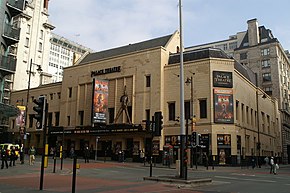
Palace Theatre, Manchester
Photo Wikipedia


You may have heard a lot of talk from politicians about a "Northern Powerhouse". That may be because there is an election is the offing and the politicians who have had most to sat about the idea - namely the Chancellor of the Exchequer and the Deputy Prime Minister - hold Northern seats. But there is a case for growing the North as a counterweight to London in order to rebalance the British economy.

In its report on The Work of Arts Council England of 28 Oct 2014 The Culture, Media and Sport Committee found that:
"London has long received a disproportionate share of arts funding, something which even the Arts Council acknowledges. To a limited extent this reflects London’s position as the capital city and a world cultural centre. However, there remains a clear funding imbalance in favour of London at the expense of tax payers and lottery players in other parts of the country. The Arts Council is well-placed to restore some balance. It must do so with greater urgency if it is to realise its declared ambition to engineer the provision of great art and culture for everyone."
In a response to that report an organization that represents Birmingham, Bristol, Cardiff, Glasgow, Leeds, Liverpool, Manchester, Newcastle, Nottingham and Sheffield known as "the Core Cities group" acknowledged "the important role played by London as the national cultural capital and the central role of the cultural economy in London’s attractiveness as a place to live, visit and invest" but contended that:
"the Core Cities have a unique role to play as regional cultural capitals and a similar argument in terms of the critical mass of larger-scale venues and producing companies. The substantial cultural offer of the Core Cities plays a lead role in driving economic growth and supporting competitiveness as well as providing a rich cultural environment. This role extends beyond the Core Cities themselves, to the wider city region, the region and surrounding economies. The term ‘Cultural Capital’ is therefore used here in that sense of delivering benefits to a much wider area, not in an exclusive sense."
Alleging that they contributed 28% to national output which was more than London the Core Cities continued as follows:
"[7] The cultural and creative sectors are key drivers of success (including economic diversity, human capital, innovation, quality of place), and growing competition for public and private funds will limit their growth. Sustainable development of the cultural and creative sector in the Core Cities is therefore vital to balanced growth in the wider economy.
[8] For this to be fully realised, it is important that decisions on Government spending recognise this contribution in terms of the economic impacts of cultural spend and how this relates to the wider re-balancing agenda in order to maximise growth dividends for the UK as a whole.
[9] This requires not only mechanisms which fairly reflect the activities of cultural organisations operating in the regions, but new ways of relating spending priorities to growth to take full advantage of culture’s economic contribution.
[10] Whilst the culture and creative sector contribute directly to economic growth, it should also be noted that they have a wider role to play in the Core Cities in strengthening economic competitiveness. A strong cultural economy attracts visitors and investors as well as being a significant provider of broader skills development."
They concluded "that, without a new policy direction agreed between the Core Cities and central government, it is likely that in the short to medium term, the national cultural infrastructure based in the cities and serving their regional economies, is not sustainable and its loss will have wide-ranging impact on the competitiveness of the country."

On the very day that the Core Cities' response to the Committee's report was published, Opera North announced "a new membership scheme for inspired business leaders who recognise and value the role the company plays in making the region an attractive place to live, study, work and invest" (see Business Partners scheme hits the right note ahead of its launch 12 Jan 2015 Yorkshire Business News). It appears that Opera North 25 founding business partners include AQL, Arup, Bartlett Group, Blacks Solicitors, Brewin Dolphin, The Business Desk, Dermalogica, DLA Piper, Evans Property Group, EY, Hainsworth, Hammerson plc, James Hare Ltd, KPMG, Land Securities, Leeds Building Society, Leeds City Council, MAC, Maestro! Tour Management, NJ Geddes Private Jewellery Concierge, One Medical Group, Taste Cuisine, Town Centre Securities, Yorkshire Building Society and Yorkshire Water.

To my mind raising money locally from business and the community is a better way of sponsoring the arts in the North than diverting public funds from artists in London. First, we are a very small country and London is easy to reach from any part of the UK. Nowhere is more than a couple of flying time by air and all the core cities are connected to the capital by motorway and intercity rail services. Secondly, institutions like the Royal Ballet and the Royal Opera serve us all. I would much rather see a well funded performance at Covent Garden than more experimental theatre at the local civic. Thirdly, we have excellence in the North and the Midlands (see any my reviews of Northern Ballet and Birmingham Royal Ballet). Also in Scotland (see  Like meeting an old friend after so many years 4 Jan 2015), Wales (see An Explosion of Joy 21 Sep 2014) and indeed Grantham (see The Happy Prince in Halifax 21 Nov 2014) and Hinckley (The Bedouin of Ballet 12 Dec 2014). Fourthly, we want devolution in skills, transport and economic development and all sorts of other areas so why not in culture?