Showing posts with label Northern Powerhouse. Show all posts

Monday, 20 March 2023

Digwyddiad Cyntaf yng Nghymru - February Company Class in Myndd Isa

© 2023 Powerhouse Ballet: all rights reserved


I was inspired to found Powerhouse Ballet by the examples of the Chelmsford Ballet Company in Essex and the Duchy Ballet in Cornwall,  As Huddersfield is about the same size as Chelmsford and has good road and rail connections with Manchester, Leeds and Sheffield I thought about basing the new company in Huddersfield and calling it the Huddersfield Ballet,  I decided to broaden it to Powerhouse Ballet because the original concept of the Northern Powerhouse was a Leeds to Liverpool agglomeration as a counterweight to London (see my article Creating a Northern Counterweight to London is good for the Nation 5 April 2014 IP Northwest).  That is why I resolved to alternate monthly events between Yorkshire and the Northwest.

We held our first company class in Huddersfield in May 2018 and attracted 11 dancers "from Salford in the west and York in the east, from Harrogate in the north and Birmingham in the south and points in between" (see We have a Company 27 May 2018 Powerhouse Ballet).  We held our second class in Manchester in June and attracted four beautiful dancers from Wales.  Two of them, Holly Middleton and Alicia Jelley, were chosen by Terence Etheridge to dance in his ballet Aria.  They rehearsed assiduously for 6 months even though they are busy young women with careers and families.  The distances they had to travel were enormous as rehearsals alternated between Leeds and Manchester and on one occasion York.

During that time I promised them events west of Manchester including at least one in Wales just as soon as they could be arranged.  The pandemic and the closure of our studios in Liverpool and Manchester delayed the delivery of that promise until 25 Feb 2023 when we held our first company class at Elite Studios in Myndd Isa near Mold.  The class was delivered by Alicia Jelley who teaches at the studios. It included Sarah Lambert, Sue Pritchard, Holly Middleton, a very gifted local dancer and me.  It was not a big class but it was a very good one.  Alicia worked us very hard at the barre, in the centre and in the choreographic exercises.

Elite Studios is an excellent venue.  It is very close to the A55 and there are acres of free parking in the village centre and behind the studio.  There is a Sainsbury's local with an ATM and a fish and chip shop that would delight Gareth the Orangutan nearby.  The studio has two well-equipped studios with fixed barres and well-sprung floors, ample changing facilities for both men and women and excellently maintained bathrooms.   We shall certainly be back. 

As soon as it can be arranged I plan to hold a residential summer school which will alternate between the university cities of York and Bangor.  According to Christie Barnes, York St John University could host the York school.  We have already held a Giselle workshop and a rehearsal for Aria there.  The Bangor venue could be a recently opened youth theatre called Frân Wen.  We have already recently received an expression of interest from its management.  There is a lot of work to be done and I am not sure that I will be ready by this summer but we have made a start,

Wednesday, 3 June 2015

The Creative Industries Road Show comes to Leeds

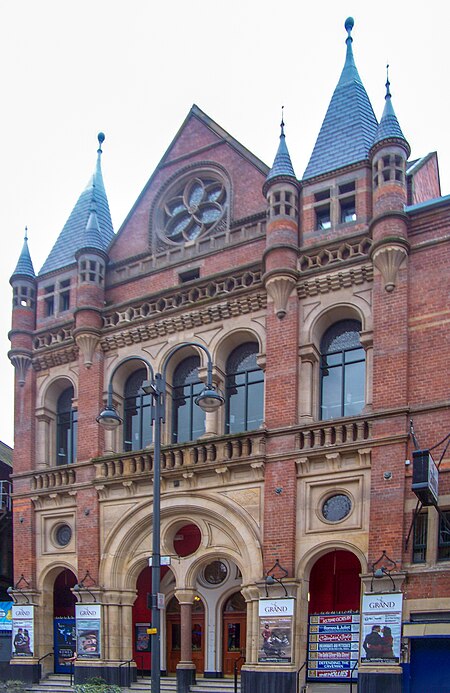
Leeds Grand Theatre
Photo Mtaylor848 
Source Wikipedia


The Creative Industries Federation describes itself as
"the first fully independent body bringing together the public and private sector, across all parts of the country, from the largest multinational to the smallest start-up, from television to computer games, from music to design, from architecture to visual arts".  
For the purpose of recruiting members the Federation recognizes the following as creative industries advertising, architecture, computer gaming, crafts, design, creative education, fashion, film, IT and software, museums, galleries and libraries, music, performing arts, publishing, radio, TV, video and photography and visual arts. English National Ballet is among the Founder Supporter Companies and Organizations as is the Royal Opera House and Tamara Rojo appears on the Federation's launch video.

The Federation is running a series of road shows around the UK "in which leading figures from the arts, creative industries and commercial education will come together to forge new links and map the challenges the sector faces in their area.".  The first of these took place in Manchester on 27 April 2015 and the second in Birmingham on 20 May 2015. On Monday, 1 June 2014, it was Leeds's turn and the caravan gathered in the Howard Assembly Room, a large auditorium leading off the bar of the dress circle in the Grand Theatre,

The event came to my attention because one of the Federation's promises is to "defend intellectual property rights in an ever more digital future." Defending intellectual property rights and indeed attacking them sometimes is what I do for a living but I would probably have given the road show a miss had I not noticed two names on the panel. One of those was Sally Joynson who is CEO of Screen Yorkshire. The other was Sharon Watson, the artistic director of Phoenix Dance Theatre.

The event was chaired by John Kampfner, CEO of the Federation and Anamaria Willis CEO of CidaCo. The first part of the evening was a monologue by Anya Hindmarsh on how she got to be where she is now. All very worthy but it is not as if we had not heard countless similar stories from other entrepreneurs from way back when. The next talk was Tom Riordan, CEO of Leeds City Council which was equally worthy. The main part of the evening for me was the panel discussion in which Sally and Sharon were billed to take part. Also on the panel were Jamie Sefton, Managing Director of Game Republic Ian Thompson, of Thompson Brand Partners, Dominic Gray of Opera North and Anya Hindmarsh.

The advertised topic of the panel discussion was
"'Uniting the Northern Powerhouse' - Following the emergence of the Great North concept how can growth and success be leveraged across the M62 corridor for the benefit of us all?"
Kampfner posed the combustible (for Leeds) question "Is the Northern Powerhouse all about Manchester and if it is does it matter?" and he asked Sharon to respond. Sharon played that ball with a very straight bat. She replied that Phoenix Dance and Northern Ballet had always regarded the North as a powerhouse so there was nothing new there. Actually that was about as much as she or anyone said on the subject because one of the first questions from the floor came from a teacher who complained that children in Yorkshire were just not taking art and design courses in sufficient numbers and that she was looking to the panellists to put that right. For the rest of the evening the panel concentrated on why that should be, whether it was because parents wanted their offspring to get "a real job" whatever that might mean and whether there was too much an emphasis in this country on STEM. As we could do better in maths and science according to recent PISA tables I was rather worried where that discussion might be leading but apart from a few calls to turn STEM into STEAM there was no serious attack on existing educational priorities.

As there had been a lot of Manchester bashing at the LEP Summit in 2011, the Leeds International Economic Conference last year and even at Northern Ballet's breakfast meeting in September 2013 I was really heartened by Dominic Gray. He urged Leeds not to compare itself to Manchester because the two cities are different.  He recalled the success of the Tour de France last year when images of our beautiful countryside were transmitted round the world. Leeds's strength lay in its hinterland, he seemed to suggest which was like music to my ears.

After the talk there was networking in the bar at which attendees had to buy their own drinks in the best Yorkshire tradition. I met a number of interesting people from different arts and creative sectors including Sharon Watson.  I am a great admirer of her company and her work and had met her very briefly on a couple of other occasions. We swapped a couple of stories about the importance of dance and I told her about my faltering efforts to learn her dance form (see My First Contemporary Dance Class 27 Feb 2015).

If anyone wants to join the Creative Industries Federation here is some further information. Subscriptions do not come cheap. Businesses with turnovers of £200 million or above are charged £15,000 plus VAT while businesses that provide support to the creative industries (such as barristers' chambers) would be charged £6,000. Even individuals aged 25 or under are charged £40.  Having said that, there are discounts for those who join in June and further discounts for those who join after attending the Leeds road show. The creative sector does need a forum and collective voice but few of the people I know in dance have that kind of spare cash.

Monday, 12 January 2015

Funding the Arts in the North

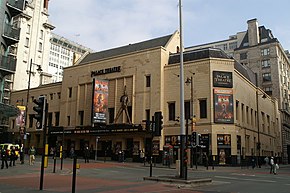
Palace Theatre, Manchester
Photo Wikipedia


You may have heard a lot of talk from politicians about a "Northern Powerhouse". That may be because there is an election is the offing and the politicians who have had most to sat about the idea - namely the Chancellor of the Exchequer and the Deputy Prime Minister - hold Northern seats. But there is a case for growing the North as a counterweight to London in order to rebalance the British economy.

In its report on The Work of Arts Council England of 28 Oct 2014 The Culture, Media and Sport Committee found that:
"London has long received a disproportionate share of arts funding, something which even the Arts Council acknowledges. To a limited extent this reflects London’s position as the capital city and a world cultural centre. However, there remains a clear funding imbalance in favour of London at the expense of tax payers and lottery players in other parts of the country. The Arts Council is well-placed to restore some balance. It must do so with greater urgency if it is to realise its declared ambition to engineer the provision of great art and culture for everyone."
In a response to that report an organization that represents Birmingham, Bristol, Cardiff, Glasgow, Leeds, Liverpool, Manchester, Newcastle, Nottingham and Sheffield known as "the Core Cities group" acknowledged "the important role played by London as the national cultural capital and the central role of the cultural economy in London’s attractiveness as a place to live, visit and invest" but contended that:
"the Core Cities have a unique role to play as regional cultural capitals and a similar argument in terms of the critical mass of larger-scale venues and producing companies. The substantial cultural offer of the Core Cities plays a lead role in driving economic growth and supporting competitiveness as well as providing a rich cultural environment. This role extends beyond the Core Cities themselves, to the wider city region, the region and surrounding economies. The term ‘Cultural Capital’ is therefore used here in that sense of delivering benefits to a much wider area, not in an exclusive sense."
Alleging that they contributed 28% to national output which was more than London the Core Cities continued as follows:
"[7] The cultural and creative sectors are key drivers of success (including economic diversity, human capital, innovation, quality of place), and growing competition for public and private funds will limit their growth. Sustainable development of the cultural and creative sector in the Core Cities is therefore vital to balanced growth in the wider economy.
[8] For this to be fully realised, it is important that decisions on Government spending recognise this contribution in terms of the economic impacts of cultural spend and how this relates to the wider re-balancing agenda in order to maximise growth dividends for the UK as a whole.
[9] This requires not only mechanisms which fairly reflect the activities of cultural organisations operating in the regions, but new ways of relating spending priorities to growth to take full advantage of culture’s economic contribution.
[10] Whilst the culture and creative sector contribute directly to economic growth, it should also be noted that they have a wider role to play in the Core Cities in strengthening economic competitiveness. A strong cultural economy attracts visitors and investors as well as being a significant provider of broader skills development."
They concluded "that, without a new policy direction agreed between the Core Cities and central government, it is likely that in the short to medium term, the national cultural infrastructure based in the cities and serving their regional economies, is not sustainable and its loss will have wide-ranging impact on the competitiveness of the country."

On the very day that the Core Cities' response to the Committee's report was published, Opera North announced "a new membership scheme for inspired business leaders who recognise and value the role the company plays in making the region an attractive place to live, study, work and invest" (see Business Partners scheme hits the right note ahead of its launch 12 Jan 2015 Yorkshire Business News). It appears that Opera North 25 founding business partners include AQL, Arup, Bartlett Group, Blacks Solicitors, Brewin Dolphin, The Business Desk, Dermalogica, DLA Piper, Evans Property Group, EY, Hainsworth, Hammerson plc, James Hare Ltd, KPMG, Land Securities, Leeds Building Society, Leeds City Council, MAC, Maestro! Tour Management, NJ Geddes Private Jewellery Concierge, One Medical Group, Taste Cuisine, Town Centre Securities, Yorkshire Building Society and Yorkshire Water.

To my mind raising money locally from business and the community is a better way of sponsoring the arts in the North than diverting public funds from artists in London. First, we are a very small country and London is easy to reach from any part of the UK. Nowhere is more than a couple of flying time by air and all the core cities are connected to the capital by motorway and intercity rail services. Secondly, institutions like the Royal Ballet and the Royal Opera serve us all. I would much rather see a well funded performance at Covent Garden than more experimental theatre at the local civic. Thirdly, we have excellence in the North and the Midlands (see any my reviews of Northern Ballet and Birmingham Royal Ballet). Also in Scotland (see  Like meeting an old friend after so many years 4 Jan 2015), Wales (see An Explosion of Joy 21 Sep 2014) and indeed Grantham (see The Happy Prince in Halifax 21 Nov 2014) and Hinckley (The Bedouin of Ballet 12 Dec 2014). Fourthly, we want devolution in skills, transport and economic development and all sorts of other areas so why not in culture?