Showing posts with label Federico Beonelli. Show all posts

Wednesday, 14 December 2016

The Royal Ballet's Nutcracker in the Merrie City

Wakefield from Sandal Castle
Author Tim Green
Creative Commons Licence
Source Wikipedia


The Royal Ballet, The Nutcracker, streamed to cinemas 8 Dec 2016

Immediately after watching the preview of Calyx and mingling with the artists and guests on 8 Dec 2016 I galloped down to Leeds central station, jeté on to a train to Wakefield Kirkgate where I had left my car the previous day for a dash down to London to give a talk on IP Planning for Brexit and chasséd  on over to Cineworld which was streaming the Royal Ballet's The Nutcracker live from Covent Garden. I arrived at the cinema at 17:29 and presented my driving licence as proof of my antiquity to claim an old age pensioner's concessionary ticket for the show.
"You're too late, love" said the man at the ice cream concession dourly. "Picture started about 'half an 'hour ago. You'll have to come back tomorrow."
Would you believe that Wakefield, originally called Waca's Field, was once known as the "Merrie City"? No neither would I. Never believe everything in Wikipedia. On the other hand, having observed the young folks of Wakefield on the Saturday night pub crawl that the proprietor of the Springfield Beauty Salon once told me was known locally as the "Westgate Run", I would not be at all surprised to learn that its name derives from "Whackers' Field."
"It's not on, tomorrow", I protested. "It's not a picture but a ballet screening. And the only thing that I am likely to have missed is Darcy Bussell's patter, twitter hashtags and trailers for forthcoming shows."
"Oh well suit tha'sane, love", said the jolly ice cream vendor as he took my money
I entered the auditorium just as the orchestra was striking up the first notes.

According to the trailer on the Royal Ballet's website,
"The Royal Ballet celebrates Peter Wright’s 90th birthday with his much-loved production of this beautiful classical ballet, danced to Tchaikovsky’s magnificent score."
Sir Peter Wright is amazing. I met him briefly at the cast party after the Hungarian Ballet had premiered his version of The Sleeping Beauty at Budapest Opera House (see My Trip to Hungary 21 April 2016). He moved about the stage like a 20-year old as the cast took curtain call after curtain call and then gave an excellent impromptu speech to the cast, guests and production crew. In our brief conversation, he asked me where I came from and what I did for a living. To my great surprise, he had remembered that information for he introduced me at our next meeting which was the London Ballet Circle's 70th-anniversary celebration to a lady whom I shan't identify with a son who is reading law in Manchester (see 70 Years of the London Ballet Circle 10 May 2016).

As I said in The Good Nutcracker Guide 31 Oct 2016 we are spoilt for choice for versions of The Nutcracker this year but my first choice is the Royal Ballet's. If you can't make it to Amsterdam to see Ted Brandsen's Coppelia then Sir Peter Wright's Nutcracker really is the next best thing. Having said that, Birmingham's is pretty good, Wayne Eagling's is not bad if you don't mind the transposition of the Stahlbaums to the banks of the Thames and the rodent king's reappearance in Act II (see Cracking 14 Dec 2013). As for the other Christmas shows, Christopher Hampson and Scottish Ballet can do no wrong in my book (see Scottish Ballet's Hansel and Gretel 23 Dec 2013 and the last Act of Northern Ballet's Beauty and the Beast impressed me when I saw it in 2011 (see Jane Lambert Ballet and Intellectual Property - my Excuse for reviewing "Beauty and the Beast" 31 Dec 2011 IP Yorkshire).

There seem to have been a few changes to the Royal Ballet's Nutcracker since the last time I saw it.  There is a new Chinese dance in the divertissements in Act II and the sets and costumes seem a bit fresher. Francesca Hayward was a beautiful Clara. I like versions where Clara (or, if you prefer, Marie) has something to do but I never want her to morph into the Sugar Plum. It's quite a demanding role because (a bit like Juliet) she has to persuade her audience that she is still a young girl but the dancing requires the skills and expertise of a principal. She was partnered admirably by Alexander Campbell as the Nutcracker. Two of my all time favourite dancers, Lauren Cuthbertson and Federico Bonelli dazzled us in the final pas de deux. I should mention in passing that there is a young man from Novara who reminds me very much of Bonelli with the Dutch National Ballet as well as a young woman from Bologna with more than a little of Ferri's flair. And my favourite of the show? Well, how could it be anyone other than Gary Avis as Drosselmeyer? He was also at the London Ballet Circle's 70th where I was able to tell him how much I had enjoyed his work when I shook his hand.

I have learned from experience that the best is the enemy of the good. Having seen Brandsen's Coppelia it is probably not a good idea for me to see any of the other Christmas shows just yet. In any case, the Royal Ballet's The Nutcracker was sold out weeks ago. But I will be well over that when Scottish Ballet bring Hansel and Gretel to Newcastle in February.

Friday, 18 November 2016

McGregor Triple Bill

Wayne McGegor
Author Deborah Hustic
Source Wikipedia/Random Dance Company
Creative Commons Licence


Royal Ballet Chroma, Multiverse and Carbon Life Royal Opera House 17 Nov 2016. 19:30


To celebrate the 10th anniversary of his appointment as resident choreographer at Covent Garden, the Royal Ballet has staged a short season of Wayne McGegor's works. These include two of his most popular creations, Chroma and Carbon Life, and a new work, Multiverse, which was performed for the first time just over a week ago. McGregor is remarkable for the volume of work that he has created, for the awards and distinctions that he has achieved for such work and for being the first contemporary choreographer to become a resident choreographer at Covent Garden.

Chroma is a work that I already know quite well having seen it several times, most recently by the Dutch National Ballet as part of their Cool Britannia programme (see Going Dutch 29 June 2015). The Dutch National Ballet is not the only company to perform that work. According to McGregor's website it has been danced by many other leading companies including the Australian Ballet, the San Francisco Ballet and the Bolshoi. One company that dances it particularly well is Alvin Ailey's American Dance Theatre as can be seen from the YouTube video below.

Standard YouTube Licence

No doubt that was why Luca Acri, Federico Bonelli, Lauren Cuthbertson, Sarah Lamb and Calvin Richardson of the Royal Ballet were joined on stage by Jeroboam BozemanJacqueline GreenYannick LebrunRachael McLaren and Jamar Roberts of Alvin Ailey. The latter company has just completed a tour of the UK visiting the Bradford Alhambra and the Lowry where I caught them (see Alvin Ailey in Bradford  29 Sept 2016 and Alvin Ailey in Salford 8 Oct 2016).  It was good to see them again, particularly Roberts who earned an especially loud applause at the end. He is tall, strong and commands the stage in the way few other dancers can.

In all three works that we saw last night, McGregor offered not just choreography (thrilling though it was) but total theatre particularly in the set designs and lighting. In Chroma, for instance, John Pawson's simple geometric shapes were bathed in subtly changing lights beautifully engineered by Lucy Carter. The importance of lighting - another principal in the show - is obvious from the title. The programme notes began with the dictionary definition:
  1. "The purity of a colour or its freedom from white or grey
  2. Intensity of distinctive hue, saturation of a colour"
When combined with Moritz Junge's costumes and Joby Talbot and Jack White III's score, this work excites all the senses. Clearly, that explains why the work is loved so much by audiences as well as admired.

Multiverse was more challenging, at least for me, even though similar techniques were used and Junge and Carter contributed the costume designs and lighting. The performance began quite unexpectedly with the curtain rising on a set with two figures against a plain geometric set of two high walls while the house lights were still on. The hubbub from the audience continued for a few seconds after the curtain rose until the realization that the show had started sank in. The house lights dimmed gradually and the words of a street preacher in San Francisco from over 50 years ago began to fill the auditorium:
"After a while - it's gonna rain after a while! For forty days and for forty nights! And the people didn't believe him. And they began to laugh at him! And they began to mock him! And the began to say 'It aint gonna rain.'"
In his famous work from 1965, It's Gonna Rain, which was written at the height of the cold war when the risk of thermonuclear war threatened to wipe out life on earth in the way that environmental catastrophe had threatened the world at the time of Noah, Steve Reich chops up that recording until it becomes percussive and repetitive. Not easy listening as anyone who plays the YouTube Steve Reich - It's gonna rain  will probably agree. But although the movements against the stark towering walls seem angular in the beginning the piece begins to soften. The walls break down into slabs of colour like the sides of a Rubik cube and eventually elements of a painting. It's Gonna Rain ends and the more soothing Runner takes its place. Reich is said to be America's greatest living composer. I have not heard enough of his work to judge but I have heard his Drumming several times which was used by Arthur Pita in Ballet Black's Cristaux (see Ballet Black in Doncaster 3 Nov 2016) and that work has definitely grown on me.

My favourite work of the evening was Carbon Life which began almost magically with the artists behind a gauze screen lit only by what appeared to be fairy lights. Music was provided by a live band on stage including a rapper called Dave who earned an enormous titter from the audience with his dig at President-elect Trump. Each scene presented something exciting and something new. The dancing was vigorous and exuberant. Carter provided the lighting once again and Gareth Pugh's costumes bordered on the fantastic. I particularly liked the colour combination such as the green stripes against the black.  Sadly, it came to an end all too soon. I felt compelled to rise to my feet as first the dancers and then the musicians appeared on stage to take their bow. Standing ovations do not happen every day at Covent Garden but these folks deserved it and I am glad to say one or two people in the stalls and more in the slips and circles seemed to follow my example.

I floated out of the Opera House on a cloud which carried me off to Holborn tube, followed me down the escalator onto the Piccadilly line and even on to the 23:30 train back to Doncaster.  Not even the exorbitant £20.90 parking charge (£5 more than my train fare from London) which the Frenchgate Centre extracted because all the spaces in the section reserved for rail passengers had bee full spoilt my evening. On the train back I read in the programme that McGregor came from Stockport which is just across the Mersey from Didsbury where I was born. Yet another reason to like him, I'd say.

Wednesday, 22 June 2016

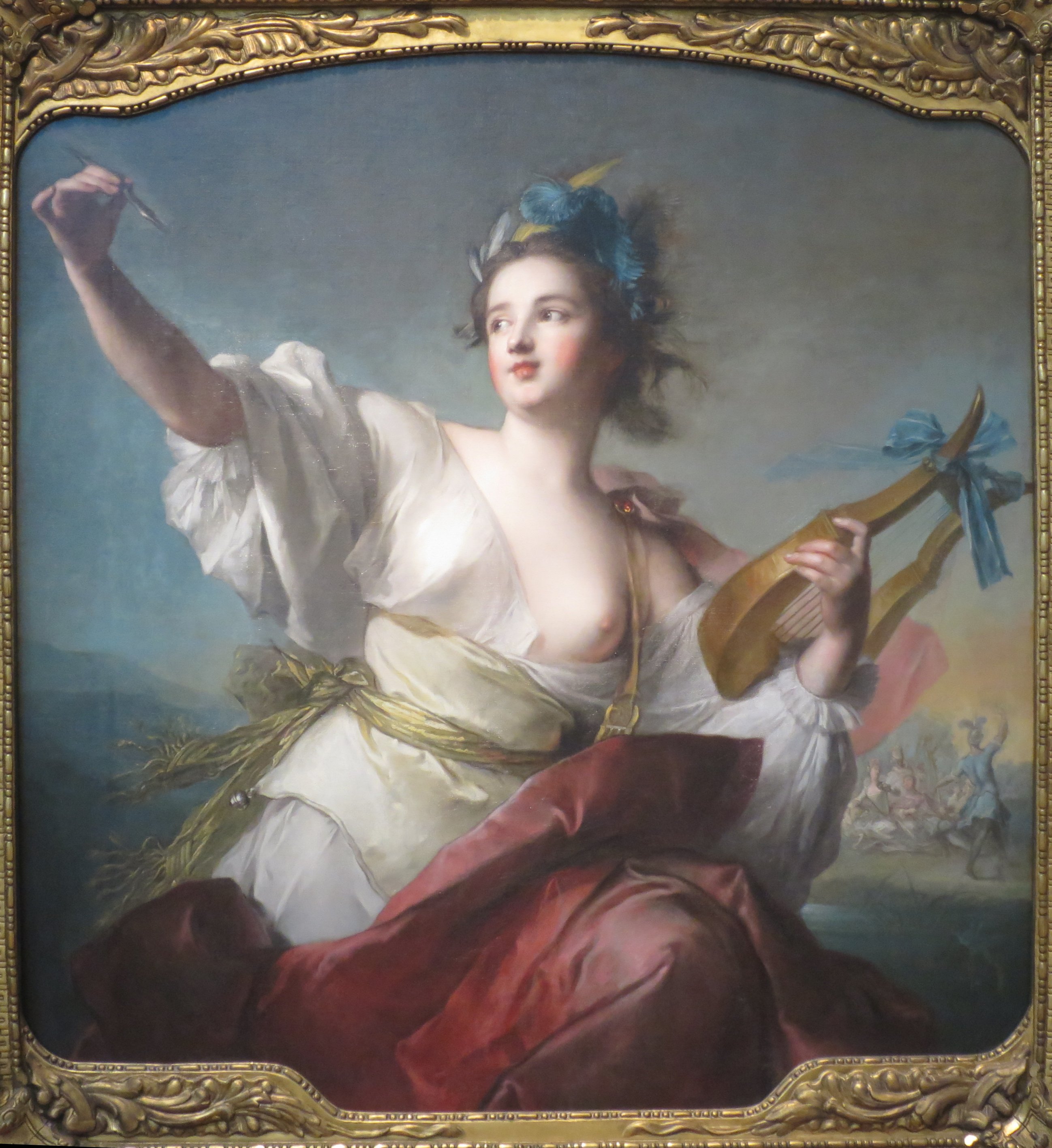
Terpsichore votes "Remain"

Τερψιχόρη
Jean-Marc Nattier


Tomorrow I will vote "Remain" and one of the reasons why I shall do so is that I care about the arts and creative industries in general and the performing arts and ballet in particular.

The case for Remain was made eloquently by members of the Creative Industries Federation in their briefing note Why is EU membership so important for the health of UK’s arts, creative industries and cultural education?  It was echoed  in Ismene Brown's article The Royal Ballet and Sadler’s Wells explain how Brexit will hurt dance 13 June 2016 and supported by Jessica Duchen's I'm IN, and here's why you should be too 25 May 2016 JDCMB which I mentioned in my own article Should we stay or should we go? 30 May 2016.

Much of the steam for the Leave campaign has been generated by concern about immigration. There is some outright xenophobia in that sentiment but I believe that it is mainly a worry about shortages of housing, healthcare, education and other public services which could be overcome with proper planning and resourcing.

For the arts, free movement of labour is essential.  Let me give just one example. Earlier this month the Scottish Ballet delighted audiences throughout Scotland and the North of England with David Dawson's Swan Lake (see Empire Blanche: Dawson's Swan Lake 4 June 2016). Dawson was born in London and trained at Tring Park and the Royal Ballet School but he has spent much of his career with the Dutch National Ballet where he is now an associate artists. He is not the only Brit there. The company's artistic director is Matthew Rowe who is another Londoner (in fact as there is a reference to him in the latest issue of The Pauline he may even have attended my old school).

Conversely many of Scottish Ballet's finest dancers come from France: Constance Deverney recently promoted to principal, Sophie Martin, Marge Hendrick, and Laura Joffre to name just a few. The same is true of our other leading companies. Where would the Royal Ballet be without Laura Morera or Federico Bonelli? The Birmingham Royal Ballet without Koen Kessels?  English National Ballet without Tamara Rojo or Alina Cojocaru?

There are dancers from the EU also in our splendid regional companies like Giuliano Contadini and Kevin Poeung with Northern Ballet and Allegra Vianello and Andrea Battagia with Ballet Cymru. I could go on.

Those artists delight us. Let's continue to make them feel welcome tomorrow.

Thursday, 19 May 2016

Rarely have I been so impressed by a new ballet


Standard YouTube Licence


Screening of the Royal Ballet's Frankenstein, 18 May 2016

I always look forward to my Wednesday evening ballet class at Northern Ballet or the University of Huddersfield and I have turned down invitations to posh receptions in order to attend one or other of those classes before now. Tonight, however, I skipped class to attend the screening of Liam Scarlett's Frankenstein.   I am very glad I did for rarely have I been more excited by a new ballet. I am metaphorically kicking myself for not getting a reasonably priced ticket in the amphitheatre stalls during the Friends' booking window when I had the chance. However, I did the next best thing by watching the HDTV transmission from Covent Garden in the National Media Museum in Bradford, which happens to be the home town of Thomas Whitehead who played a key role in last night's ballet.

As Darcey Bussell noted before the screening most of us know Frankenstein from Hollywood rather than Mary Shelley's novel and fail to appreciate its themes and subtleties. Scarlett has returned to the original in creating his ballet. Very briefly, a young medical student called Victor Frankenstein, grief stricken by the death of his mother in childbirth, becomes obsessed with bringing the dead back to life. In a neurology class in the anatomy theatre a lecturer applies Galvani's experiments with frog legs to human body parts and gets a limb to twitch after a  current is applied to the nerve ends.  That was possible with frogs but not with more advanced creatures at that time but never mind. That experiment gives Victor the idea that electricity is the life force. Instead of enjoying himself womanizing in the pub like all the other medical students he experiments with stitching together body parts and charging them with electricity. Eventually he succeeds in making a functioning composite cadaver which breaks out of the laboratory and terrorizes the public.

One of its victims is Victor's little brother who is left alone blindfolded for a few minutes by his family. The monster plays with him gently at first but the boy dies of shock on seeing the monster's gruesome form. The boy's body is found by his nurse, Justine, who is accused of murdering him. The second act ends with the poor woman dangling from the gallows which to my mind is the most disturbing scene of the show. In the last act Victor marries his sweetheart, Elizabeth, but the monster shows up at their wedding knocking off first Victor's father, then his best mate Henry and finally Elizabeth. Desperate at the loss of everyone he has ever loved in his life Victor shoots himself. The last scene shows the monster cradling its creator.

This is a tremendous work making enormous demands of every single role player in the story. I suppose the greatest demands are made of the monster danced last night by Steven McRae. "McRae as a monster", I hear you cry. "He's the last dancer I would cast in that role. Ed Watson perhaps or maybe Muntagirov, but McRae is such a sweet, sensitive young man." Well let me tell you, McRae does monsters and how. The make-up and wardrobe department performed a minor miracle in dressing him with horrid gory stitch marks across his face and body. He was as horrible as anything out of Hammer Films. But this was a sensitive monster who was looking for love first from the little boy, then Elizabeth and finally his creator. Not so very far off McRae's other roles I think you will agree.

Federico Bonelli danced Victor Frankenstein. I have long been a fan of this dancer but he rose even higher in my esteem as he developed his character on stage from lost little boy, to swotty undergraduate, obsessed researcher, young master, gentle suitor and in all stages of the ballet tortured soul. The other big male role was Henry who played all round good egg from the moment he befriended Victor in medical school. Like Victor he had no time for drinking, carousing and having a nice time like all other sensibly adjusted students. He was danced last night by Alexander Campbell, and a very good job he did too.

The main female role was Elizabeth danced last night by Laura Morera who was Scarlett's muse in Viscera (see Au Revoir but not Adieu 19 Nov 2015. I am a great fan of Morera and once had the pleasure of meeting her and telling her how much I admire her work (see Laura Morera 25 Aug 2015). She is a fine actor well as a great dancer. She is a master of detail - remember her little mannerisms as she writes in Victor's commonplace book as he is about to set off for medical school - but also her mid-air rotations as Victor tosses her into the air without really looking at her. It must have been so scary for her to do those turns.

"And Thomas Woodhead? You say he danced a key role." Why yes, indeed, for he was the lecturer who demonstrated the life giving force of electricity to the students and gave Victor the idea for his research. We have all taken classes from lecturers like him. Brilliant. Sarcastic. Frightening for the callow undergraduate. I was reminded of my economic history classes at St Andrews. "Karl Marx was born in 1818 and died - not a day before time - in 1883" delivered in the cultured tones of Morningside "where sex is what the coal comes in."

A ballet like this requires a remarkable score and it was provided by Lowell Liebermann. It was a work of our times - not a pastiche - but it caught the flavour of the period where that was needed. It was one of the most beautiful new works I have ever heard and I long to listen to it again perhaps next time in the concert hall. If anyone wants to get me a present for Christmas I'll have a recording of the score as soon as soon as it comes out on DVD.

Equally impressive were John MacFarlane's designs, particularly his apparatus for generating static electricity and the electrodes for applying it to humans. This was one of the most realistic props I have ever seen on stage in any kind of show.  And the gallows scene too which would have made me throw up had I visited the Kash before the show rather than after.

There is so much to write about this production but I have a living to earn and nobody pays me to write ballet reviews.  There are still some seats available for the last three performances in London. If you can make the show then go. It will soon be staged in San Francisco.  I'd say its worth the 9 hour flight if you miss it here and I am seriously contemplating a trip there.

Liam Scarlett is a remarkable talent. First, Vicera. then No Man's Land  and now this. He is still a very young man.  Imagine what he will be doing in 20 or 30 years time.

Sunday, 3 April 2016

Cuthbertson's Giselle


Standard YouTube Licence

Royal Ballet, Giselle, Royal Opera House, Covent Garden, 2 April 2016

In an interview with the journalist Mark Moynihan which is transcribed in the Royal Ballet's programme notes for this season's Giselle, Sir Peter Wright said:
"When I first saw Giselle way back in the early 1940s I used to think: 'That's silly. That doesn't make sense. So when John [Cranko] asked me to do Giselle my first reaction was, 'Oh no, I couldn't do that - that poor young girl going mad'. The ballet always seemed rather inconsistent to me and sometimes downright stupid."
Until last night that had been my reaction too. I had always been troubled by the libretto (possibly for the same reason as Wright for he had been brought up as a Quaker and I have become one) as the second act is very dark, superstitious, even a little satanic, or so it had appeared to me for many years. My coping mechanism until last night had been to put the story out of my mind and concentrate on the dancing as thought it were an abstract work like Jewels or Les Sylphides.

However, Sir Peter changed his mind about Giselle and so have I.  In Sir Peter's case it was only when he saw the great Russian ballerina Galina Ulanova's interpretation of the role of Giselle when the Bolshoi first came to London that he realized what an extraordinary work it could be. That is because the libretto is coded or perhaps, more accurately, on more than level. There is all the difference in the world between knowing the story of a ballet and understanding it. Sir Peter needed Ulanova to unlock the work for him and it was Lauren Cuthbertson last night who did the same for me.

I am not a newbie when it comes to ballet. I have seen Giselle many times by several different companies with some of the world's greatest ballerinas in the title role. The best compliment that I can pay to Cuthbertson is that she unlocked the ballet for me much in the way that Ulanova appears to have done for Sir Peter. Yesterday I saw not a ballerina dancing Giselle but Giselle herself and for the first time I really understood the ballet which has far more substance than I had previously supposed. Giselle was not stupid but in love - or least infatuated - and infatuation makes fools of us all. I have seen what it has done to my friends and it is actually one of the stories on my favourite radio soaps right now as Helen ignores the danger signs that are so obvious to her friend, Kirsty - just as Giselle ignores the tampering with the petals and the other indicators that were so clear to her mum and, of course, Hilarion.

What is it about Cuthbertson's performance that was so special last night? I don't know. I had seen her several times before and admired her artistry and virtuosity. I had listened to her talk to the London Ballet Circle and even managed to meet her brielfy afterwards to say how much I enjoyed her work. It may be that her horrendous injury has made her an even greater artist (see Nowness's video London's Royal Ballet I Portrait of a Dancer: Lauren Cuthbertson) but if that were so, why? Perhaps she was in the right place at the right time to interpret Giselle for me.

One of the hitherto exasperating points of Giselle had been that Albrecht, the cad, survived the wilis but Hilarion who lost the girl also had to die. But actually that is one of the points of the ballet that Wright's production and Cuthbertson's dancing brought out last night. Nobody is beyond redemption - not even after death. Albrecht showed remorse for his treachery and Giselle forgave him and, who knows, was perhaps redeemed herself by sustaining him through his trial. There is a crucial bit of the choreography that I had missed in the past where Giselle stands before Albrecht with her hands outstretched in the form of a cross from which Myrtha and the other wilis are forced to turn away. They recover, of course, and continue their persecution until the exhausted Albrecht is saved, quite literally, by the bell.

And Hilarion? Well he was jealous and let his jealousy get the better of him which caused Giselle to stab herself (at least in Sir Peter's version). He did visit her grave but he fell asleep and ran into the woods as lights flashed and wilis darted across the stage. It was perhaps his lack of courage, his lack of resolve and his jealousy and selfishness that condemned him.

Great though Cuthbertson was last night she needed a strong partner and Federico Bonelli partnered her magnificently. "Wasn't that so beautiful!" whispered the lady next to me during a moment for applause, "he held her as if she were a feather." It was indeed beautiful and I was close to tears. I have to think long and hard in my half century of ballet going to remember a pas de deux that has moved me as much. Sibley and Dowell perhaps? But I can't for the moment think what that could have been.

A strong performance, too, from Benet Gartside as moody, sulky, vengeful and in the end irresolute, Hilarion. As I say, I had always felt sorry for the gamekeeper in the past but I had less sympathy for him in Gartside's interpretation of the role - though I still find it hard to understand why he had to die. Berthe (Giselle's mum) danced by Elizabeth McGorian was crucial to the story. Usually she is the spoil sport - Madame Simone transposed - who stops her daughter dancing but yesterday she showed she had good reason as she predicted her daughter's suicide in mime. Spine chilling performances, also, from Claire Calvert as the icy, imperious, heartless, spiteful queen of the wilis and from Elizabeth Harrod as Moyna and Meaghan Grace Hinkis as Zulme. In fact, the whole cast was great. The only reason I have not mentioned more names are the usual limitations of time and space.

Regrettably I had to leave the Opera House, Cinderella like, after the first few curtain calls to catch my train back to Yorkshire but the clapping and cheers were deafening even outside the auditorium. When the flower market was next door the stage would have been knee deep in flowers after a performance like last night's. The dancers - Cuthbertson in particular - were extraordinary and I hope this review does justice to them all.