Showing posts with label Laura Morera. Show all posts

Saturday, 21 January 2023

"Like Water for Chocolate" in the Cinema

Standard YouTube Licence


Royal Ballet Like Water for Chocolate Royal Opera House Recorded 9 June 2022, Screened 19 Jan 2023

If you have not already seen Like Water for Chocolate on stage or on screen I strongly advise you to watch the encore tomorrow.  I have done both.  Tomorrow I am going to the Leeds Showcase to watch it for a third time.  It is the best show that I saw last year.  Indeed, it is one of the best that I have seen in a lifetime of theatre-going.

I was in Covent Garden on 8 June 2022 which was the day before the show was recorded for Thursday's and tomorrow's screenings.  I reviewed it in Like Water for Chocolate on 23 July 2022.  The ballet prompted me to hire the film and buy the book which I could, quite literally, not put down until I had reached the very last page (see Further Reflections on "Like Water for Chocolate" 26 July 2022),  In those articles, I  enthused over Wheeldon's libretto and choreography, Talbot's score, Crowley's designs and Katz's lighting. If you want to learn about all that you will find them in those articles. 

Music and designs for the three-dimensional stage do not always transfer well to a two-dimensional screen. In this case, I think the change of medium worked well.  The biggest difference between the live performance and Thursday's screening was the cast.  

Tita was Francesca Hayward who interpreted the role quite differently from Yasmine Naghdi. I sensed the difference early in the ballet.  At her sister's wedding, the guests throw up. For Hayward that was a disaster. A final humiliation after a day of humiliation.  I really suffered with her. For Naghdi I felt: "serve them bloody right." Not quite revenge but certainly kama. 

Marcelino Sambe danced Pedro exactly as I had imagined him in the book,  Not all that bright and rather wet but somehow infuriatingly attractive.  Again, very different from Cesar Corrales's Pedro who became a very convincing Juan Alejandrez on screen.  

Laura Morera was a scary Elena in life and perhaps even more in death.  I softened to her the first time around as I recalled her suffering but my sympathy quickly evaporated as that outside body with its shock of straight orangey-brown hair tormented her daughter. Meaghan Grace Hinkis was Gertrudis, the sister to whom I warmed the most. Mayara Magri danced Rosaura, the one to whom I warmed the least. Matthew Ball danced the decent but injured Dr John.

One of the advantages of the recording was the focus on the Mexican conductor Alondra de la Parra. She had also been the musical consultant introducing composers, instruments and music from Mexico.  In an interview before the show, pride in her country and culture were brimming.  On the day I visited Covent Garden, she unfurled a Mexican tricolour at the reverence or curtain call. 

Of course, there would have been no ballet had there been no book. Those who have never read the book nor seen the film can track the story here.  There is a wonderful interview of Esquivel with Wheeldon on YouTube entitled Insights: Like Water For Chocolate — Beginnings and Origins.  I cannot recommend it too highly.

Wednesday, 6 November 2019

All Credit to the Royal Ballet's Dancers last night. If only the Presenters and Techies were as good.


Standard YouTube Licence


Royal Ballet Triple Bill: Concerto, Enigma Variations and Raymonda  streamed from the Royal Opera House to cinemas worldwide including Leeds-Bradford Odeon, 5 Nov 2019, 19:15

If the Royal Opera House had subcontracted the streaming of its live performances to Pathé Live or at least recruited Ekaterina Novikova, yesterday's screening of the Concerto, Enigma Variations and Act III of Raymonda would have been perfect.  The double act between Anita Rani and Darcey Bussell just did not work. Alexander Campbell and Kristen McNally who recently hosted World Ballet Day were so much better.

Also, I probably saw the screening at the wrong cinema.  I was at Leeds Bradford Odeon which has been promoted as a super luxury auditorium. Each seat has an airline-style tray enabling patrons to chomp away as you watch the feature.  Fine for Disney perhaps but not for ballet.  Also, the transmission started late.  No more than 5 minutes before the curtain was raised.  Nobody in the cinema had bothered to print the programmes even after I had given a member of their staff the URL from which they could be downloaded. The ladies' loos on the first floor were a disgrace because they could not be flushed properly.

Happily, my mood changed the moment Maestro Sorokin entered the orchestra pit. Soon I was enchanted by the music of Shostakovich and MacMillan's choreography.  Concerto is a very short piece but it must require considerable strength, stamina and concentration to do well.  The dancers were Anna Rose O'Sullivan, James Hay, Yasmine Naghdi Ryoichi Hirano and Mayara Magri.  The set was very simple.  Just a red disc like a setting sun for the second movement.  So, too, were Rose's costumes. They filled the stage and uplifted even the cinema audience.

In the interval, Rani and Bussell interviewed Wayne Sleep and Alfreda Thoroughgood.  They were the leading dancers of my youth and it was so good to see them again. They had, of course, aged but they were still beautiful.  I am not sure that I ever saw Thoroughgood in Enigma Variations but I certainly remember Sleep, Anthony Dowell and the wonderful Antoinette Sibley as Dorabella.  When one associates a role with a dancer it is always difficult to watch another artist a generation later fill her shoes but I was more than happy with Francesca Hayward in Sibley's role.  I was also delighted with Laura Morera as Lady Elgar and Christopher Saunders as Elgar.  I think is my favourite Ashton work. It is certainly my favourite of his short works.  I can't remember when I last saw it but it was good to see it again.

The last work was a treat with Natalia Osipova in the title role and Vadim Muntagirov as de Brienne. Having seen the Bolshoi's performance of Raymonda on 27 Oct 2019, I would dispute that it is a silly story or not much of a story as Bussell or someone else last night.  I think there is a love triangle between de Brienne, Raymonda and Abderakhman and anyone restaging the ballet might want to develop that.  Abderakhman/s treatment could be explained by Islamophobia or racism. To my mind, the last Act, which is one big divertissement, is the least interesting of the ballet.  But it provides plenty of scope for virtuosity,  Being Guy Fawkes day, Osipova and Muntagirov excited us as well as any pyrotechnics outside.

So my thoughts of the evening are as follows: All credit to the Royal Ballet's dancers and creatives last night, If only the presenters and techies were as good.

Tuesday, 5 September 2017

Ann Maguire Gala 2017


On Sunday 3 Sept, my friend Erin and I attended the Ann Maguire Gala 2017 at Leeds Grand Theatre. The money raised by the ticket sales went towards the Ann Maguire Arts Education Fund less the essential running costs. All the performers and stage crew volunteered to be part of this event. 

But this event was not just any old dance gala.  No. It was an incredible opportunity for us to feast our eyes upon dancers from the Royal Ballet, Northern Ballet and Ballet Boyz. The repertoire consisted of choreography by Kenneth MacMillan, Frederick Ashton, Liam Scarlett, Will Tuckett, Alastair Marriott, Steven McRae and Christopher Wheeldon.

As one who does not have a lot of money, this was an opportunity for me to see some of my favourite dancers.

I was so incredibly excited!

Erin and I filled with excitement for the night's event. 
The show began with an introduction by Wayne Sleep.  I was surprised to see how small he is in real life

The first act included
  • the second movement pas de deux from Concerto,
  • a piece enitled simply New Work, 
  • the White Swan pas de deux, 
  • Quizas, 
  • Aeternum pas de deux and 
  • Voices of Spring.  
I shan't go into detail about every piece of the programme, but will instead talk about the pieces that have stuck in my mind since Sunday night.
Quizas was a new piece choreographed by Will Tuckett, to the track of the same name by Nat King Cole and Shigeru Umebayashi. It was performed by Laura Morera and Ricardo Cervera. It has a very latin vibe to it but was still balletic.  I truly found myself falling in love with it. I just wanted to get up and dance with them. It looked so incredibly fun! And, of course, effortless, much to the credit of the dancers.

Ashton's Voices of Spring was performed by Yuhui Choe and recently promoted Alexander Campbell. It was so beautiful to watch. It left me feeling like I was dreaming at the end of the act!

The second act opened with a musical medley of songs from Les Miserables and West Side Story performed by Leeds Youth Opera.

Act two included
  • Debussy's Clair de Lune performed by Edward Watson,
  • Christopher Wheeldon's Within the Golden Hour pas de deux,
  • Asphodel Meadows - second movement pas de deux
  • Northern Ballet's 1984 by Jonathan Watkins- the final pas de deux
  • Steven McRae's famous tap piece Czardas
  • Meditation from Thais pas de deux, and 
  • Le Corsaire - pas de deux.
Clair de Lune was one of my favourite performances of the whole night. It was very simple and elegant. Watson executed the most incredible attitude turns (believe me when I say from my own experience they're hard). His ending position which was a plié in second, left Erin and me breathless for he did not move at all - for what seemed like forever. Not even shaking!

Czardas by Steven McRae was so much fun. He was accompanied on the stage with violinist Vasko Vassilev. Both artists were truly incredible to watch.  I would love to watch this over again and again.*

Le Corsaire pas de deux was performed by Akane Takada and Benjamin Ella. Akane did all 32 fouette turns perfectly and Benjamin flew across the stage with his incredible jumps. It was a truly a delight to watch. It left the audience on such a high note!

Finally, the night concluded with a thank you from Wayne Sleep and Emma Maguire (the daughter of the late Ann Maguire and event organiser) followed by, of course. the curtain call. each of the performers was given a single red rose.  I was left feeling overwhelmed and happy to have watched such a wonderful night of performances.

Myself with Edward Watson
Erin with Alexander Campbell

The night, however, did not end there for Erin and I decided to go to the stage door after the performance. We were fortunate enough to meet Alexander Campbell, Steven McRae, Fumi Kaneko and Edward Watson. All of whom were lovely, and we had enjoyable conversations with them. We found out that the stage was raked, which made us gasp even more. We sadly did not meet any of the other artists due to having to catch a train back to Huddersfield from Leeds and it was quite late. But I still cannot believe we met some of our absolute favourite dancers, let alone watched them perform. It will be a night I will remember for the rest of my life!

Amelia x

* You can.  He performed it on World Ballet Day and a video of his performance is right here (Ed).

Wednesday, 12 April 2017

Jewels - The Royal Ballet at its best


Standard YouTube Licence

The Royal Ballet, Jewels, transmitted live to cinemas, 11 April 2017, 19:39


I once asked a distinguished panel of dance critics, dancers and the artistic director of Scottish Ballet whether a narrative ballet needed a plot (see My Thoughts on Saturday Afternoon's Panel Discussion at Northern Ballet 21 June 2015). All said no except Tobias Batley who was then a premier dancer at Northern Batley and seemed to have an interesting point to make but did not get the chance to develop it. When I asked that question I had Balanchine's Jewels in mind which actually tells a lot of stories from the history of ballet to the choreographer's life history without actually having a libretto.

Jewels is like a denial of service attack on the senses. Each of the three ballets is a feast in itself. You feel you can only take so much colour, and movement, and music in one evening - but after each act, there is more.  The only experience with which I can compare this ballet is, in fact, my first sight of real jewels. The Crown Jewels on my first trip to London. The impression that the dazzling display of light and colour made on a little five-year-old from the North in post-war Britain was very much the same as the concatenation of dancers in green, red and white create whenever I see Balanchine's masterpiece.

On Sunday I remarked that I had seen the Bolshoi at its best (see A Hero of our Time 10 April 2017). Yesterday, audiences around the world saw the Royal Ballet at its best. The company fielded Beatriz Stix-Brunell, Valeri Hristov, Laura Morera, Ryoichi Hirano, Emma Maguire, Helen Crawford and James Hay in Emeralds.  As readers know, I am one humongous fan of Morera whose hand I once had the good fortune to shake (see Laura Morera  25 Aug 2015). She always delights me but yesterday she raised my admiration to a new level.

More favourites in Rubies - Sarah Lamb, Steven McRae and Melissa Hamilton. If Emeralds was lyrical, Rubies was spectacular. One gorgeous explosion of movement after another culminating in McRae's exit in chaînés. A dynamo harnessed to McRae at that moment could have powered a fair size town. Rubies is the shortest work in the three ballets but it is the one I like best, possibly because of Stravinsky's Capriccio possibly just the New World razmataz. The energy. The fun.

Diamonds, the white act, is sublime. An homage to Petipa. Marianela Nuñez and Thiago Soares were majestic. Stix-Brunnell and Hay returned to join them together with Claire Calvert, Tierney Heap, Yasmine Naghdi, Nicol Edmonds, Fernando Montaño and Valentino Zucchetti. Not all Petipa's ballets end well but some of them do. Think of The Sleeping Beauty, The Nutcracker and all your other favourites rolled into one and combine it with Tchaikowsky's Polish symphony and you understand why I compared the overpowering of the senses to the overwhelming of a website by millions of messages.

I should also say something about the presentation. I was very impressed with Kristen McNally. I warmed to her the moment she opened her mouth. Proud, elegant, knowledgeable, amusing and above all, Northern. I do hope the Royal Opera House enlists her services again. It was also good to see Darcey Bussell as it always is but this time she was there in her capacity as a great ballerina escorting a member of the original cast to the jeweller's shop that inspired Balanchine. A beautiful dancer surrounded by beautiful things. That is how I like to think of her. It would be good to see more of her in scenes like that.

Wednesday, 22 June 2016

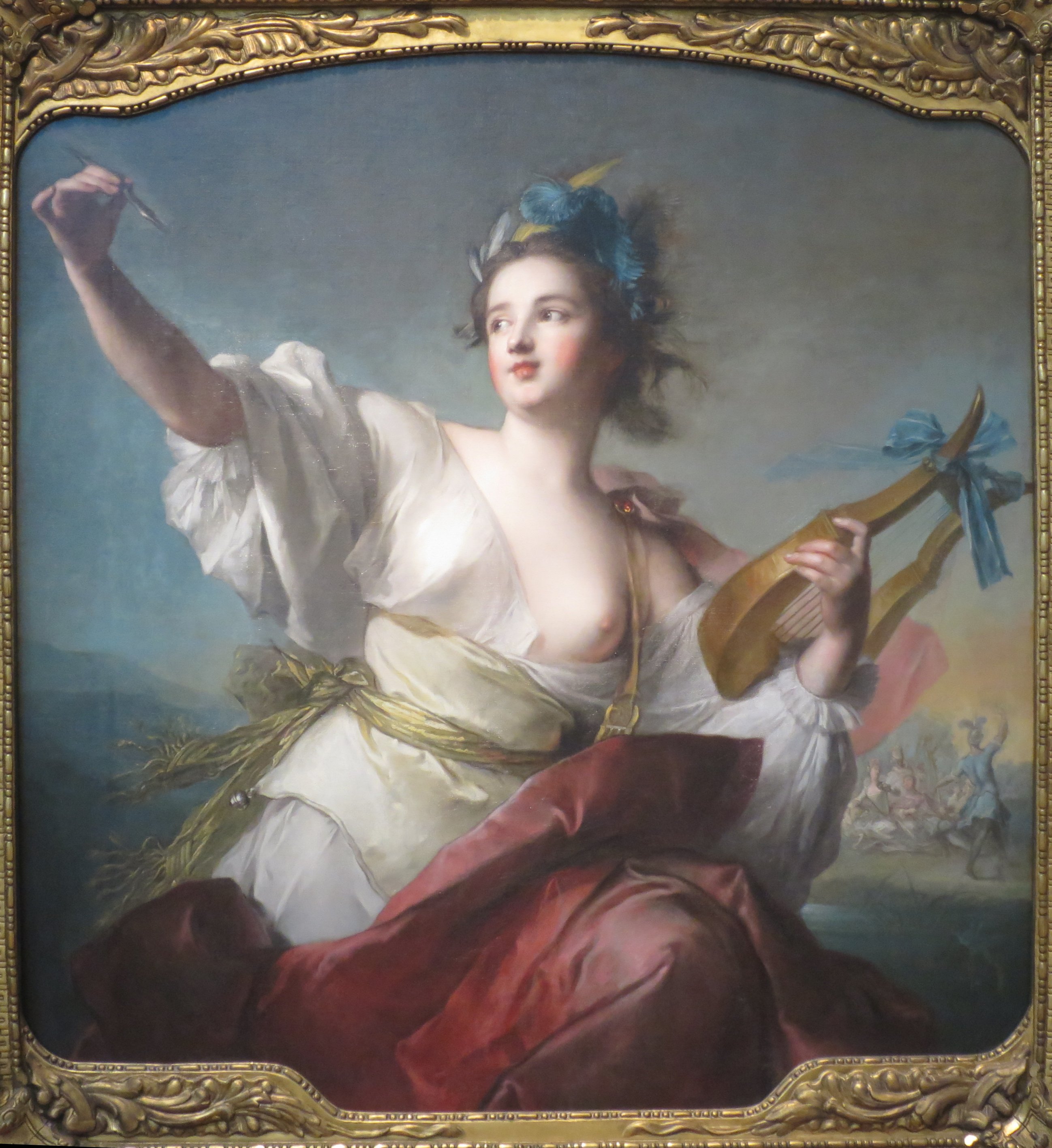
Terpsichore votes "Remain"

Τερψιχόρη
Jean-Marc Nattier


Tomorrow I will vote "Remain" and one of the reasons why I shall do so is that I care about the arts and creative industries in general and the performing arts and ballet in particular.

The case for Remain was made eloquently by members of the Creative Industries Federation in their briefing note Why is EU membership so important for the health of UK’s arts, creative industries and cultural education?  It was echoed  in Ismene Brown's article The Royal Ballet and Sadler’s Wells explain how Brexit will hurt dance 13 June 2016 and supported by Jessica Duchen's I'm IN, and here's why you should be too 25 May 2016 JDCMB which I mentioned in my own article Should we stay or should we go? 30 May 2016.

Much of the steam for the Leave campaign has been generated by concern about immigration. There is some outright xenophobia in that sentiment but I believe that it is mainly a worry about shortages of housing, healthcare, education and other public services which could be overcome with proper planning and resourcing.

For the arts, free movement of labour is essential.  Let me give just one example. Earlier this month the Scottish Ballet delighted audiences throughout Scotland and the North of England with David Dawson's Swan Lake (see Empire Blanche: Dawson's Swan Lake 4 June 2016). Dawson was born in London and trained at Tring Park and the Royal Ballet School but he has spent much of his career with the Dutch National Ballet where he is now an associate artists. He is not the only Brit there. The company's artistic director is Matthew Rowe who is another Londoner (in fact as there is a reference to him in the latest issue of The Pauline he may even have attended my old school).

Conversely many of Scottish Ballet's finest dancers come from France: Constance Deverney recently promoted to principal, Sophie Martin, Marge Hendrick, and Laura Joffre to name just a few. The same is true of our other leading companies. Where would the Royal Ballet be without Laura Morera or Federico Bonelli? The Birmingham Royal Ballet without Koen Kessels?  English National Ballet without Tamara Rojo or Alina Cojocaru?

There are dancers from the EU also in our splendid regional companies like Giuliano Contadini and Kevin Poeung with Northern Ballet and Allegra Vianello and Andrea Battagia with Ballet Cymru. I could go on.

Those artists delight us. Let's continue to make them feel welcome tomorrow.

Thursday, 19 May 2016

Rarely have I been so impressed by a new ballet


Standard YouTube Licence


Screening of the Royal Ballet's Frankenstein, 18 May 2016

I always look forward to my Wednesday evening ballet class at Northern Ballet or the University of Huddersfield and I have turned down invitations to posh receptions in order to attend one or other of those classes before now. Tonight, however, I skipped class to attend the screening of Liam Scarlett's Frankenstein.   I am very glad I did for rarely have I been more excited by a new ballet. I am metaphorically kicking myself for not getting a reasonably priced ticket in the amphitheatre stalls during the Friends' booking window when I had the chance. However, I did the next best thing by watching the HDTV transmission from Covent Garden in the National Media Museum in Bradford, which happens to be the home town of Thomas Whitehead who played a key role in last night's ballet.

As Darcey Bussell noted before the screening most of us know Frankenstein from Hollywood rather than Mary Shelley's novel and fail to appreciate its themes and subtleties. Scarlett has returned to the original in creating his ballet. Very briefly, a young medical student called Victor Frankenstein, grief stricken by the death of his mother in childbirth, becomes obsessed with bringing the dead back to life. In a neurology class in the anatomy theatre a lecturer applies Galvani's experiments with frog legs to human body parts and gets a limb to twitch after a  current is applied to the nerve ends.  That was possible with frogs but not with more advanced creatures at that time but never mind. That experiment gives Victor the idea that electricity is the life force. Instead of enjoying himself womanizing in the pub like all the other medical students he experiments with stitching together body parts and charging them with electricity. Eventually he succeeds in making a functioning composite cadaver which breaks out of the laboratory and terrorizes the public.

One of its victims is Victor's little brother who is left alone blindfolded for a few minutes by his family. The monster plays with him gently at first but the boy dies of shock on seeing the monster's gruesome form. The boy's body is found by his nurse, Justine, who is accused of murdering him. The second act ends with the poor woman dangling from the gallows which to my mind is the most disturbing scene of the show. In the last act Victor marries his sweetheart, Elizabeth, but the monster shows up at their wedding knocking off first Victor's father, then his best mate Henry and finally Elizabeth. Desperate at the loss of everyone he has ever loved in his life Victor shoots himself. The last scene shows the monster cradling its creator.

This is a tremendous work making enormous demands of every single role player in the story. I suppose the greatest demands are made of the monster danced last night by Steven McRae. "McRae as a monster", I hear you cry. "He's the last dancer I would cast in that role. Ed Watson perhaps or maybe Muntagirov, but McRae is such a sweet, sensitive young man." Well let me tell you, McRae does monsters and how. The make-up and wardrobe department performed a minor miracle in dressing him with horrid gory stitch marks across his face and body. He was as horrible as anything out of Hammer Films. But this was a sensitive monster who was looking for love first from the little boy, then Elizabeth and finally his creator. Not so very far off McRae's other roles I think you will agree.

Federico Bonelli danced Victor Frankenstein. I have long been a fan of this dancer but he rose even higher in my esteem as he developed his character on stage from lost little boy, to swotty undergraduate, obsessed researcher, young master, gentle suitor and in all stages of the ballet tortured soul. The other big male role was Henry who played all round good egg from the moment he befriended Victor in medical school. Like Victor he had no time for drinking, carousing and having a nice time like all other sensibly adjusted students. He was danced last night by Alexander Campbell, and a very good job he did too.

The main female role was Elizabeth danced last night by Laura Morera who was Scarlett's muse in Viscera (see Au Revoir but not Adieu 19 Nov 2015. I am a great fan of Morera and once had the pleasure of meeting her and telling her how much I admire her work (see Laura Morera 25 Aug 2015). She is a fine actor well as a great dancer. She is a master of detail - remember her little mannerisms as she writes in Victor's commonplace book as he is about to set off for medical school - but also her mid-air rotations as Victor tosses her into the air without really looking at her. It must have been so scary for her to do those turns.

"And Thomas Woodhead? You say he danced a key role." Why yes, indeed, for he was the lecturer who demonstrated the life giving force of electricity to the students and gave Victor the idea for his research. We have all taken classes from lecturers like him. Brilliant. Sarcastic. Frightening for the callow undergraduate. I was reminded of my economic history classes at St Andrews. "Karl Marx was born in 1818 and died - not a day before time - in 1883" delivered in the cultured tones of Morningside "where sex is what the coal comes in."

A ballet like this requires a remarkable score and it was provided by Lowell Liebermann. It was a work of our times - not a pastiche - but it caught the flavour of the period where that was needed. It was one of the most beautiful new works I have ever heard and I long to listen to it again perhaps next time in the concert hall. If anyone wants to get me a present for Christmas I'll have a recording of the score as soon as soon as it comes out on DVD.

Equally impressive were John MacFarlane's designs, particularly his apparatus for generating static electricity and the electrodes for applying it to humans. This was one of the most realistic props I have ever seen on stage in any kind of show.  And the gallows scene too which would have made me throw up had I visited the Kash before the show rather than after.

There is so much to write about this production but I have a living to earn and nobody pays me to write ballet reviews.  There are still some seats available for the last three performances in London. If you can make the show then go. It will soon be staged in San Francisco.  I'd say its worth the 9 hour flight if you miss it here and I am seriously contemplating a trip there.

Liam Scarlett is a remarkable talent. First, Vicera. then No Man's Land  and now this. He is still a very young man.  Imagine what he will be doing in 20 or 30 years time.

Thursday, 19 November 2015

Au Revoir but not Adieu


Embedded pursuant to YouTube's standard licence


I was very tempted to attend the Royal Ballet's mixed programme to see Carlos Acosta's last performance on the main stage of Covent Garden on Thursday night for I was offered a ticket for the grand circle for only £100. The reason I was tempted was that I knew that I would see a little piece of balletic history. But then I would have missed Phoenix Dance Theatre at the Royal Opera House and I knew that that would be good too. Torn though I was I opted for Phoenix (see The Phoenix Soars over London 13 Nov 2015) as they are from Leeds. I see them nearly every time I attend an adult ballet class. Some of these classes even take place in their studios.

One of the reasons why I chose to watch Phoenix in the Linbury was that I knew the mixed bill would be filmed and that I would get a chance to see that film at the Huddersfield Odeon on Sunday, That is what I did. The Royal Opera House HDTV transmissions have just about got it right now. The show was introduced by Fiona Bruce who is an experienced TV presenter. Darcey Bussell interviewed Carlos Acosta and Kevin O'Hare and contributed anecdotes from her experience as a principal dancer. The programme consisted of four ballets: Liam Scarlett's Viscera. Jerome Robbins's Afternoon of a Faun, Tchaikowsky Pas de Deux by Balanchine and Carlos Acosta's Carmen. It was a thrilling programme showing the Royal Ballet at its best.

Ever since I heard Laura Morera's talk to the London Ballet Circle I have wanted to see Viscera (see Laura Morera 25 Aug 2015). Although the work was commissioned by Miami City Ballet it is associated with Morera in this country.  In the cinema transmission Morera was accompanied by Ryoichi Hirano and Marianela Nuñez.  Viscera is a spectacular ballet in three movements. It reminds me very much of David Dawson's Empire Noir which I saw in Amsterdam as part of the Dutch National Ballet's Cool Britannia programme earlier in the year  (see Going Dutch 29 June 2015) in that everything except the second movement is done on the double. There were spectacular turns and jumps by in the first and last movements and a delicious duet in the middle with the most delicate lifts and holds. The ballet was set to Lowell Liebermann's First Piano Concerto. You can get a taste of Liebermann's work from this concert performance of the third movement on this YouTube video.

Viscera was followed by an interval which showed an interview of Carlos Acosta by Darcey Bussell over tea. Acosta spoke about his career in England: how he entered ballet largely on his father's insistence, his short time with the English National Ballet where he actually contemplated giving up dance, his audition with the Royal Ballet, his career with the company and the two works that he created for it. Bussell shone as Acosta's interviewer. She coaxed the story from Acosta adding her own reminiscences here and there. This is what she does well.

The next act consisted of Afternoon of a Faun and the Tchaikovsky Pas de Deux.  These are two short works by two of America's best known choreographers.  Robbins's Afternoon  shares the music and title of Nijinsky's L'Après-midi but, as can be seen from archive film of the Nijinsky's work and a video of the Ballett am Rhein's performance of Robbin's, the narratives are quite different.  I am not sure which work I prefer. The Robbins probably makes more sense as it is set in a dance studio with the audience acting as a mirror on the fourth wall. Nobody is dressed in an animal costume or moves like a faun. However, Nijinksky's work for Diaghilev has the rich backcloth by Leon Bakst. Afternoon was danced by Vadim Muntagirov and Sarah Lamb. This was the first time I had seen them together and they teamed up well. Balanchine created the Pas de Deux from music that Tchaikovsky wrote originally for Swan Lake. It is a gorgeous work with male and female solos and a thrilling coda. It was danced magnificently by Steven McRae and Iana Salenko.

There followed quite a long interval when I went in search of a hot dog to avoid the tweets and trailers which is the one part of the Royal Opera House's transmission that I wish the House would drop. Towards the end there was a short interview of O'Hare by Bussell in which they discussed World Ballet Day, the career of Carlos Acosta and his latest work Carmen.  Then the curtain rose on the last Act which was Carlos Acosta's Carmen.

Acosta is not the first choreographer to transpose Prosper Mérimée's novella and Bizet's score into ballet. Roland Petit created a version for himself and Zizi Jeanmaire in 1949. So, too, did Alberto Alonso for the Bolshoi and the National Ballet of Cuba with Maya Plisetskaya in the lead  (see Wikipedia's Carmen Suite (Ballet)). Neither of those works has stuck and I am not sure why.  It seems that a full length opera does not translate easily into a one act ballet. Whether Acosta's work fares any better than his compatriot's or Roland Petit's remains to be seen. If it does not, it will not be for want of trying. Acosta threw just about everything bar the kitchen sink into the mix - voice, flamenco, contemporary and a new character called Fate danced by Matthew Golding. Surprisingly, Acosta found no role for Michaela which might have been an interesting one for a ballerina. I have mixed feelings about the work but it was certainly exciting. Acosta danced Don José, Nuñez was Carmen and Federico Bonelli Escamillo. Fiona Kimm sang the fortune teller's role.

Whatever the strengths of the work the audience loved it. As you can see from the above video there was a flower throw. O'Hare made a speech. The whole cast appeared on stage, It must have been one of those memorable evenings that the Royal Opera House does so well. I stayed in the auditorium for as long as the video of the applause continued long after everyone else had left with the ushers glancing pointedly at their watches. I felt that was the least I could do for Acosta who has given me and many others so much pleasure over his long career.

Sunday, 1 November 2015

Ballet Cymru Am Byth


Embedded pursuant to a standard YouTube licence


It is not often that my heart leaps when I see the nominations for the National Dance Awards but it did this time when I read that Ballet Cymru has been nominated for the best independent company award (see Judith Mackrell's National Dance Awards 2015 nominations: ice dance, flamenco and independent companies celebrated 29 Oct 2015 Guardian Dance Blog). I am very fond of that company. Last month I visited them at their studios in Newport (see Ballet Cymru at Home 5 Oct 2015). Next Friday I will be in Newport for the première of Traces Imprinted, the new work by Marc Brew, which will be performed with TIR and Celtic Concerto.

One of the reasons why I like Ballet Cymru is that they worked with wheelchair dancers and others in Stuck in the Mud. Marc Brew choreographed that work to a score by Jack White who has composed the music for Cinderella which you can hear above. Brew has also created work for Candoco Dance Company which has been nominated for the Outstanding Company award. That is another company that admire. Founded in 1991 it describes itself as "the company of disabled and non-disabled dancers". This is a company with first class productions which also manages to provide first class outreach opportunities for the general public. It is up against English National Ballet, New Adventures and Northern Ballet for that award. Even though I would normally support any of those three companies for that award I am rooting for Candoco on this occasion.

Three of my favourite male dancers, Steven McRae, Vadim Muntagirov and Ed Watson are up for the best male dancer category and I am conflicted because I cannot choose between them as I like them all. I have seen superb performances by all of them this year but the one that touched my heart was Muntagirov's pas de deux from Swan Lake with Daria Klimentova at Northern Ballet's Sapphire gala in Leeds on 14 March 2015 (see Sapphire 15 March 2015). I never thought I would ever see them dance together again and they were the highlight of my evening.

The choice is slightly easier for best female dancer. After seeing her Juliet in the Albert Hall last year it has to be Alina Cojocaru (see Romeo and Juliet in the Round - Saturday 14 June 2014 20 June 2014) though I am also a great fan of Alessandra Ferri and Marianela Nuñez. I am delighted to see Laura Morera in the outstanding female performance category for her role as Lise (see The Best Fille Ever 18 April 2015 and my flat footed attempt to congratulate the ballerina in Laura Morera 25 Aug 2015). I am also pleased for Eve Mutso to be nominated for her performance in A Streetcar Named Desire. I saw Luciana Ravizzi dance the role when I saw the ballet (see Scottish Ballet's Sreetcar 2 April 2015) but I have seen Mutso in other works this year and she never fails to delight me.

I would have expected Streetcar to have been nominated for best classical choreography as well as Darius James's Cinderella but what do I know? However, I was delighted to see nominations for David Bintley's The King Dances and William Bracewell's performance in that work. For me the performance of that work to celebrate Bintley's 20th anniversary as artistic director of the Birmingham Royal Ballet and its 25th anniversary in Birmingham was was one of the highlights of the year (see In Praise of Bintley 21 June 2015).

I am conscious that I have not mentioned a lot of people who deserve mention. As I come from the North of England I take particular pleasure in Kenneth Tindall's nomination for two categories as well as Northern Ballet's and Tobias Batley's for outstanding company and best male dancer respectively. I congratulate everyone and every company that has been nominated, I thank them all for their work and wish them all well for the future.

Tuesday, 25 August 2015

Laura Morera


I extended my stay in London after seeing La Bayadère for another day to see Susan Johnson interview Ricardo Cervera and Laura Morera. I had to endure the miserable weather in London and drive nearly 200 miles through the night but it was worth it because Morera's performance on on 16 April 2015 was exquisite (see The Best Fille Ever 18 April 2015). Fille is pretty well my favourite ballet and I have seen a lot of performances over the years but that evening was special and I wanted to tell her that myself.

I can say nothing about the discussion last night because the London Ballet Circle embargoes reporting of its proceedings, but I can direct you to a photograph of Cervera, Morera and Johnson on the Circle's Facebook page.  Morera has had a splendid career with the Royal Ballet which is summarized on her page on the Royal Opera House's website:
"She trained at The Royal Ballet School and graduated into the Company in 1995, promoted to First Artist in 1998, Soloist in 1999, First Soloist in 2002 and Principal in 2007. Her repertory includes Manon and Lescaut's Mistress (Manon), Tatiana (Onegin), Mitzi Caspar and Marie Larisch (Mayerling), Lise (La Fille mal gardée), Gamzatti (La Bayadère), Sugar Plum Fairy (The Nutcracker), Giselle and Myrtha (Giselle), Effie (La Sylphide), Titania (The Dream), the Queen of Hearts (Alice's Adventures in Wonderland), Paulina (The Winter's Tale) and Principal roles in Song of The Earth, Rhapsody and Viscera."
The same web page embeds a YouTube video on the staging of Manon in which Cervera as well as Morera discuss the ballet and its characters.

Meetings like the one last night provide a rare opportunity for interaction between a dancer and his or her audience. We can express our appreciation on the night by clapping, cheering, rising to our feet and even throwing flowers but that is not the same as saying "your dancing touched my soul".  Do dancers need to know that? I don't know but I do know that I feel compelled to say that sometimes.

Saturday, 18 April 2015

The Best Fille Ever


Royal Ballet, La Fille mal gardée, Royal Opera House, 16 April 2015

I first saw La Fille mal gardée in 1970 with Merle Park as Lise, Michael Coleman as Colas, Brian Shaw as Simone, Alexander Grant as Alain and Leslie Edwards as Thomas. I've seen a lot of performances of this ballet since then. But I don't think I have ever seen a better one than last Thursday night's. Vadim Muntagirov danced Colas, Laura Morera Lise, Will Tukett Simone, Paul Kay Alain and Gary Avis Thomas. Ashton would have been delighted with their performance.

Morera was an adorable Lise. Ashton had created that role for Nadia Nerina who retired just before I could afford to take myself to Covent Garden. I saw her only on black and white television of which a few fragments remain on YouTube (see the ribbon dance with David Blair and a rather longer extract from Act II). For me Lise was Merle Park and I have compared every ballerina who has danced that role over the 45 years to her. The highest compliment that I could pay a dancer in that role whenever I reviewed that ballet was that she reminded me of Park. That is what I said about the performance of the lovely Maureya Lebowitz when Birmingham Royal Ballet danced Fille in Nottingham last year (see Fille bien gardée - Nottingham 26 June 2014 27 June 2014). Morera has put her signature on that role.  How charmingly she coaxed her mum into her clogs clicking them gently together. How sweetly she pretended to catch, swat and stamp on an imaginary fly. A disobedient daughter, yes, but such an affectionate one. How could anyone remain angry with her for long?

Muntagirov was the best Colas that I have ever seen. In previous productions he had been overshadowed by Lise which is perhaps as it should be as  Fille is in the title in contrast to the other great ballet about an arranged marriage that went wrong, Romeo and Juliet. Muntagirov transformed that role with his power and grace. He is a magnificent dancer of whom I can never see enough.

Tuckett was a very convincing Simone. Previous dancers in that role had danced it as a pantomime dame but Tuckett was womanly.  At least one person in the audience expressed surprise that Simone was a man on reading the cast list. Kay portrayed the gormless and gulled Alain skilfully. It is a difficult role to dance in the 21st century. Fifty years ago we were less kind to folk with learning difficulties and other disabilities. We laughed at them then but don't any more. Kay won our hearts and our sympathy.

On 9 April Avis tweeted:
I have always liked Avis so I replied

It was such a treat to see him so soon after that exchange.

And yet another treat was to be in a London audience who had seen ballet before and knew when to clap and when to roar. Every single seat in the House was taken. There was a buzz. There was gaiety. There was flair. The crowd was there to watch and live the show. Not simply to be seen by their neighbours in the hope of appearing in the social pages of a county glossy. Such a glorious experience in every way.