Showing posts with label music. Show all posts

Monday, 15 May 2017

Music Copyright

By User:Milantex (File:DVD-4.5-scan.png) 
[Public domain], via Wikimedia Commons


Yesterday someone asked a very interesting question about music copyright on BalletcoForum. I shall not address the specific question but I shall say a few words about music copyright generally.

What is Copyright?
In the United Kingdom, copyright is defined by s.1 (1) of the Copyright, Designs and Patents Act 1988 as
"a property right which subsists in accordance with this Part in the following descriptions of work--

(a) original literary, dramatic, musical or artistic works,

(b) sound recordings, films or broadcasts, and

(c) the typographical arrangement of published editions."
Although this Act applies only to the United Kingdom, the definition will be very similar in most other countries as most of the world has agreed to bring their copyright laws into line with certain international agreements.

What is a Copyright Work?
The above definition says that copyright can subsist in musical works and sound recordings.  A musical work is essentially a score.  A sound recording is a recording of a performance of a score. Thus there at least two separate copyrights in every DVD or other sound recording.  One copyright will subsist in the work of the composer who wrote out the notes. The other will lie in the work of the recording studio which captured the playing of the work and reproduced it on DVDs or other media. If the music is a song then a separate literary copyright will subsist in the words of the song.  If there is more than one tune on the DVD there will be a separate copyright for each tune. On a typical DVD, there will be lots of different types of copyright works.

What does Copyrught do?
Copyright confers on the copyright owner the exclusive right to do various acts in respect of a copyright work.  These include copying the work and performing and playing the work in public. Unless you are the copyright owner (which is usually the person who created the work or his or her employer) you need the copyright owner's permission to do any of those things. If for instance, you want to play a DVD in public, you will need permission from the owner of the copyright in the score - that is to say the composer or music publisher - and the owner of the copyright in the sound recording.

Where do you get Permission?
Most copyright owners belong to collecting societies which grant permission to play, perform or make available copyright music on behalf of their members and members of collecting societies overseas in return for a fee. For instance, The Performing Rights Society represents songwriters, composers and music publishers and has formed an alliance with the Mechanical Copyright Protection Society.  You can find out whether you need a licence and, if so,  how much you will have to pay, from the Music Users section of the PRS website.

What if you don't get Permission?
Unless you fall within one of a number of exceptions you will infringe the copyright in the work which will entitle the collecting society to sue you for an injunction (an order by a judge to do or not to do a specified act), damages (compensation for your wrongdoing) or an account and surrender of the profits you made from your wrongdoing and an order that you contribute to the other side's legal fees and other expenses in bringing you to court.  Some copyright infringements are also offences which are punishable by long terms of imprisonment and unlimited fines.

Are there any Exceptions?
There is actually one for dance schools and a more limited one for teachers outside dance schools who provide teaching for recognized exams.

Further Advice
Copyright law is complex and if you are in any doubt you should seek specialist professional advice.

Saturday, 17 September 2016

Ballet in Cornwall


The peninsula in the far south west of our island is a magical land that I know well. I am told that I took my first steps on the sands at St, Ives where my parents lived when my father taught at Redruth. They returned to Cornwall for a few years while I as at St Andrews. During that time my address in St Austell was one of the remotest in the student directory. I have also spent many holidays and weekends in the duchy particularly in Looe and its environs.

"I can't believe that I am in England" remarked my friend on her first trip to Cornwall to which I replied "You are not." Administratively it may be part of England but it has an identity that is quite distinct despite centuries of emigration to the Americas, Antipodes, other parts of the British Isles and the rest of the world and a massive influx of migrants and visitors from every part of the world over the last 100 years or so. That identity is based largely on culture with a strong literary and musical tradition inspired by a rich folklore with its tales of mermaids and pixies.

Drama and dance are part of that tradition including the famous passion plays and furry danceDuchy Ballet, Cornwall's national ballet company, has drawn on that tradition from time to time with such works as The Mousehole Cat and The Mermaid of Zennor (see the Productions page of the Duchy Ballet website). Some of those works were created or staged by Terence Etheridge who has enjoyed a distinctive career as a dancer and choreographer with some of the world's leading companies including the London Festival Ballet which is now known as the English National Ballet.

According to Kay Jones, the artistic director of Duchy Ballet, the company started because
Standard YouTube Licence

many children and indeed adults in Cornwall had never seen a full length classical ballet. Thanks largely to Jones, Etheridge and their collaborators that lacuna has now been filled.The company performs a full length work at the Hall for Cornwall every year which gives young Cornish dancers valuable stage experience. Some of those young people have been accepted by the Royal Ballet School, the Rambert School, Northern Ballet School and other well known ballet schools (see the "Springboard" column of the About page on the Duchy Ballet website).

According to the company's Facebook page, its next performance will be The Sleeping Beauty which it will dance on 17 and 18 March 2017. Somehow Team Terpsichore will get a reviewer to that show for Duchy Ballet is just the sort of initiative that this website and its associated blogs are keen to support.  The company seems to have created an audience for dance for the Hall for Cornwall is visited regularly by the Birmingham Royal Ballet, Rambert and other companies. Also, Plymouth, whose hinterland includes much of South East Cornwall, has always been visited by the leading national touring companies.

Of course, most of those who study ballet have careers or ambitions that lie outside the stage and it is good to see that there are many ballet schools in Cornwall some of which offer classes to adults (see the Dance Schools page of Duchy Ballet). The dance agency for Cornwall is Dance and Theatre Cornwall and Plymouth Dance is the dance agency for Plymouth and surrounding districts.

Wednesday, 20 January 2016

Dance Law #1: PRS for Music Charging Policies

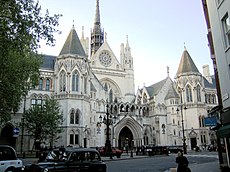
Royal Courts of Justice
Author Anthony M
Creative Commons Licence
Source Wikipedia


Copyright is a property right which subsists in original literary, dramatic, musical or artistic works, sound recordings, films or broadcasts, and typographical arrangement of published editions. It is the exclusive right to do or authorize the following acts in respect of the work:
(a) to copy the work
(b) to issue copies of the work to the public
(ba) to rent or lend the work to the public
(c) to perform, show or play the work in public
(d) to communicate the work to the public
(e) to make an adaptation of the work or do any of the above in relation to an adaptation.
Anyone who does or authorizes any of those acts in the UK without the licence of the owner infringes that right, Such an infringer may be sued in the civil courts or in some circumstances prosecuted in the criminal courts. If found guilty the penalties for copyright infringement are approximately the same as for theft.

As civil litigation can be expensive owners of certain types of copyright works have established organizations known as "collecting societies" to enforce their copyrights. One of those collecting societies is PRS for Music which describes itself as "the home of PRS and MCPS, representing the rights of over 115,000 members in the UK," The PRS and the MCPS are two separate collecting societies representing respectively the rights of the owners of the copyrights in words and music and those of the owners of the copyrights in the sound recordings. PRS for Music offers to license the performance of their  members' works on terms that are regulated by statute. They have reciprocal agreements with collecting societies in other countries to enforce the rights of foreign collecting societies' members' rights here, The foreign collecting societies enforce the rights of British copyright owners elsewhere.

The statute that protects the rights of copyright owners in the United Kingdom is The Copyright, Designs and Patents Act 1988 ("the CDPA"). Section 2 of that Act confers the exclusive tight mentioned above subject to a number of exceptions. One of those exceptions is provided by s,34:
"34 Performing, playing or showing work in course of activities of educational establishment
(1) The performance of a literary, dramatic or musical work before an audience consisting of teachers and pupils at an educational establishment and other persons directly connected with the activities of the establishment--
(a) by a teacher or pupil in the course of the activities of the establishment, or
(b) at the establishment by any person for the purposes of instruction, is not a public performance for the purposes of infringement of copyright. 
(2) The playing or showing of a sound recording, film or broadcast before such an audience at an educational establishment for the purposes of instruction is not a playing or showing of the work in public for the purposes of infringement of copyright.
(3) A person is not for this purpose directly connected with the activities of the educational establishment simply because he is the parent of a pupil at the establishment."
Doubts have arisen over the years as to whether a dance school falls within that exception.  Until the beginning of this year it was the opinion of PRS for Music that it did not. Following representations from the Royal Academy for Dance (see PRS for Music - Educational Exemptions 4 Jan 2016) the collecting society appears to have changed its position. In its PRS for Music Charging Policies the collecting society writes that it has a number of non-charging policies that define circumstances in which it chooses not to make a charge for its licence and one of these is dance schools:
"Section A - Dance Schools that are educational establishments
Where a dance school qualifies as an educational establishment, section 34 of the 1988 Act provides that a public performance licence will not be required from PRS (or any other copyright owner) for performances before an audience of teachers and pupils/students at the school (and other persons directly connected with it) provided that the performance is given
  • by a teacher or pupil in the course of the activities of the dance school; or
  • at the dance school by any person for the purposes of instruction.
Section B - Dance tuition provided by persons other than educational establishments
Where copyright music is used for the purpose of dance tuition, a licence will ordinarily be required by the course provider. However, if the music is performed within the context of and for the purposes of a lesson and/or examination leading to a qualification aligned with Regulated Qualifications Framework (RQF) Level 1 or above, [for the purposes of calculating charges under the dance tuition session of the current DS tariff and proposed new Fitness and Dance Tariff], PRS is willing to treat such performance as if it were given in circumstances to which section 34 of the Copyright, Designs and Patent Act 1988 applies and accordingly will not make any charge respect of that session."
First, it has to be stressed that that is only a position statement from a collecting society - albeit a powerful one - and not a statute, judgment or other authoritative statement of the law. Having said that, I stress that I do not necessarily disagree with it. If anyone wants to challenge that position in respect of charges made in previous years they can still do so though I am not encouraging (or indeed discouraging) them to do so. Secondly, this statement does not bind copyright owners who are not represented directly or indirectly by PRS for Music. Thirdly, this position statement applies only to the United Kingdom and those other territories to which the CDPA applies.

If anyone wants to learn more about copyright in music or relating to dance, exemptions and licences, collecting societies and enforcement he or she should call me on 020 7404 5252 during office hours or use my contact form.

Monday, 14 September 2015

Watkins on 1984

The world in 1984
Author MichaelsProgramming
Source: Wikipedia


After Northern Ballet's performance of 1984 at the West Yorkshire Playhouse on Friday Jonathan Watkins agreed to answer questions from members of the audience.  The session took place in the Quarry auditorium where the ballet had been informed.

I had read up about Watkins earlier in the year because I liked his A Northern Trilogy and seen a number of videos in which he had appeared on YouTube. I was aware that he came from South Yorkshire, that he had trained at the Royal Ballet School and that he had danced with the Royal Ballet between 2003 and 2013. It occurred to me that Ernst Meisner, one of my favourite choreographers, would have been one of his contemporaries.

The session was opened by a lady whose name I forget but who I believe must have been Selina McGonagle for she introduced herself as Northern Ballet's Director of Learning. As she was chairing the session she reserved the right to ask the first question which was on how the concept of the ballet had changed since her first discussion with Watkins about the ballet several months ago. Watkins replied that there had been change largely to reflect the input of the dancers whom he praised very highly and the other members of the creative team. I got the impression that he had an outline in his mind but the ballet had developed organically.

As the chair had warned us that we had time for only 3 or 4 questions I stuck my hand up next.  As I said in My First Impressions of 1984 12 Sept 2015 the ballet had a very retro feel and I asked him whether that was intentional. I am not sure whether he asked for amplification or whether I volunteered it but I was thinking specifically of Miracle in the Gorbals and Job. Watkins knew Job but not Miracle even though it had been re-staged recently by Gillian Lynne.  He replied that that had not been his intention but he had been exposed to many influences through his training at the Royal Ballet School and his work in the company. If he was influenced  by anything it was the cinema. He mentioned several films that he admired including Kes which he had translated into dance and the Lego Movie. Indeed he mentioned the Lego Movie several times in different contexts in the Q & A.

The next question was on why Watkins had chosen 1984  and whether he had any other works in the pipeline. He replied that he had read the book as a teenager and had been affected by it. He had contemplated how it could be translated into dance for some time. The same had happened with the Ken Loach film Kes which he first saw about the same time. That film resonated with him because it was set in the area in which he had spent his childhood. Last year he had the chance of stage it for The Crucible in Sheffield. By staging Kes and 1984 he had achieved two longstanding ambitions. He did have other projects in mind but he did not want to announce what they were for the time being.

A lady behind me congratulated him on his love scenes which she described as "erotic". He acknowledged her praise and remarked that those are scenes that many people like best.

He was asked about his collaboration with the composer and whether he specified the music he needed. He confirmed that that was the way he worked.  He described the music as "a character in itself."

A gentleman congratulated him on his use of colour.  Watkins replied how the colours of the party members and proles had been chosen. They started with brown and developed into orangey reds.

A lady with a North American accent who was there with her daughter mentioned her daughter's amazement that the story had been told without a spoken word. I couldn't help reflecting that was the whole point of ballet and indeed all dance drama.  Watkins accepted that praise graciously.

He was asked several detailed questions about the transposition of the story and the characters from the book, why there were no children in the ballet and how he had maintained the tension of the story in the ballet. The last question prompted him to ask whether the audience felt he had maintained tension and he was told that he had.

All in all I found Watkins a very likeable chap with a good sense of humour. Because my senses were still overwhelmed by the marvellous gala I had seen in Amsterdam three days earlier (see The best evening I have ever spent at the ballet 13 July 2015) I probably didn't do justice to his work. Indeed it is unlikely that I would have done justice to anybody's work. Maybe I should have stayed away until Amsterdam had worn off but then I would have missed this Q & A with Watkins.

Wednesday, 15 April 2015

We're in the Paper


A reporter and photographer from the Yorkshire Post visited our class the other day. I remember their visit. Here's their report: Raising the barre: Pirouetting pensioners

I had an off day on Monday and asked myself whether I wasn't getting a little too old for this sort of thing. I suffer from fallen arches and my right foot was playing up. For the first time in a dance class I caught myself watching the clock.  "Why do you put yourself through this pain?"  I asked myself, "Aye and paying for it" I added. "Are you sure it is worth it?" Until I read this report I was beginning to wonder but it reminds me why I turn up to Quarry Hill on Tuesdays and Thursdays as often as I can, week after week.

The first reason is that Northern Ballet's Over 55 class is more than a ballet class.  I have got to know my fellow students over the last 18 months and have made friends with some of them. We meet in Café 164 after the class for a cup of tea and a chat. They are all have a story to tell. This class is where I get to meet them. It does not seem to happen in other classes.  Or at least not so much.  In other classes we exchange smiles and greetings at the barre and look forward to seeing each other next week. But then we get into our cars and scatter to the four winds.

The second reason I love class is that I like the tinkly music even if it is recorded. At Northern Ballet we usually have a pianist for the main class though our teacher uses a DVD for an extra class where we work on more difficult exercises. That used to be one of the highlights of my week until my arches started to give me grief. There's something about ballet exercise music that attracts me. There's one particular recording that all my teachers have played which almost brings tears to my eyes when I hear it. The music plugs me into a tradition which links me albeit very tenuously into a tradition that has been followed by every dancer, choreographer, teacher and student who has gone before.

And I think that is the third reason I need class. In Le jour de gloire est arrivé - Dame Antoinette Sibley with Clement Crisp at the Royal Ballet School 3 Feb 2014 I wrote how Sibley spoke adoringly about her teachers, particularly the great Karsavina. I added:
"As Sibley spoke about her teachers I realized that every teacher represents to his or students every dancer, choreographer and teacher who has gone before. Sibley loved her teachers and I can relate to that because I love every one of mine. Those who have gently corrected my wobbling arabesques and feeble turns."
I feel that connection with the great balletic tradition in every class but particularly strongly in Northern Ballet where we sometimes meet members of the company as we file out of their studio.

Oh and I get fit in the process, mentally as well as physically. I have a lot of stress in my work. I spend a lot of time in front of a computer. I have to concentrate on detail and that happens in class even in simple exercises.  Class helps to relieve that stress, to clear my head, to stretch my body and think straight when I am in court or con.  I don't think I could do my job - or at least not so well - without it.

Post Script 20 April 2015

I had another class with Fiona Noonan on Wednesday night at Huddersfield University and it couldn't have been more different from Monday. It was 90 minutes instead of the usual hour and the teacher worked us hard. Yet even though there was more jumping there was no pain. The class set me up for a really long day on Thursday which began 2 hours after I had gone to bed and included a 200 mile dash to London, several meetings and La Fille mal gardee. Friday was just as hectic with a three and a half hour con and another long drive home but now I am back and looking forward to Ballet Black.

More on the Over 55 Class

Gita Mistry   Coming Back to Ballet 12 March 2015
Jane Lambert Elizabeth Rae  7 Oct 2013
Jane Lambert  New Term at Team Hud - and around the World 2 Oct 2014
Jane Lambert  Coming Down to Earth Gently 30 June 2014
Mel Wong   The Dance DID go on - Northern Ballet Academy Show 2014 29 June 2015
Jane Lambert The Time of My Life 28 June 2014
Jane Lambert Nervous? Shhhhh...... Northern Ballet's Over 55 Class End of Term Show 24 June 2014
Jane Lambert A Treat For Us Old Ladies 27 Feb 2014
Jane Lambert Realizing a Dream 12 Sep 2013

Thursday, 27 November 2014

Class

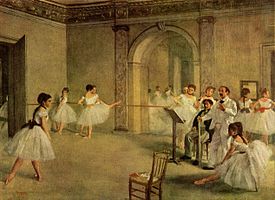
Edgar Degar  Ballet Class
Photo Wikipedia


Exactly two years ago I took my first ballet with Fiona Noonan at The Base Studios in Huddersfield.  It was my first class for 45 years. It wasn't easy. Most of the other students were young. Some were still at school. All had studied ballet for years. I was so unlike them. An overweight 63 year old barrister. I didn't even have the right kit. I took my first class in jogging trousers, tee-shirt and socks. I am sure the other students wondered why I was there and I certainly did. I can't say I enjoyed that class because I could  do hardly any of the exercises. I still can't do all of them even now. And my body ached for ages afterwards.

But I came back. I took private lessons from Fiona who patiently taught me to stack my body and balance first on two legs in demi and then one leg with the other in retiré. I managed to do the barre exercises and some of the jumps. Turns are a different matter - soutenus are all right and even chaînés but I just can't stay in relevé with my non-supporting leg in retiré long enough to do a full pirouette (see A Really Useful Video on Pirouettes 22 Nov 2014). And when I tried posé turns in Leeds I fell flat on my back.  I did wonder then whether I was getting a little too old for this ballet malarkey but I got up, dusted myself down and carried on.

I'm so glad I did because I love class and I have been trying to work out why. The music is one reason. We have some lovely pianists at Northern Ballet, particularly Alena Panasenka whom you can hear in the video but even the recording that Fiona and some of my other teachers use for the adagio is beautiful.


Camaraderie is another reason. The ladies in the film speak about it and it was that video that drew me to Northern Ballet. Those ladies and I danced together last June in And The Dance Goes On in which I had the time of my life and I am glad to say that the ladies are now my friends.  I have also made friends in my other classes in Huddersfield, Sheffield and Manchester.

I have also been fortunate in having wonderful teachers.  None of them resembles the awful Miss Polly in Ballet Black's Dogs Don't Do Ballet. The bond between dancer and teacher is very special. Dame Antoinette Sibley spoke of it when she talked about her classes with Tamara Karsavina (see Le jour de gloire est arrive 3 Feb 2014) as did Elena Glurdjidze and indeed my friend Pamela Newton when remembering Olga Preobrajenska. Look at the interaction between teacher and students in the classes in Moscow and San Francisco in Adult Ballet in Moscow and San Francisco. I have experienced something like that in my own short ballet career as you may recall from my dialogue with Fiona after I told her that I had spent the afternoon listening to Clement Crisp and Antoinette Sibley:
"'Oh super jealousy' she replied.
'Don't be jealous' I responded 'You are also part of the tradition. You live it, I just see it. And you pass on your gift to others.'
'Awwwww Thanku xxxx'
'When I go to class you or Annemarie represent every dancer, choreographer and teacher who ever lived'.
'Aw Jane! I won't be able to leave the room soon'
'I am only paraphrasing Sibley. She should know. Through you I am linked to your teacher who is probably linked to someone at Ballet Russes who is linked to Petipa.'
'xxxxx wise woman!'"
And that brings me onto my final and most important reason which I only appreciated fully this month after watching the company classes of English National Ballet and Chantry Dance who do some of the same exercises that I do with my teachers. It is the sense of being part of a worldwide community with a 200 year heritage. 

That is why I push myself to class even when I feel rotten and why I am always so glad to have done so after we bow or curtsy and clap our teacher and pianist.

Further Reading

Adult Beginner   First Class Stories  Adult Beginner 
David Wilson    Just Started Ballet  Dave Tries Ballet
Greta Wright   How to choose a Ballet class  Danceworks
Jane Lambert  For Emma 28 April 2914
Jane Lambert  Realizing a Dream 12 Sep 2013 

Sunday, 16 March 2014

Christopher Marney

I have seen quite a lot of Christopher Marney since I started this blog and I have reviewed his work in several articles. The quality of his work that I most admire, both as a dancer and as a choreographer, is his sensitivity to music. He is as sensitive to sound and as accurate as an oscilloscope but unlike that lifeless instrument he translates sound into the most beautiful movement. It was Marney's dancing as Count Lilac - powerful and vital - that saved Matthew Bourne's Sleeping Beauty for me last year. It was his choreography that I admired so much in Ballet Black and Ballet Central's mixed bills.

Though still a young man Marney has packed a lot of experience into his career - Balletboyz, Gothenberg, Biaritz, Berne, Japan to list just a few of his engagements.  As Jessica Wilson observed in "Christopher Marney: Dancer, Choreographer, Dance Extraordinaire!" 8 July 2013 Dance Direct he is a "man of many talents."  According to that article Marney he started to choreograph in Gothenberg.  In an interview that he gave for Ballet Central's blog ("Backstage with choreographer Christopher Marney" 26 Feb 2013) he explained how he was encouraged by the keen dancers and great theatre.

Ballet Central asked Marney to describe his style. He replied that it was "narrative" explaining how he loves to create a piece around a strong plot, particularly with a contemporary theme so that the audience can be drawn in emotionally.  He added:
"A narrative also gives an awful lot of scope for different movement and opportunities to play with the audience’s humour. Even without an obvious storyline, there has to be an intention, an emotive purpose to every movement."
That is certainly true and it came out particularly well in War Letters where Marney explored every emotion that emerges in war anchoring his work to readings from contemporary letters to and from the front and the voice of Alvar Lidell. Incidentally, in this 100th anniversary year of the start of the First World War, Marney's ballet remembers the contribution of the millions of servicemen from Africa, the Caribbean and South Asia in both world wars that is not yet properly acknowledged (see "Africa's forgotten wartime heroes"  14 Aug 2009).

However. as I said before it is his interpretation of music which is the quality that I most admire. Some call that musicality. Others lyricism.  For me, without the benefit of a thorough education in music or dance, I would say that Marney brings out in the movements of his dancers -particularly Kanika Carr Sayaka Ichikawa of Ballet Black - the several qualities of the music. I noted that particularly in Two of a Kind set to Tchaikovsky and Ravel - the last of Marney's works that I have seen and the one I like best so far.

In her interview with Marney, Jessica Wilson asked "What is the best part about dance?" He replied:
"I think the best part is when it touches someone and a person can be moved or made to feel something by what they are witnessing. It is amazing how that cycle continues to inspire generations."
Well with Two of a Kind and War Letters Marney has certainly touched me. I could tell from the reaction of the audiences in London and Leeds that I was not the only one.