Showing posts with label Balanchine. Show all posts

Sunday, 15 September 2019

The Dutch National Ballet's 2019 Gala

Xander Parish and Maria Khoreva in "Diamonds"
Author Michel Schnater, © 2019 Dutch National Ballet: all rights reserved


Dutch National Ballet Gala 10 Sept 2019, 19:30 Music Theatre, Amsterdam

The opening night gala of the Dutch National Ballet's new season is one of the highlights of my year. It is always a grand affair, the gentlemen in dinner jackets and the ladies in gorgeous evening attire.  The Music Theatre (or Stopera as the building that combines Amsterdam's city hall (Stadhuis) and opera house is unofficially called) is packed. The video on my review of last year's gala conveys some of the excitement and atmosphere.

At 19:30 the lights dim and the conductor enters the orchestra pit.  He (I have not yet seen a woman conduct an orchestra in the Music Theatre though I am sure many will do so in future) raises his baton and the orchestra plays the polonaise from The Sleeping Beauty.  The curtain rises to a row of children, the first-year students of the National Ballet Academy.  The first years are followed by the second and subsequent years, each year in different coloured uniforms.  The Academy is now under the direction of the magnificent Ernst Meisner, still a young man but already a widely acclaimed choreographer. He is also artistic coordinator of the Junior Company  The students are followed by the Junior Company, then the élèves, the corps de ballet, the coryphées, grands sujets, soloists and finally the principals. The women appear in dazzling white classical tutus and the men in dashing tunics. This is known as the Grand Défilé and although it is very simple it is an impressive spectacle.

The company then performs scenes from its current repertoire or works that are staged specially for the occasion.  There is always something from Hans van Manen, usually something from one of the other great Dutch choreographers, Rudi van Dantzig and Toer van Schayk and often works by the company's artistic director, Ted Brandsen, David Dawson, Juanjo Arques and, of course, Meisner.  I particularly look forward to Meisner's works because his choreography appeals to me more than almost any other. His Embers and  No Time Before Time are among the most beautiful works that I have ever seen and I can't watch them without emotions welling up. Much of Meisner's work has been created for the Junior Company who must be the 12 most beautiful dancers on the planet.  Their performance is always the highlight of my evening much as I admire the company's principals and other fine dancers.

Brandsen usually makes two speeches at the gala.  One to welcome the audience and introduce the show.  The other to present the prima ballerina, Alexandra Radius, in whose name the company's Friends award a prize to the dancer of the year.  Usually, the winner is a principal but last year it was Timothy van Poucke who joined the Junior Company in 2016. Brandsen usually delivers long passages of his speeches in English as many members of the audience are from countries other than the Netherlands.

The gala is always a party.  Wine, beer, soft drinks and canapés are offered the moment guests enter the theatre.  The hospitality continues during the interval and after the show.  As soon as they have changed the dancers make a grand entrance down the staircase of the lobby.   This is the audience's chance to mingle with their heroes and heroines and perhaps dance with them in the disco at the entrance to the theatre.  In that regard, anyone can say that he or she has danced with the Dutch National Ballet in the Music Theatre.

This year's gala was a little different from previous years.  For a start, it seemed to be shorter.  Only five pieces were performed in the first half and one on the second.   There was no performance by the Junior Company as such though some of its members were in other pieces.  Nor was there any work by Meisner.  I would have been a little disappointed had I not reminded myself that I had seen the Junior Company at the Linbury in July for the first time in several years (see Welcome Back! Junior Company returns to the Linbury 6 July 2019) as well as in Dancers of Tomorrow at the Music Theatre a few days later.  The third way in which this year's gala differed from previous years was that Brandsen delivered his entire speech in Dutch which is not unreasonable since the show took place in Amsterdam.  Dutch is the first cousin to both English and German which I studied at secondary school and as I visit the Netherlands several times a year I have picked up a little bit of the language. I think I understood most of the director's speeches.

Despite those differences, I enjoyed the gala very much indeed,  Matthew Rowe, one of my favourite conductors, lifted his baton. The Grand Défilé was as impressive as ever.  Having seen those excellent young dancers in Dancers of Tomorrow in July I felt particularly close to them.  I am doing my best to support the Academy in any way I can and I hope that I will be able to arrange for funding through lifetime gifts or legacies for talented young dancers like Conor Walmsley who studied in Amsterdam, joined the Junior Company and has recently graduated into the senior company.

The show continued with the pas de deux in Diamonds from Balanchine's Jewels by Xander Parish and Maria Khoreva from the Mariinsky.  I have been following Parish's career since July 2007 when he and his sister Demelza appeared at A Summer Gala of Dance and Song at the Grand Opera House in York.  I did not blog about ballet in those days but Charles Hutchinson of The Press reviewed the show.   Those two young dancers performed with the likes of Samara Downs and Marianela Nuñez but it was their piece that impressed the audience the most and it has been etched in my memory ever since.  Since then I have seen Parish in London as Romeo in 2914 and in Ballet 101 in Leeds in Northern Ballet's 45th-anniversary gala.  I also had the pleasure of meeting him at the London Ballet Circle. Parish has always thrilled me but his performance on Tuesday was masterly. He commanded the audience's attention like a king. I do not recall seeing Khoreva before but I shall follow her in future.  Not only did she partner him well. She showed considerable virtuosity in her solo.  That pas de deux alone justified the trek to Amsterdam.

Parish and Khoreva were followed by Maia Makhateli and Young Gyo Choi in a pas de deux from Le Corsaire.  I was very puzzled by the programme note for it stated that the piece was created by Samuel Andrianov and premiered at the Mariinsky Theatre on 12 Jan 1915. As the music for Le Corsaire was composed by Adolphe Adam who wrote the score for Giselle I knew that this ballet must be very much older.  According to Wikipedia, it was first performed in Paris in 1856 but all modern productions are based on Marius Petipa's of 1863. I had never heard of Andrianov until I read the article on Balanchine in the French Wikipedia where I learned that he had been one of Balanchine's teachers. There is no similar mention in the English article.  A short paragraph on the piece in Dutch - not a language that I have ever studied formally so I may well have got the wrong end of the stick - the piece was created for students and was introduced to the Netherlands by Rudolf Nureyev in 1965. That would make sense for Young is a powerful dancer who reminds me of Nureyev. Makhateli is always a delight to watch.  The crowd was delighted.

The only work that seemed to be completely unconnected with Balanchine was van Manen's Trois Gnossiennes.  This was set to a piano score by Erik Satie which was earlier used by Sir Frederick Ashton in an orchestrated version for his Monotones.  Van Manen uses a single piano played by Olga Khoziainova mounted on a platform on castors which was pushed gently around the stage by four young male dancers. The dancers were Igone de Jongh and  Jakob Feyferlik of the Vienna State Opera House's Ballet Company.  It was very beautiful.   I just can't make up my mind whether I prefer van Manen's work or Ashton's.

The last work of the first part of the gala was the first of Balanchine's Symphony in Three Movements to the score by Stravinsky by the same name.   This is a work for 12 dancers including 6 soloists - Quian Liu and Young Gyu Choi, Anna Tsygankova and James Stout and Floor Eimers and Jozef Varga.   This is an exuberant piece with a lively score. The women wore simple leotards and their hair in ponytails.  It was fast and slick and left the audience on a high.

As in previous years, complimentary drinks and savouries were served during the interval.  These were a bit different from ours in that chunks of cheese, ham or sausage were served without bread or biscuit. I took a sample of each of them as well as a glass of quite potable wine.  I have got to know some of the Dutch ballet goers over the years and met several in the lobby. I usually find myself at the merchandise stand buying cards or t-shirts for friends in England but, as that stand has disappeared on Tuesday, I took advantage of the interval to stand on one of the terraces overlooking the Amsel and take in the September night air.

After we had returned to our seats, Brandsen stepped back on stage and announced that the time had come for the Alexandra Radius award.  He explained that the money had been raised by Friends of the company and asked us to stick up our hands.  At least, I think that is what he said because the conversation was entirely in Dutch.  He then introduced Alexandra Radius who is still beautiful.  He announced that the winner of the 2019 prize was Edo Wijnen and played a short film which showed Wijnen's achievements. Radius presented Wijnen with his prize which included a trophy.  He gave a short acceptance speech part of which was in English. Both he and Radius received enormous bouquets.

The rest of the evening was taken up with Balanchine's Who Cares? A great celebration of New York to the music of George Gershwin and Hershi Kay.  Readers can gain an idea of the energy and exuberance of the piece from the YouTube trailer. De Jongh and Makhateli performed solos in the piece together with Vera Tsyganova and Constantine Allen who joined the Dutch National Ballet only in 2018.  I think this was the first time that I had seen him and it will certainly not be the last   Yet again the audience rewarded the dancers with a standing ovation. One that they truly deserved.

Last year I missed the party because one of my guests was a child. This year I stayed and met many friends and acquaintances from the company and the audience.  I had been looking out for Xander Parish, Ernst Meisner, Michaela DePrince and Matthew Rowe but I did not encounter any of them. Hardly surprising as the crowd was massive and the noise deafening.  As far as I know, no British company holds a party for its audience after a gala like this.  That is a shame because it is one of the reasons why every Dutch person I know has great pride and great affection for the national company even if he or she never actually attends any of its performances.

Wednesday, 12 April 2017

Jewels - The Royal Ballet at its best


Standard YouTube Licence

The Royal Ballet, Jewels, transmitted live to cinemas, 11 April 2017, 19:39


I once asked a distinguished panel of dance critics, dancers and the artistic director of Scottish Ballet whether a narrative ballet needed a plot (see My Thoughts on Saturday Afternoon's Panel Discussion at Northern Ballet 21 June 2015). All said no except Tobias Batley who was then a premier dancer at Northern Batley and seemed to have an interesting point to make but did not get the chance to develop it. When I asked that question I had Balanchine's Jewels in mind which actually tells a lot of stories from the history of ballet to the choreographer's life history without actually having a libretto.

Jewels is like a denial of service attack on the senses. Each of the three ballets is a feast in itself. You feel you can only take so much colour, and movement, and music in one evening - but after each act, there is more.  The only experience with which I can compare this ballet is, in fact, my first sight of real jewels. The Crown Jewels on my first trip to London. The impression that the dazzling display of light and colour made on a little five-year-old from the North in post-war Britain was very much the same as the concatenation of dancers in green, red and white create whenever I see Balanchine's masterpiece.

On Sunday I remarked that I had seen the Bolshoi at its best (see A Hero of our Time 10 April 2017). Yesterday, audiences around the world saw the Royal Ballet at its best. The company fielded Beatriz Stix-BrunellValeri HristovLaura MoreraRyoichi HiranoEmma MaguireHelen Crawford and James Hay in Emeralds.  As readers know, I am one humongous fan of Morera whose hand I once had the good fortune to shake (see Laura Morera  25 Aug 2015). She always delights me but yesterday she raised my admiration to a new level.

More favourites in Rubies Sarah LambSteven McRae and Melissa Hamilton. If Emeralds was lyrical, Rubies was spectacular. One gorgeous explosion of movement after another culminating in McRae's exit in chaînés. A dynamo harnessed to McRae at that moment could have powered a fair size town. Rubies is the shortest work in the three ballets but it is the one I like best, possibly because of Stravinsky's Capriccio possibly just the New World razmataz. The energy. The fun.

Diamonds, the white act, is sublime. An homage to Petipa. Marianela Nuñez and Thiago Soares were majestic. Stix-Brunnell and Hay returned to join them together with Claire CalvertTierney HeapYasmine NaghdiNicol EdmondsFernando Montaño and Valentino Zucchetti. Not all Petipa's ballets end well but some of them do. Think of The Sleeping Beauty, The Nutcracker and all your other favourites rolled into one and combine it with Tchaikowsky's Polish symphony and you understand why I compared the overpowering of the senses to the overwhelming of a website by millions of messages.

I should also say something about the presentation. I was very impressed with Kristen McNally. I warmed to her the moment she opened her mouth. Proud, elegant, knowledgeable, amusing and above all, Northern. I do hope the Royal Opera House enlists her services again. It was also good to see Darcey Bussell as it always is but this time she was there in her capacity as a great ballerina escorting a member of the original cast to the jeweller's shop that inspired Balanchine. A beautiful dancer surrounded by beautiful things. That is how I like to think of her. It would be good to see more of her in scenes like that.

Monday, 6 March 2017

Attending the Ballet in Florida: Miami City Ballet's Program Three

Simone Messmer and Miami City Ballet dancers in Alexei Ratmansky's The Fairy's Kiss
© 2017 Gene Schiavone: all rights reserved, reproduced with kind permission of the company 


Gita Mistry

Miami City Ballet, Program Three: Walpurgisnacht Ballet, Polyphonia and The Fairy's Kiss Kravis Center for the Performing Arts, 25 Feb 2017, 20:00

I have just returned from Florida where I attended the South Beach Wine and Food Festival, gave a cookery demonstration and looked up some old friends who have moved to the United States. While there, I checked out the local theatres.  I found that Alvin Ailey American Dance Theater was to perform at the Adrienne Arsht Center for the Performing Arts in Miami between the 23 and 26 Feb 2017 and that Miami City Ballet was to dance a triple bill that included a new work by Alexei Ratmansky at the Kravis Center for the Performing Arts in West Palm Beach. Having seen Alvin Ailey at the Bradford Alhambra and the Lowry when they visited us a few months ago I opted for the Miami City Ballet even though the Adrienne Arsht Center was much closer to where I was staying. The appeal of a new ballet by Ratmansky was hard to resist.

This was the first time that I had seen a dance performance in the United States and, indeed, the first time that I had seen a live performance by an American classical company anywhere.  I had heard a lot about national styles in ballet and that Americans are trained and perform quite differently from dancers in England, Russia and France. I was curious to know whether I would recognize a distinctly American style. I had, of course, seen Americans who dance with European companies such as Damien Johnson, Martha Leebolt and Michaela DePrince but I had never detected a particularly American feel to their performances.

I invited one of the friends I was visiting to watch the ballet with me. I do not know whether this was the first ballet that she had seen on stage but I got the impression that she does not go to the ballet very often. For instance, she had expected to see women in classical tutus and wondered where they were.

West Palm Beach is about 70 miles north of Miami and my friend kindly drove us there.  It was a pleasant drive along the coast but it took us 90 minutes to reach our destination as there was fairly heavy traffic on the motorway. The Kravis Center was huge.  It is quite a modern building - all steel, concrete and glass which reminded me a little of the Music Theatre or Stopera in Amsterdam.  It is called a "Center" because it has several auditoriums the largest of which seats nearly 2,200. You can get some idea of its scale from the Kravis Center of the Performing Arts in West Palm Beach.  

Visiting the Kravis Center was different from attending a theatre at home.  For a start, there was plenty of parking at the venue and patrons were offered a service called "valet parking" where staff offer to take patrons' keys and find parking spaces for them thereby enabling motorists and their passengers to make their way immediately to the auditorium. A very convenient service for those who travel some distance and are pressed for time as parking near the theatre can be something of a bind in Britain, particularly in London. On the other hand, picking up the tickets that I had purchased over the internet was somewhat more complicated. I was asked to show photographic identification before they could be released to me. Programmes are included in the ticket price at the Kravis Center and I am told that is generally the case in Amerca.  However, mine was delivered through a tiny slot which was so narrow that it had to be folded. The ushers were somewhat more bossy than those at home, directing patrons to their seats in a tone of voice that primary school teachers might use with young schoolchildren. In several places, there were notices asking patrons to stay in their seats until after the artists had taken their bow. I discovered why such signs are necessary later.

Our seats were on the second tier of the auditorium. I should add that seating areas are known by different names in America.  "Stalls" for instance are called "the orchestra" and there is a tier of seating called "loges" which I guess must derive from the French word "loge" which means "box". Our seats were expensive by British standards and were by no means the best.  However, they commanded a clear view of the stage which was larger than most stages that I had seen at home.  The audience seemed quite well-heeled and many appeared to have dressed up for the occasion.  Though there were some children and young people I would say that most of the audience were middle-aged to elderly.

Program Three was a triple bill consisting of three one act ballets:
You can get a flavour of the performance from this trailer on YouTube.  All of those ballets were new to me although I had seen others by Balanchine and Wheeldon.

I have to say that I am not a big fan of Balanchine. I know that he is one of the greats of modern ballet and that Americans hold him in the same sort of awe that we hold Sir Frederick Ashton. the Russians Marius Petipa and the Dutch Rudi van Dantzig. I acknowledge his genius and the purity of his style but I still find it hard to appreciate him. Too stark and minimalist for me and relying entirely on the technique of the dancers, particularly the virtuosity of the principals. 

The curtain rose on a stage that was bare except for the backdrop and wings. Walpurgisnacht is said to be the night that witches roam and Balanchine adapted the music for the ballet from Gounod's Faust. The programme notes mentioned: "Twenty four girls stampeding across the stage - most of them purple, their hair flowing - and a single man."  From where I was sitting the lighting made the women look as though they were in pink and I found their loose hair to be distracting and an interruption to their line. I would have preferred their hair to have been tied back in a classical bun and I have found at least one version on YouTube where that is how the female dancers appeared (see Charles Gounod: "Walpurgisnacht Ballet"). "The man" in this case was the Brazilian soloist  Jovani Furlan and he partnered Lauren Fadeley and Nathalia Arja. Other dancers with solo roles included Emily Bromberg, Ashley Knox, Jordan-Elizabeth Long, Callie Manning, Adriana Pierce and Nicole Stalker.  The solos and duets were performed in an enclosure bounded by the corps. Each of the soloists danced well but I think one needs a taste for Balanchine to enjoy a work like this fully. Hopefully, that is a taste that I may one day acquire.

Wheeldon's Polyphonia was very much more to my liking and I hope that was not just because of the nationality of the choreographer. Looking through the notes that I made in the interval I used adjectives like "brilliant," "refreshing" and "exciting."  The choreography followed various movements of piano works by György Sándor Ligeti. I loved the music.  "Edgy", "modern" and "compelling" were words that I used to describe the score. Wheeldon had interpreted the music ingeniously with pairs or larger groups dancing particular movements.  I found them fascinating. Some were like watching a Rubik’s cube turn by itself. Others were more like the intricate workings of a timepiece.  "Just as I like it!" I wrote and "welcome to 2017."  I think I wrote those words because Wheeldon had blended contemporary with balletic movements and I relish the freedom of contemporary dance. Knox, Bromberg and Furlan made a second appearance in this ballet and were joined by Tricia Albertson, Jennifer Lauren, Reyneris Reyes, Renato Penteado and Kleber Rebello. They were all good but I was particularly impressed by Bromberg. Being a sportswoman, I often like to choose a man or woman of the match and, for me, Bromberg was the woman of the match in Polyphonia.  I should also like to commend Holly Hynes for her simple dark costumes and Mark Stanley for his lighting design. The silhouetting of the dancers towards the end was spectacular. The ballet has a silky, upbeat feel which I loved. I think Polyphonia was my favourite work of the evening.

I also enjoyed The Fairy's Kiss which was billed as the highlight of the evening.  In contrast to the earlier works, this was a narrative ballet based on the Ice Maiden by Hans Christian Andersen. Briefly, a little boy, who loses his mother in a snowstorm, is kissed by a fairy who chooses him as her own. The boy is rescued by the villagers who bring him up as a strong young man. He falls in love with a village girl and they decide to marry but the fairy intervenes just before the wedding and takes him away with her forever. The music is by Stravinsky which I described at the time as "delectable."  I am aware that Sir Kenneth MacMillan made a version of this ballet for the Royal Ballet but I have never seen it. 

I loved the opening, particularly the clever simulation of the snow scene and the dramatic way that depicted the young man's transformation from child to adulthood. A little boy appeared momentarily on stage and was replaced by the adult danced by Renan Cerdeiro, a technique, incidentally, which Wheeldon had used in the prologue of The Winter's Tale. I enjoyed Cerdeiro's dancing with Jeanette Delgado, his fiancée, and also with Simone Messmer who was the fairy. The other leading role was the boy's mother which was danced by Long.  I was most impressed by Cerdeiro and he was definitely my man of the match for The Fairy's Kiss. Indeed, he was my dancer of the match for the whole evening. I have to congratulate Jérôme Kaplan on his clever sets and costume designs. He conjured a period feel with a sense of place for buildings through a clean, modern but entirely functional set that achieved slick scene changes. It reminded me of a very expensive but understated handbag or item of jewellery. I particularly liked the green costumes of the spirits which contrasted with the golds and reds of the other costumes. Congratulations are also due to James Ingalls for his ingenious lighting and Wendall K Harrington for his projection design.

Having seen an American company in action I think I now understand what is meant by the American style. The dancers are very athletic, very polished, very precise and seem to project a measure of pride and showmanship that I have only seen in dancers from Russia. When the corps moves it moves in sync with military precision. When the dancers turn they are ramrod straight. The English style is softer more lyrical. It is difficult to say which is better. They are each pleasing in their own way, but different. I had been asked to compare them with the Royal Ballet and the other leading companies of the United Kingdom. Because the American and English styles are so different it is impossible to make a fair comparison but in technique I would say that the Miami dancers stand comparison with any of ours, including those in the Royal Ballet. I would certainly see them if they ever came to London and I would try to see them again should I ever make another trip to Florida.

Now something that I found rather shocking was that the auditorium emptied as the dancers took their curtain call. I now understand the reasons for the signs asking the audience to stay in their seats until after the it was over. I can think of nothing more demoralizing for an artist who has danced his or her heart out than to face rows of empty seats or the backsides of retreating patrons. These are some of the best dancers in the world. They have spent years at ballet school giving up many of the pleasures that other children and teenagers enjoy in order to perfect their art. They have competed against the best in the world and somehow found their way into a very tough and very competitive profession. They deserve respect and in most other theatres of the world I am sure that they would get it.

I expressed my dismay to the ushers and one of the managers who agreed with me completely. I asked whether this was an isolated lapse or whether it happened all the time. They told me the latter which is why the management had erected the signs. There was no particular reason for the exodus except perhaps to be first in the queue to pick up their cars from the valet parking service. The ushers asked me not to judge the audience too harshly because most of them support the Center generously and regularly attend its shows. 

That may be so, but it is very sad for the patrons as well as the artists are missing out on the most precious part of the evening. Ballet, like all the performing arts, is a two-way communication and the reverence is there for a reason. The artists thank us, the audience, for our attention and we congratulate them for their performance. Anyone who buzzes off to his car as soon as the curtain falls is treating the stage as though it were cinema or, worse, a vending machine. 

One last memory from West Palm Beach. I spotted one of the dancers - I think it must have been Nieser Zambrana - in the car park on the way to his motor car.  I waved at him and mouthed my greeting and appreciation, a signal that he acknowledged with grace. I was glad to see that he stepped into quite a smart motor, more expensive perhaps than those members of the corps de ballet in many of our companies could afford.  I am pleased that he and his fellow artists are appropriately rewarded.

Now that we have made contact with Miami City Ballet I hope that they will stay in touch with us. It would be good to see them to the United Kingdom one day. It would be better still if they could work with some of the choreographers and dancers here and if some of our companies could work with some of their choreographers and dancers.

Friday, 7 October 2016

World Ballet Day: from Amsterdam to Oslo


Standard YouTube Licence

It is quite impossible even for the most died in the wool balletomanes to watch World Ballet Day from start to finish without a break. I had a jolly good stab at it but even I had to eat and sleep and take a ballet class in Manchester. I have spent much of the last two days trawling through the footage looking at some of the bits I missed.  Even so I have barely begun to scratch the surface.

As I said on Wednesday, the best bit of World Ballet Day for me was the Dutch National Ballet's rehearsal of La Bayadere (see Dutch National Ballet's La Bayadere - the Highlight of my World Ballet Day 6 Oct 2016). My only regret is that we did not see more of them. The Dutch have produced three of the greatest choreographers of our time - Rudi van Dantzig, Toer van Schayk and Hans van Manen - and have two of the world's greatest dance companies, the Dutch National Ballet and the Netherlands Dance Theatre. The two guest slots offered by the Royal Ballet and the Bolshoi were far too short.

It was the young Dutch dancer, Bart Engelen who led me to the Norwegian Ballet (see The Norwegian Ballet 11 Aug 2015) and it was that company that offered the most spectacular lift of the day. The Artistic Director,  Ingrid Lorentzen, showed us:
I have been fascinated by Ekman ever since I saw the trailer for his Swan Lake:


Standard YouTube Licence

"Humans dressed as swans!" Now if you are going to jazz up Swan Lake that's the way to do it.  It was great to see him in the flesh.

But the piece de resistance came in The Nutcracker pas de deux immediately after the fish dive when Carreño turned Correa upside down and somehow suspended her on his back 4 feet in the air. "My!" exclaimed Ms, Lorentzen who has the most delightful smile and infectious giggle, "More exciting than opening presents." And she was right.

The Norwegians were dancing at the same time as my beloved Scots who had nurtured my love for ballet when I was an undergraduate at St. Andrews some 50 years ago. I turned to them in the hope of catching Bart who is part of Nasjonalballeten UNG which seems to be a special youth wing of the company. The director explained that they were on tour and dancing in Kristiansund.

I am quite hooked  by the Norwegians. I would love to see their Nutcracker but even if I don't make it Oslo between 1 and 23 Dec I should be able to make Paris in March where they will dance Swan Lake at the Theatre des Champs Elysees.

Thursday, 7 April 2016

The Royal Ballet's New Season

Royal Opera House


The Royal Opera House announced its 2016-2017 season yesterday and released a video of a discussion between Kasper Holten and Kevin O'Hare about their respective companies' offerings. So far as ballet is concerned the season starts well with La Fille mal gardée and ends well with three glorious works by Ashton. There are also one or two treasures in between like Jewels but it also includes one not very welcime surprise.

I am talking, of course, about the revival of Anastasia which I saw in 1971 and which I have never been tempted to see again. According to the performance database there have been two productions. The first by Sir Kenneth MacMillan ran between 22 July 1971 and 1 Dec 1993 and the second, produced by his widow, between 2 May 1996 and 12 May 2004. The work is about Anna Anderson who claimed to be the Archduchess Anastasia a member of the Romanov family who had ruled Russia until the revolution.  We now know from DNA tests that Anderson was an imposter and that the grand duchess almost certainly died with the rest of her family at Ekaterinberg but that was not known for certain in 1967 when Sir Kenneth created the first version of the ballet.

It is a very long time since I saw the work but I distinctly remember some film and some very dissonant music. Nowadays that would be commonplace. We would probably call it multimedia. In the pre-digital 1970s it was unusual. I saw it when I was in my early twenties when I would have been my most receptive to new ideas. If I didn't take to it then I am quite unlikely to take to it now. I gave Nixon's Swan Lake a second chance last month and found that the judgment that I had formed in 2004 had not changed (see Up the Swannee 17 March 2016). One of the threads of an internet forum to which I subscribe and occasionally contribute was "What is your LEAST favourite ballet?" to which I wrote that it was a dead heat between Northern Ballet's Swan Lake and Beauty and the Beast and Anastasia. Beauty and the Beast is also about to be revived.  If I say that Jonathan Watkins's 1984 which I have seen twice is not too far behind you will understand that 2016 will not have been a very good year in that regard.

However, that is all a matter of taste and my taste may not be your taste. Each of the ballets on my "least favourite" list has its aficionados some of whom are surprised and even a little hurt to find someone with a contrary view. Anastasia has not exactly been big box office over the last 50 years but that may change as it is to be streamed to cinemas on 2 Nov 2016.  I shall not be traipsing down to London to see it and I will have to be at a very loose end even to take the bus to the Huddersfield Odeon.

One ballet that is definitely worth a trek to London is The Sleeping Beauty. This is one of my favourite ballets but one that I was surprised to find on quite a lot of subscribers' least favourite list. I have already seen a very creditable performance by the Chelmsford Ballet (see A Real Beauty: Chelmsford Ballet's The Sleeping Beauty 25 March 2016) and I am about to watch Sir Peter Wright's production for the Hungarian Ballet in Budapest (see The Hungarian National Ballet's Sleeping Beauty 24 Feb 2016). Funny isn't it that ballets like buses seem to come along in threes. I can see why some folk don't like it. It is a bit long and the story of the disappearance of a whole kingdom is even more unbelievable than girls morphing into swans or wilis but, hey ho, the music is lovely and divertissements like the bluebird pas de deux are among the most enchanting in dance.

Even more worthy of an awayday to the Smoke will be Balanchine's Jewels which will be running this time next year. Balanchine is one of my favourite choreographers and Jewels along with Serenade are among my favourite works. I missed Jewels when the Dutch National Ballet did it last season and also in the cinema when it was streamed from Moscow as I was travelling up from High Wycombe after seeing the Royal New Zealand Ballet's Giselle. Wild horses won't keep me from Covent Garden this time.

Having enjoyed Wayne McGregor's Chroma when performed by the Dutch National Ballet as part of its Cool Britannia triple bill last year (see Going Dutch 29 June 2015) I am looking forward to the Wayne McGregor triple bill (Chroma / New Wayne McGregor / Carbon Life) in November. I am also looking forward to new works by McGrego's protégés, Charlotte Edmonds and Robert Binet in the Clore Studio. I have already been introduced to their works by the Dutch National Ballet Junior Company (see The Dutch National Ballet Junior Company's best Performance yet 8 Feb 2015 and Ballet Bubbles 16 Feb 2016). If these young choreographers are good enough for Ernst Meisner and his outstanding young dancers then they are good enough for me.

The Christmas show this year will be The Nutcracker again. This is in honour of Sir Peter Wright's 80th birthday. It will be just as I like it with a real Clara Stahlbaum (not Edwards) somewhere in Mittleeuropa and not on the banks of the Thames, no balloons, no rodents hanging on into Act II, a Columbine and Harlequin, a Sugar Plum Fairy and her cavalier and all the usual divertissements. As reassuring as turkey with all the trimmings, Christmas pud and mince pies.

Woolf Works, another McGregor ballet, is to be revived. I missed it first time round largely because I find Virginia Woolf's Orlando a bit too close to the bone. Those who have read the book and know me will understand why. But the ballet has been received enthusiastically and the video of McGregor's rehearsal with Edward Watson indicates why. So maybe I shall give it a try this time round.

Another triple bill by David Dawson, Christopher Wheeldon and Crystal Pite (The Human Seasons / Aftethe Rain / New Crystal Pite) comes next, followed by MacMillan's Mayerling, a new work by Liam Scarlett as well as Forsythe, Balanchine and Wheeldon (The Vertiginous Thrill of Exactitude / Tarantella / Strapless / New Liam Scarlet) and finally the piece de resistance,  The Dream / Symphonic Variations / Marguerite and Armand).

A lot of new work this season together with some old favourites. Something for everyone and quite enough to keep me happy. Happily the Dutch National Ballet will be dancing La Bayadere in November which is just about the same time as Anastasia so I have a lot to relish and little to dread.

Thursday, 19 November 2015

Au Revoir but not Adieu


Embedded pursuant to YouTube's standard licence


I was very tempted to attend the Royal Ballet's mixed programme to see Carlos Acosta's last performance on the main stage of Covent Garden on Thursday night for I was offered a ticket for the grand circle for only £100. The reason I was tempted was that I knew that I would see a little piece of balletic history. But then I would have missed Phoenix Dance Theatre at the Royal Opera House and I knew that that would be good too. Torn though I was I opted for Phoenix (see The Phoenix Soars over London 13 Nov 2015) as they are from Leeds. I see them nearly every time I attend an adult ballet class. Some of these classes even take place in their studios.

One of the reasons why I chose to watch Phoenix in the Linbury was that I knew the mixed bill would be filmed and that I would get a chance to see that film at the Huddersfield Odeon on Sunday, That is what I did. The Royal Opera House HDTV transmissions have just about got it right now. The show was introduced by Fiona Bruce who is an experienced TV presenter. Darcey Bussell interviewed Carlos Acosta and Kevin O'Hare and contributed anecdotes from her experience as a principal dancer. The programme consisted of four ballets: Liam Scarlett's Viscera. Jerome Robbins's Afternoon of a Faun, Tchaikowsky Pas de Deux by Balanchine and Carlos Acosta's Carmen. It was a thrilling programme showing the Royal Ballet at its best.

Ever since I heard Laura Morera's talk to the London Ballet Circle I have wanted to see Viscera (see Laura Morera 25 Aug 2015). Although the work was commissioned by Miami City Ballet it is associated with Morera in this country.  In the cinema transmission Morera was accompanied by Ryoichi Hirano and Marianela NuñezViscera is a spectacular ballet in three movements. It reminds me very much of David Dawson's Empire Noir which I saw in Amsterdam as part of the Dutch National Ballet's Cool Britannia programme earlier in the year  (see Going Dutch 29 June 2015) in that everything except the second movement is done on the double. There were spectacular turns and jumps by in the first and last movements and a delicious duet in the middle with the most delicate lifts and holds. The ballet was set to Lowell Liebermann's First Piano Concerto. You can get a taste of Liebermann's work from this concert performance of the third movement on this YouTube video.

Viscera was followed by an interval which showed an interview of Carlos Acosta by Darcey Bussell over tea. Acosta spoke about his career in England: how he entered ballet largely on his father's insistence, his short time with the English National Ballet where he actually contemplated giving up dance, his audition with the Royal Ballet, his career with the company and the two works that he created for it. Bussell shone as Acosta's interviewer. She coaxed the story from Acosta adding her own reminiscences here and there. This is what she does well.

The next act consisted of Afternoon of a Faun and the Tchaikovsky Pas de Deux.  These are two short works by two of America's best known choreographers.  Robbins's Afternoon  shares the music and title of Nijinsky's L'Après-midi but, as can be seen from archive film of the Nijinsky's work and a video of the Ballett am Rhein's performance of Robbin's, the narratives are quite different.  I am not sure which work I prefer. The Robbins probably makes more sense as it is set in a dance studio with the audience acting as a mirror on the fourth wall. Nobody is dressed in an animal costume or moves like a faun. However, Nijinksky's work for Diaghilev has the rich backcloth by Leon Bakst. Afternoon was danced by Vadim Muntagirov and Sarah Lamb. This was the first time I had seen them together and they teamed up well. Balanchine created the Pas de Deux from music that Tchaikovsky wrote originally for Swan Lake. It is a gorgeous work with male and female solos and a thrilling coda. It was danced magnificently by Steven McRae and Iana Salenko.

There followed quite a long interval when I went in search of a hot dog to avoid the tweets and trailers which is the one part of the Royal Opera House's transmission that I wish the House would drop. Towards the end there was a short interview of O'Hare by Bussell in which they discussed World Ballet Day, the career of Carlos Acosta and his latest work Carmen.  Then the curtain rose on the last Act which was Carlos Acosta's Carmen.

Acosta is not the first choreographer to transpose Prosper Mérimée's novella and Bizet's score into ballet. Roland Petit created a version for himself and Zizi Jeanmaire in 1949. So, too, did Alberto Alonso for the Bolshoi and the National Ballet of Cuba with Maya Plisetskaya in the lead  (see Wikipedia's Carmen Suite (Ballet)). Neither of those works has stuck and I am not sure why.  It seems that a full length opera does not translate easily into a one act ballet. Whether Acosta's work fares any better than his compatriot's or Roland Petit's remains to be seen. If it does not, it will not be for want of trying. Acosta threw just about everything bar the kitchen sink into the mix - voice, flamenco, contemporary and a new character called Fate danced by Matthew Golding. Surprisingly, Acosta found no role for Michaela which might have been an interesting one for a ballerina. I have mixed feelings about the work but it was certainly exciting. Acosta danced Don José, Nuñez was Carmen and Federico Bonelli Escamillo. Fiona Kimm sang the fortune teller's role.

Whatever the strengths of the work the audience loved it. As you can see from the above video there was a flower throw. O'Hare made a speech. The whole cast appeared on stage, It must have been one of those memorable evenings that the Royal Opera House does so well. I stayed in the auditorium for as long as the video of the applause continued long after everyone else had left with the ushers glancing pointedly at their watches. I felt that was the least I could do for Acosta who has given me and many others so much pleasure over his long career.

Tuesday, 8 July 2014

Crossing Paths with Choreography


Dancers: Gabrielle Lamb & Thomas Forster in Emery LeCrone's 'With Thoughtful Lightness' 
Photographer: Matt Murphy*

I'm going to take Terpsichore readers back a few days in my imaginary time machine to week commencing Sunday 29th June. It wasn't that long ago, so I doubt any of you will be travel-sick, but please accept my apologies if you are! This week was quite a significant one for me because it started with an insightful chat over a decadent afternoon tea with a certain UK choreographer and dancer who I have raved about, and mid-way through brought about an interesting revelation about my own choreographic abilities. 

At the very start of the week, as Jane herself mentioned in 'Coming down to earth...' I found my awkward self sitting next to Kenneth Tindall at the 10-year Anniversary Gala for the Northern Ballet's CAT programme. Amidst my whinging about having to sit down on a chair and eating more food (that weekend was a particularly indulgent one on the 'om nom nom' front), I actually managed to compose myself enough to start chatting with Tindall about his choreography, ideas, inspiration, what David Lynch's Silencio is like, and his natural transition into making dance as well as performing it. Although I wasn't exactly in roving reporter mode, I did manage to pick up and remember a few insights from him the most important being to just get myself out there. If I want to be taken seriously as a choreographer and dancer, I need to go to The Place that will give me a fair assessment instead of simply brushing off my lack of relevant experience.

I also asked Tindall a few questions about the recent process of choreographing 'The Architect' on his Northern Ballet dancers, since it was really clear to me that all the dancers were fully on-board with his vision and direction during their performance of the work in the June premier. Interestingly, he did mention that it can be hard sometimes to convince even these incredible physical performers to move in a way that is out of the classical ballet box, and that also got me thinking about the true relevance of linear training paths. Now I'm not in any way even going to attempt to compare myself  to any working professional classical ballet (or even contemporary) dancer for that matter, but I found it hard to imagine being so 'stuck' in a way of moving that I wouldn't be fully able to grasp or understand something that was a little bit different to that. Maybe it's my own versatile movement background, or maybe it's because at heart I am very inspired by Bruce Lee's philosophy on movement, either way I'm generally that over-enthusiastic dancer on the sidelines who will try anything (including 'Smooth Criminal' induced faceplants!) Is a liner dance training path too closeted, should physical performers of in 21st Century classical ballet be open to and incorporate new and different ways of moving? And in some cases, how can an individual with a background similar to mine be considered less relevant as a dancer and dance maker than someone who has pursued a singular way of moving for much of their adolesence and adult life? These are questions that I'm sure Jane herself will have asked after astutely saying ballet needs to avoid atrophy in her introduction to me last month.

Anyway, back to my significant week! On Wednesday I attended a CPD day with one of my teachers and general all-round dance inspiration Benoit Egloff, entitled 'Crossing Points'. Egloff is a true exponent of European classical and neo-classical ballet (I could devote posts and posts to the beauty of his supremely arched feet and long lines), no wonder really due to his training background at Paris Opera Ballet and the Paris Conservatoire du Dance. However, in his time he was exposed to 'radical' and unorthodox training methods, and even though his creative voice is very established he still seems to be one of those people to whom new and different ways of moving in classical dance are relevant and important. He's also been the source behind the now-legendary terms (at least in Sheffield!) 'Google Maps: be over your work!', 'arms in seconde, no chicken wings', 'put your nose in your port de bras, Mel' and the classic 'no camembert' for hands in fifth!


Egloff performing a solo choreographed by Jamie Thomson

 'Crossing Points' really was a day of creative exploration, to start with we learned and danced a (what would then have been) radical contemporary ballet piece by Felix Blaska (and got the opportunity to create our own sections in the dance 'in the theme of') but it was the second part of the workshop that I found most beneficial and revelatory about the direction that I may be heading in as a dance artist and maker. Although the whole day was focused on developing a new sense and understanding of musicality, the task of physically choreographing the music, instruments and quality heard in Verdi's overture to 'La Traviata' was probably one of the best studio-based experiences I've had this year. 

Naturally, this music sets my ears and brain on fire. It's evocative, and then some, and a bit of a heart-wrencher. But in its richness and versatility offers lots of areas for exploration, which in our 2-hour creative task I tried to take full advantage of. We split into two smaller groups, after performing an improvised entrance to the music's mournful introduction, and my group were tasked with making Egloff see the string's aria-like quality on our bodies and in our movements. I could see some participants were a bit flummoxed by the task, but I was really in my creative element. And even though when my brain gets all fired up like that it can lose focus, I managed to contribute choreography to the group that was coherent and well-suited to the quality of the music. We went from sweeping GRAND port de bras to collapses onto the floor before carrying on the pizzicato quality of the music with synchronised swimming-inspired beaten legs. But it was the clarity of knowing that I can make music come to life with my physical movement that was the most positive thing that I took away from the day. 

For sometime now I have been questioning not just my relevance as a maker and performer of dance but also how I actually combine all my influences and ambitions into coherent movements. In my weekly choreographic explorations at Hype Dance Company I often don't get the chance to be purely led by a piece of music, understandable since I am trying to develop a decent skillset, but I've learned from Egloff's CPD day that do actually want to try choreographing in this way. I don't need to over-complicate something as simple as moving to music by imposing concepts, structures, pre-defined emotions and expectations, it's actually OK to experiment with how music looks on a body. After all, it was good enough for George Balanchine


*This image has nothing to do with my revelatory dance week, however it is a beautiful one!

Sunday, 25 May 2014

Who is this Terpsichore Bint anyway?

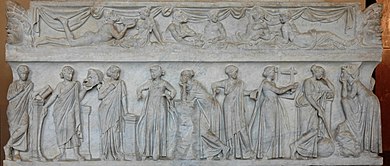
The Nine Muses including Terpsichore on a Roman Sarcophagus
Source Wikipedia


When I was young which was not all that long ago nearly everybody who was likely to appreciate ballet would have studied at least a little Latin and probably some Greek. They would have known who Τερψιχόρη was or, at the very least, how to pronounce her name correctly. Sadly that is not the case today for I am often introduced or referred to as Terpsi-core. For future reference there is a useful pronunciation guide (albeit with an American accent) on YouTube.

I don't know whose fault it is but I suspect Lady Williams who did away with grammar schools. If not her then maybe one of Lady Thatcher's Education Secretaries who sacrificed the classics in pursuit of the chimera of relevance. If that was indeed the aim then it was sadly misconceived for nothing has prepared me more for life than the classics. Not only have they helped me understand and express myself in my own tongue but they have helped me learn also other natural languages including those not derived from Latin such as Japanese. They also helped me to learn programming because computers are (or at least were) very unforgiving just like my masters at St. Paul's. I suspect the abandonment of Latin has much to do with the decline in our children's ability to code and the rise of UKIP.

Anyway I digress, Terpsichore was one of nine muses who personified the arts and literature. They were the daughters of Zeus, the ruler of the gods. Terpsichore was the muse of dance and she carried a lyre. The others in alphabetical order were Calliope, muse of poetry, Clio (history), Erato (lyric poetry), Euterpe (song and elegiac poetry), Melpomene (tragedy), Polyhymnia (sacred music), Thalia (comedy) and Urania (astronomy). You will see them all lined up in the frieze above which I think is in the Louvre. I believe Terpsichore is third from the the right. There are more images of Terpsichore on the Warburg Institute website.

As the muse of dance Terpsichore has been the subject of many ballets including one by Marius Petipa to the music of Cesare Pugni.  She also appears in Balanchine's Apollo which was revived recently by the Royal Ballet. There are many dance schools around the world that call themselves Terpsichore. There is lots of other references to her in film, drama and literature and I have even found a page for Terpsichore on Facebook.

Post Script

Here is another post on the continuing relevance of the classics. Interestingly it appeared on the Old Paulines Alumni Linkedin Group of which I am also a member. Probably the only female member.

Classical studies still relevant today

Helping people and automating everything elseHandling PTSD - soldiers returning from battle, brought the war home with them
A soldier returns home from battle but has brought the war with him. He stares off into the distance, unable to take joy in his family or friends, still hyperalert to threats he no longer faces. Unable to heal his invisible wound, he takes his own.
Ancient warrior myths help veterans fight PTSDnews.yahoo.com


Wednesday, 22 January 2014

Emeralds, Rubies and Diamonds - "Jewels" streamed from Moscow

I am something of a fan of the Bolshoi's HDTV broadcasts as readers will recall from my review of Spartacus. They are the next best thing to seeing ballet on stage. In one important respect they are actually better because their engaging presenter Katerina Novikova interviews people like Sergei Filin, the Bolshoi's artistic director, and Merrill Ashley, the US ballerina who helped the Bolshoi stage Jewels.

Ballet goers have seen a lot of Jewels lately. The Bolshoi brought it to London a few months ago (see  Luke Jennings's review in The Observer 18 Aug 2013) and the Royal Ballet has just staged its own version  as an alternative to all those Nutcrackers that appear over Christmas. Choreographed by George Balanchine for the New York City Ballet the work consists of three acts each of which could stand as a ballet in its own right.

The programme notes say that the ballet was inspired by the beauty of the gem stones at the jewellers Van Cleef & Arpels though the Wikipedia entry quotes Balanchine as saying that "The ballet had nothing to do with jewels. The dancers are just dressed like jewels." And so they are: 
  • green in the first act to symbolize emeralds the women in romantic tutus dancing to a Fauré score;
  • red in the second to symbolize rubies the cast dressed as for a Broadway musical dancing to Stravinsky; and
  • white in the third to symbolize diamonds the women in classical tutus dancing to Tchaikovsky.
According to the presenter there was to have been a fourth act where the dancers were to be in blue to represent sapphires but that never came off. A pity though it would have made for quite a long ballet.

Ms Novikova also said that each of those gems or colours was to represent a city that was important to Balanchine and its associated dance tradition. Emeralds were to represent Paris and the romantic ballet as well as wine and perfume and some of the other good things in life; Rubies New York with its razzmatazz and all that jazz; and Diamonds were to stand for St Petersburg and the classical ballet. 

There was a bit of criticism in the press and also in BalletcoForum of the first and second acts but everyone seems to have liked Diamonds and I certainly did.  That act reminded me of Serenade which Balanchine had created over 30 years earlier and which Boston Ballet had performed in London on 4 July 2013 (see 
Boston Ballet: "High as a flag on the Fourth of July!" 7 July 2013). But I liked the lot particularly Emeralds which reminded me of the exquisite Giselle I had seen the night before ("Giselle - Royal Ballet 18 Jan 2014").

The Bolshoi has helpfully published a cast list so that you can see who did what on Sunday. I liked all of the dancers and it would be unfair for me to single any of them out for special praise.  Ms, Novikova did tell one of the principals (I won't say which for the reasons I have just given) that her performance was "stunning" and it was so good to see her smile as she accepted the compliment. The truth is that they were all stunning and although I have my favourites I can give no good reason for my choice.

The next HDTV transmission from Moscow will be Ratmansky's Lost Illusions on the 2 Feb 2014 which alas clashes with Sibley and Crisp at the Royal Ballet School and wild horses will not drag me from another chance to glimpse Antoinette Sibley, my favourite ballerina of all time.

Sunday, 7 July 2013

Boston Ballet: "High as a flag on the Fourth of July!"

What better way to spend the 4 July than with Americans? Americans bring a zest to ballet. I first noticed it as a young graduate student when I saw New York City Ballet at Lincoln Center. I saw it again when American Ballet Theatre brought Cynthia Gregory and Carla Fracci to Covent Garden as America's gift to the silver jubilee celebrations of 1977. Such zest almost exploded when the Dance Theatre of Harlem came over. There are magnificent companies in Russia, Denmark and, of course, our own country but none of them have excited me as much as those Americans.

On Thursday I experienced excitement again when I saw Boston Ballet at the Coliseum. They danced a quadruple bill:
Choreographed in 1934 Serenade was the first great American ballet and was tremendously influential in the USA (see Toni Bentley "The Ballet that changed Everything" 3 Sep 2010 Wall Street Journal)   Although it alludes to the great 19th century ballets with a Tchaikovsky score it is nevertheless very American with more than a touch of Hollywood about it.  There is no scenery or props to speak of.   Just the corps de ballet in romantic tutus bathed in blue.  As the curtain rose there was a collective gasp and then spontaneous applause.  To understand why, take a butcher's at Cheryl Angear's photos in "Serenaded  by Boston Ballet" of 4 July 2013 in her excellent blog Ballet News.  I learned today that the planet Mercury has a crater called "Balanchine" because it generates blue rays reminiscent of the lighting and costumes of the ballet. 

On the 4 July the main roles were danced by Kathleen Breen Combes, Dusty Button,Seo Hye Han, Bo Busby and Nelson Madrigal. All danced well but I have to say that I was captivated by Breen Combes. It was the first time I had seen her and she was dazzling.  I was instantly reminded of Fracci when she danced at the Royal Opera House all those years ago.

So far as I know Serenade is not in the repertoire of any British company.That is a pity because it is a lovely ballet. The score is haunting and soaring and accompanies the other worldliness of the blue bathed stage perfectly. I saw the show with a student from my adult ballet class in Huddersfield who had taken class for years yet had somehow managed to reach adulthood without ever having seen ballet on the stage..  I was quite envious of her because I can think of no better introduction to ballet than Serenade.

Leon Bakst's stage setting for Faune
The next work was one that had hooked me onto ballet nearly 50 years ago: Nijinsky's L'après-midi d'un faune. I was drawn to the ballet by the richness of Leon Bakst's design rather than the choreography.   This ballet has been controversial ever since the day it was first performed by Diaghilev's Ballets Russes just over 100 years ago and it is controversial now. Cheryl Angear, who knows far more about ballet than I ever will, tweeted that it was one of her least favourite works.  It is an unconventional ballet but how can one not relish Bakst's designs, Debussy's score and Nijinsky's choreography.  Anyway the audience on Thursday seemed to love it as much as I did.  John Lam danced the Faun drawing cheers as he entered the stage with a deer like step almost becoming the creature. Ashley Ellis danced the Nymph exquisitely. 

Elo's Plan to B was the only work which we saw on Thursday that had been choreographed specifically for the Boston Ballet and its only recent work. It was first performed in Boston on the 25 March 2011.  No doubt because it is the company's very own work it was danced with particular exuberance.   The score was by Heinrich Ignaz Franz Biber von Bibern which I had not heard before. The dancers were Button, Sylvia Deaton, Isaac Akiba, Jeffrey Cirio, Paul Craid and Bradley Schlagheck. They too drew thunderous applause.

The last work was another Balanchine but from the other end of his career nearly 40 years after Serenade,   It was first performed on 18 June 1972 to a score by Stravinsky who had died just one year earlier.   This was the work that showed what this remarkable company could do and just about everybody who had come to London was on the stage. The dancers who impressed me most were Lia Cirio and her brother Jeffrey (see Lia's YouTube interview). There were also strong performances by Misa Kuranaga, Rie Ichikawa, Lasha Khovashvili and Schlagcheck.

This is the company's first visit to London since 1981 and it was a very short season. I sincerely hope they do not leave it another 30 years and that they stay longer when they return. I hate to admit it as a proud  northerner but there is something special about a London audience. I used to go to Covent Garden, the Coliseum and Festival Hall a lot when I was at law school and starting my career because those theatres rub shoulders with legal London. I got to know the regulars and, indeed, probably became one of them. Muriel from Muswell Hill and Ida from Ilford had seen everyone from Ninette de Valois to Rudolf Nureyev and analysed their performances in the minutest detail. When a London audience reacts as they did on Thursday you know you have seen something special.

More on Boston Ballet
Shelby Elsbree "Touring with Boston Ballet" 4 July 2013 The Ballet Bag
Cheryl Angear "Serenaded by Boston Ballet" 4 July 2913 Ballet news
Boston Ballet "In the Press"  Company website
Boston Ballet Facebook page