Showing posts sorted by relevance for query Made in Wales. Sort by date Show all posts

Friday, 29 March 2019

Made in Wales

© 2019 Sian Trebart: all rights reserved
Reproduced with kind permission of Ballet Cymru


Ballet Cymru Made in Wales Dance House, Cardiff, 22 March 2019 19:30

One of the reasons why the Dutch National Ballet is so strong is that it provides "a stepping stone for young dancers to make the leap from the Dutch National Ballet Academy to The Dutch National Ballet, Holland’s largest ballet company."  That stepping stone is the Junior Company and it has launched the careers or some of HNB's most exciting young dancers such as Michaela DePrince, Martin Ten Kortenaaar, Riho Sakamoto and Sho Yamada.

I have often argued for a British junior company and I think I may have found one at Rogerstone in South Wales.  Rogerstone is a small town near Newport where Ballet Cymru is located.  One of Ballet Cymru's initiatives is a Pre-Professional Programme for "talented, aspiring and highly motivated young dancers with bold ambitions." Like the Junior Company, the Pre-Professional Programme is "designed to facilitate the transition from full time training into professional company life in a focused, nurturing environment."

Last Thursday, I was lucky enough to meet those motivated young dancers and to watch them rehearse. There are 13 of them:
  • Natalia Cimpeanu
  • Beau Dillen
  • Kibyusa Forcos
  • Anais Gentjens
  • Colleen Grace
  • Emma Ikavalko
  • Caitlin Liston
  • Renan Alvez Manhaes
  • Sophie Morris
  • Guilia Machado Rossi
  • Michaela Skuce
  • Naomi Stientstra, and
  • Ann Wall.
They come from Australia, Belgium, Brazil, Canada, Finland, Romania, the UK and Ukraine and have trained at some of the world's top ballet schools such as the Australian Conservatoire, Ballet West, English National Ballet School, the International Dance Academy of Berlin, Kiev State Choreographic College, the National Ballet School of Finland, Northern Ballet Academy, the RAD Academy, Royal Ballet School of Flanders, the Royal Winnipeg Ballet School and the State School of Municipal Theatre in Rio de Janeiro.  

They have all done well to have progressed as far as they have. Awareness that they have achieved a lot gives them confidence and poise in their dance but there is no cockiness about them. They are 13 of the most likeable young people that I have ever met or am ever likely to meet.  When we discussed connections I told Sophie Morris, who had graduated from Ballet West, that I had attended the first year undergraduates' class with Jonathan Barton and that I have dined out about it ever since. They laughed heartily imagining the honour to have attended such a class but also the exertion it must have required of me (see Visiting Taynuilt 6 May 2018).

The piece the dancers rehearsed for me was an excerpt of As We Are choreographed by Emma Lewis who had been teaching them when I arrived.  They were to perform it the following evening at the Dance House in Cardiff. Ballet Cymru had very kindly offered me a ticket to the show which I had declined as I had to be in Leeds to set up Powerhouse Ballet's company class on Saturday morning.  After watching those angels move I just had to see them again even if though it would mean driving through the night to Yorkshire.  I asked whether I could change my mind about the ticket and, happily, I could.

The Dance House is behind the Wales Millennium Centre, an auditorium that I had visited once before to see Ballet Cymru's Little Red Riding Hood and Three Little Pigs (see Ballet Cymru's 'Sleeping Beauty' Moment  5 Dec 2016). It is very close to the National Assembly for Wales and reminded me of The Quays near Manchester with its waterfront, pubs and restaurants and expensive looking flats and townhouses. The Dance House is the home of the National Dance Company of Wales which is a frequent and very welcome visitor to the North of England.

The Cardiff Dance House is somewhat smaller than ours in Manchester but it appears to be very well equipped.  The auditorium reminds me of the Stanley and Audrey Burton in Leeds and the Lilian Baylis Studio at Sadler's Wells in that it is a very intimate space.  The front row is within inches of the dancers.

We saw five pieces on 22 March 2019:
  • Excerpts from Child's Christmas by Darius James OBE and Amy Doughty 
  • As We Are by Emma Lewis
  • Concerto Junkins by Alex Hallas
  • Ex Situ by Jack Philps, and
  • Divided We Stand by Patricia Vallis.
Each work was introduced by a short video from the choreographer just as the Junior Company's shows.

The Child's Christmas is very familiar to me as I had seen it in Leeds and Bangor and described it aptly as the company's best work ever (see Ballet Cymru's Dylan Thomas Programme: The Company's Best Work Ever 13 Dec 2018). I had even danced a little bit of In My Craft or Sullen Art at Ballet Cymru's workshop in Leeds on 28 Nov 2018 (see More than a Bit Differently: Ballet Cymru's Workshop and the Launch of the Powerhouse Ballet Circle 29 Nov 2018). When the words "Not for the proud man apart" I felt myself bracing as I had been taught to do in the workshop.

I loved all the works but one that made a particularly deep impression on me was Alex Hallas's Jenkins Concerto.  That is partly because I like Carl Jenkins's music and in particular, The Armed Man and Dies Irae which formed the bulk of Hallas's contribution, partly because it was an opportunity for Renan Alvez Manhaes (the only gentleman on the course) to show his potential which is considerable and partly because the ballet enabled all the artists to shine.  Not an easy work but, I should imagine, an immensely satisfying one to perform.

Hallas, a Yorkshireman, has impressed me several times in Ballet Cymru's Cinderella and the Dylan Thomas double bill and Ballet West's The Nutcracker.  He attended our reception in Leeds after Ballet Cymru's workshop and he taught at KNT's Day of Dance in December. I have booked him for a workshop for Powerhouse just as soon as he is free. Maybe he can teach us some of his Concerto Jenkins or other choreography.

Even though I had to stop for an espresso at every service station between Cardiff and Sheffield and arrived so full of caffeine that I could not sleep once I made it to my bed in Holmfirth at 05:45, I would not have missed the evening for all "the cats in Wales standing on a wall" with a 6 foot drift of snow. Or, indeed, even a fire in Mrs Prothero's parlour.

Monday, 13 March 2017

Excellence in Wales

Ballet Cymru "The Light Princess"
(c) 2017 Ballet Cymru: all rights reserved


The Wales Theatre Awards recognize excellence in theatre, dance and opera created and presented in Wales. Nominations for the 2017 awards were made by 40 English and Welsh language critics working throughout Wales for print, broadcast and online platforms. They made 830 nominations for 281 artists and 157 shows from 89 companies (see Mike Smith Wales Theatre Awards - The Winners 25 Feb 2017 Art Scene in Wales).

I am delighted to report that two of the companies that we follow were among the winners.  Ballet Cymru won best dance production with Little Red Riding Hood and the Three Little Pigs which David Murley reviewed brilliantly in Little Red Riding Hood comes to London 2 Dec 2016 and I covered in Ballet Cymru's Summer Tour 22 May 2016 and Ballet Cymru's "Sleeping Beauty Moment" 5 Dec 2016. Caroline Finn of the National Dance Company of Wales won the best female dance artist award with Folk which I reviewed in Cambriophilia on 18 March 2016.

The best male dance artist award was won by Phil Willians of Cascade Dance Theatre. I have not yet made the acquaintance of Mr Williams or his company but I hope to do so before long. His company describes itself as
"a repertory touring company working with the Creu Cymru dance touring network to provide ensemble dance that is artist-led with a Wales and international perspective, having high production values and with an equal emphasis on quality of the art and a passion to speak to a general public audience."
For the benefit of readers outside Wales, I should say that Creu Cymru is the development agency for theatres and arts centres in Wales. Its members include nearly all the professionally run theatres, arts centres and other venues in Wales.

Last year was a good year for Ballet Cymru having been nominated for the second year running for one of the National Dance Awards. It has recruited some fine young dancers one of whom was my outstanding young dancer for 2016 (see The Terpsichore Titles: Outstanding Young Dancers of 2016 28 Dec 2016). We hope to see more of them in Ballet Cymru's Spring Tour with its new production, The Light Princess which I previewed in Ballet Cymru's The Light Princess 25 Jan 2017 and A Midsummer Night;s Dream that I also mentioned in that post. Ballet Cymru has now supplied us with the photo for The Light Princess with its press release which I have posted above.

Tuesday, 16 November 2021

Made in Wales

Ballet Cymru's triple bill at Sadlers Wells 

 Joanna Goodman

The Lilian Baylis Studio at Sadlers Wells in London is quite a small theatre and on Saturday night it was full. There was a buzz of excitement and anticipation for Ballet Cymru’s Made in Wales triple bill – and there were a lot of dancers in the audience, so expectations were high. And we were not disappointed. 


The opening piece, Poems and Tiger Eggs, by Amy Doughty and Ballet Cymru’s founder Darius James OBE, was an interpretation of some of Dylan Thomas’ best known poems. These were read live on stage by Cerys Matthews (who some might remember as the energetic lead singer of Catatonia) accompanied by music written by Matthews and performed by jazz musician Arun Ghosh. Matthews has a relaxed yet compelling stage presence and her beautiful melodious voice brought familiar poems to life in new ways. The choreography was complex and energetic and engaged the audience straight away. The 12 dancers shifted smoothly from combination to combination and from an amusing depiction of suburban life in ‘That sanity be kept’ through the poignant drama of ‘The hunchback in the park’ to darker works, ‘Do not go gentle’, ‘And death shall have no dominion’. The dancers’ simple costumes and acrobatic contemporary style accentuated their strength and flexibility which combined with power of Thomas’ poetry and Matthews’ emotive performance was a hard act to follow. 


This was achieved by Liam Riddick’s Murmurations, set to music by Welsh singer Charlotte Church. Riddick was an award-winning dancer, performing with BalletBoyz and the Richard Alston Dance Company, whose influence can be seen in his choreography. This is Riddick’s first work for Ballet Cymru and its lyrical freshness is a great addition to the repertoire.


Ballet Cymru’s choreographers and dancers come from all over the world, and they all look different – unlike the typical corps de ballet – yet they move together in a fluid and harmonious way, blending classical ballet and flowing contemporary moves. This was particularly noticeable in Murmurations, which was inspired by the way starlings fly in ballet-like formations.  The dancers move together in flowing and leaping combinations, lifting and supporting each other in different ways. Again, the choreography was demanding and acrobatic, but it is also abstract, balancing out the dramatically figurative Poems and Tiger Eggs where the choreography often directly reflected Dylan Thomas’ words as well as its rhythm. Notwithstanding its abstract nature, it was a moving interpretation, enhanced by Joe Powell-Main’s beautiful expressive shoulders and arms which also spun his wheelchair with incredible speed and strength.


While the first two pieces felt like the essence of Wales, the final work, Isolated Pulses, was more broadly resonant. Created during lockdown by the company’s resident choreographer Marcus Jarrell Willis, and set to a medley of tracks ranging from Olafur Arnalds to George Frideric Handel, to the LSU Tiger Marching Band, the choreography was designed to convey the significance of individual existence and how each individual contributes to and shapes the world, through a series of  synchronised configurations around simple props of chairs and mirrors – each person was locked down in their own space, until they shifted and mingled with each other.  Here the costumes were more individualistic, and each role had a personality that interpreted the choreography in different ways, even though the coordinated sequences were designed to make moving shapes and patterns on the stage. 


While the first two pieces tended to move from cameo to cameo, Isolated Pulses belied its name with a broader range of music and bigger scenes, with all the dancers on the stage together throughout the piece. This perhaps echoed Willis’ background at Alvin Ailey American Dance Theatre and Rambert Dance. Again, despite its theme and title, Isolated Pulses reached out beyond Wales, expressing the way all of us have reacted collectively and individually to a situation that has affected the whole world. It was a great finale to an evening that showcased Wales’ cultural heritage and diverse contemporary talent in an original and enjoyable way. If you get the chance to see this, definitely go! This is my first experience of Ballet Cymru and I am looking forward to more of their interesting and unique work.


Thank you, Ballet Cymru and Terpsichore.

Joanna Goodman, November 2021

Thursday, 13 December 2018

Ballet Cymru's Dylan Thomas Programme: The Company's Best Work Ever


Standard YouTuvbe Licence


Ballet Cymru  Dylan Thomas – A Child’s Christmas, Poems and Tiger Eggs 29 Nov 2018 Stanley and Audrey Burton Theatre, Leeds, 1 Dec 2018 Pontio Arts and Innovation Centre, Bangor

I have been following Ballet Cymru for over five years and they have never failed to impress  In 2015 their Cinderella was my ballet of the year and their TIR was the runner-up (see Highlights of 2015. 29 Dec 2015).  In that year they were also my year and I tipped Krystal Lowe as a dancer to watch. They have continued to impress me every year but I think their Dylan Thomas double bill - Dylan Thomas – A Child’s Christmas, Poems and Tiger Eggs - is their best work yet.

It was so good that I saw it twice. The first time was in Leeds on 29 Nov and the second at the Pontio Arts and Innovation Centre at Bangor on 1 Dec 2018.  Leeds was excellent but Bangor was even better as Cerys Matthews and Arun Ghosh were on stage and the audience was even more receptive and responsive.  The show was in effect a double bill.  It began with Poems and Tiger Eggs which consisted of readings of a selection of Thomas's poems by Matthews to Ghosh's music.  The second piece was A Child's Christmas in Wales.  Both works were created by Darius James and Amy Doughty.

Poems and Tiger Eggs opened and closed with In My Craft or Sullen Art.  That is a poem I did not know before Ballet Cymru introduced me to it at the workshop on 28 Nov 2018 (see More than a Bit Differently: Ballet Cymru's Workshop and the Launch of the Powerhouse Ballet Circle 29 Nov 2018). It is now a poem that I adore.  Beth Meadway danced to it as a solo in the opening and the whole cast danced to it at the end.  In the workshop, we were taught to listen for the words "Not for the Proud Man" and then react. Meadway turned her head sharply in the solo and the whole cast moved as one when the poem was read again.

Scottish Ballet had staged Ten Poems by Christopher Bruce on the centenary of Dylan Thomas's birth which I saw in Edinburgh and reviewed in Bruce Again on 6 Oct 2014.  One of the works that Bruce had set to dance was Do Not Go Gentle Into That Food Night.  Darius James and Amy Doughty also chose that poem for Poems and Tiger Eggs.  Both Bruce and James and Doughty created duets but James and Doughty's was somehow softer and more lyrical.  Incidentally, if anyone wants to listen to a fine reading of the poem, I strongly recommend the performance by Benjamin Zephaniah which is published on YouTube by the Poetry Society.

Thomas's poems incline to the melancholy but there was some levity too in Laugharne with Krystal Lowe as the stranger who got off the bus and forgot to take it back again.  I particularly liked the bit about people coming from all sorts of places like Tonypandy and even England.  The cast made the sign of the cross at that point though I wonder whether Calvinist Nonconformist chapel folk would do that.  Maybe the Welsh Italians (of whom there are many) though there are more of them on the banks of the River Chubut than the Taf Estuary.

A Child's Christmas was very different and undiluted fun.  It began with a film clip made (I think) by my good friends Lawrence and Samantha Smith-Higgins of Red Beetle Films.   In it, children explained what Christmas (or, in the case of one little girl, Eid) meant to them. Mainly presents and lots to eat.  It proceeded with "One Christmas was so much like the others" and proceeded to snow, cats and Mrs Protheroe's fire.  That fire was better than all the cats in Wales lined up on a wall.  There was the "What would you do if you saw a hippo?" and the carol singing where the children heard a ghostly voice joining in their carol. My favourite bit of the dancing was "Still the Night" before a stained glass image. There were other favourites too such as "The Uncles". I'm not Welsh but I can relate to that for we Saes have uncles too as well as aunties who get a little tipsy and start singing about death.

The workshop on 28 Nov 2018 helped my understanding of James and Doughty's choreography considerably.  Sue Pritchard, who also attended the workshop, thought the same.  Peter Harrop (who lives in Wales) joined us the performance. Peter was not in Leeds on 28 Nov 2018 but he attended Ballet Cymru's company class and reported that it was very gruelling. Apparently, no concessions were made for the adult ballet dancers.

The Pontio Arts and Innovation Centre is an impressive building just below the Arts building of Bangor University.  It has a theatre, cinema and a FabLab (see  Liverpool Inventors Club Re-launch - Fabulous FabLab 28 Jan 2012 NIPC Inventors Club).  There has been a lot of investment by the university to build a knowledge-based economy on both sides of the Menai Straits (see Jane Lambert Anglesey and the Fourth Industrial Revolution 12 Oct 2018 IP Northwest).  There has always been a close link between the University and the community in this corner of Wales. It was actually founded by a subscription of local quarrymen, This Centre will do much for the artistic and cultural life of the region.

Monday, 5 December 2016

Ballet Cymru's "Sleeping Beauty Moment"

The Millennium Centre
(c) 2016 Jane Lambert: all rights reserved


Ballet Cymru Little Red Riding Hood and Three Little Pigs Millennium Centre, 4 Dec 2016

Yesterday I was fortunate enough to attend an event which may be as significant for Ballet Cymru as the first performance of The Sleeping Beauty by the Sadler's Wells Ballet in the Royal Opera House on 20 Feb 1946 was for the Royal Ballet. That performance of The Sleeping Beauty made the Royal Ballet. There is every chance that yesterday's performance of Little Red Riding Hood and the Three Little Pigs before a packed house at the Wales Millennium Centre with the entire BBC National Orchestra of Wales will do the same for Ballet Cymru. The performance celebrated two significant anniversaries: the centenary of Roald Dahl's birth in Llandaff  and the 30th anniversary of the formation of Ballet Cymru (see Our History on Ballet Cymru's website).

The show took place in the Donald Gordon Theatre which is a massive auditorium as my photograph shows. According to Wikipedia it has 1,897 seats which makes that auditorium significantly larger than The Lowry with 1,730, the Leeds Grand Theatre with 1,550. and the Bradford Alhambra with 1,440 and only slightly smaller than the Royal Opera House and the Coliseum. There was barely an empty seat in the house.  With a population of only 346,000, Cardiff is not a massive city. To attract nearly 1,900 people tat 16:00 in the run-up to Christmas speaks volumes for the regard that members of the public have for Ballet Cymru.

I had seen the show at the Riverfront Theatre in Newport on 21 May 2016 and reviewed it in Ballet Cymru's Summer Tour 22 May 2016. David Murley saw it in the Lilian Baylis Studio at Sadler's Wells last week and reviewed it in Little Red Riding Hood comes to London on 2 Dec 2016. On each of those occasions the dancers performed to recorded music. Dancing to a massive symphony orchestra presented logistical questions such as where to put the musicians. They were too numerous for an orchestra pit and part of the attraction was to experience the orchestra playing a new work.

Donald Gordon Theatre
(c) 2016 Jane Elizabeth Lambert: all rights reserved
The answer was to put the orchestra on stage as in Elite Syncopations. Just before the show started the musicians and dancers assembled behind the screen in the photo to the left. As the house lights dimmed, silhouettes of the musicians and dancers could be made out. The curtain rose and the lights focused on Mark Griffiths who began the story by introducing the wolf and other forest creatures. I had feared that a work that had been designed for small or medium theatres would be swamped by the sheer expanse of the auditorium but the orchestra scaled up the production naturally and seamlessly.

The role of Little Red Riding Hood had been danced by Lydia Arnoux. I don't know whether Darius James and Amy Doughty had created it for her but she was well suited to it. When I read in David Murley's review that Anna Pujol had danced Little Red Riding Hood in London I was intrigued because Pujol is taller and dances differently. Pujol certainly impressed David Murley:
"Spanish company Artist Anna Pujol portrayed a likeable, empowered, no-nonsense and even glamorous Little Red Riding Hood. Pujol has sass and class. There were moments speckled throughout the piece when she was a budding Cyd Charisse."
I was impressed too. She made the role her own. There are a lot of chaînés and other  pyrotechnics in James and Doughty's choreography which Pujol executed exquisitely.

All the dancers performed well and it would be unfair to single any out for special praise but I loved Robbie Moorcroft's depiction of the "bad grandma", Dylan Waddell's mean wolf and half pantomime cow and Miguel Fernantes's other half. It was as always good to see Krystal Lowe on stage again as a guest artist.

I met the dancers briefly at a small party after the show. They told me about the thrill they experienced at dancing to a full house in a massive theatre. They also loved dancing to live musicians. They want more of both. They are ambitious. They want to see their company grow. They are looking forward to Farnham Maltings on Thursday but they are ready for bigger things now.

Other Reviews

Mike Smith  Little Red Riding Hood and The Three Little Pigs, Ballet Cymru, BBC National Orchestra of Wales, Wales Millennium Centre 5 Dec 2016 Art Scene in Wales

Tuesday, 1 December 2015

Ballet Cymru in London

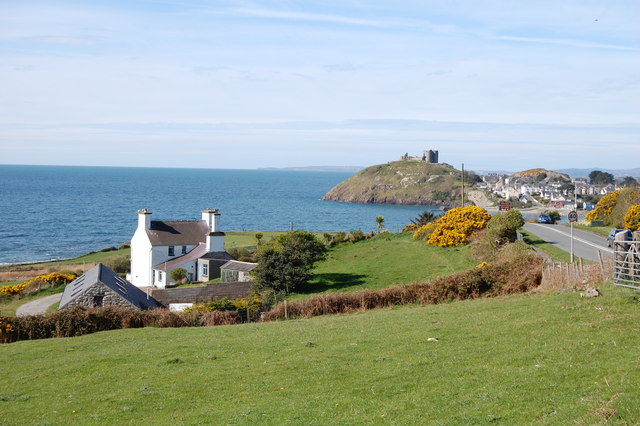
Criccieth, one of my favourite places on the planet
Author Ken Bagnall
Source Wikipedia
Creative Commons Licence


Ballet Cymru Triple Bill Lilian Baylis Studio, 30 Nov 2015

To the best of my knowledge and belief there is not a millilitre of Welsh blood in my veins. Such Celtic heritage as I can claim is Irish and Scottish yet I love Wales as much as anyone who was lucky enough to have been born in the principality. I guess one of the reasons I love Wales so much is that I spent much of my childhood on Black Rock Sands, the banks of the Dwyfor, the slopes of Swowdon and the towers and battlements of Edward I's castles. My parents could not afford continental holidays in the 1950s but Wales was as good as abroad with its own language and distinct landscapes and architecture, but nothing like as far away,

The Welsh language fascinated me and I longed to learn it. I even bought a phrase book called Welsh in a Week and must have tried the patience of every shopkeeper in Portmadoc and Criccieth (many of whom seemed to come from the Midlands or Lancashire) as I tried out my phrases. My mother once told me that my first words were in Welsh which is possible but unlikely as I don't know where I could have picked them up. Later when I learned Latin I saw lots of similarities like ffenestr for window (not too different from fenestra) and eglwys for church (apparently derived from ecclesia). Welsh is a naturally musical language with an "-ion" sound like a peel of bells. The language has lots of sounds that don't exist in English like the double "L" that seems to be produced by placing the tongue at the roof of the mouth and breathing over it.

Cerys Matthews has made an album of folk songs  called TIR most of which are in Welsh. I was led to her album by Ballet Cymru's YouTube video and yesterday I actually bought it. Indeed the artiste actually signed it and shook my hand. I think I have become one of her biggest fans though I regret to say I am also one of the most recent ones and I am grateful to Ballet Cymru for introducing her to me. She is a patron of the company. Yesterday she disclosed that she used to study ballet as a child and actually did very well in her RAD exam. She mentioned that fact between the songs that Darius James and Amy Doughty had choreographed for their dancers.

The dancers come from every part of the world other than Wales but they interpreted Matthews's words eloquently. Some bits of the performance were exuberant like  Bugeilio’r Gwenith Gwyn while other songs such as Myfanwy (danced by Emily Pimm-Edwards) tugged at our heart strings. The Rev Eli Jenkins's prayer in memory of Mandev Sokhi was particularly moving. Those members of the audience who had seen him dance were close to tears. For the dancers who had worked with Mandev it was so much harder. However, they are pros and though we could see their emotion in their faces they never missed a count or movement. TIR finished with Sosban Fach where each of the dancers did his or her turn. Each and every one of them impressed us but I have to say a special word for Tim Hill who thrilled us with his entrechats.

Ballet Cymru welcomed back Daisuke Miura and Suzie Birchwood as well as Pimm-Edwards for TIR. Birchwood is artistic director of ActOne ArtsBase. I first saw her in Stuck in the Mud where I was impressed by her grace and technique. The beauty of her dancing lies in her port de bras whether lifted in a pas de deux or sitting in a wheelchair. I never tire of watching her and I try to imitate her arm movements in my own dancing.  Miura and Pimm-Edwards delighted me in Romeo a Juliet and is was a treat to see them again.

Stuck in the Mud had been choreographed by Marc Brew whom I met in Llandudno. He created Traces Imprinted which I had admired in Newport. I had seen that work from the dress circle at the Riverfornt theatre in Newport where I appreciated its form and the movement of the dancers but missed much of the detail.  I caught all that detail yesterday from the second row of the stalls in a much more intimate auditorium. It was though I was seeing a different ballet. There was harshness with one dancer literally treading on the back of another but also tenderness as in the final duet. I think I understood the ballet a little better second time round.  Traces Implanted suggests memories and in particular memories of people who are no longer with us. Some of those memories we overwrite - hence the treading - others we keep alive and build upon - as in the duet.

I had missed Celtic Concerto in Newport for various reasons that I explained in The Pride of Newport and the Pride of Wales 8 Nov 2015 which was a shame because this ballet tuned out to be a gem. Choreographed by James and Doughty to a Catrin Finch's it begins with the company on stage and then some delightful solos and duets. You can get the idea from this video. I admired the stained glass projection and the costumes - simple black tutus for the women and shorts and translucent tops for the men.

The evening in Newport was very special but so was yesterday. Matthews asked whether there were any Welsh folk in the audience yesterday and it transpired that they were several.  They must have been so proud of their nation's ballet company. Also in the audience were several members the London Ballet Circle who had visited the company in October (see Ballet Cymru at Home 5 Oct 2015). We are certainly proud of our association with the company.

Other Reviews

Judith Mackrell   Ballet Cymru review – Cerys Matthews joins dancers for mercurial performance 1 Dec 2015 The Guardian

Saturday, 3 May 2014

Branding and Ballet - Copyright and Rights in Performances

Theatre Royal Drury Lane 1821                                           Source Wikipedia


This is the fourth in my series of articles on ballet and branding which is my thank you to companies, theatres and dancers for a lifetime of pleasure watching their performances. The others are "Ballet as a Brand? How to bring More Money into Dance for Companies and Dancers" 13 March 2014, "Protecting the Brand" 31 March 2014 and "Branding and Ballet - Licensing the Brand" 18 April 2014. In this article I shall discuss two important intellectual property rights ("IPR") for companies, theatres and dancers: copyrights and rights in performances.

What is IP?
Intellectual property ("IP") is a portmanteau terms for the bundle of laws that protect investment in intellectual assets.  Intellectual assets are creations of the mind that give one business a competitive advantage over all others. Such assets can be a new invention, a blockbuster film or novel, the cachet that is given to luxury product and so on.  

Intellectual assets fall into four categories:
  • Brands
  • Design
  • Technology, and
  • Works of art and literature.
The laws that protect the investment in creating those assets in the UK include the Patents Act 1977, the Copyright, Designs and Patents Act 1988 ("CDPA") and the Trade Marks Act 1994. The rights that those laws confer, such as patents for inventions, copyrights in original works of art and literature and registered trade marks for signs that distinguish one business's goods or services from those of all others are types of IPR (intellectual property rights). 

The exercise of those rights can be very valuable for a business which is why we regard them as property.  As they protect creations of the mind or intellect we call them intellectual property.

Copyrights and Rights in Performances
The intellectual assets that copyrights and rights in performances protect are works of art and literature. 

Copyrights have existed in one form or another since the days of Queen Anne. The first copyright statute for this country is still referred to as The Statute of Anne. Copyrights prevent the unauthorized copyright, distribution, performance and other exploitation of works that are written, drawn or otherwise created in some permanent medium such as film or optical or magnetic memory. 

Rights in performances are much more recent. These protect the performances of actors, musicians, dancers and other performers from unauthorized broadcasting, filming or taping and other exploitation of their performances. The existence of those rights has only been possible since the development of sound and motion picture recording and transmission technologies. 

The CDPA
In the UK copyright and rights in performances are conferred by different parts of the CPDA.  Copyright is conferred by Part I of the Act and rights in performances by Part 2.  The CPDA came into force on the 1 Aug 1989 and has been amended many times since then. The Intellectual Property Office has helpfully compiled an up to date version of Parts 1 and 2 of the Act together with other relevant legislation.

International Agreements
The UK is party to a number of international agreements that require foreign governments to protect the intellectual assets of British businesses and individuals in their territories and the British government to protect the intellectual assets of foreigners here.  The agreement that provides reciprocal protection of works or art and literature is the Berne Convention for the Protection of Literary and Artistic Works ("Berne").  The agreement that provides reciprocal protection for performances is the Rome Convention for the Protection of Performers, Producers of Phonograms and Broadcasting Organizations ("Rome"). Berne and Rome have been supplemented by a number of other international agreements of which the most important are the WIPO Copyright Treaty and the WIPO Performances and Phonograms Treaty. One of the reasons why Parliament enacted and has revised the CPDA was to enable the UK to comply with those conventions and treaties.

Copyright Works
The CDPA protects the following types of work from unauthorized copying, publishing, performance and other distribution in the UK:
  • Original artistic, dramatic, literary and musical works
  • Broadcasts, films and sound recordings, and
  • Typographical arrangements of publications.
That covers such works as the story, score, the choreology, broadcasts and HDTV transmissions and some of the art work such as scenery and fabric designs.  One of the many things that the Court of Appeal decided in Massine v De Basil[1936 - 1945] MCC 233, one of the few copyright cases relating to ballet, was that there is no such thing as copyright in a ballet. There are instead a bundle of copyrights in the works that make up a ballet such as an outline of the plot, the music, notation, artwork for the scenery, costumes and other works. Secondary copyrights are created in any videos that are made during class and rehearsals as well as in any sound recordings that may be made. Yet more copyrights are made in the notes, photos, compilation, editing and typographical arrangement of the programmes. 

Rights in Performances
Performers including dancers and those who have contracted with a dancer or other performer to broadcast, film or tape a performance such as the BBC, a film studio or a record company have the right to object to the broadcasting, filming or taping of a performance regardless of whether the performance takes place in a theatre, TV studio or film set.

Creating a Copyright?
There is no system of copyright registration in the UK though there is in some other countries. Copyrights come into being the moment a work in which copyright can subsist is created by a British citizen or resident or a citizen or resident of any other state that confers confers protection on the works of British citizens and residents within its territories pursuant to the Berne Convention or some other agreement with the UK government. Most countries of the world are party to Berne and the few that are not have entered other multi or bilateral agreements with the UK.

Copyright can subsist in any of the works listed above provided that it is not copied wholly from another work. Essentially copyright rewards the labour, skill and taste that has been expended on a work. Thus, a poet may write a poem which creates a literary copyright; an artist a drawing that creates an artistic copyright; and an editor may choose the poem and the drawing and combine them with other poems and drawings in an anthology which creates yet another literary copyright in the compilation.

Creating a Right in a Performance
Consent is required for broadcasting, filming or taping of a performance from the moment the dancer or other performer walks on stage to the final curtain call so long as the performance takes place in the UK or by a national of a country that is party to the Rome Convention or some agreement with the UK.

Who owns Copyright?
Usually the author (that is to say the person who makes the work) is the first owner of the copyright subsisting in the work but there are a number of exceptions. If the author is employed to create the work under a contract of employment or apprenticeship the author's employer becomes the first owner unless the employer and employee have agreed otherwise. Merely commissioning a work, however, does not usually confer copyright on the commissioner unless the circumstances suggest that that is what the parties had intended as happened in Massine v de Basil.  When commissioning a score, choreography or other work it is important for the parties to think about who is to own the work and what rights (if any) each of the parties has or should have in its exploitation.

Who owns a Right in a Performance?
In the first instance it is up to the dancer or other performer to consent to the broadcasting, filming, taping or other exploitation of his or performance.  In practice the terms upon which such consent is given have been negotiated by Equity on behalf of its members. Such terms are incorporated into individual performers' contracts of employment. Broadcasters, film and recording studios that have negotiated exclusive contracts to record a performance can also object to broadcasting, filming and taping of performances.

How to make Money from Copyrights and Rights in Performances
Copyrights and rights to make, distribute and otherwise exploit copies of recordings may be assigned or licensed for money or moneysworth.   How much will be paid by way of a royalty, licence fee or other payment will depend on supply and demand. The work of a well known artist, choreographer or composer will generally command a greater payment than that of a lesser known one.  Some copyright owners assign their rights to organizations known as "collecting societies" which collect payments on behalf of all their members and distribute them after deducting their expenses as individual dividends. BECS (British Equity Collecting Society) collects royalties for licensing performers' rights on behalf of their members.

Moral Rights
In addition to the rights mentioned above which are generally referred to as "economic rights" performers and some copyright owners have rights to be identified as performer or author and the right to object to derogatory treatment of their works that are known as "moral rights".  These subsist quite independently of the economic rights and cannot be assigned.

Enforcement
Violation of an IPR is known as "infringement".

Large scale deliberate infringement of copyright (known as "piracy") and rights in performances ("bootlegging") are offences that can be punished by up to 10 years imprisonment and an unlimited fine. Local authority trading standards officers have a statutory duty to investigate and prosecute such offences.

IPR owners can also sue infringers in the civil courts for injunctions (orders of the court to refrain from or stop infringements on pain of fine or imprisonment for disobedience), damages (compensation for past infringements) or an account of profits (disgorging any profits that have been made from infringements), surrender of infringing copies and their costs (legal expenses for bringing the action). In England and Wales most claims for IPR infringement (including small claims) are brought in the Intellectual Property Enterprise Court ("IPEC") or the Intellectual Property list of the Chancery Division of the High Court of Justice.

Collecting societies also bring proceedings in the civil courts on behalf of their members.

Further Reading
The Intellectual Property Office has published a very useful guide entitled "Copyright, Essential Reading" which can be downloaded in pdf from its website. Equity also has a considerable volume of materials on performers' rights which is accessible to its members.

Should anyone require additional information he or she can call me during office hours on 020 7404 5252 or send me a message through my contact form, twitter, Facebook, G+, Linkedin or Xing.

Happy May bank holiday everybody.

Tuesday, 27 December 2022

Powerhouse Ballet Looks Forward

Powerhouse Ballet in Class
© 2022 Jane Elizabeth Lambert


This year has been Powerhouse Ballet's best ever.  We gave our second and third public performances to packed houses at the Chroma Q Theatre in Leeds on 19 Nov 2022.  I reviewed the show in A Celebration of Dance: Wilis and More on 21 Nov 2022.  We held full-day workshops on The Nutcracker in March and Giselle in July.  We returned to the Northwest with company classes in Bolton and Salford in September and November.  We have offered training and rehearsing opportunities for four of our members with teaching skills, namely Katherine Wong, Lauren Savage, Christie Barnes and Alicia Jolley.

We are now on a roll and will build on that success immediately with a special online-only Post-Christmas company class with Beth Meadway between 14:00 and 15:30 on 28 Dec 2022.  Beth is one of Ballet Cymru's lead dancers.  I reviewed her performance as Helena and the Wall in Dream in Ballet Cymru at its Best on 13 Nov 2022 and in A Child's Christnas in Wales and  Terms and Conditions in Ballet Cymru in Bangor - Finishing a Great Week of Ballet on 19 Dec 2022.  Anyone can attend Beth's class from anywhere in the world.  There will be no charge.   All you need is a computer with an internet connection, a leotard or other danceweaer, ballet shoes and a little bit of space at home or elsewhere.  It is not every day that you get a chance to dance with an up and coming ballet star from the comfort of your home.  If you want to attend, register here.

Our first class in the studio of the New Year will be given by Northern Ballet Academy's Annemarie Donoghue at Dance Studio Leeds from 13:00 to 14:30  on 28 Jan 2023.  In February we hope to give our first class in Wales.   Alicia Jolley who danced in Aria has kindly agreed to give that class.   The date, time and venue have yet to be agreed but it will probably take place in Mold on the afternoon of Saturday, 25 Feb 2023.   In response to popular demand I have asked Fiona Noonan to deliver our March class and she has accepted in principle.   Her class is likely to take place on 25 March 2023 either at Dance Studio Leeds or Huddersfield University.  

Karen Lester-Sant of KNT Danceworks has kindly invited Powerhouse Ballet to dance in KNT's next show in Manchester.   We are looking forward to this opportunity immensely.   We shall start rehearsals as soon as we know the date.   We already have the piece that we presented in Leeds on 19 Nov 2022 but it is possible that we may have a new work by then. Jane Tucker who directed and choreographed the Dance of the Wilis has offered us a workshop on another scene from Giselle early in the New Year.  I shall leave the choice of scene to Jane but we have discussed some of the possibilities.  These include the Retour des Vendageurs in act 1 as there is a big role for the ensemble.   As soon as Jane gives me a date, I shall announce the workshop on Eventbrite.

One of the objectives of Powerhouse Ballet is to provide opportunities for members to develop their skills in all aspects of theatre.   We have already made use of our members' teaching skills but other members also have skills that could be useful to the company.  Fiona Cheng, for instance, is a  drama student at Leeds Conservatory.   I have seen her act in one of the Conservatory productions and was very impressed.  The betrayal scene at the end of act 1 of Giselle requires considerable dramatic skills from Giselle and the other characters  Drama is not formally taught in many dance schools and perhaps it should.   I have therefore invited Fiona to propose an acting workshop for us.  Other possible workshops include exhibition classes in Kathak and Welsh folk dancing with its spectacular grasshopper step.

As we are a company and not a school we will never charge our dancers for attending our classes and workshops.  However, we shall be introducing a Friends scheme for those who wish to support the company and participate in some of its activities but not dance in its shows.   A year's subscription will be around £25 a year and it will be possible for members to switch from "Friend" to "Dancer" and vice versa within the course of the year.   

As this will be one of my last posts for this year, I should like to wish all my readers a happy and prosperous New Year.

Wednesday, 10 November 2021

Ballet Cymru's Giselle

Author Sian Trenberth Photography   © 2021 Ballet Cymru - all rights reserved


Ballet Cymru Giselle Riverfront Theatre, Newport 6 Nov 2021 19:30

On its home page Ballet Cymru proclaims:
"We are a ballet company who like to do things a bit differently. We enjoy finding new ways to make what we do exciting, innovative and relevant."

Nothing exemplifies that better than their new Giselle which was premiered at Lichfield cathedral and online on 8 July 2021 (see Giselle Reimagined 9  July 2021).  They are a small but important company which spends much of its time on the road.  Many of their venues are small auditoriums with limited ranges of stage equipment.  Ballet Cymru's artistic directors, Darius James and Amy Doughty, have taken the essentials of some of the world's great ballets and refashioned them for a small cast that is constantly travelling before audiences that may not see a lot of ballet.  They succeeded spectacularly with their Cinderella and Romeo a Juliet.  Their Giselle is a similar success.

Making such adaptations often requires adjustments to the libretto, characters and score.  For example, the mesmeric effect of rank upon rank of artists in white romantic tutus approaching each other in arabesque as the music reaches a crescendo is difficult to achieve with a small cast on a tiny stage playing recorded music.  Moreover, most modern audiences are unfamiliar with Rhineland folk tales about forest maidens who die before their wedding day.   Most of us have seen or at least heard of horror movies about the undead who crawl out of their tombs at night.  That is why there were zombies crawling about the stage instead of wilis en pointe in Act II.

If you replace wilis with zombies you probably need a new score.  James and Doughty commissioned Catrin Finch to adapt Adam's music. Finch had previously contributed the music for Celtic Concerto and The Light Princess and it was through those works that I first learned about her.  I have started to explore her other work. I was lucky enough to meet her at a reception at the Riverfront Theatre after the show.  I hope to write more about her work in this publication later.  Finch kept important parts of Adam's score such as the overture to Acts I and II and passages from the made scene but the greater part of the work was her own.  Some of it was very dramatic such as the percussion to indicate a heartbeat.

Apart from substituting zombies for wilis, James and Doughty kept the story more or less intact.   It unfolds with great clarity.  In keeping with their mission to make everything they do exciting, innovative and relevant James and Doughty set the ballet in contemporary Wales rather than the medieval Rhineland.  As there are not too many lords of the manor in Brexit Britain, Albrecht is no longer a noble, Merely a married man playing the field away from home.  He does not carry a sword but he does keep something in his wallet that enables Hilarion to denounce him.  The main character changes are the introduction of male as well as female zombies and Cerys, a besty for Giselle instead of an over solicitous mum,

I have now seen the ballet three times - once on-screen on 8 July, once live at the Stanley and Audrey Burton in Leeds on 4 Nov and again live in Newport on 6 Nov.   Each performance was a different experience. The company danced well in Lichfield and Leeds and must have made a lot of friends in both places but their performance in Newport before their home turf was of a different order of magnitude.  After a performance of TIR some years ago, their patron Cerys Matthews described them as "the pride of Newport and the pride of Wales".   She won a peel of polite applause for that remark.  On Saturday, it was palpable.  The crowd in the Riverfront have learnt to appreciate ballet and taken their home company to their hearts.  Just like the crowd in the Grand has adopted Nothern and the Hippodrome BRB.  Ballet Cymru has put down roots that may one day blossom into a mighty national company with its own school.

The cast was the same in all three shows.   Beth Meadway danced Giselle with grace and poise.  It was as if she was born for that role. Tall with an expressive countenance, there were instances when she was on pointe in Act II that reminded me of the lithographs of Grisi.  Andrea Battagia is a powerful athletic dancer but he is also a fine dance actor capable of expressing the subtleties of Albrecht's personality and his many emotions.  Isobel Holland, one of the most pleasant individuals one could ever hope to meet in real life, was a convincing personification of decay and evil as the lead female zombie.  So, too, was Robbie Moorcroft - again congeniality itself in real life - who created the new role of lead male zombie.  Two newcomers to the company impressed me particularly: Yasset Roldan as Hilarion and Hanna Lyn Hughes as Cerys.  I shall follow their careers with great interest. All the members of the company danced well in all three performances and I offer all of them my congratulations. 

James designed the sets and video projections.   These were ingenious and set each of the scenes effectively.   I particularly admired the churchyard scene just before dawn.  Ballet Cymru relies heavily on such projections but these were particularly good.   The opening scene of an ECG flashed onto the gauze together with the percussion and the cast's jumping like cardiac muscles warned the audience at the start that Giselle had a weak heart. James's designs were accompanied by skilful lighting design by Chris Illingworth and the imaginative costumes of Deryn Tudor.

Wales has a strong dance tradition as you can see from this grasshopper dance but it does not yet have a national ballet school or comprehensive nationwide facilities for developing balletic talent.  There are good ballet teachers in the main towns and cities but most of Wales is rural.   Ballet Cymru's Duets Programme goes some way to filling that lacuna.   Before Saturday's show, several young local schoolchildren on that programme presented a short demonstration of what they had learnt in a very short time.  They drew rapturous applause after which most of them watched Giselle in the row in front of me.  Ballet Cymru's investment in its nation's youth will create, at the very least, an eager and informed audience for dance and possibly even some of the next generation of the world's principals.

Sunday, 24 November 2019

Ballet Cymru at the Bangor Pontio Centre


Standard YouTube Licence

Ballet Cymru has commissioned Charlotte Edmonds to create a new ballet called Wired to the Moon. to a score by Katya Richardson with sets and costumes by  Eleanor Bull,  It will be performed at the Pontio Centre in Bangor together with Patricia Vallis's Divided We Stand and Darius James and Amy Doughty's Celtic Concerto on 29 Nov 2019.  I saw Divided We Stand in Cardiff earlier this year (see Made in Wales 29 March 2919) and Celtic Concerto at Sadlers Wells (see Ballet Cymru in London 1 Dec 2015). I can recommend the evening for those two works alone.  Having seen Edmunds's Fuse for the Dutch National Ballet Junior Company and her contribution to Northern Ballet's Tell-Tale Steps I think we can expect a very special evening.

The Pontio Centre is more than a theatre as I said in The Pontio Centre: A Resource for Inventors, Designers and Makers in North Wales 14 Dec 2018 NIPC Inventors Club. There is also a cinema, restaurant, students' union, bars and cafés and, most importantly, the Hwb which is the Pontio innovation area.  According to the Centre's website:
"Pontio Innovation is about equipping individuals and businesses with the tools they need to succeed in the modern economy. With a focus on transdisciplinary working and rapid prototyping, the Co-Lab, Media Lab, Hackspace and Fablab areas are equipped with cutting-edge technologies. It will boost the University’s cross-disciplinary teaching programmes and encourage collaborative work between students, staff and local businesses,"
Like the Menai Science Park (M-SParc) which I shall be visiting earlier in the day to give a talk to local entrepreneurs, inventors and creatives it is an initiative of Bangor University. New knowledge-based businesses are sprouting are springing up on both banks of the Menai Strait.

Many of the folk who have migrating or returning to Bangor and Anglesey will be attracted by the combination of coastal, mountain and pastoral landscapes that make Northwest Wales one of the most beautiful corners of the planet, but they also require the arts.  That is why the Ponto Centre's facilities supporting regular visits by Wales's classical dance company and other world-class performing artists are crucial to the social and economic development of Northwest Wales.

Saturday, 1 June 2019

A World-Class Company for a Changing Nation


Standard YouTube Licence

Ballet Cymru Rome a Juliet 31 May 2019 Riverfront Theatre, Newport

This is the third time I have seen Darius James and Amy Doughty's Romeo a Juliet and each time I see it I have found something new. Last night I saw two exceptional talents: Danila Marzilli, one of the finalists in the ballet category of the BBC Young Dancer of 2019, for the first time; and Beau Dillen whom I had seen two months earlier in Made in Wales. Marzilli danced Juliet in the second professional performance of her life (the first being the previous night) and Dillen the nurse, standing in for Krystal Lowe at the very last moment.

To give a young dancer straight out of ballet school the leading role is an incredibly risky thing to do both for the dancer and the company. James and Doughty did that once before with Gwenllian Davies the last time I saw Romeo a Juliet and it worked spectacularly well (see A Romeo and Juliet for Our Times 7 Nov 2016). It also worked last night with Mazilli. Mazilli is very accomplished technically but she can also act. The despair in the bedroom was palpable after Romeo had taken flight and her parents, grief-stricken with the loss of Tybalt, were piling on the pressure for her to marry Paris. So, too, was the fear as she considered whether to take Friar Larence's potion.  So, also, was the agony of finding Romeo's body in the Capulet family grave.  These and all the other thoughts and feelings fleeting through young Juliet's consciousness were communicated with considerable eloquence.

In most versions of Rome and Juliet and, of course, the play the nurse is much older than Juliet and her social inferior.  In James and Doughty she is a confidante.  In previous performances by this company, she has been called Cerys.  In last night's show, she was referred to simply as "Juliet's friend." As such, she adds a dynamic to the narrative that actually enhances Shakespeare.  She recognizes Romeo at her parents' ball and tries to lead Juliet away.  She tries to intercede with Juliet as she rejects Paris. It is she who finds Juliet stone cold the morning of her wedding. This is a role that requires maturity and authority which is why it is usually performed by one of the company's most experienced dancers. Dillen is the company's apprentice yet she filled that role magnificently.

Romeo was danced by Andrea Maria Battagia who performed that role the last time I saw the ballet.  He is everything a male lead should be.  A virtuoso who thrills with his solos but nevertheless displays his ballerina like the setting of a precious jewel so that she dazzles.  I think we owe a lot to Battagia for the way he partnered Mazilli last night, much as he did with Davies in 2016. Battagia can also act.  For the first time ever I saw Romeo as a flawed hero. Possibly because he despatched Tybalt and Paris with plebian knives rather than gentlemen's swords.  A whiff of brexit Britain rather than renaissance Verona.

That brings me on to another quality of James and Doughty's work. It is set in our time and our country.  The first time I saw the work I noted Tybalt's dragon tattoo and the substitution of Cerys as a confidante of Juliet in place of the nurse (see They're not from Chigwell - they're from a small Welsh Town called Newport 14 May 2013).  Instead of a duke, the brawl between the Capulets and the Montagues is broken up by the flashing lights and shadowy figures of the Gwent Constabulary. The knifings of Mercutio and Tybalt took place not in the Piazza of Verona but underneath the flyover of the exit lane from the bridge over the Usk.   I recognized the setting in the projections against the backdrop. Again there were the flashing lights of the Heddlu.

Talking of Tybalt it is always a delight to watch Robbie Moorcroft swagger on stage. Our hearts go out for Miguel Fernandes as Mercutio, the cub of the Montague pack with something to prove. Romeo tried to hold him back but too late.  He takes on the wily Tybalt who knifes him.  His bravado after his first wound is one of the most heart-rending scenes of classical dance. The second knifing turns Romeo and Juliet from a saccharine romance into drama. Romeo has to get involved.  He then has to go on the run. There is no way this story could end otherwise than badly.

Lord and Lady Capulet danced by two of my favourite dancers, Alex Hallas and Beth Meadway, added yet another quality to the work. Other productions show a tearful, vengeful Lady Capulet but her husband's role is usually minor.  Not in James and Doughty's work. They are sleek, powerful, authoritarian - and Northern. It just so happens they are both from Yorkshire. I could almost hear them:
"Now listen up, our kid. There's nowt wrong with Paris. You could do a lot worse than wed him. I know he's not much to look at but he's got brass and he's not wanted by the law. Not like that Romeo Montague. Ooh, I do hope they catch him, lock him up and throw away the key. How could you even look at him after what he did to Tybalt?"
And with her friend joining in, is it any wonder that Juliet buried her face in a pillow before quaffing Friar Lawrence's potion and eventually killing herself?

Everyone in this show danced well.  Joshua Feist was a perfect Paris, another recent recruit whose career I shall follow with interest. Isobel Holland was an impressive Friar Lawrence. Much closer to Shakespeare than the manipulative cleric in Jean-Christophe Maillot's version of the ballet. Maria Teresa Brunello was a convincing Benvolio.  Not easy to dance a role of the opposite gender.  Holland and Brunello are to be congratulated for that alone.   Especially as there are some in ballet who would not countenance it.   I recently met a teacher and choreographer who was scandalized by my learning to dance the bronze idol in an adult ballet intensive.

James and Doughty have big plans for their company.  They are touring China soon where I am sure they will be admired.   They hope to employ their dancers on full-term rather than short-term contracts.  Ballet Cymru reminds me a lot of Scottish Ballet when they first moved to Glasgow 50 years ago.

Like Scotland in the 1970s, Wales is changing fast.  I sense a growing sense of nationhood.  The National Assembly now makes primary legislation.  The Supreme Court already sits in Cardiff and there are calls even from Unionists for a separate Welsh court system.   Until a few years ago the economy of the North was largely rural and that of the South was not unlike that of the American rust belt.  The economy is changing rapidly into one that is knowledge-based.   I see signs of that transformation every time I visit M-Sparc, Aber Innovation or the Pontio Arts and Innovation Centre.  The entrepreneurs, innovators and creative folk who are driving that change need the arts and expect the best.  They demand world-class dance and Ballet Cymru is delivering it to them.

Saturday, 14 June 2025

Ballet Cymru's Giselle 3.0

Scene from Act Two of the Original Performance of Fisekke


Ballet Cymru Giselle  Pontio Arts and Innovation Centre, Bangor 13 Jun 2025 19:30

Yesterday I saw Ballet Cymru's third production of Giselle.  Their first production was in 2006 when they were known as Independent Ballet Wales (see Ballet at the Bridport Arts Centre, BBC website, Oct 2006).  Their second was livestreamed from Lichfield Cathedral on 5 Jul 2021 (see Giselle Reimagined, 9 Jul 2021).  I later saw it in Leeds and Newport and even danced a bit of Darius James and Amy Doughty's choreography for a workshop that Ballet Cymru held for Powerhouse Ballet when they visited Leeds (see Ballet Cymru's Giselle, 10 Nov 2021).  Their latest version was premiered in Newport on 16 May 2025 and is now touring the United Kingdom (see Ballet Cymru's New Giselle, 8 Jun 2025).  I was not in Bridport to see Giselle 1.0, but I did see and liked Giselle 2.0.  In Giselle 3.0, Darius James and Amy Doughty reverted to Adolphe Adam's original score and much of Petipa's choreography, albeit with a simplified libretto.   I thought it worked very well.

The versions of Giselle that big national companies perform, such as Peter Wright's, Rachel Beaujean's or Mary Skeaping's, require a lot of dancers for such roles as the vignerons and hunters in Act 1 and the wilis in Act 2.  Ballet Cymru is still not a big company so the story has to be tweaked if it is to be told successfully.  That is probably why James and Doughty dropped such characters as Giselle's mother who warns her daughter of the likes of Albrecht and the consequences of too much dancing for a girl with a dicky heart, Bathilde (Albrecht's betroathed) who presents Giselle with a necklace just before Hilarion exposes Albrecht or Moyna and Zulma in Act 2 aptly described by Susan Dalgetty-Ezra as "Myrtha's sidekicks".  But they did keep a lot of the essentials, including the peasant pas de deux and the mesmerizing arabesques from Act 2.  They set Act 1 in a Welsh village and Act 2 in a forest, and they dressed their wilis, including the men, in romantic tutus.

Isobel Holland, who had danced Myrtha powerfully in Giselle 2.0, was equally impressive in the equivalent role in Giselle 3.0.  If I am not mistaken, her makeup and costume in Giselle 3.0 were similar to her costume and makeup in  Giselle 2.0.   I gave her my loudest clap at the reverence.  Also impressive were Mika George Evans in the title role and Jakob Myers as Albrecht.  They are both athletic dancers, and they came into their own in Act 2.  I once saw Carlos Acosta and Natalia Osipova in Giselle, and Evans and Myers reminded me strongly of their performance.  Jacob Hornsey elevated Hilarion's role into a major part of the drama, which cannot have been easy, as he is portrayed as a bit of a churlish chump in most productions.   The same is true of Wilfred, Albrecht's squire. James Knott, who danced the equivalent role as Albrecht's friend, made that a much bigger role.  It is not clear from the cast list whom I should congratulate for the peasant pas de deux bit they delivered one of the highlights of my evening.

Before the show, the audience was treated to a performance by local ballet students called Duets.  It is part of a programme that offers dance training to children in rural or former mining, steel-making or heavy industrial communities who would otherwise be unable to receive it.  Immediately after their performances, the children are led to any vacant seats in the auditorium where they watch the company.  Until Wales gets its own national ballet school with connected associates schemes, it is the best way to identify and promote talent and ambition in that nation.  It is good not only for Ballet Cymru and Wales but also for all the other ballet, contemporary dance and theatre companies in the rest of the UK and beyond.  It is a project that deserves the widest possible support.  


Friday, 6 December 2019

Ballet Cymru - Even Better than Last Year

Author Sian Trenberth Photography Ltd
© 2019 Ballet Cymru: all rights reserved
Reproduced with kind permission of the company


Ballet Cymru (Three Works: Wired to the Moon, Divided We Stand and Celtic Concerto) Pontio Centre, Bangor 30 Nov 2019, 19:30

In my review of 12 Dec 2018, I described Ballet Cymru's Dylan Thomas programme as "the company's best work ever" but I think this year's triple bill was even better.  I say that because Dylan Thomas's words as read by Cerys Matthews eclipsed the dance whereas this year the focus was on dance. 

The three works that Ballet Cymru could not have been more different: Celtic Concerto, an exquisite classical work by Darius James and Amy Doughty, Patricia Vallis's cotemporary Divided We Stand and Charlotte Edmond's innovative Wired to the Moon. The company performed all three works with flair. Ballet Cymru is undoubtedly a company in the classical tradition but it can shine in other styles as well.

In my preview of Ballet Cymru's appearance in Bangor, I linked to a YouTube film of the company's inaugural performance of Celtic Concerto in Newport in 2013.  Readers will appreciate the beauty of Catrin Finch's score, the exuberance of the choreography and the elegance of the costumes and lighting.  The women in black tutus and the men in matching leotards.  The cast has changed since then with highly talented young recruits like Beau Dillen, Joshua Feist and Oliver Wilkinson-Smith.  I first saw that work at Sadler's Wells exactly four years ago. I like it even better now than I did then.

I saw Divided We  Stand in Made in Wales on 22 March at the Dance House in Cardiff.  That was the end of course performance of the Pre-Professional Programme.  If I am not mistaken, Patricia Vallis has added to that work.  There is dialogue and real needle in some of the duets.  The choreographer trained in Rotterdam and New York which explains why I was put in mind of both NDT and Joffrey by her work.  Everyone danced well but there was an exchange between Alex Hallas and Beth Meadway that seemed to express perfectly the message that I drew from the work, namely a new harmony eventually emerges from confrontation.  The score was by Henry Purcell that suited the narrative precisely.  

In the programme, Wired to the Moon is said to have been inspired by functioning systems and how they respond to changes in their environment and shows us "how technology is an extension of our world and in this increasingly interconnected works we must exist in balance." Well, maybe. To me, the work seemed to have more in common with tide and beaches. There was a beach on the front page of the programme, some of the artists removed their trousers as if preparing for a swim, white boxes on stage suggested crests of waves or breakwaters. For a while, I was puzzled by the title then I realized that the moon actuates our tides and I suppose that it is a kind of system.  Katya Richardson's score was dramatic and Eleanor Bull's designs were thought provoking.  The dancing was, of course, superb.

I enjoyed all the elements of the triple bill, perhaps Celtic Concerto and Divided We Stand slightly more than Wired to the Moon because I had seen the first two works before and understood them better.  Although the company performed all three works equally well I think Celtic Concerto showed the artists to their best advantage.  They are a classical company and it is in that style that they are (in my eyes at least) most beautiful.

I saw the show with a member of staff of M-SParc and her 12-year-old daughter.  My guest's daughter had studied ballet for a while but she had previously seen only one live performance.  She was thrilled by Ballet Cymru and delighted to meet Darius James, Patricia Vallis and the cast after the show.  Several of the dancers asked whether she would like to dance professionally to which she said she would.  She told me that she would resume her classes with renewed enthusiasm.  She was not the only young student to have been inspired by Ballet Cymru. Just before the performance, pupils from the local schools performed a curtain-raiser in the foyer.  I missed most of it but I caught a scene on the balcony and those students were very good. Alex Hallas, who had rehearsed them, told me that quite a few of the children including several boys intended to join local classes. 

Most if not all major ballet companies in the UK have associates and outreach programmes but none seems to be as close to their local communities and young people from those communities as Ballet Cymru.  When I told Patricia Vallis what my guest's daughter had said to me, she replied: "That is such wonderful news! That is one of the reasons why we do what we do!"  It is yet another reason why I love Ballet Cymru so.